_**Did you know that up to 40% of standard guest post backlinks are never actually indexed by Google?**_
Building high-quality backlinks remains the cornerstone of modern [off-page SEO](https://www.stanventures.com/blog/off-page-seo-techniques/). However, there is a harsh industry reality: a backlink only passes PageRank and search equity if [Googlebot crawls, renders, and indexes](https://www.stanventures.com/blog/crawling-indexing-ranking/) the specific host page containing your link.
If the host page fails Google’s internal quality filters, that link is functionally non-existent to Google’s ranking algorithm.
In this advanced guide, we cut through standard SEO platitudes and generic “pinger” advice. Drawing on data from auditing millions of [backlink-building campaigns](https://www.stanventures.com/powerful-link-building-service/), we introduce the Stan Ventures Indexation Quality Threshold (IQT) framework and provide step-by-step technical blueprints to audit and secure rapid backlink indexation using purely white-hat, technically sound practices.
## Stan Ventures IQT (Indexation Quality Threshold) Framework
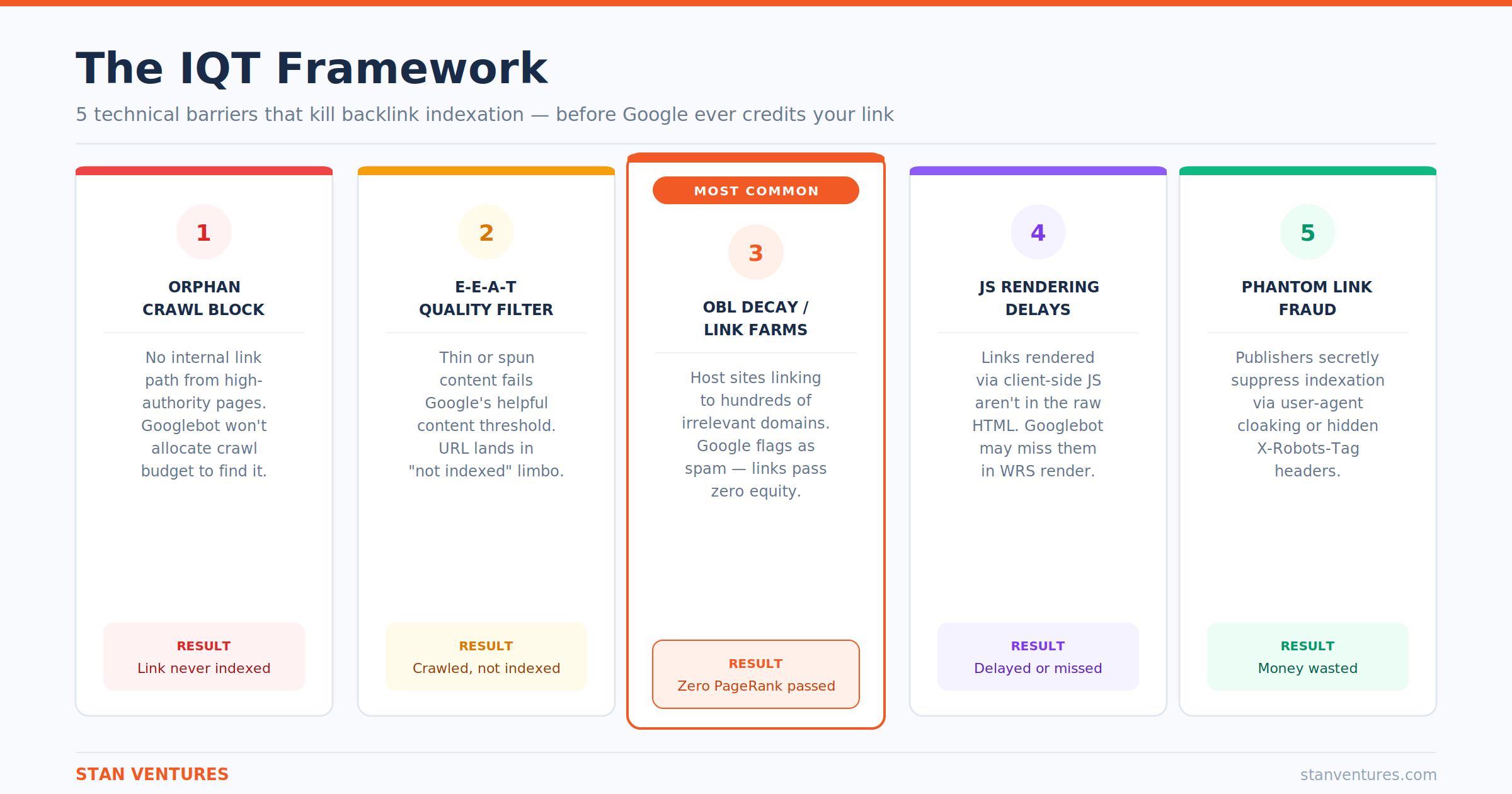
Many SEOs assume that if a page is discovered by Googlebot, it automatically gets indexed. In reality, Google uses a multi-layered Indexation Quality Threshold (IQT) to protect its search index from resource bloat.
To crawl and index the web, [Googlebots](https://www.stanventures.com/blog/googlebot-user-agent-string/)must prioritize its crawl budget based on two main criteria:
### The 5 Technical Barriers & Advanced Pitfalls
1. **The Orphan Crawl Block:** If the newly published article lacks an internal link path from the host site’s high-authority pages (e.g., category feeds, homepage), Googlebot is highly unlikely to allocate a crawl budget to find it.
2. **Helpful Content Quality Filters (E-E-A-T): **Google’s helpful content systems evaluate the content of the host page immediately. Spun, low-effort AI summaries, or pages lacking original research fail the content threshold, placing the URL in the permanent “Crawled – currently not indexed” bucket.
3. **Outbound Link Ratio (OBL) Decay:** Host sites that act as “link farms” by linking out to hundreds of irrelevant external domains suffer from severe domain authority decay. Googlebot quickly learns that these outgoing links pass zero value and flags the host page as spam.
4. **Server-Level Rendering Delays:** Pages relying on heavy, unoptimized client-side JavaScript to render outbound links can exhaust Google’s Web Rendering Service (WRS) execution timeout limit. If the link is not painted in the initial viewport paint, Googlebot misses it entirely during the initial crawl and it may surface only in the next crawl phase.
5. **The “Phantom Link” Publisher Fraud:** A growing scam in the outreach industry where publishers secretly block indexation to avoid search engine penalties while charging full price. They utilize techniques like conditional user-agent cloaking or hidden headers.
## Unmasking “Phantom Link” Fraud: A Technical Audit Blueprint
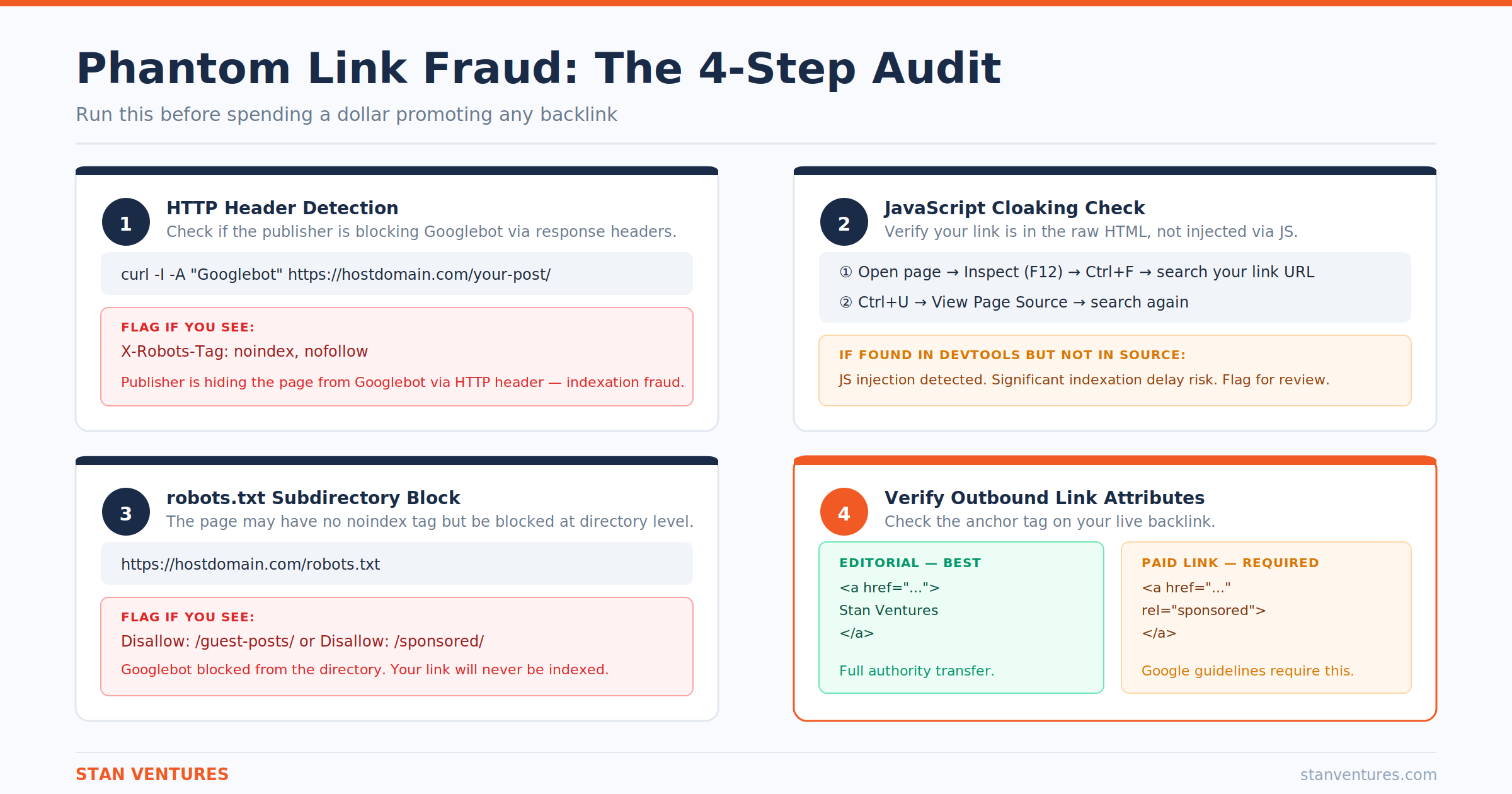
Before spending time or resources promoting a backlink, you must perform a programmatic check to ensure the publisher is not actively hiding your content from search engines.
Here is the exact Stan Ventures Triple-Verification Protocol (TVP) you should execute:
### Step 1: Detect HTTP Header-Level Blocking (X-Robots-Tag)
Some publishers are clever: they keep the in the HTML code to pass visual audits, but send a noindex directive via the HTTP header.
You can expose this instantly using a simple terminal curl request:
curl -I -A “Googlebot” https://hostdomain.com/your-guest-post/
What to look for: Inspect the response headers. If you find the following header, the publisher is committing indexing fraud:
X-Robots-Tag: noindex, nofollow
### Step 2: Unmask Client-Side JavaScript Cloaking
Use Google Chrome’s DevTools to verify if your link is injected into the DOM dynamically.
- Open the page, right-click, and select Inspect.
- Press Ctrl+F or Cmd+F and search for your link’s URL.
- Next, press Ctrl+U or Cmd+Option+U to View Page Source (the raw HTML served before JS execution) and search again.
_**The Verdict:** If the link is present in the DevTools Inspector but completely missing from the raw Page Source, the host website is using client-side JavaScript injection. Because Googlebot renders JavaScript in a two-stage process, this link will suffer massive indexation delays and may never pass authority._
### Step 3: Inspect for robots.txt Subdirectory Crawl Blocks
Even if the page itself has no noindex tags, the publisher may have blocked Googlebot from ever visiting the directory. Check: https://hostdomain.com/robots.txt
Look for disallow rules targeting the directory of your guest posts:
_User-agent: * Disallow: /guest-posts/ Disallow: /sponsored/_
### Step 4: Verify Outbound Link Attributes
Verify that your HTML anchor tag does not contain sneaky attributes that strip search equity:
_ Stan Ventures _
_ Stan Ventures_
## The 5 Pillars of White-Hat Link Indexation (The Stan Ventures Protocol)
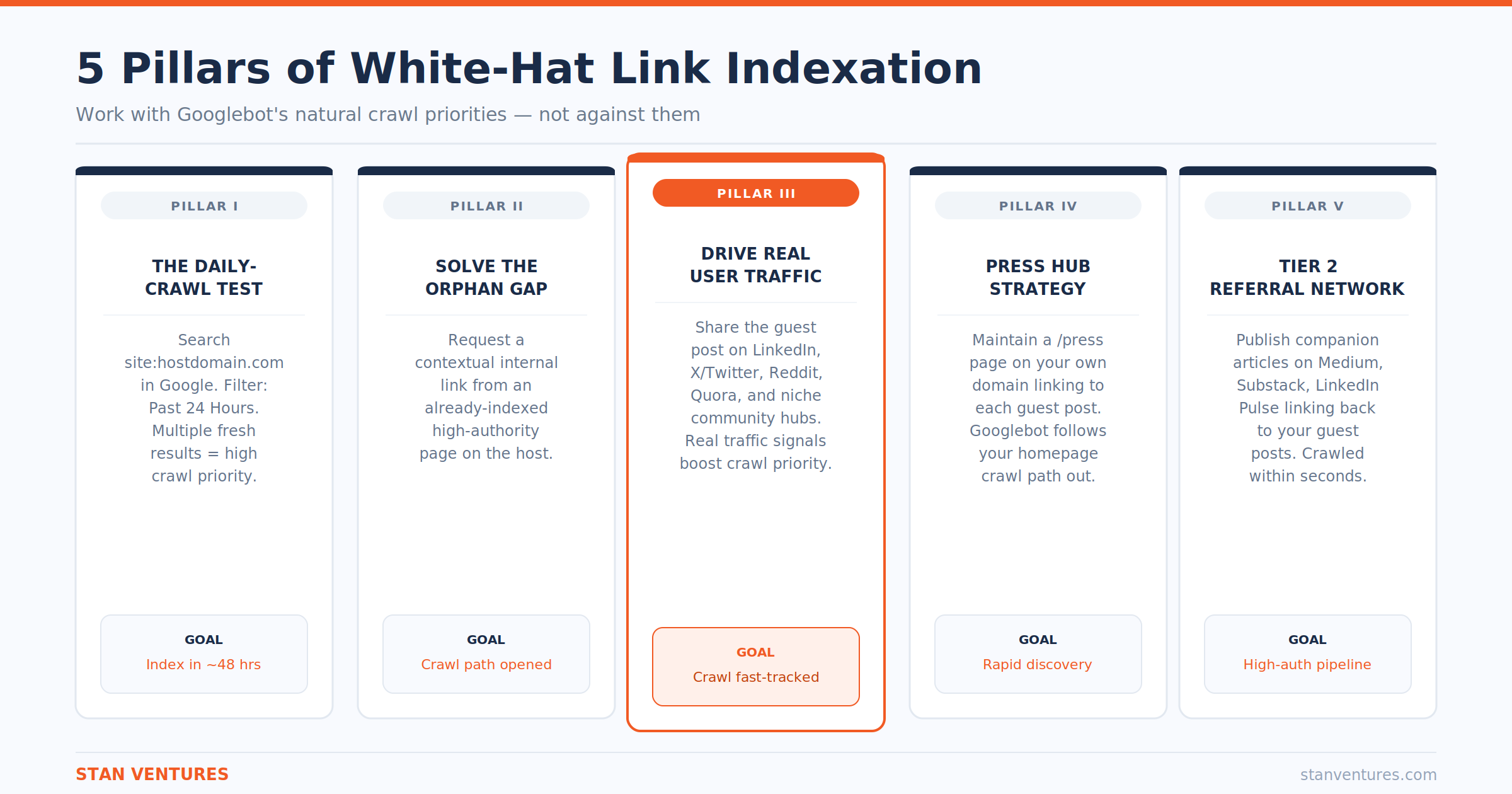
To get your backlinks indexed quickly without risking manual actions or algorithmic penalties, you must align with Googlebot’s natural search algorithms.
- ### Strict Pre-Vetting (The “Daily-Crawl” Test)
The fastest way to index a backlink is to place it on a domain that Googlebot already visits constantly. Before securing a link, analyze the host domain’s indexing cadence:
**The Site Operator Test:** Search _site:hostdomain.com_ in Google, click Tools, and set the time filter to Past 24 Hours.
**The Insight:** If Google has indexed multiple new articles in the last 24 hours, the site has a high crawl priority, and your backlink will likely index within 48 hours of publication.
- ### Reciprocal Authority Injection (Solve the Orphan Page Gap)
When a guest post is published, it is typically an orphan page. To bridge this gap, request that the publisher insert contextual internal links from existing, highly-ranked, and indexed URLs on their domain pointing to your new post.
_**Why it works:** Googlebot crawls high-performing pages frequently. When it hits the internal link to your guest post on an authoritative page, it will instantly follow the link path and crawl your backlink._
- ### Force Crawls via Chrome User-Engagement Signals
Googlebot’s crawl queue is highly reactive to human traffic. By driving organic user signals, you force Googlebot to prioritize the URL.
**The Strategy: **Share the guest post on highly active social channels (LinkedIn, X/Twitter) and community hubs (Reddit, Quora, or industry forums).
**The Technical Reality: **Real visits from Google Chrome browsers trigger immediate field-data telemetry. Google’s system registers the sudden spike in user engagement and pushes the URL straight to the front of the Googlebot rendering queue.
- ### The “Featured Hub” Strategy
Do not rely entirely on the host site to guide Googlebot. You can drive crawl paths directly from your own domain:
**Step 1: **Maintain a beautifully designed /featured-in or /press page on your primary website (e.g., example.com/press).
**Step 2:** Deep-link your guest articles and media mentions directly from this page.
_The Mechanical Loop: Because Googlebot frequently crawls your authoritative homepage, it will follow the internal link to your Press page, discover the outgoing links to your guest posts, and crawl them instantly._
- ### Controlled, White-Hat “Tier 2” Referral Networks
Instead of using hazardous spam tools to build thousands of automated links, use high-authority platforms to build safe Tier 2 structures:
**Step 1:** Write valuable companion articles on highly authoritative, auto-crawling platforms like Medium, Substack, or LinkedIn Pulse.
**Step 2:** Naturally link from these articles back to your primary guest posts (Tier 1).
_Because platforms like Medium are crawled and indexed within seconds, they act as rapid, high-authority pipelines guiding Googlebot directly to your backlink._
## Toxic Indexing Tactics That Kill Site Authority
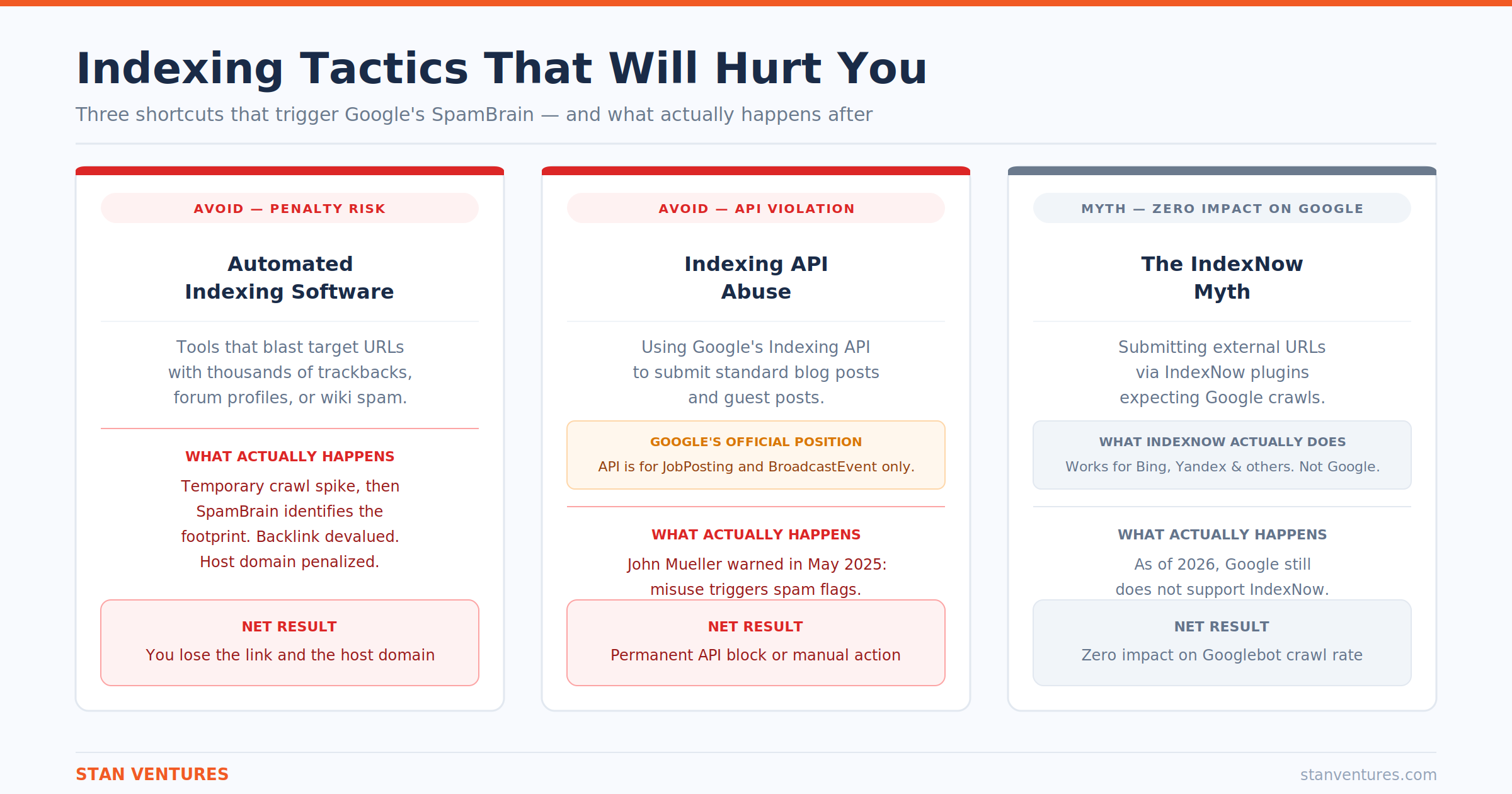
Many generic SEO guides recommend outdated automated tricks. However, these methods trigger immediate flags in Google’s SpamBrain AI system:
**Automated Indexing Software:** Tools that blast target URLs with thousands of automated trackbacks, forum profile links, or cheap wiki comments are highly toxic. While they may trigger a temporary search crawl, Googlebot eventually flags the spam footprint, resulting in the permanent de-indexation of the host domain and the devaluation of your backlink.
**Indexing API Abuse: **Some SEO plugins advocate using Google’s Developer Indexing API to submit standard articles and guest posts. Google’s documentation explicitly states that the Indexing API is strictly reserved for Job Postings and Broadcast Events. Misusing the API for commercial blog posts can result in a permanent API block or manual spam actions on your primary domain.
**The IndexNow Myth: **While Bing and Yandex actively support the IndexNow protocol to instantly crawl new pages, Google does not. Submitting external URLs via IndexNow will have zero impact on Googlebot crawl rates.
## Actionable Indexation Checklist
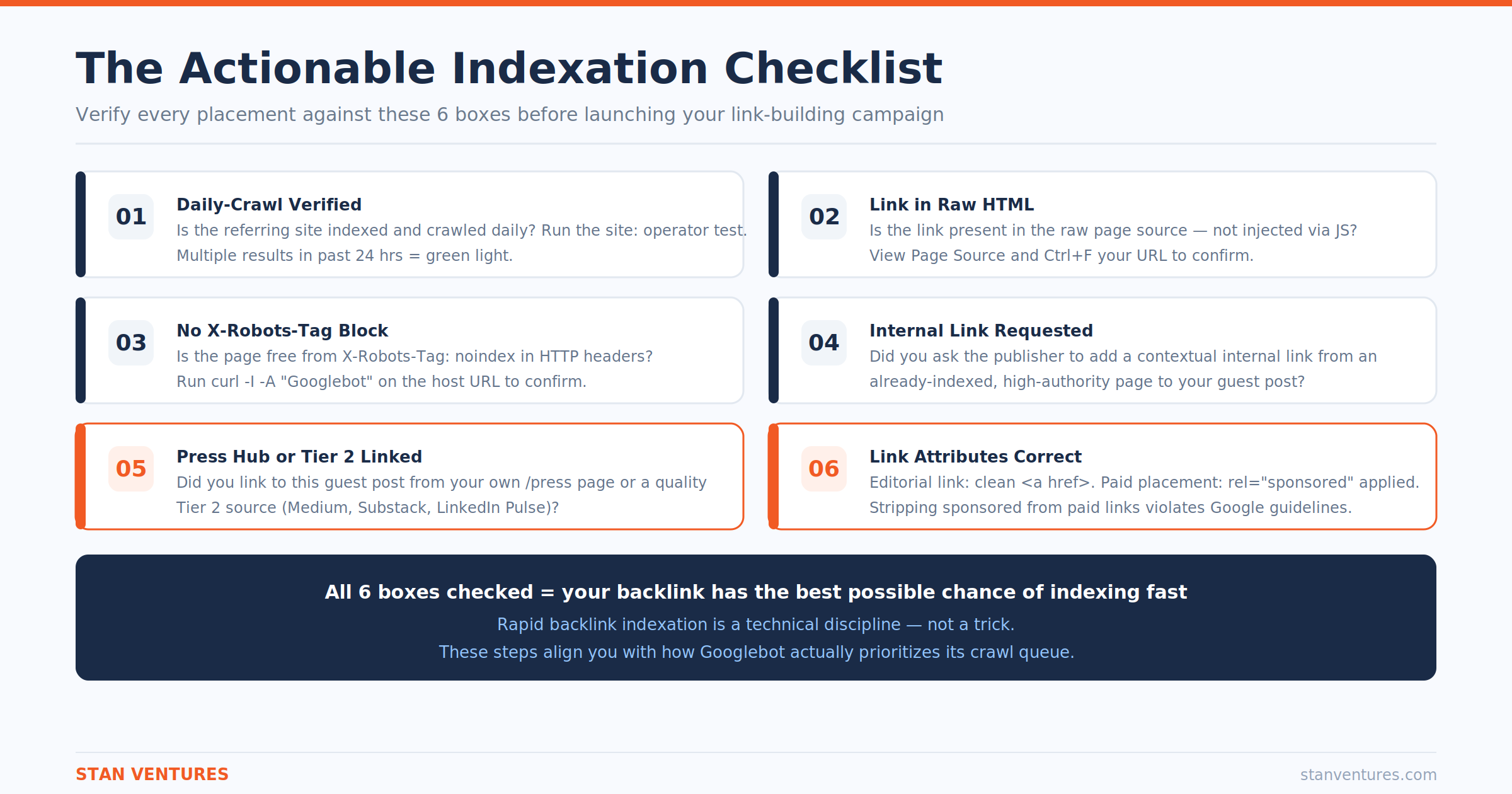
Ensuring rapid backlink indexation is not about tricks, it is a technical discipline. By shifting your focus from low-grade volume to the IQT framework, you align perfectly with how Google’s rendering systems actually prioritize crawl budgets.
Before launching your next link-building campaign, verify every asset against this checklist:
- Is the referring site indexed and crawled daily?
- Is the link present in the raw, server-side HTML (no JS injection)?
- Is the page free from HTTP-level X-Robots-Tag: noindex headers?
- Did you request a contextual internal link from an authoritative host page?
- Did you link to the guest post from your own “Press Hub” or a high-quality Tier 2 source?
By systematically checking these technical boxes, you ensure that every backlink you acquire passes maximum PageRank, drives sustained organic visibility, and converts your SEO investment into first-page rankings.
## Frequently Asked Questions
**Why does a backlink pass zero value if it is not indexed?**
If a page is not indexed by Google, it does not exist in the search engine’s directory. As a result, its outbound links are invisible to the search algorithm and cannot pass anchor text relevance, page equity, or PageRank.
**How long does a guest post take to index naturally?**
An authoritative, highly active domain will naturally index a new post within 24 to 72 hours. A newly established blog with lower authority and low crawl budgets can take anywhere from 2 weeks to 2 months.
**Can I submit a third-party guest post URL to Google Search Console manually?**
No. The URL Inspection tool in Google Search Console is restricted to domains that you have verified ownership of. You cannot manually submit guest post URLs on external domains. If you own the domain this should be on top of your todo list for getting backlinks indexed faster.