Most SEO agencies don’t have a growth problem. They have a scaling problem.
They sign clients. Revenue goes up. And somehow the owner is working more hours, the team is closer to burnout, and the bank account isn’t growing the way the client roster is. More work came in. More money didn’t stick around.
That gap is the whole story. This guide walks through how to add clients without adding chaos, what to automate, what to keep human, where AI fits, and how to protect quality and margins while you do it.
Growing and scaling aren’t the same thing
Growing means more clients and more revenue. Simple.
Scaling means more clients and more revenue without your costs rising at the same rate. That’s the harder, more valuable thing, and it’s where most agencies stall.

Here’s why they stall. At a lot of agencies, delivery is built around people instead of systems. Every new client means someone has to set up tracking, pull data, write reports, run the work, and manage the relationship.
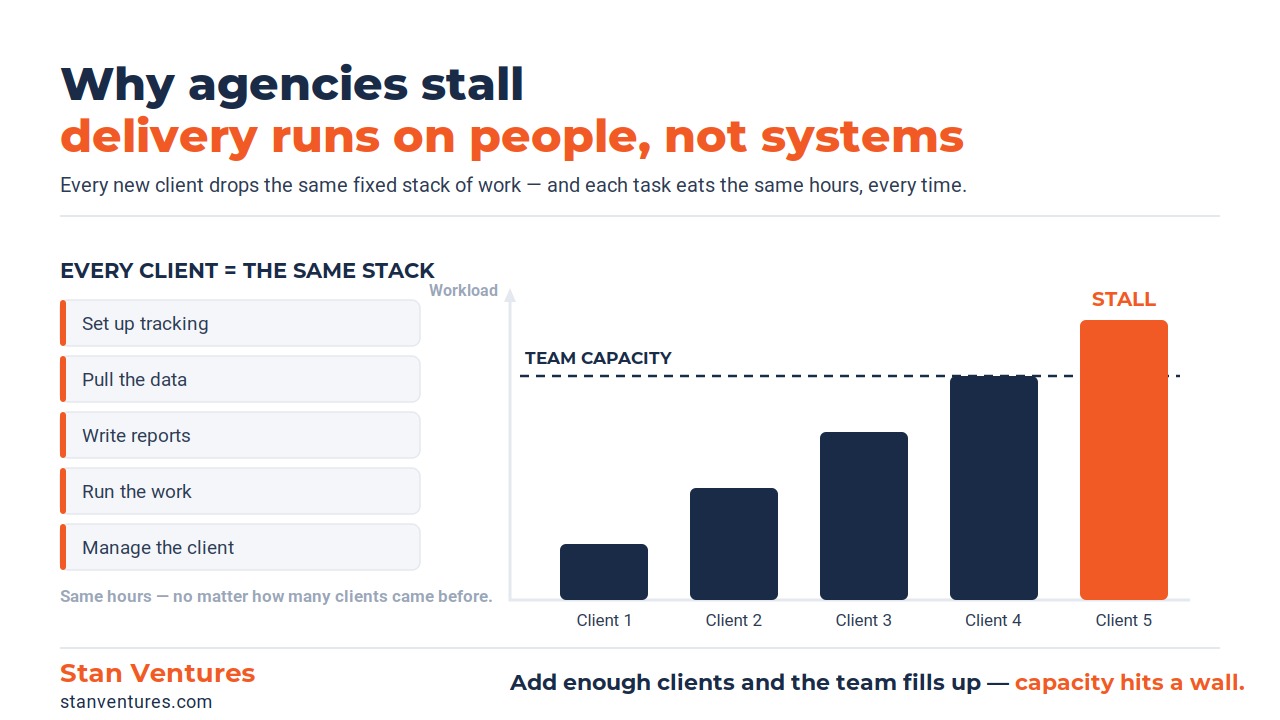
Each of those tasks takes about the same number of hours no matter how many clients came before. So when the team fills up, the owner has exactly three options: turn down work, let quality slip, or hire. None of those make the business better on their own.
The agencies that actually scale treat hiring as a last resort, not a first reflex. They squeeze the inefficiency out of how work gets done first. Then they hire.
Are you actually ready to scale?
Before you chase more clients, be honest about whether the foundation holds.
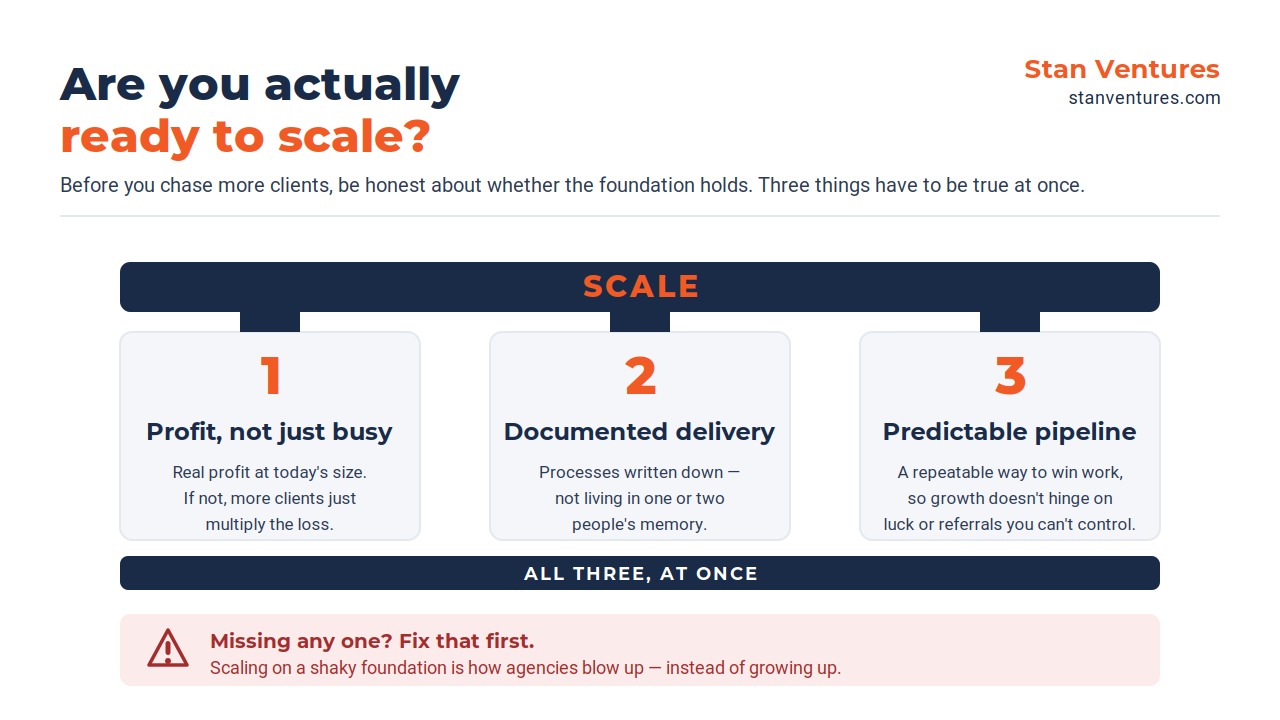
You’re ready to scale when three things are true at once. First, you’re consistently profitable on the clients you already have, not just busy. If you’re not turning a real profit at your current size, more clients will multiply the loss, not fix it. Second, your delivery runs on documented processes, not on one or two people’s memory. Third, you have a predictable way to bring in new business, so growth doesn’t depend on luck or referrals you can’t control.
If you’re missing any of those, fix that first. Scaling on a shaky foundation is how agencies blow up instead of growing up.
The numbers that tell you it’s working
The market is on your side. The global SEO services industry was valued at roughly $81 billion in 2024 and is projected to reach about $172 billion by 2030. Demand isn’t the constraint. Your operating model is.
So track the numbers that actually measure scaling, not just the ones that measure busyness.
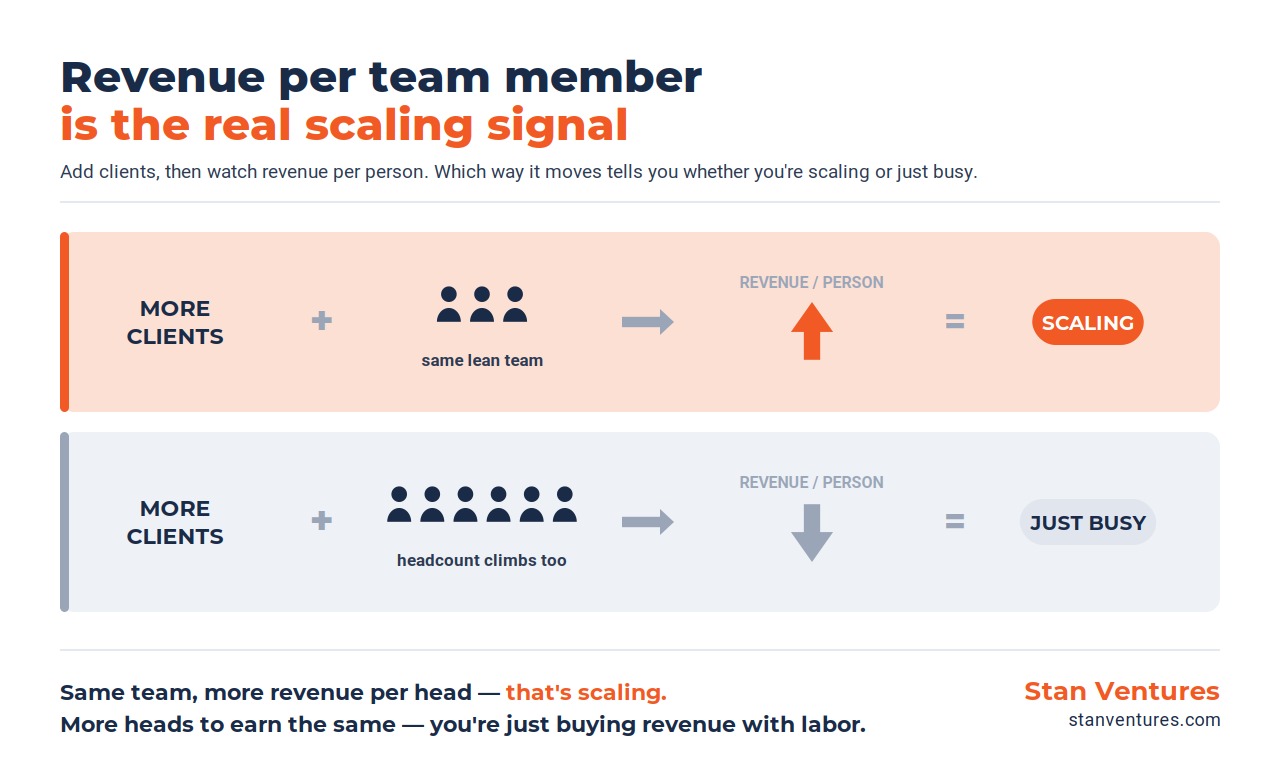
Revenue per team member: This is the clearest signal. If you add clients and revenue per person climbs, your systems are absorbing the new work. If you add clients and revenue per person stays flat or drops, you’re growing, not scaling. You’re just buying revenue with labor.
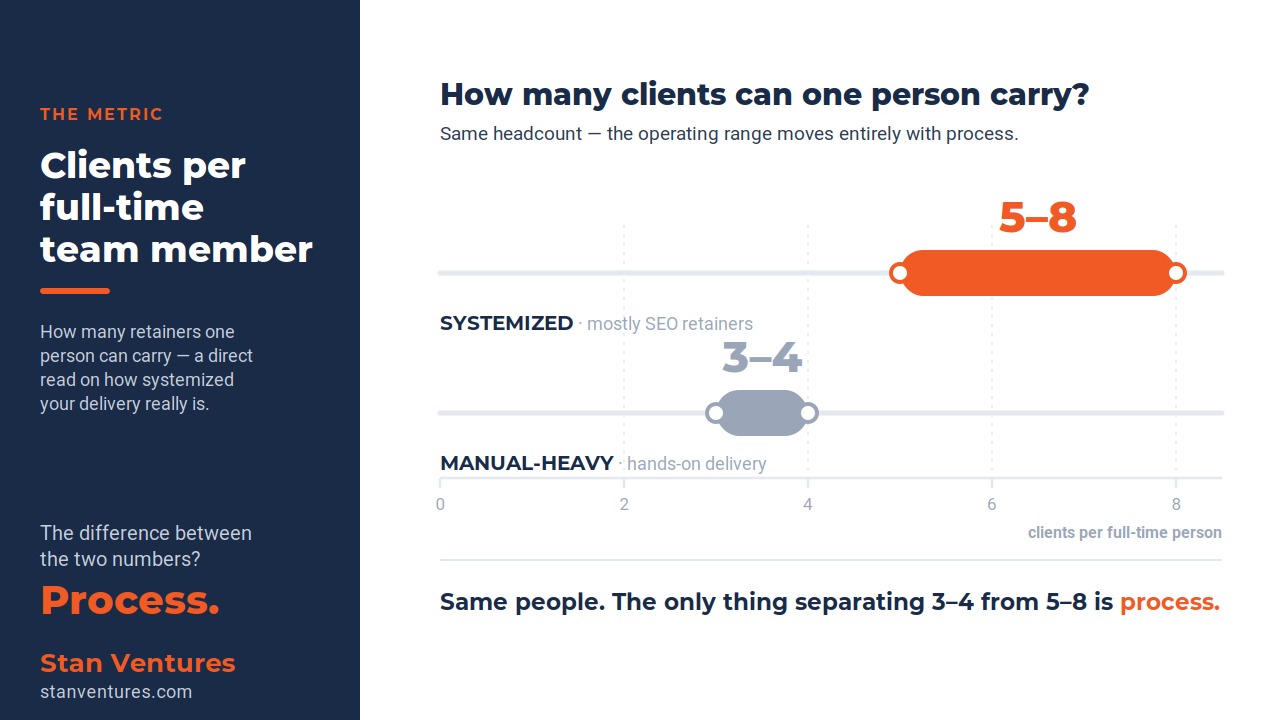
Clients per full-time team member: A well-systemized agency running mostly SEO retainers can handle somewhere around five to eight clients per person. Agencies that lean on manual work tend to top out at three or four. The difference between those two numbers is almost entirely process.
Where the hours actually go: Map it. For most agencies, the time per client per month breaks down something like this:
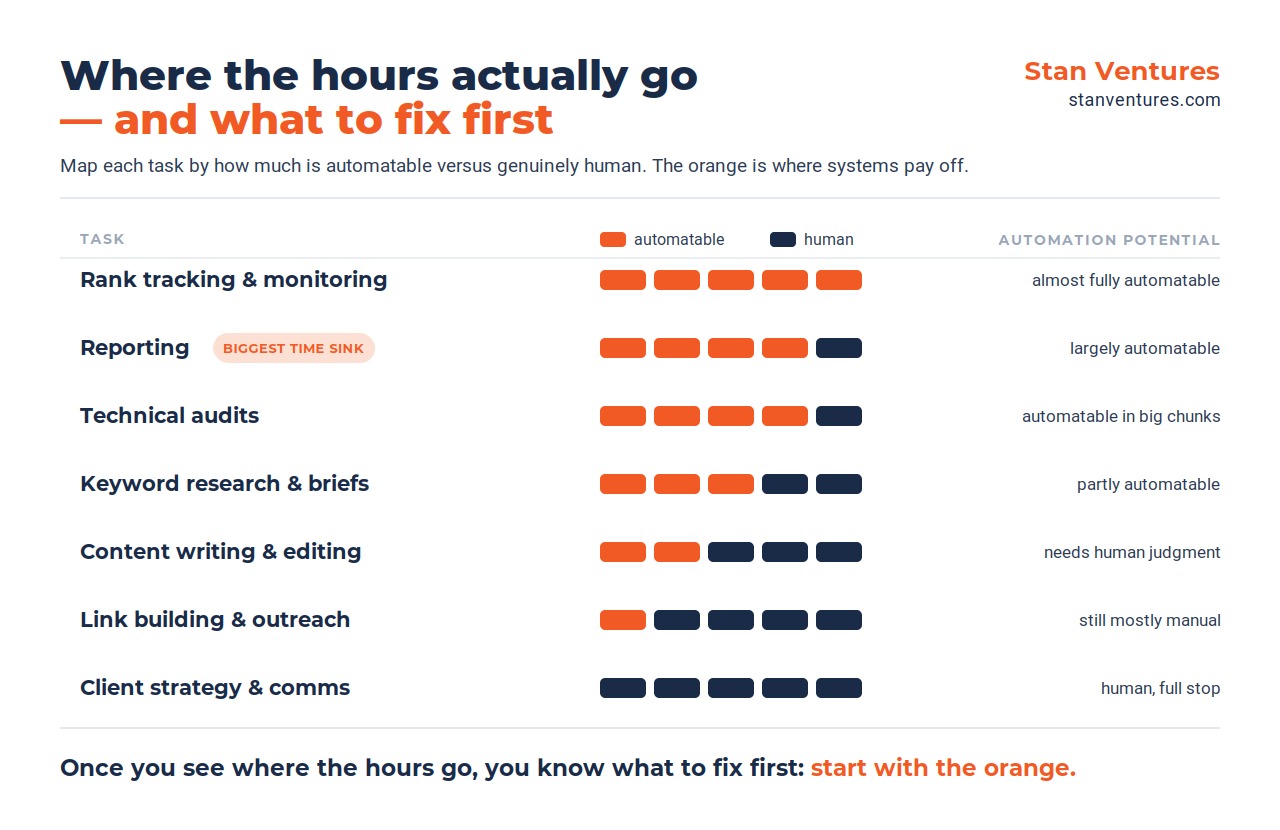
- Rank tracking and monitoring: a few hours, and almost fully automatable
- Reporting: often the single biggest time sink, and largely automatable
- Technical audits: automatable in big chunks
- Keyword research and content briefs: partly automatable
- Content writing and editing: scales with volume, needs human judgment
- Link building and outreach: still mostly manual
- Client strategy and communication: human, full stop
Once you see where the hours go, you know exactly what to fix first.
Niche down so you can scale up
The agencies that “do it all” are the hardest to scale. Strategy for a SaaS company looks nothing like strategy for a local roofer or a law firm. When you serve everyone, you rebuild your playbook for every account.
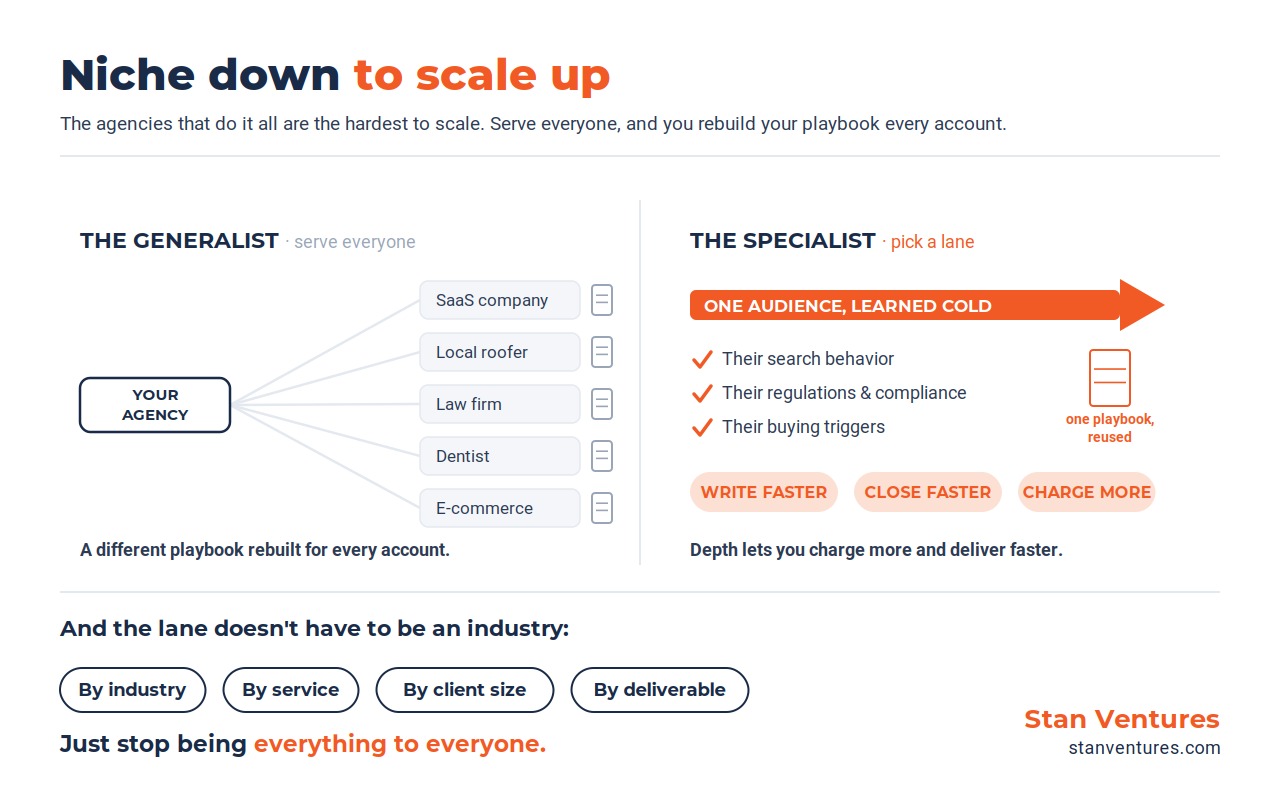
Pick a lane. When you specialize, you learn one audience’s search behavior, regulations, and buying triggers cold. You write content faster because you’ve written it before. You close faster because prospects can tell you actually know their world.
A focused agency targeting law firms understands legal compliance and the keywords that bring in cases. One built around local SEO knows Google Business Profile, citations, and map-pack ranking better than any generalist. That depth is what lets you charge more and deliver faster, which is the whole point of scaling.
You don’t have to choose a niche by industry. You can niche by service, by client size, or by deliverable. Just stop being everything to everyone.
Fix your pricing before you add a single client
There’s an old project-management triangle: speed, quality, price. You get to pick two. You can’t be the fastest, the best, and the cheapest. Anyone promising all three is lying or about to go broke.
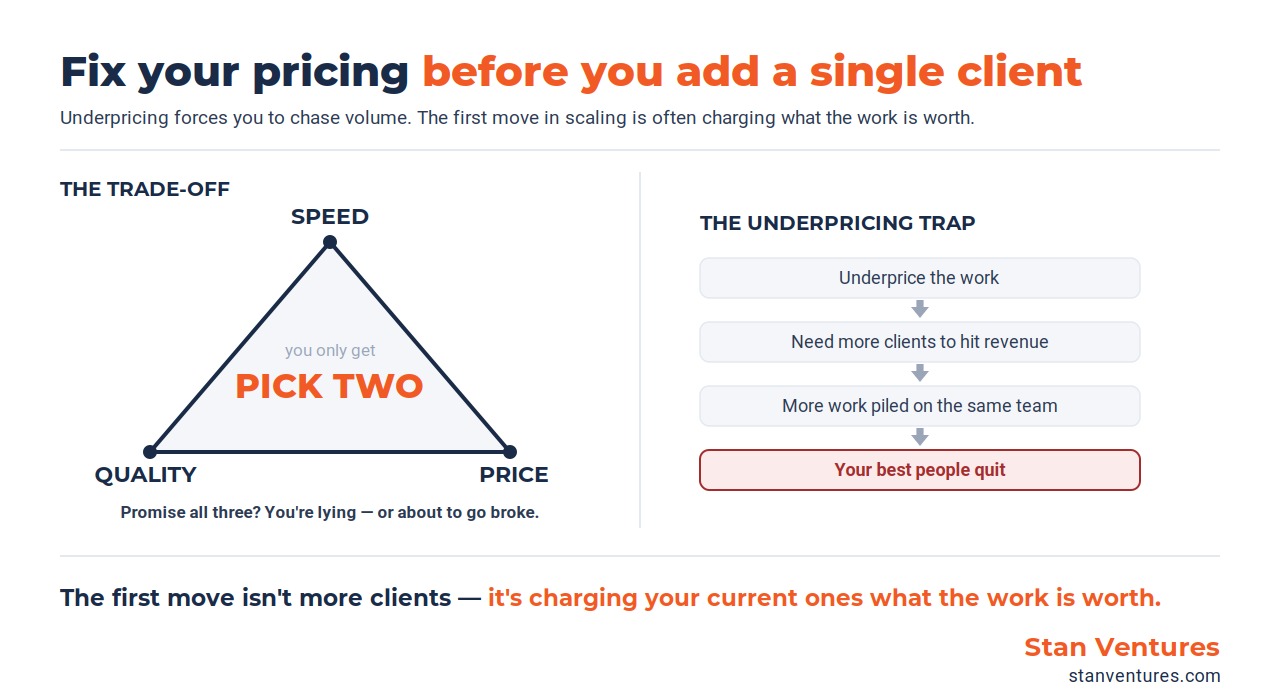
If you underprice, you have to take on more clients to hit your revenue goals. More clients means more work piled on the same team. And you can’t squeeze blood from a stone. Push too hard and your best people quit. So the first move in scaling often isn’t getting more clients. It’s charging your current ones what the work is worth.
Two pricing habits make scaling far easier:
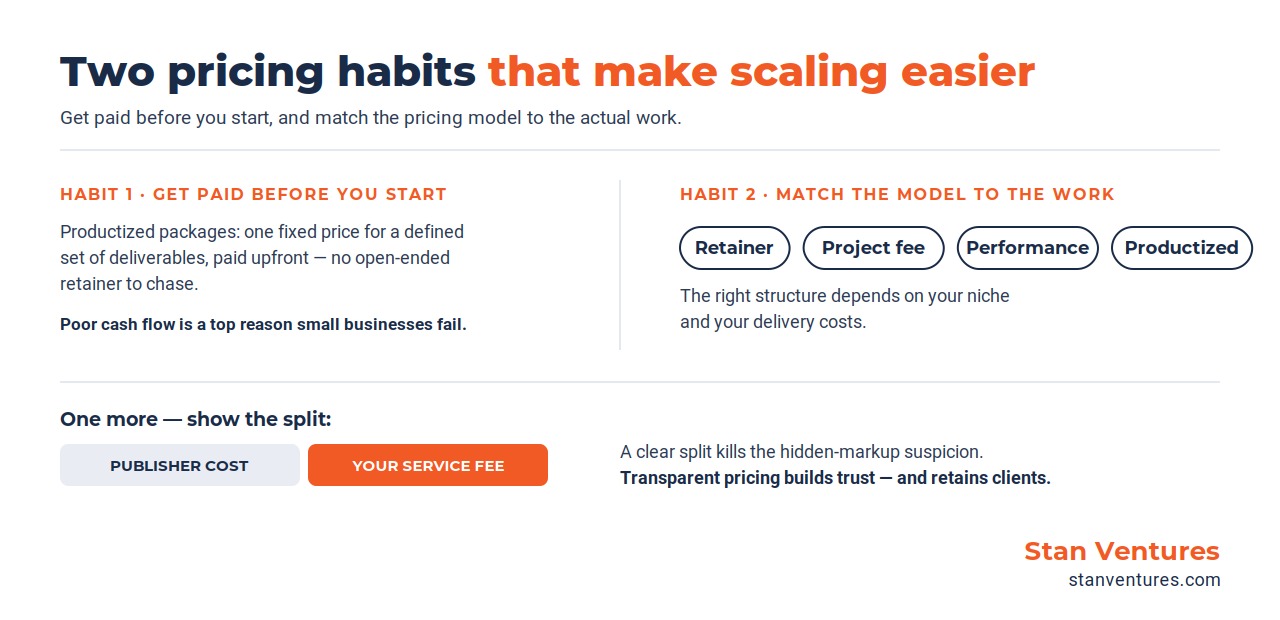
Get paid before you start. Late and unpaid invoices wreck cash flow, and poor cash flow is one of the top reasons small businesses fail. Productized packages help here. The client pays a fixed price for a defined set of deliverables, upfront, instead of an open-ended retainer you have to chase. There’s no ambiguity about scope and no invoice hanging over the engagement.
Match the model to the work: Retainers, project fees, performance pricing, and productized packages all have a place. The right structure depends on your niche and your delivery costs. If you’re weighing the tradeoffs, this breakdown of SEO pricing models for agency owners is a useful starting point.
One more thing on pricing: the way you separate costs for your own clients matters. Showing a clear split between what a publisher charges and what your service costs builds trust and kills the suspicion that you’re hiding a markup. Transparent pricing isn’t just ethical. It retains clients.
Systematize first, then automate, and let AI carry the repetitive load
Automation only works on processes that are already consistent. If every account manager formats reports differently, there’s nothing to automate. So standardize before you touch a single tool.
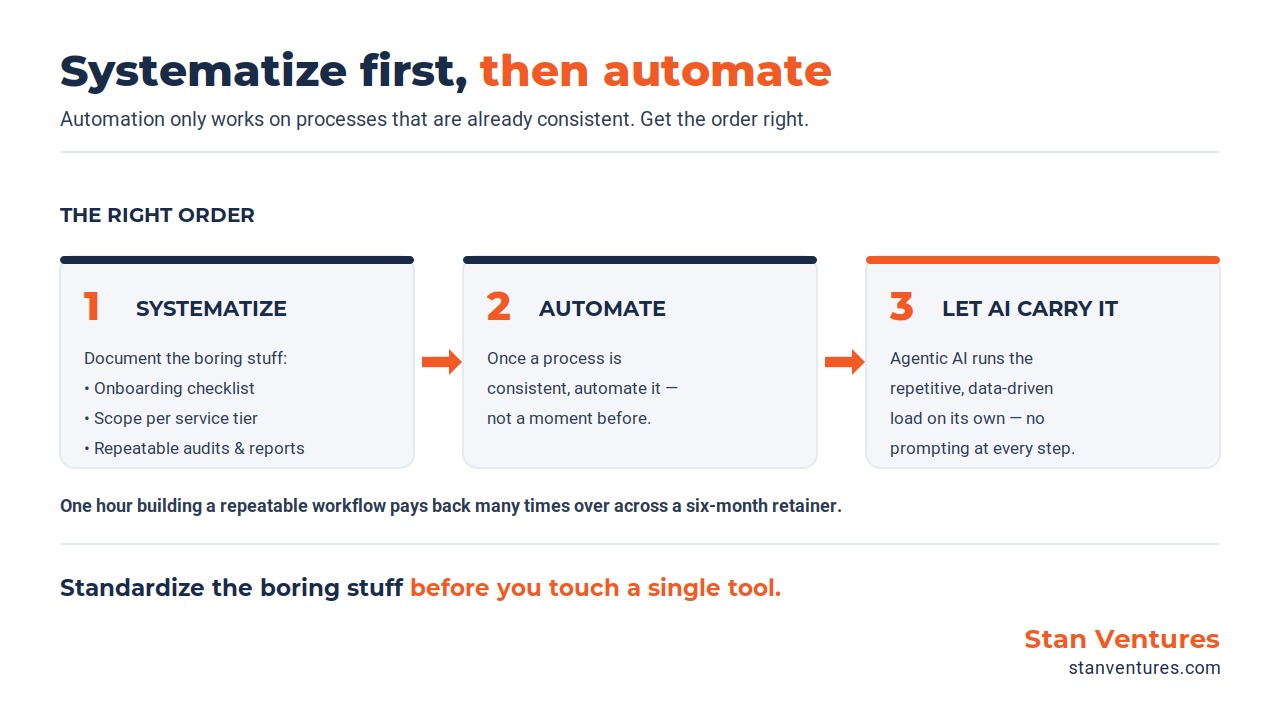
That means documenting the boring stuff: a client onboarding checklist anyone on the team can run, a defined scope for each service tier so the work doesn’t quietly expand, a repeatable structure for audits and reports. One hour spent building a repeatable workflow pays back many times over across a six-month retainer. Across a full roster, that math gets serious fast.
Once a process is consistent, automate it. And this is where AI changed the equation.
Plain AI tools answer prompts. You ask, they reply. Agentic AI is different. An agentic system can take a goal, break it into steps, use tools to execute those steps, check its own output, and hand back a finished result without being prompted at every stage.
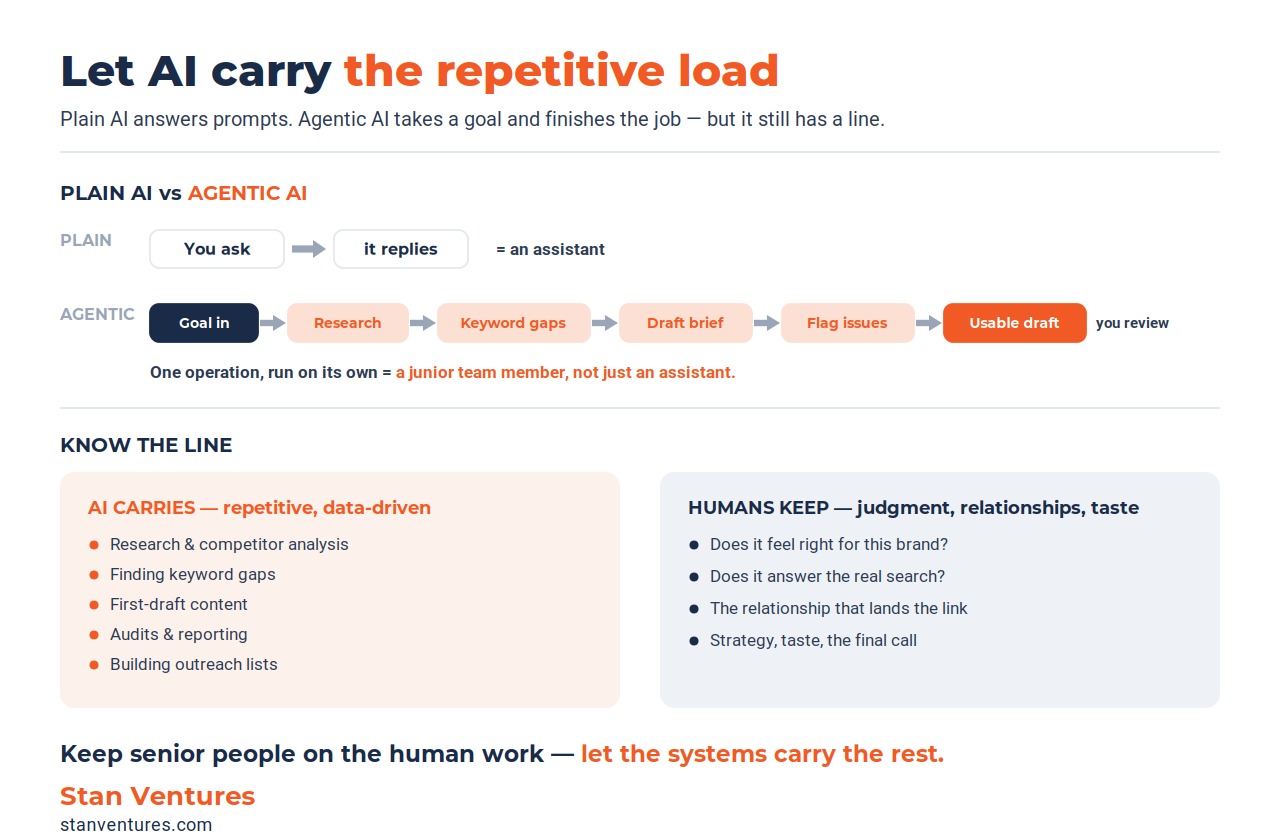
For an agency, that’s the difference between an assistant and a junior team member. Given a topic, an agentic setup can research competitor content, find keyword gaps, draft a brief, flag technical issues, and return a usable draft as one operation. Your strategist reviews the output instead of doing the grunt work to produce it. There are plenty of practical entry points here, and this rundown of SEO tasks AI can simplify shows where the quick wins are.
But know the line. AI handles repetitive, data-driven work well. It does not handle judgment, relationships, or taste. It can draft content, but it can’t tell you whether a piece feels right for a specific brand or answers the real question behind a search. It can prepare an outreach list, but it can’t build the editorial relationship that lands the link. Keep your senior people on the work that needs a human, and let the systems carry the rest.
Sell AI visibility before your competitors do
Here’s the shift that’s reshaping the whole job. Ranking a blue link isn’t enough anymore. Your clients need to show up inside AI answers.
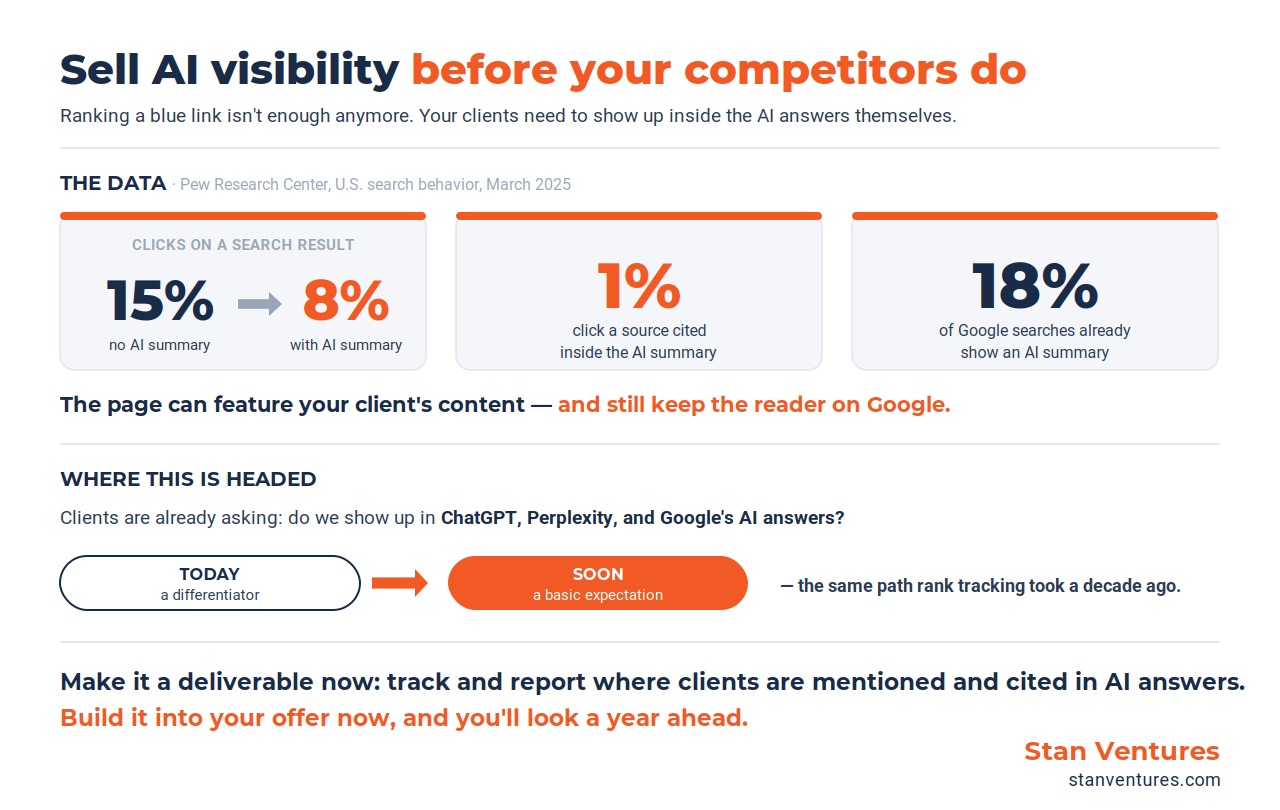
The data is hard to argue with. A Pew Research Center study of U.S. search behavior found that when an AI summary appears, users click a traditional search result just 8% of the time, compared to 15% when no summary is shown. Only 1% click a source cited inside the summary. And around 18% of all Google searches in the study already produced an AI summary. The page can feature your client’s content and still keep the reader on Google.
Clients are starting to ask whether they show up in ChatGPT, Perplexity, and Google’s AI answers. Agencies that can’t answer that question, or can’t show movement on it over time, are going to lose those accounts. AI visibility tracking is heading the same way rank tracking did a decade ago: from a differentiator to a basic expectation.
So make it a deliverable now. Track where and how your clients get mentioned and cited inside AI answers, and report on it. If you need to get fluent fast, start with these GEO terms every SEO needs to know, then look at how AI search is reshaping the field faster than most expected. Agencies that build this into their offer now will look like they’re a year ahead.
Outsource the right work to the right partner
You cannot scale by hiring for every gap. Hiring is slow, expensive, and hard to reverse when a client pauses. Outsourcing turns a fixed cost into a variable one. You get a specialist team without the payroll, and you can scale capacity up or down with your client count.
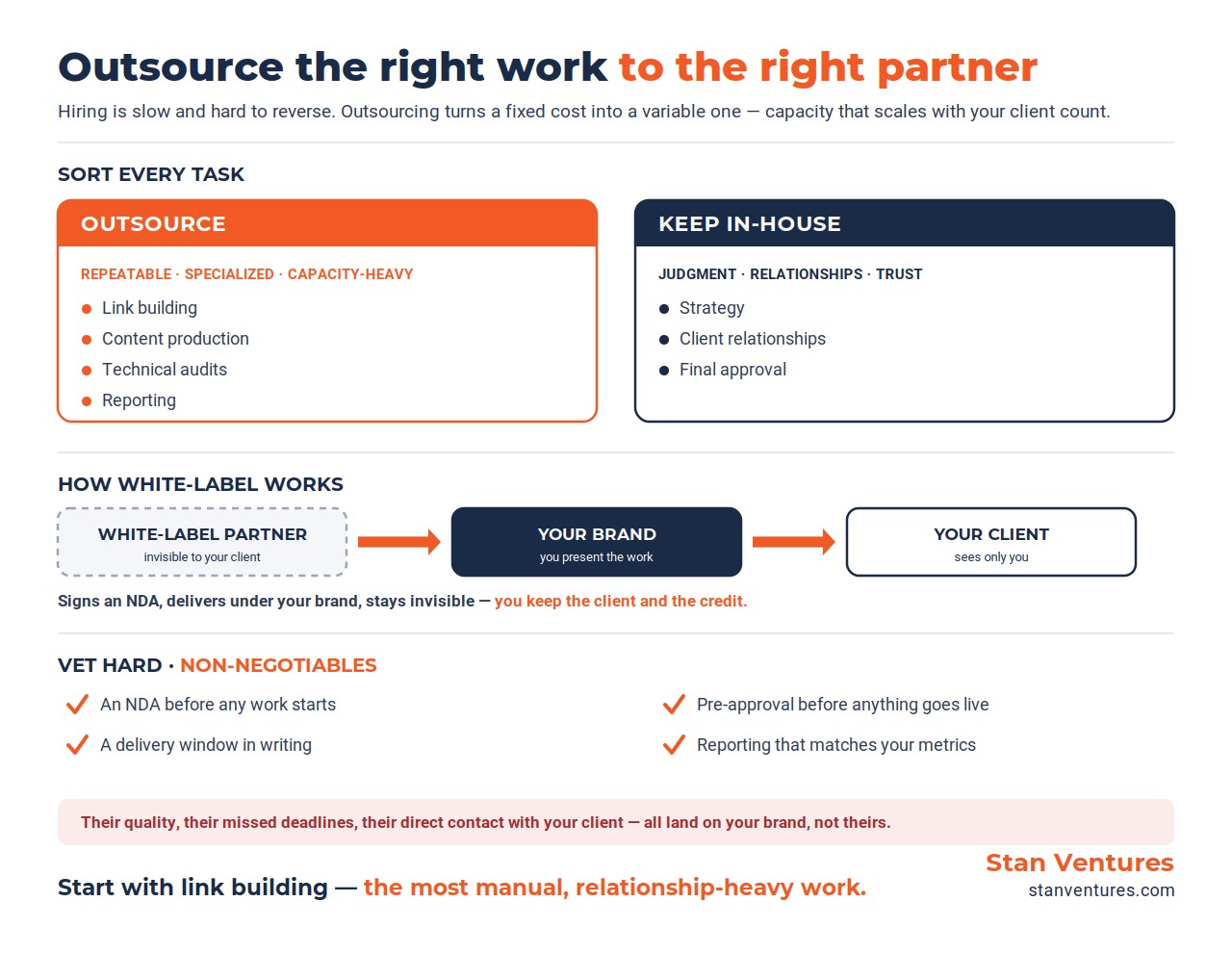
The trick is choosing what to hand off. Outsource the work that’s repeatable, specialized, or capacity-heavy: link building, content production, technical audits, reporting. Keep strategy, client relationships, and final approval in-house. A clear breakdown of what to keep and what to send out lives in this SEO outsourcing guide.
This is where a white-label SEO partner earns its keep. A good one delivers under your brand, signs an NDA, and stays invisible to your client. The model has real upside for margins and capacity, laid out plainly in these benefits of white-label SEO for agencies.
It also has real risks, so vet hard. If a partner’s quality doesn’t match your standards, your brand takes the hit, not theirs. If they miss deadlines, your client blames you. And if they ever contact your client directly, you could lose the account. Protect yourself with a few non-negotiables:
- An NDA before any work starts
- A delivery window in writing, since turnaround time directly shapes how your client feels about you
- Pre-approval on the work, so you see and sign off before anything goes live
- Reporting that matches the metrics you already track
For most agencies, link building is the first and best thing to hand off, because it’s the most manual and relationship-heavy function in SEO. A specialist white-label link building partner can run outreach at a scale a single in-house person never could. If you’d rather hand off the full stack, a white-label SEO reseller setup covers on-page, off-page, and technical under one roof. Either way, you keep the client and the credit. For the link-specific tradeoffs, this guide on outsourcing link building goes deeper.
Protect quality as the client count climbs
Scaling too fast is its own trap. Pile on clients before your systems can handle them and quality drops, deadlines slip, your team burns out, and the clients you fought to win start to leave. That’s not growth. It’s a treadmill.
A few habits keep quality intact while you add accounts.
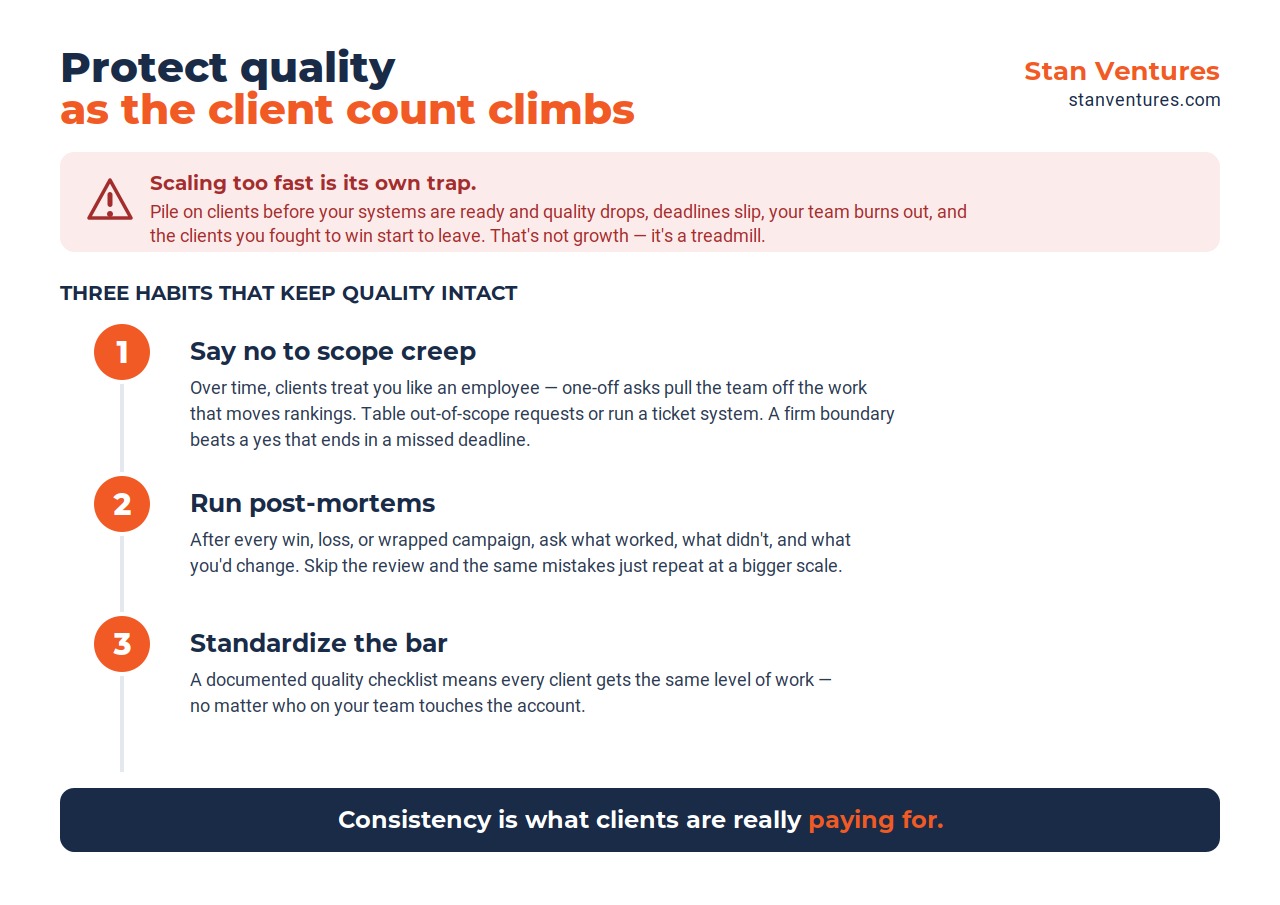
Say no to scope creep. The longer a client works with you, the more they start treating you like an employee instead of a partner. Random one-off requests pile up and pull your team off the strategy that actually moves rankings. Push back. Table out-of-scope asks until the current work is done, or set up a ticket system so requests get acknowledged without derailing the plan. Clients respect a firm boundary more than a yes that ends in missed deadlines.
Run post-mortems. When you lose a client or wrap a campaign, sit down and ask what worked, what didn’t, and what you’d change. Without a habit of reviewing the work, the same mistakes repeat at a bigger scale. Process improvement is what keeps delivery lean as you grow.
Standardize the bar. A documented quality checklist means every client gets the same level of work, no matter who on your team touches the account. Consistency is what clients are really paying for.
Turn reporting into your retention engine
A report is how most clients understand what they’re paying you for. Get it wrong and you lose accounts even when the work is good.
Two things separate a report that retains a client from one that quietly erodes trust.
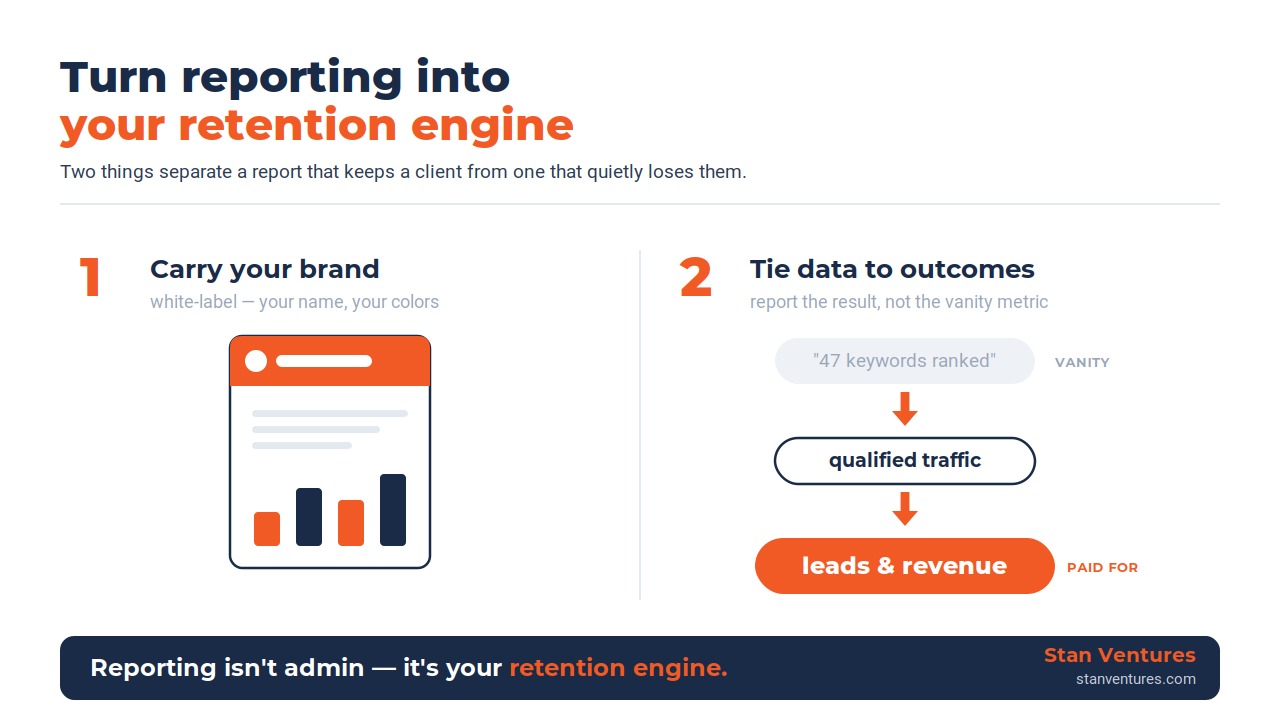
First, it carries your brand, not a third party’s. Every report with someone else’s logo on it tells your client, even subconsciously, that you’re reselling somebody else’s work. White-label reporting fixes that. Your name, your colors, your analysis.
Second, it connects data to outcomes the client cares about. “You ranked for 47 new keywords” means little on its own. “These rankings drove this much qualified traffic, which turned into this many leads” means everything. Report on the business result, not the vanity metric.
Do this well and reporting stops being an admin chore and starts being the reason clients stick around. Retention is the quiet engine of scaling. Every client you keep is one you don’t have to replace, and replacing churned clients is where growth secretly leaks away.
Keep the pipeline full so growth doesn’t stall
You can build the best delivery machine in the world and still flatline if no new business is coming in. Scaling delivery and scaling demand are two different projects, and a lot of owners forget the second one.
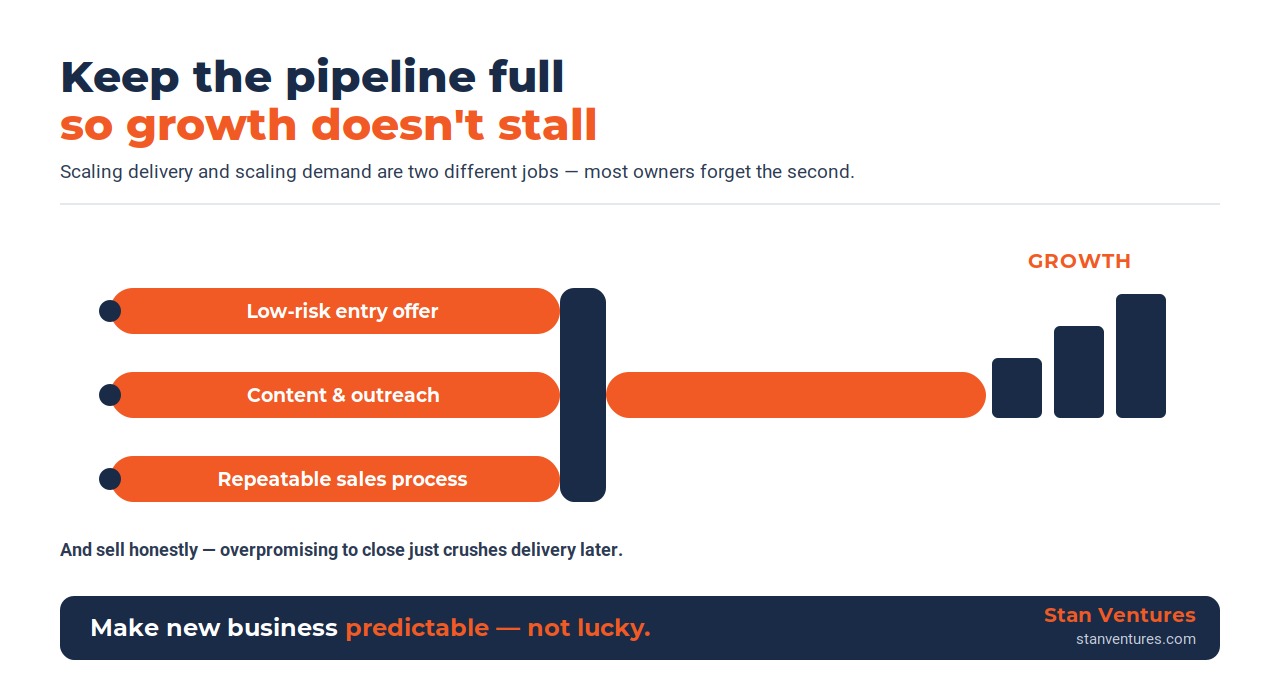
Build a repeatable way to win clients instead of waiting on referrals. That might be a low-risk entry offer that proves your value before a bigger commitment, a steady content and outreach habit that brings inbound leads, or a defined sales process your team can run without you in every call. The point is to make new business predictable, not lucky.
How you sell matters as much as how you deliver. A lot of agencies overpromise to close, then get crushed trying to deliver miracles. There’s a smarter way to position SEO that sets honest expectations and still wins the deal, covered well in this piece on how to sell SEO services the right way.
Hire well, and don’t burn out your people
When you do hire, hire for fit and for what your systems can’t replace. The most valuable people on a scaling team aren’t the ones doing repetitive tasks. They’re the ones making judgment calls: strategy, client relationships, content taste. Cast a wide net to find them, and look as hard at culture fit as at skill. The wrong hire on a small team does outsized damage. A useful look at the mistakes agencies make when hiring SEO talent is worth reading before you post a job.
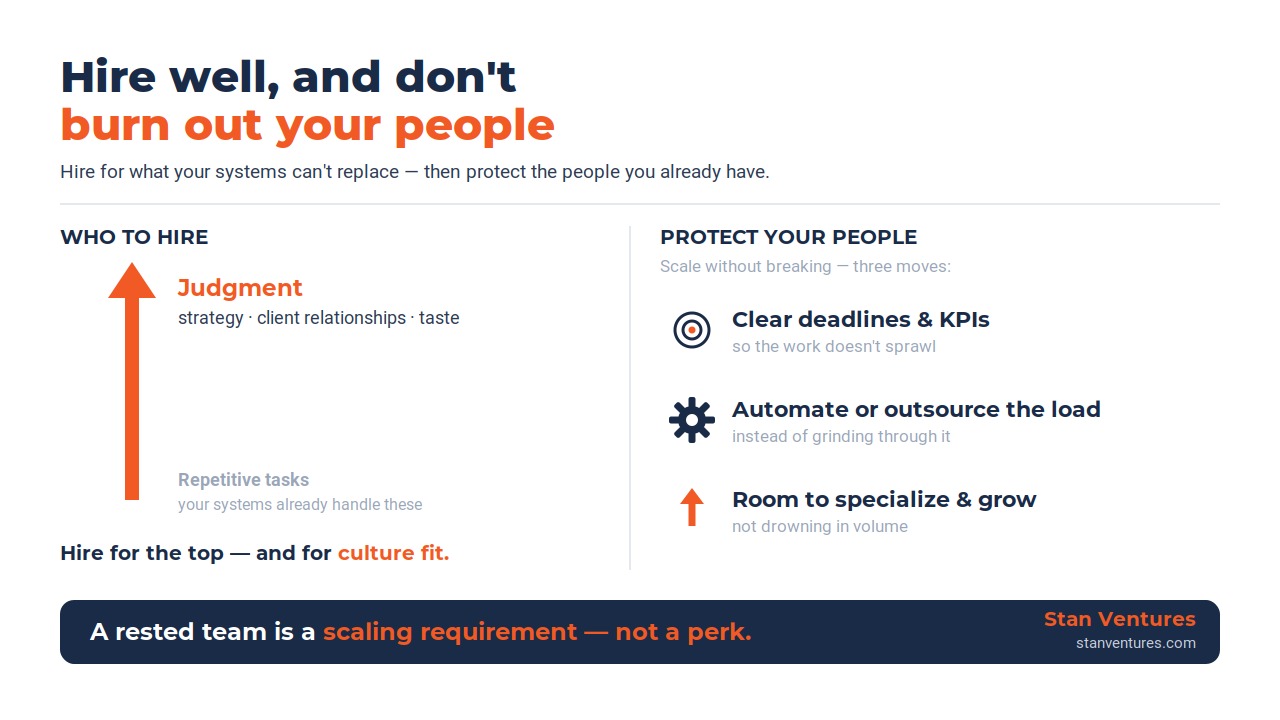
And protect the people you already have. Scaling and work-life balance feel like opposites, but they don’t have to be. The owners who keep their sanity while growing do three things: they set clear deadlines and KPIs so work doesn’t sprawl, they automate or outsource the repetitive load instead of grinding through it, and they give their team room to specialize and grow instead of drowning in volume. A team that isn’t fried delivers better work, stays longer, and lets you step out of the daily firefight. That’s not a soft perk. It’s a requirement for scaling without breaking.
Clear Google’s bar for content quality
None of this works if your content can’t rank or earn an AI citation. As you scale content production, the risk is that quality drifts toward generic, churned-out filler. Google is built to push exactly that kind of content down.
Anchor your standards to Google’s own guidance on creating helpful, reliable, people-first content. The framework it spells out is the E-E-A-T standard: experience, expertise, authoritativeness, and trustworthiness, with trust being the most important of the four. In practice, for an agency scaling content, that means a few concrete things.
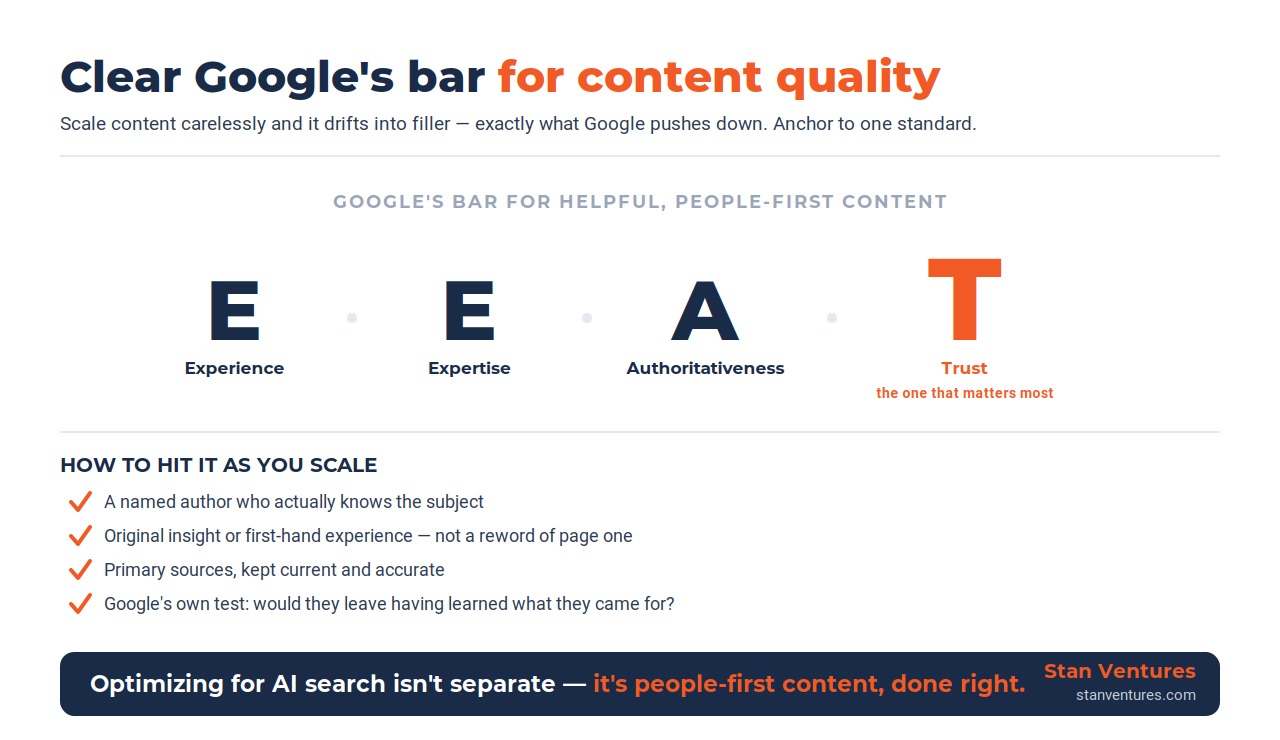
Put real expertise behind the work. Content with a named author who actually knows the subject beats anonymous, AI-spun text every time. Add original information, analysis, or first-hand experience, not a reworded version of whatever already ranks. Cite reliable, primary sources rather than secondhand summaries. Keep content current and accurate. And ask the honest question Google itself recommends: would someone leave this page feeling they learned what they came for?
That last point is also your AI visibility strategy. The same qualities that satisfy a human reader, original insight, clear structure, demonstrable authority, are what make content citable inside AI answers. Optimizing for AI search isn’t a separate discipline. It’s what good, people-first content has always been.
The Bottom Line
Scaling an SEO agency isn’t about working harder or signing every lead. It’s about building a business where adding a client doesn’t mean adding the same number of hours.
Price for your worth. Niche down. Document your processes, then automate them. Put AI on repetitive work and your best people on judgment. Make AI visibility part of what you sell. Outsource what you can to partners you trust, protect quality and retention obsessively, and keep the pipeline full while you do it.
Do that, and growth stops being a treadmill and starts compounding.

Ananyaa
AuthorAnanyaa Venkat is a seasoned content specialist with over nine years of experience creating industry-focused content for diverse brands. At Stan Ventures, she blends SEO insight with strategic storytelling to shape a compelling brand voice. She has contributed to several leading SEO publications and stays attuned to evolving trends to ensure her content remains authoritative, relevant, and high-quality.


