Key Takeaways
- The Reality: Most agencies eventually outsource SEO fulfillment. The difference between scaling profitably and burning client trust is who they pick, not whether they outsource.
- Quality over Promises: A white label SEO partner that guarantees rankings, refuses to share real reports, or operates without an NDA is not a partner. It is a liability waiting to surface in a client meeting.
- The Service Model: The safest white label arrangement is one where the agency buys the capability, including strategy, outreach, content, technical SEO, not just discounted units of labor.
- Vetting is Everything: A seven-criterion framework, applied during a 60-day paid pilot, surfaces 90% of partner problems before they reach the end client.
- The Reputation on the Line: The partner is invisible. The results carry the agency’s name. The vetting work matters in direct proportion to what the agency has built so far.
When SEO agency owners ask whether they should bring on a white label SEO partner, the answer from cautious advisors is almost always “be careful.” And they’re right to be cautious.
But ask any agency that has scaled past 20 clients, and the reality on the ground looks different.
The truth is, scaling an SEO agency on in-house headcount alone is brutally difficult. Hiring takes 90 days. Training takes six months. Quality control breaks down somewhere between client 12 and client 25. And the moment a senior link builder quits, two retainers slip.
People talk about white label SEO as if it’s a single thing. It isn’t. It’s a spectrum, from sketchy back-channel link sellers to genuine operational partners that some of the best agencies in the industry have been quietly running for years.
This creates a paradox: agencies need fulfillment leverage to grow, but the wrong fulfillment partner can sink them faster than slow growth ever would.
This is where choosing a white label SEO partner, or really, building a fulfillment relationship, comes into play. In 2026, the practice has moved well beyond the old reseller-list model where agencies bought packages off a price sheet.
It has become a serious operational decision that determines whether an agency scales cleanly or scales painfully.
This guide covers how to make that decision, from understanding what real white label SEO actually looks like, to vetting partners against a seven-point framework, to structuring the relationship so it lasts past the first quarter.
The Evolution of White Label SEO (And Why “Cheap” is Dangerous)
To pick a safe partner, it helps to first see the unsafe ones clearly. The white label SEO industry sorts into three tiers, and the difference between them is bigger than most agency owners realize until they get burned.
Tier 3: The Back-Channel Layer (Black Hat)
These are the providers that flood inboxes with offers like “DA 50+ guest post @$35.” They exist mostly on Fiverr, Telegram channels, and obscure marketplaces. Avoid them at all costs.
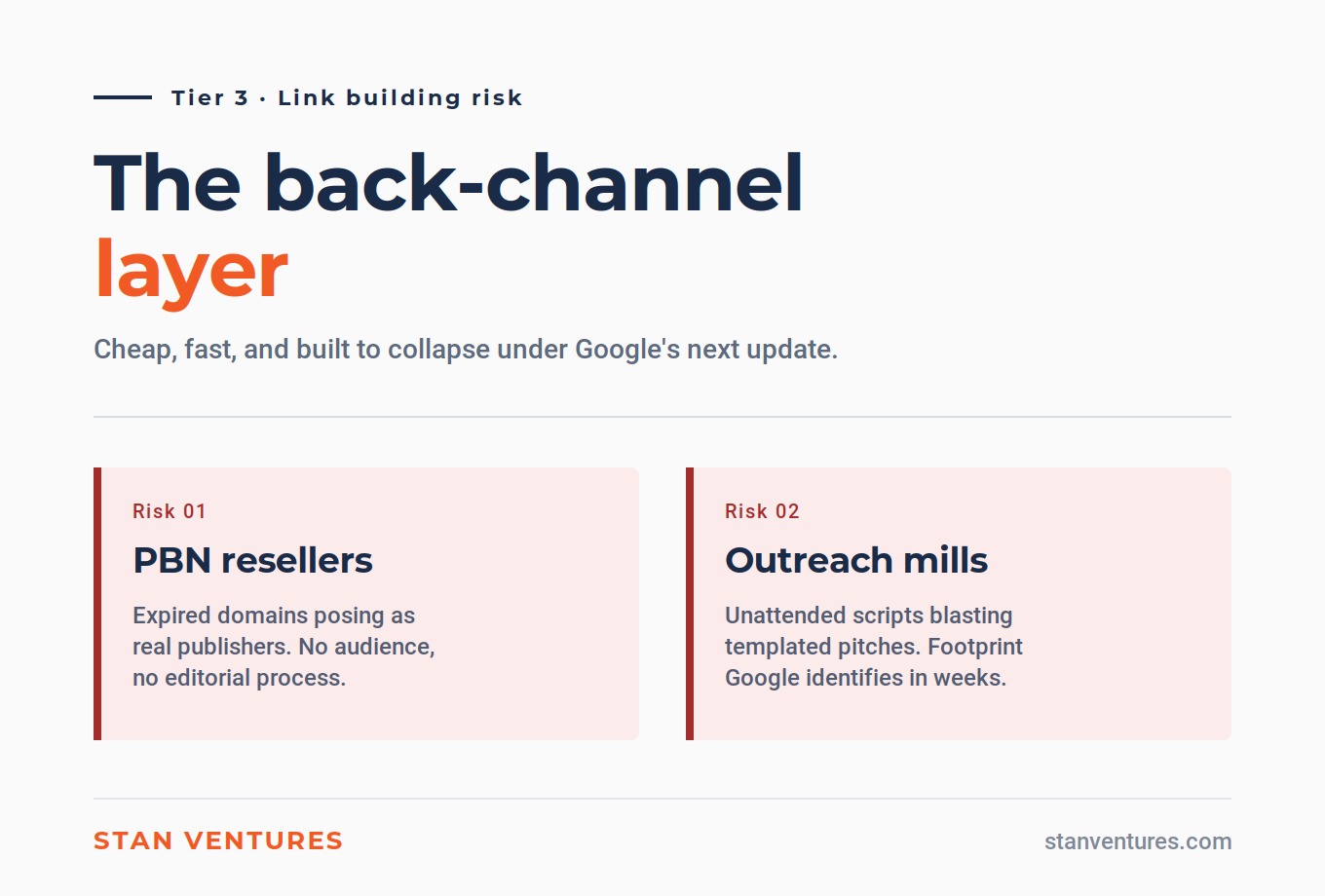
PBN Resellers: Networks of expired domains pretending to be real publishers. They look legitimate at first glance, but they have no audience and no editorial process.
The Risk: When Google catches the network, (SpamBrain catches them regularly) every client site that received links from it absorbs the damage. One bad batch can take down a year of ranking progress.
Automated Outreach Mills: Operations running unattended scripts that blast templated pitches at thousands of bloggers a day, accepting whatever publishes.
The Risk: The placements look like links on the report. In reality, they’re on sites with 30 outbound links per article, no traffic, and a footprint Google identifies in weeks.
Tier 2: The Reseller-List Trap (The “Marketplace” Layer)
These are the providers most new agency owners try first. They send a spreadsheet of 10,000 sites sorted by DA, the agency picks placements, pays per link, and the partner publishes.
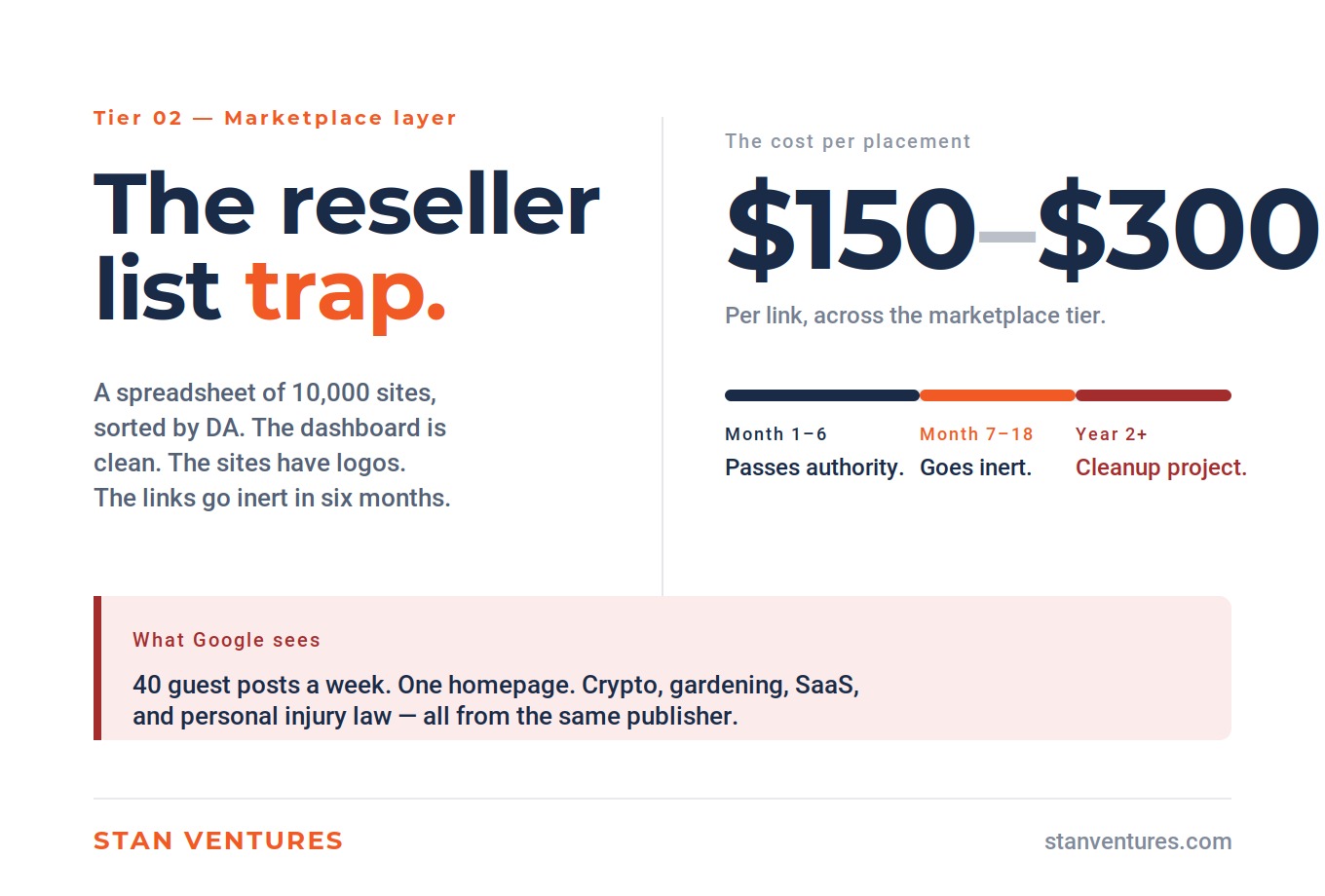
Why it seems safe: The dashboard is clean. The sites have logos and About Us pages. Reports come back fast.
Why it isn’t: Those sites exist almost entirely to sell links. They publish 40 guest posts a week across crypto, gardening, SaaS, and personal injury law, all from one homepage. Google flags this pattern through outbound link velocity and topical scatter, and the value of those links drops sharply once the site’s patterns are identified.
The Consequence: Agencies pay $150–$300 per placement on links that may pass authority for six months, then go inert, or worse, become a cleanup project two years later.
Tier 1: True White Label SEO Partnerships (The Standard to Look For)
This is the only model that holds up under Google’s current quality framework, and the only one that protects the agency’s name long term.
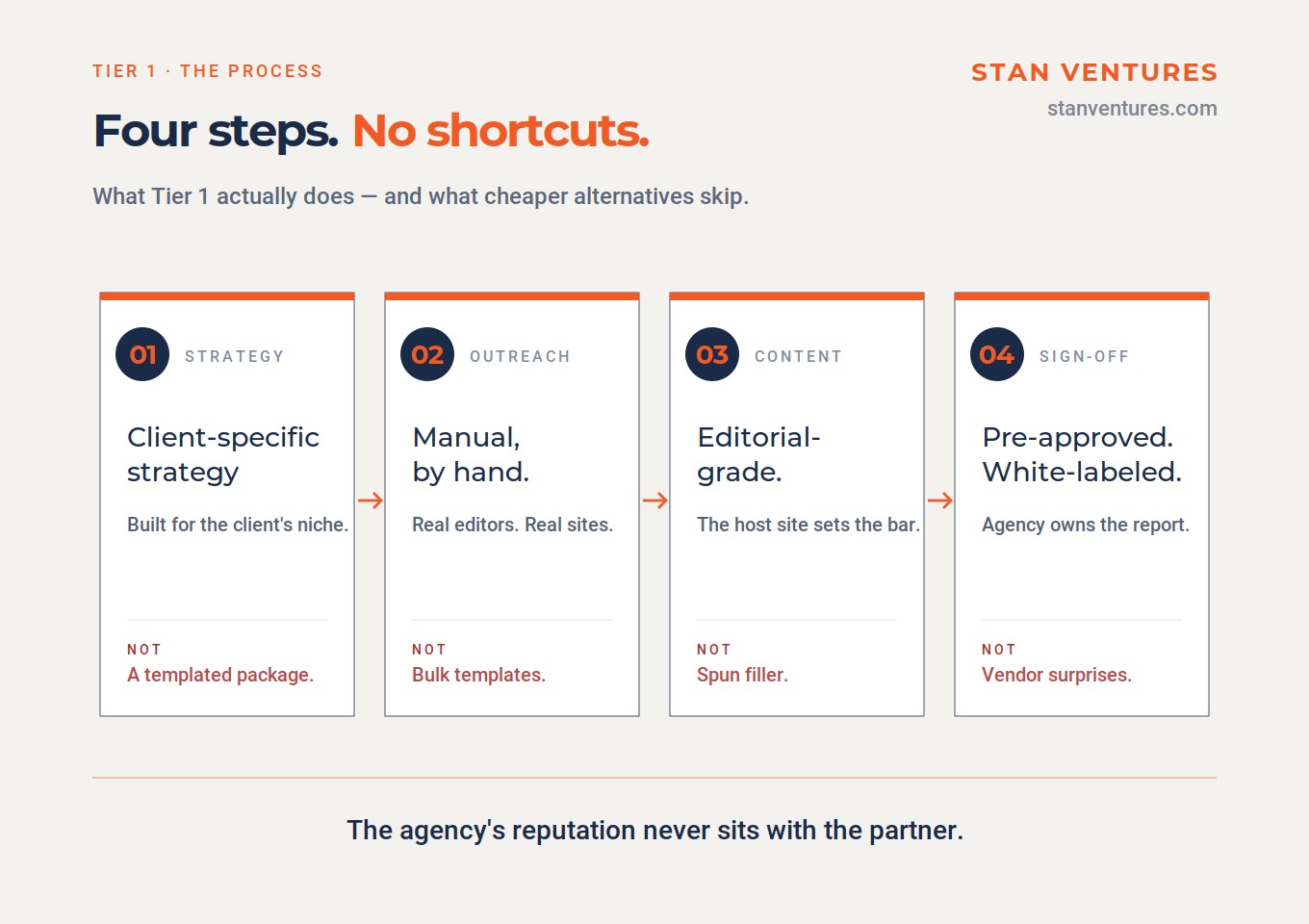
The Process: The partner builds a strategy specific to each client. Outreach is manual to real publishers in the client’s niche. Content meets editorial standards because the host site demands it. Reporting is fully white-labeled, transparent, and pre-approval on each placement is mandatory.
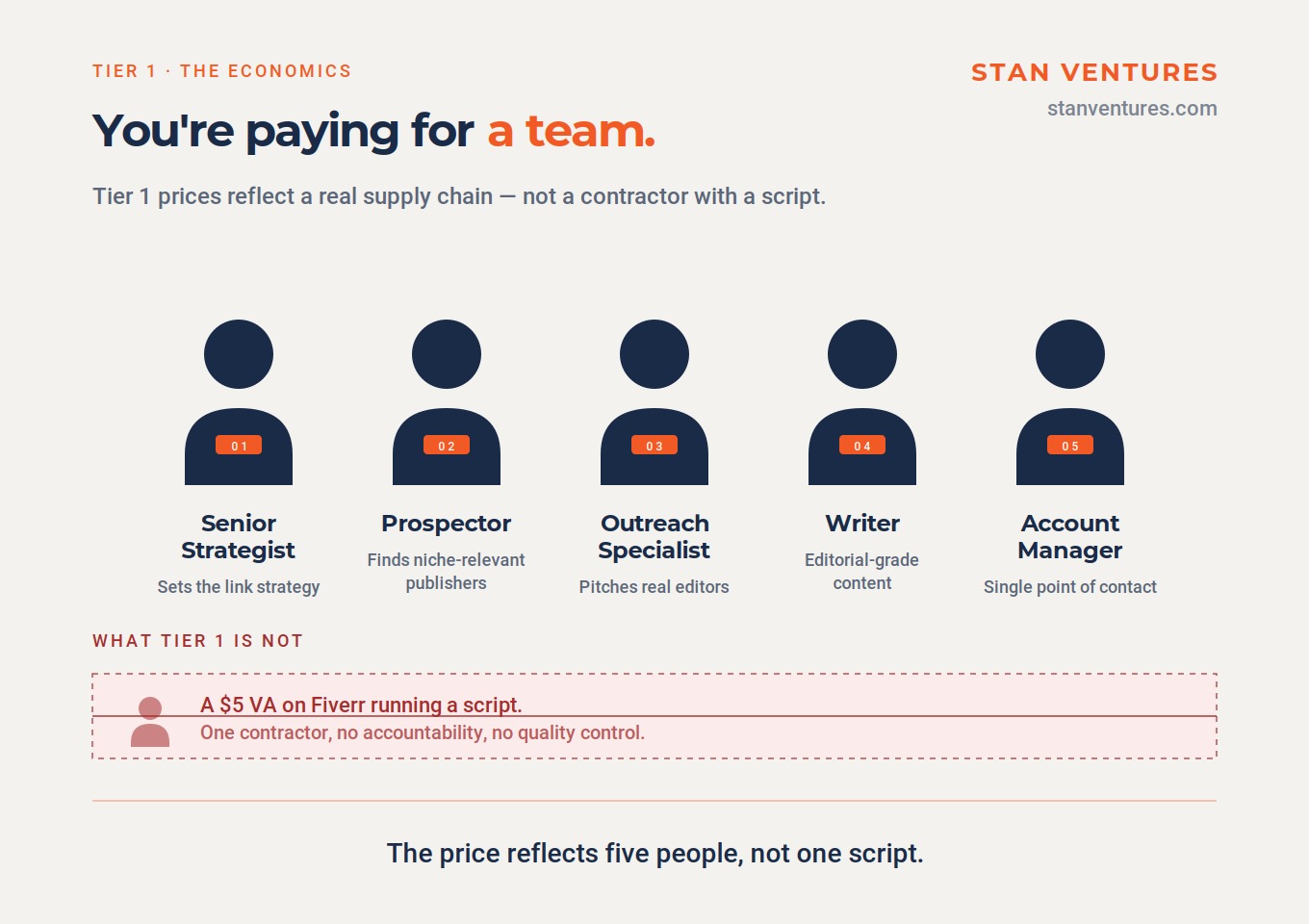
The Economics: The investment covers a real supply chain, including senior strategists, prospectors, outreach specialists, writers, and account managers, not a $5 virtual assistant running a script.
The Result: Contextual backlinks on real sites with real audiences. Reports the agency can hand to a client without flinching. A partnership that survives Google updates instead of breaking on them.
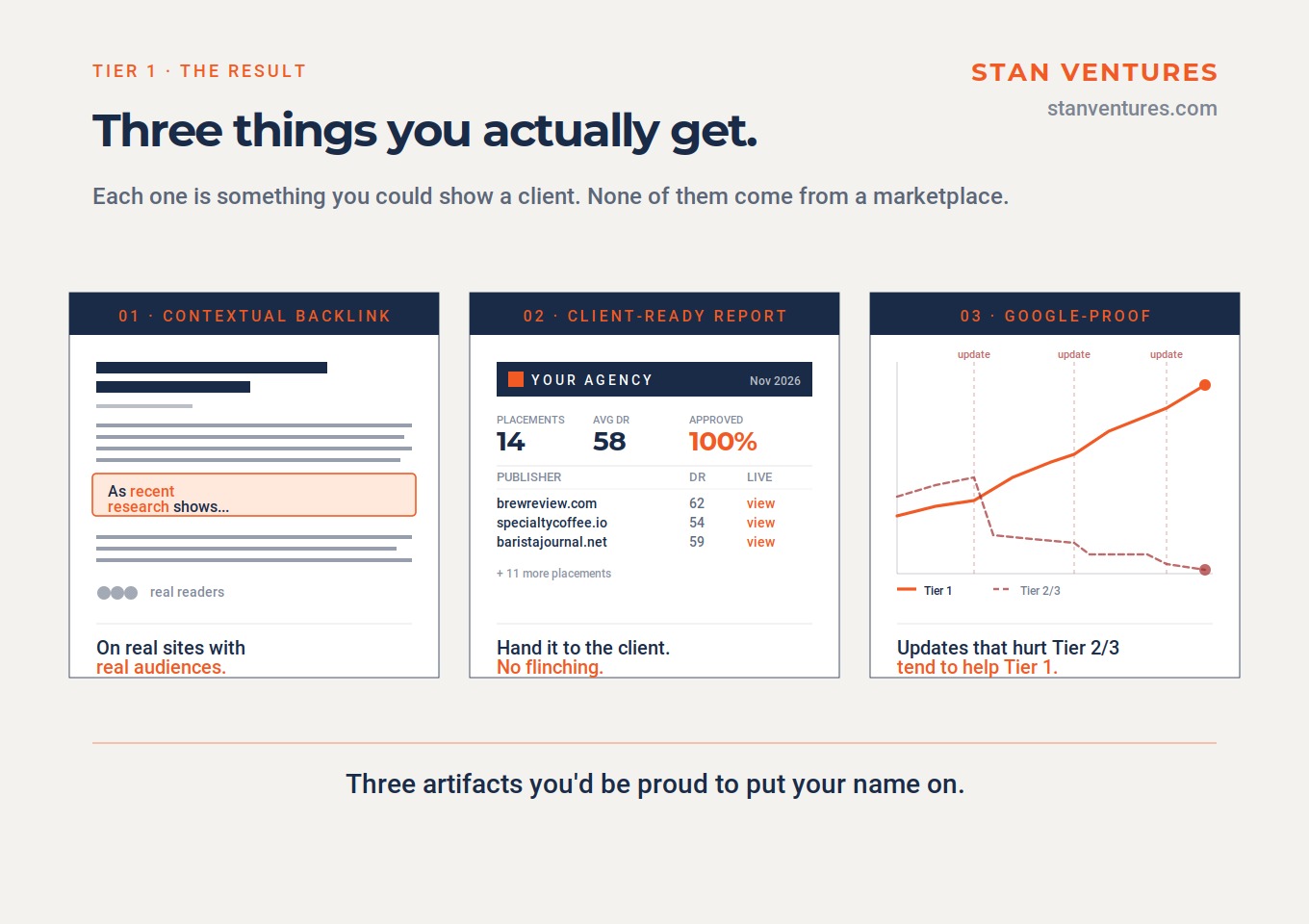
This is the tier that matters. Everything in the rest of this guide is about how to identify a Tier 1 partner before signing anything.
The Vetting Framework: How to Audit a White Label SEO Partner
Choosing a white label SEO partner is structurally similar to choosing a co-founder. The partner doesn’t have the agency’s name on the door, but they shape the work the agency’s name appears on.
A single weak campaign, including bad links on a flagship client, a sloppy audit, a leaked email from the partner’s domain, can undo years of brand building.
The following seven-point framework is the audit Stan Ventures applies internally when evaluating fulfillment partners for its own subcontracting needs. Applied honestly, it surfaces almost every problem before the contract gets signed.
1. Transparency on the Actual Work
DR, “team size,” and case studies are surface-level signals. The real test is whether the agency can see, in real time, what the partner is doing.
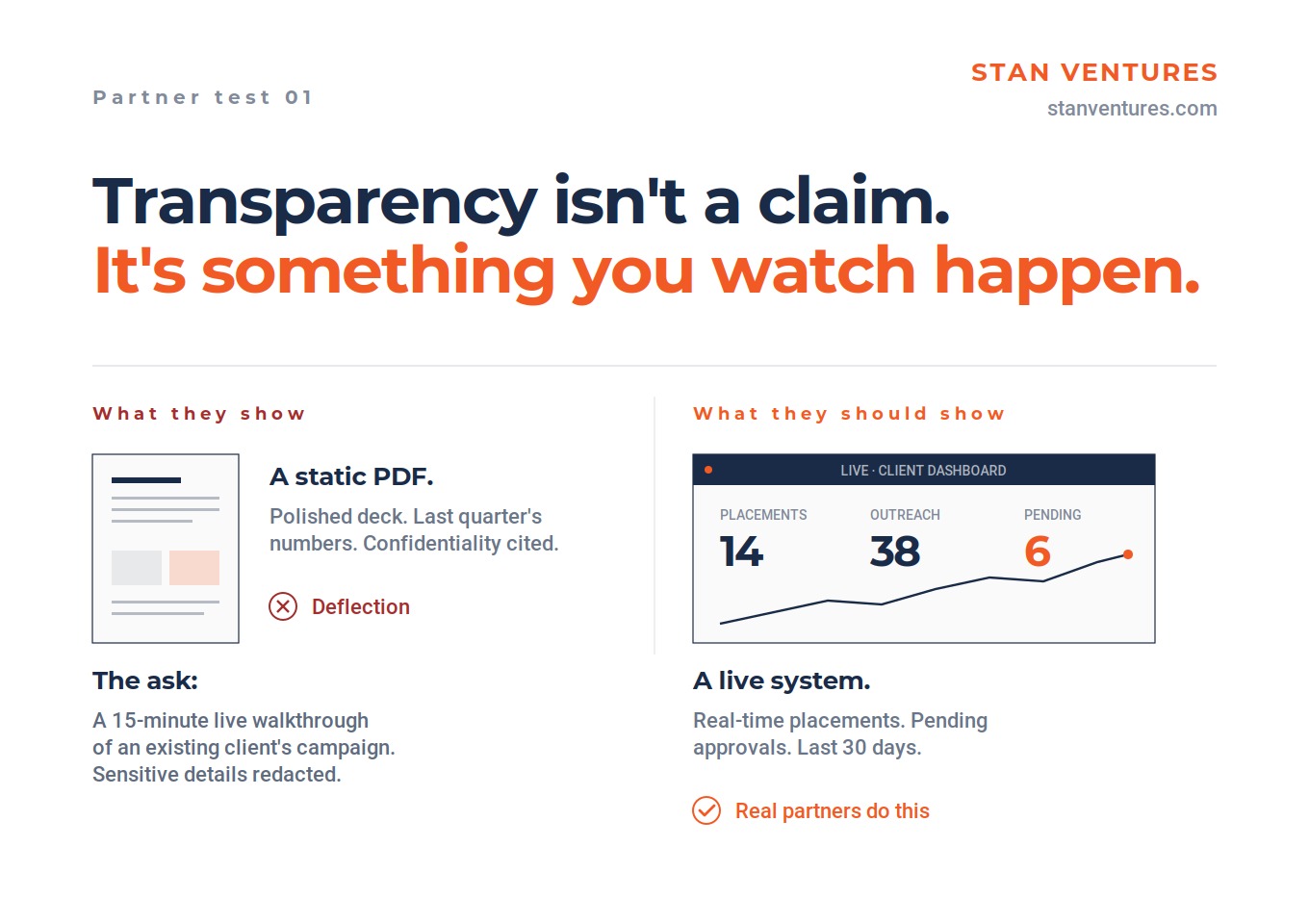
The Rule: Before signing anything, the agency should be able to see a live dashboard of an existing client (with sensitive details redacted), a recent strategy doc, and a real monthly report from the last 30 days.
How to Check: Ask for a 15-minute live walkthrough of a current client’s campaign. Real partners do this. Black-box providers send a static PDF, deflect, or quote a “confidentiality” reason that doesn’t survive scrutiny. The deflection itself is the answer.
2. Communication SLAs and the “Who Picks Up” Test
Vague answers about turnaround time are a red flag. Real SLAs are specific: response within X business hours, draft delivery within Y days, monthly reporting by the Zth of every month, with a named account manager, not a shared inbox.
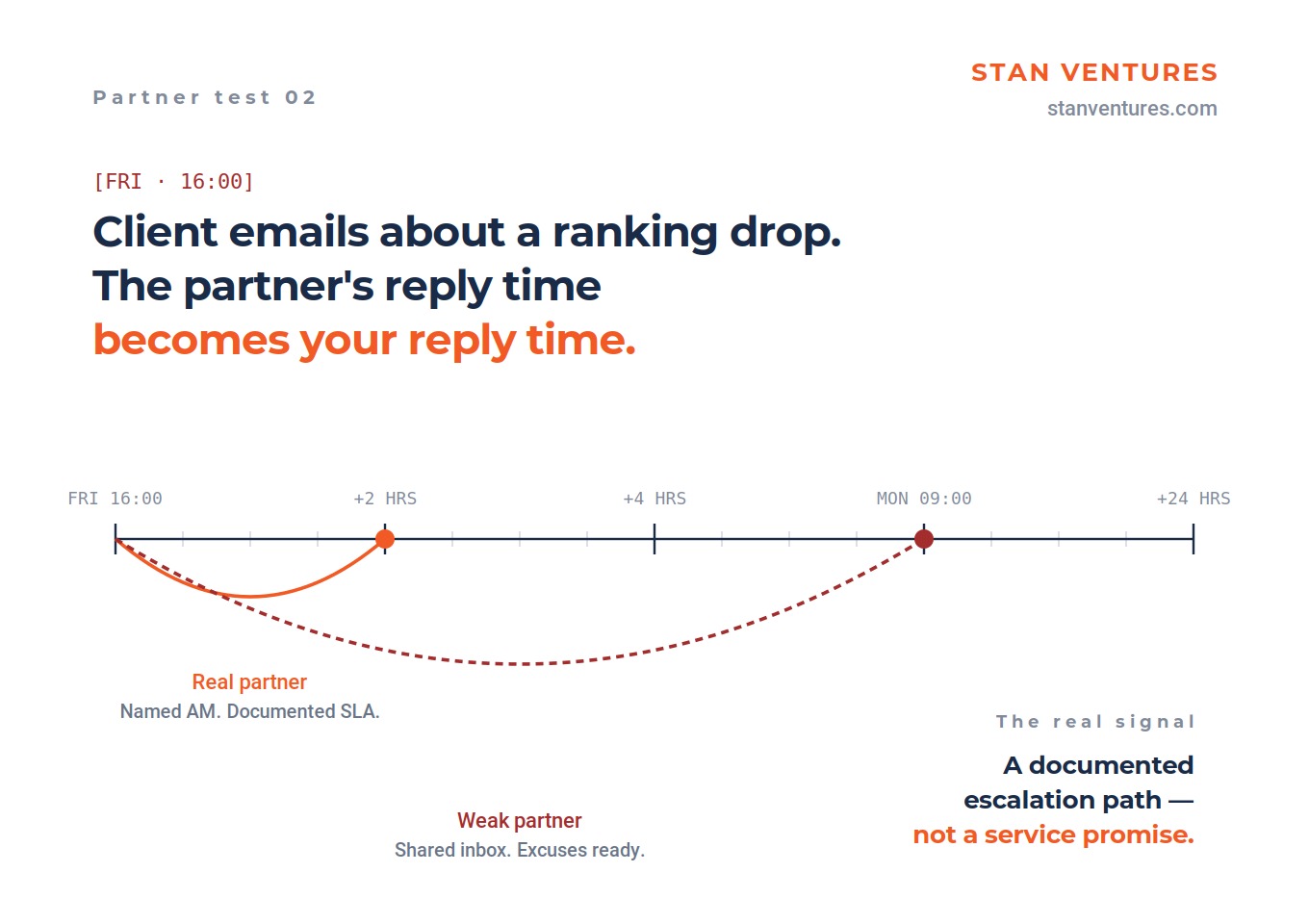
The Quality Standard: Ask what happens when an SLA gets missed. Real partners have a service credit policy. Weak ones have excuses ready. The presence of a documented escalation path is the actual signal.
For agencies, this matters most during client crises. When a client emails Friday at 4pm with a ranking drop, the white label partner’s response time becomes the agency’s response time. There is no buffer.
3. White Label Depth (Beyond a Logo Swap)
Surface-level white labeling means the report has the agency’s logo on it. Deep white labeling means:
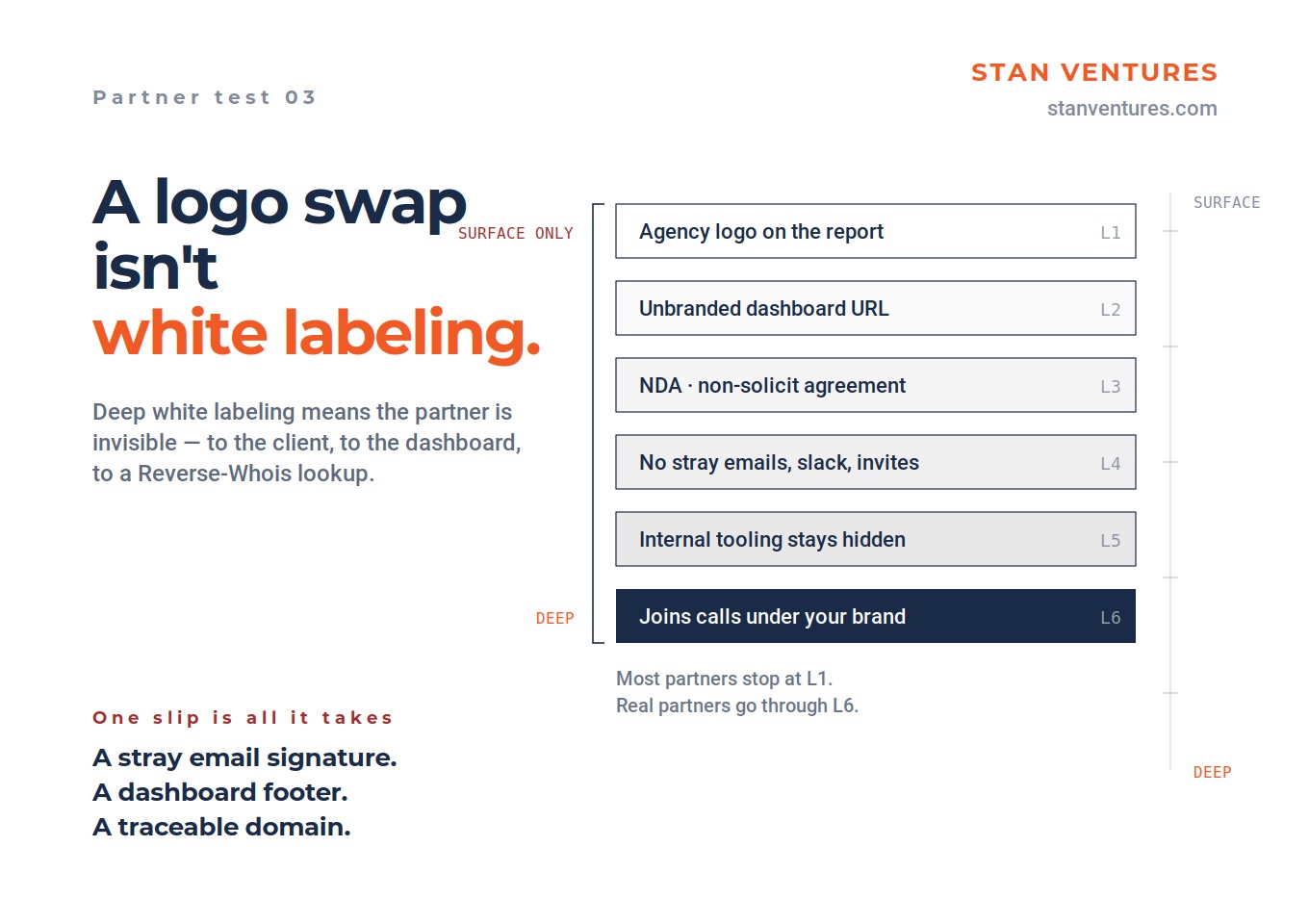
- Reports are fully unbranded down to the URL of the dashboard the agency shares with clients
- The partner signs an NDA and a non-solicitation agreement before any work starts
- The partner never appears in client communications; no stray emails, no Slack notifications, no calendar invites
- Internal tooling and project management remain invisible to the end client
- The partner can join client calls under the agency’s brand if requested
The wrong partner shows up in the email signature, in the dashboard footer, or in a domain that Reverse-Whois ties back to them. Once is all it takes for a sharp client to figure out what’s happening.
4. Strategy Capability: Do They Think, Or Just Execute?
This is the biggest differentiator between a $1,000/month link builder and a $5,000/month true white label SEO partner.
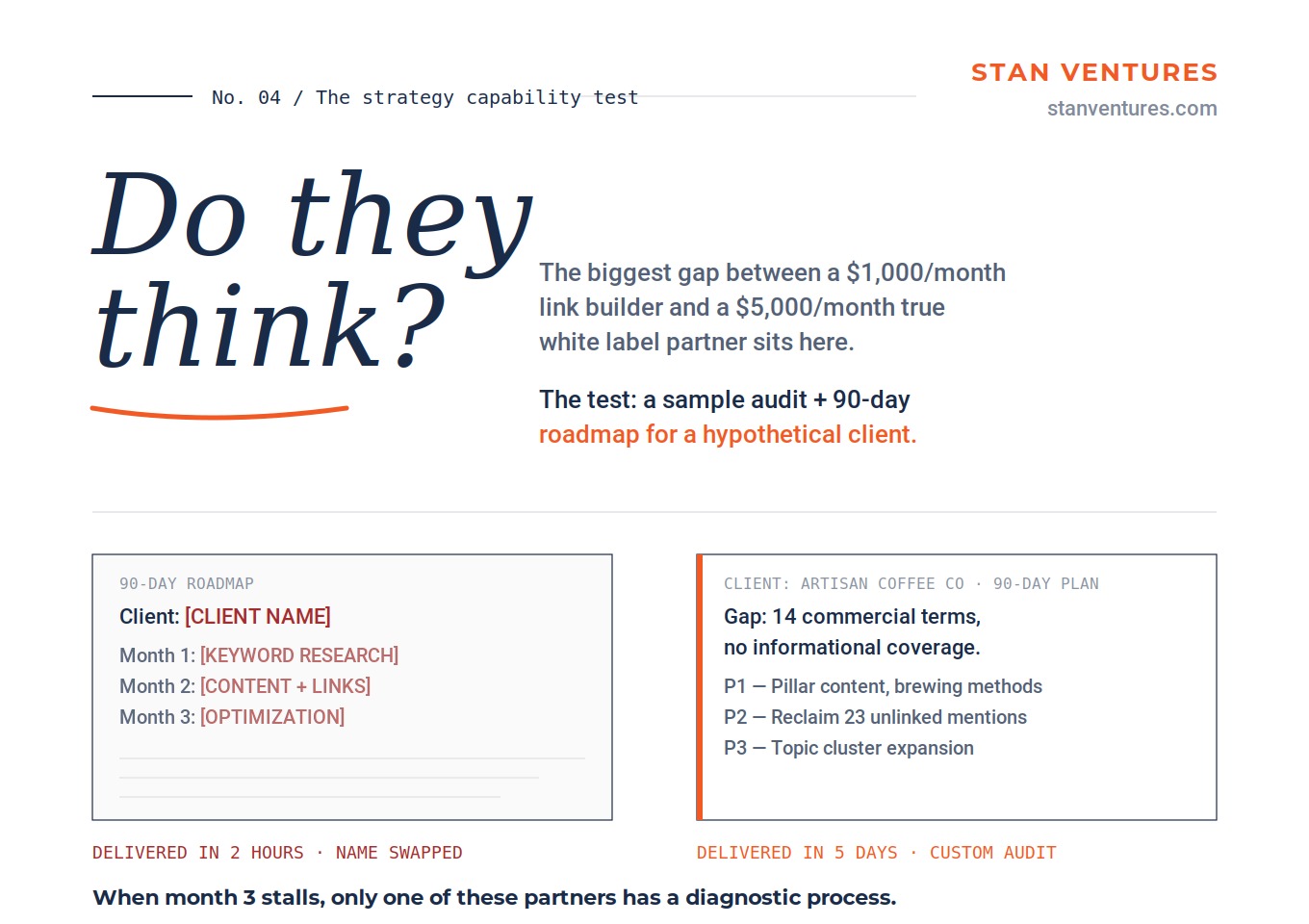
The Audit: Ask the partner to produce a sample audit and 90-day roadmap for a hypothetical client in a vertical they’ve worked in. A strategic partner produces something usable. An execution-only shop swaps the client’s name into a template and sends it back within hours.
The Verdict: Strategy capability matters most when a campaign doesn’t go to plan. When rankings stall in month three, an execution-only partner has no answer. A strategic partner has a diagnostic process: a content gap reanalysis, a backlink audit, an updated keyword roadmap.
5. Link Quality Standards and Source Networks
For white label SEO arrangements that include link building, this is the criterion that protects the client’s site from manual actions and algorithmic dampening.
Specifically, the agency should ask:
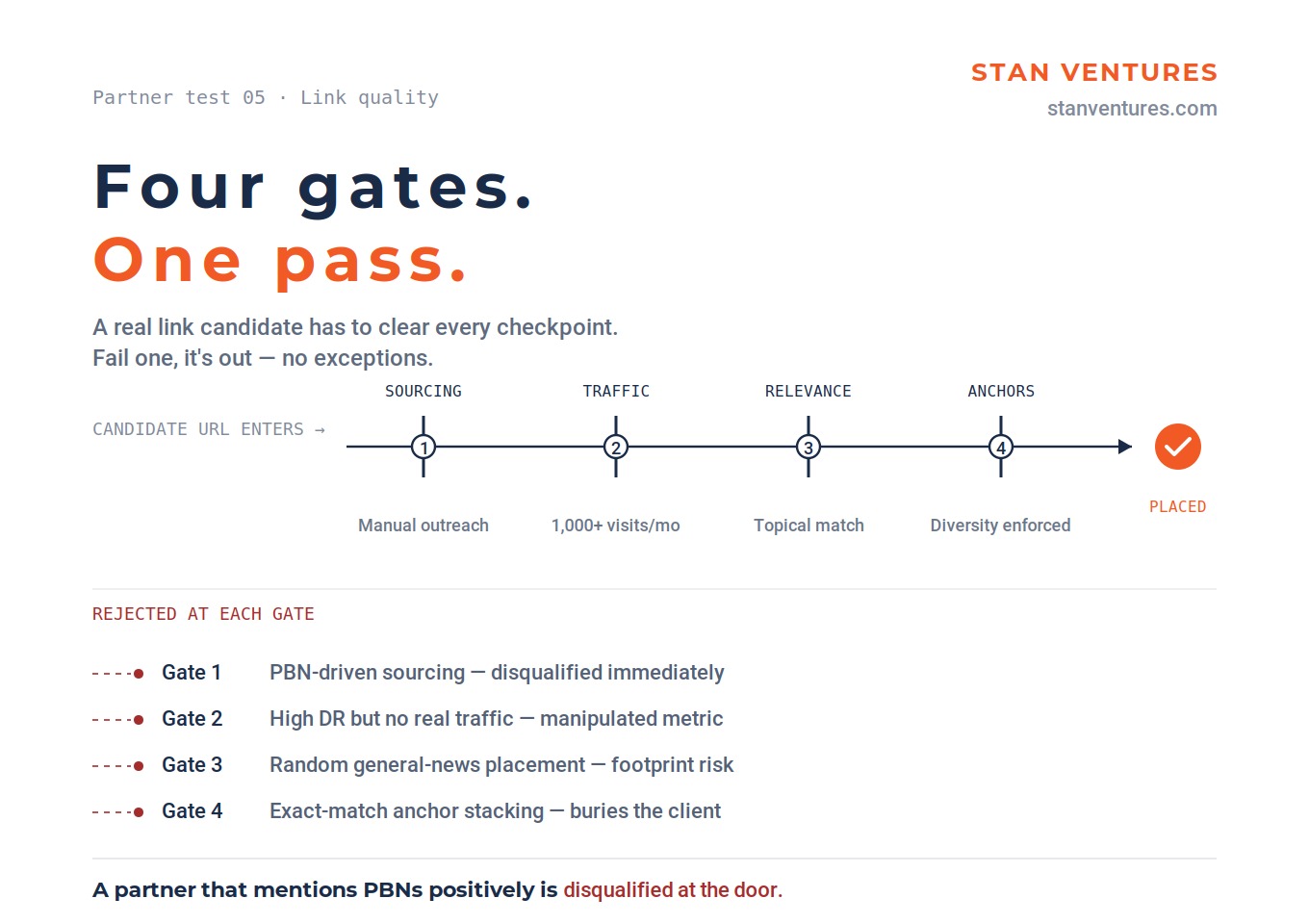
- Sourcing method: Manual outreach to real publishers? Editorial placements? PBN-driven? A partner that mentions PBNs in a positive light is disqualified immediately.
- DR and traffic thresholds: What’s the floor? Tier 1 partners enforce minimum organic traffic (usually 1,000+ monthly visits) alongside DR signals. DR alone is a manipulated metric.
- Niche relevance: Are placements topically aligned with the client’s industry? Random general-news placements on high-DR sites are a footprint risk.
- Anchor text policy: A partner that lets the agency over-optimize anchors (exact-match heavy) is going to bury a client. Strong partners enforce diversity proactively.
Google’s own link spam policies are the most authoritative reference here. Any partner whose practices contradict the spam policy guidance is offering short-term ranking lifts in exchange for long-term penalty risk on the client’s site.
Agencies specifically vetting white label link building services for SEO agencies should walk through the partner’s source list and publisher screening process line by line during the pilot.
6. Scalability Without Quality Drop
A partner that handles three clients well isn’t necessarily one that can handle 30. Scaling failures usually show up around the 6–12 month mark, when the agency’s order volume outpaces the partner’s hiring or operational capacity.
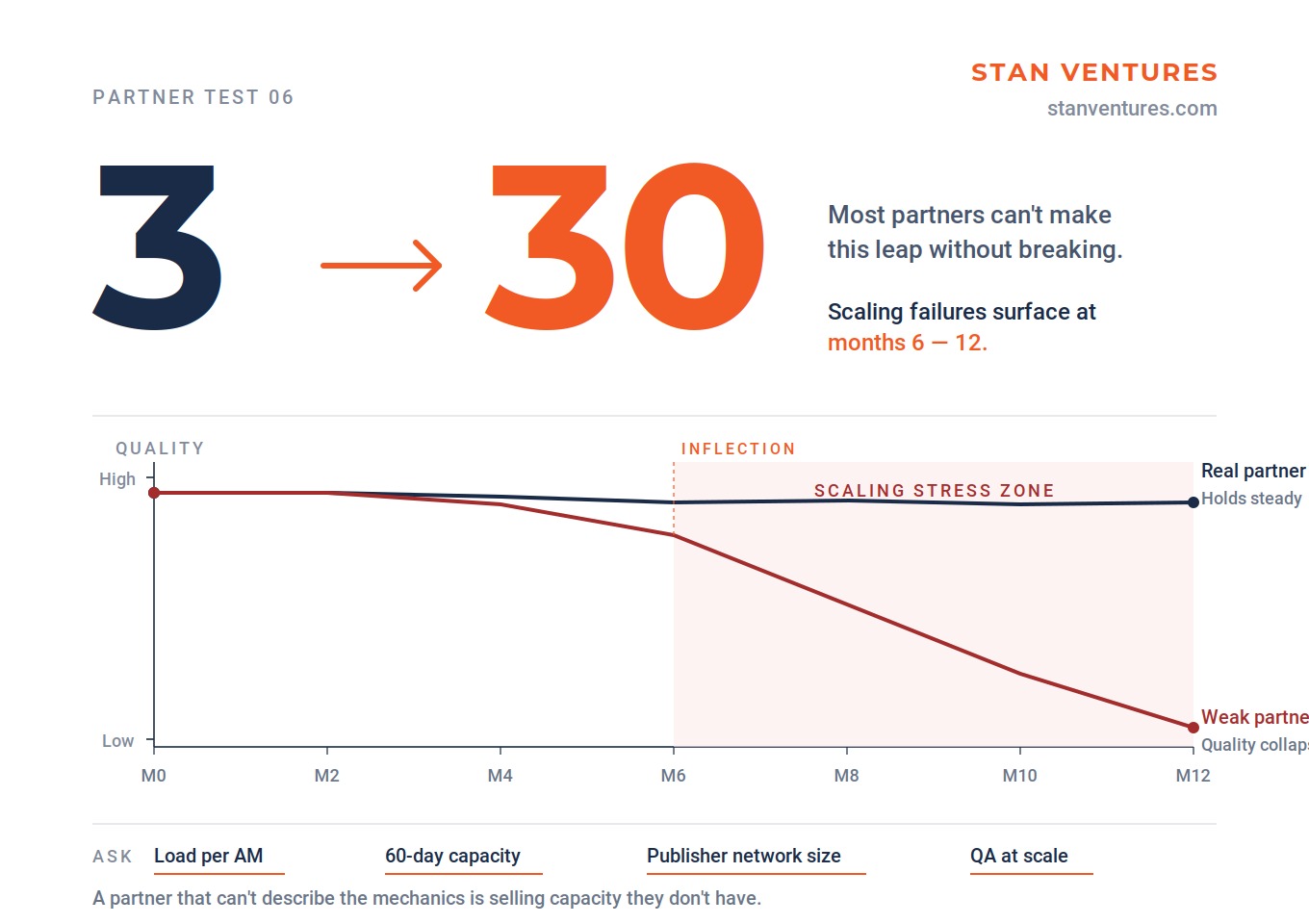
The Audit Questions:
- What’s the current client load per account manager?
- How fast can capacity scale if the agency triples its order volume in 60 days?
- For white label link building specifically: what’s the size of the publisher network? Under 5,000 publishers is thin and will hit relevance ceilings quickly.
- How is quality maintained as volume grows? What’s the QA process at scale?
The honest answer matters more than the optimistic one. A partner that says “we can scale to anything” without describing the operational mechanics is selling capacity they don’t have.
7. Pricing Model and Margin Visibility
Three pricing structures dominate white label SEO:
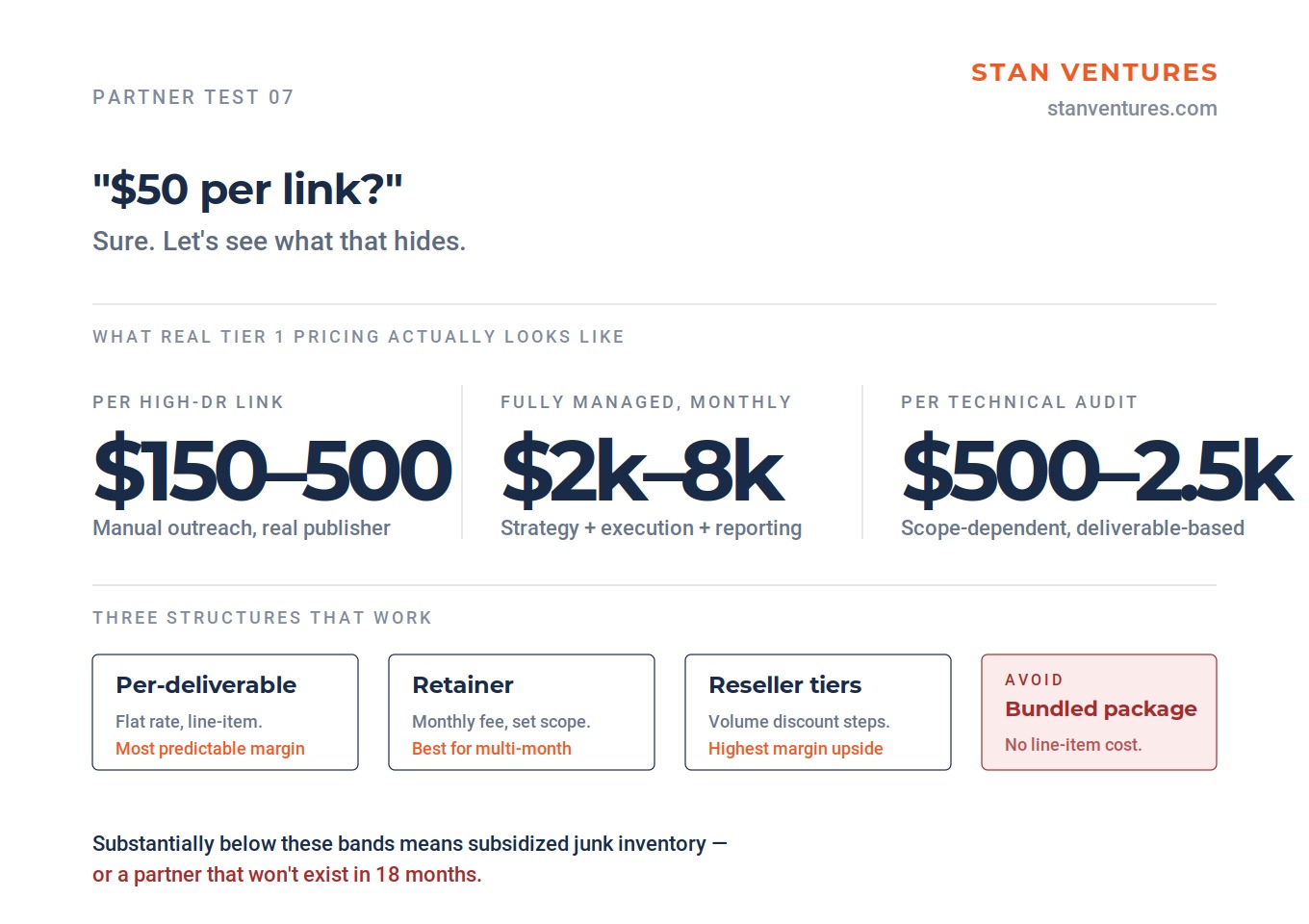
Per-deliverable. Flat rate per link, content piece, or audit. Simplest for the agency, most predictable for margin forecasting. Common in white label link building and content production.
Retainer. Monthly fee covering a defined scope. Common in fully managed white label SEO arrangements. Better for multi-month campaigns, but harder to flex up or down with client churn.
Reseller tiers. Volume-commitment pricing with discount steps. Highest margin potential, but the agency carries the volume risk if client retention slips.
The pricing structure to avoid: Bundled packages with no line-item visibility. If the agency can’t see what each component costs, it can’t negotiate, optimize, or selectively replace components when one underperforms. Opacity in pricing almost always correlates with opacity everywhere else.
For benchmarking purposes: White label SEO pricing for established Tier 1 partners typically falls between $150 and $500 per high-authority link placement, between $2,000 and $8,000 per month for fully managed retainers, and between $500 and $2,500 per technical audit, depending on scope and client complexity. Substantially below those bands almost always means subsidized junk inventory or a partner that won’t exist in 18 months.
Red Flags That End the Conversation
Some signals don’t need a framework. They’re deal-breakers. If a prospective white label SEO partner shows any of these on the discovery call, the conversation should end politely:
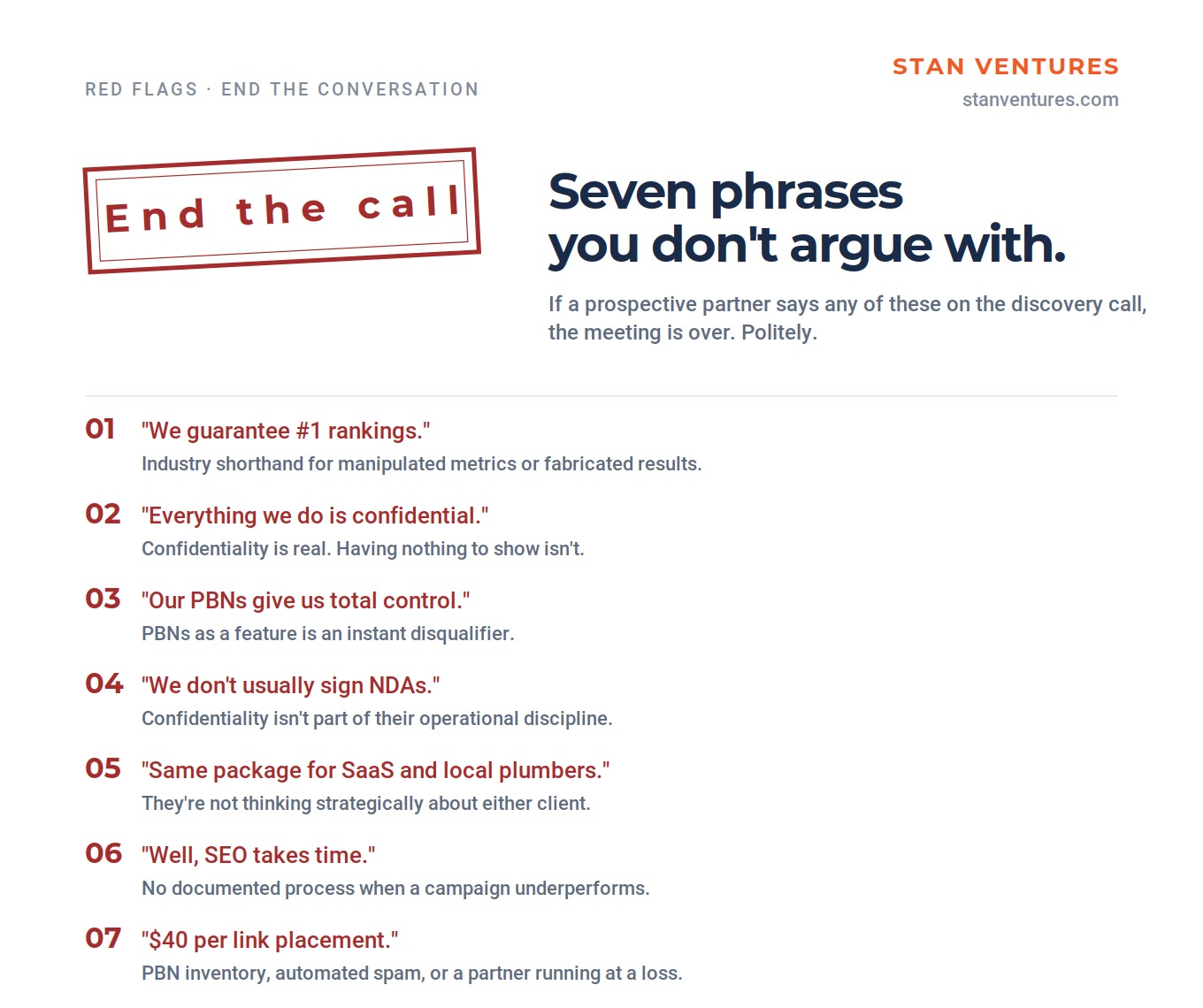
Guaranteed rankings or traffic numbers: No legitimate SEO provider guarantees a Google position. The phrase “we guarantee #1 rankings” is industry shorthand for “we’re going to manipulate metrics or fabricate results.” Google addresses this directly in its SEO starter guide and warns against any provider promising specific positions.
No real case studies, no references, no recent work samples: A partner that’s been operating for more than 12 months should have real client work to show, even with names redacted. If everything is “confidential,” it’s usually because there’s nothing to show.
PBNs described as a feature: Self-explanatory. The presence of PBN methodology in a pitch deck is a disqualification.
No NDA, no non-solicitation clause: A partner unwilling to sign an NDA is signaling that confidentiality isn’t part of their operational discipline. A partner unwilling to sign non-solicitation is positioning to poach the agency’s clients later, which happens more often than newer agency owners assume.
One-size-fits-all packages with no flex: SEO doesn’t work in one-size-fits-all. A partner that sells the same package to a SaaS company and a local plumber isn’t thinking strategically about either.
No process for underperformance: Ask: “What happens if the campaign isn’t producing results after 90 days?” Real partners have a documented response: audit, strategy revision, scope adjustment, service credit. Weak ones say “well, SEO takes time.”
Pricing far below market norms: If white label link building is offered at $40 per placement, the math doesn’t work. Either the links are PBN inventory, the outreach is automated spam, or the partner is operating at a loss they can’t sustain. None of those outcomes are good for the agency.
The Economics of a Real White Label SEO Partnership
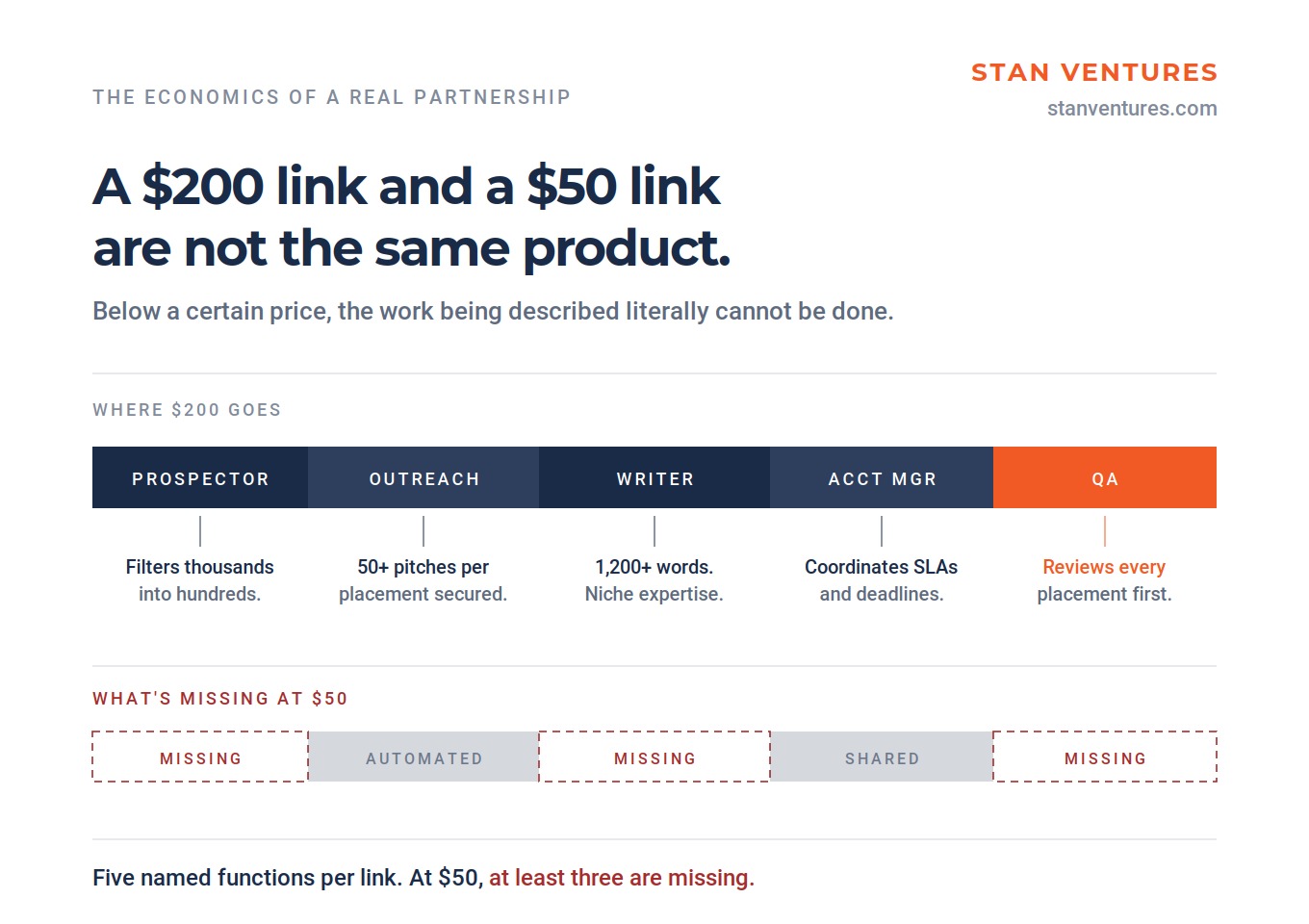
One of the most common questions agency owners ask is: “Why does a real white label arrangement cost $200+ per link, when other providers offer them for $50?”
The answer is the same one that applies to almost every fulfillment industry. Below a certain price point, the work being described literally cannot be done.
What the Real Cost Covers
When working with a Tier 1 white label SEO partner, the fee covers a dedicated supply chain of professionals:
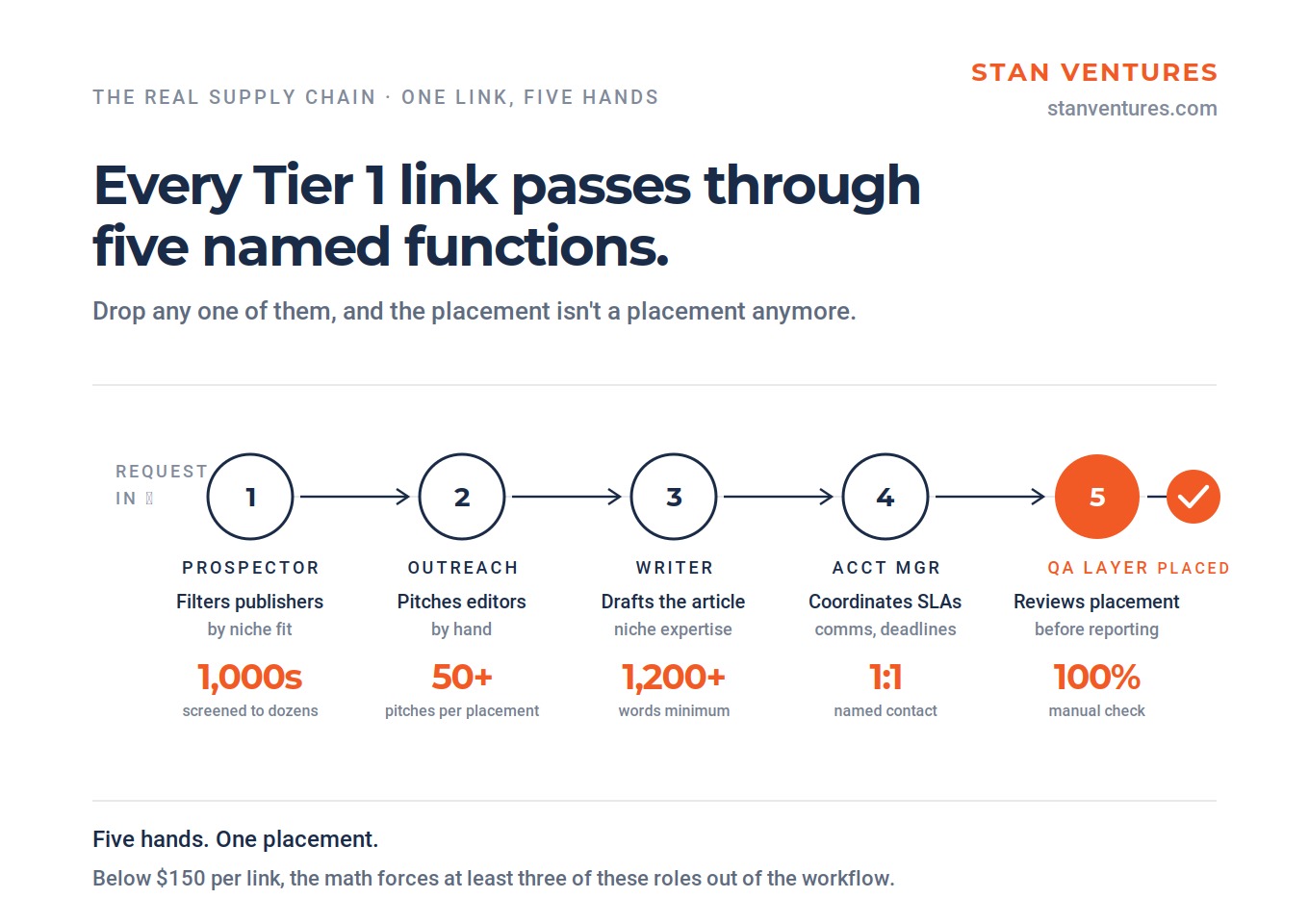
The Prospector: Uses advanced tools to filter thousands of potential publishers down to the few hundred that pass relevance, traffic, and quality screens for a specific niche.
The Outreach Specialist: Crafts personalized pitches to editors. Cold outreach in 2026 typically converts below 5%, meaning real partners contact 50+ publishers for every secured placement.
The Content Writer: Reputable blogs don’t accept AI-generated or low-effort content. They require 1,200+ word articles with genuine niche expertise and original insight.
The Account Manager: Coordinates the campaign across multiple clients, handles communication with the agency, and ensures SLAs are met.
The QA Layer: Reviews every placement against quality thresholds before it gets reported to the agency.
That’s five named functions per link. Below $150 a placement, at least three of those functions are missing.
The Hidden Cost of Cheap Fulfillment
If a partner charges $50 per link, the economics don’t support genuine manual outreach. The price almost certainly indicates the link comes from an automated marketplace, a private network, or a low-quality reseller list.
The true cost of those links isn’t the $50. It’s the cleanup later.
Based on 15 years of agency observations, it’s not unusual for site owners to spend a few hundred dollars on cheap link building, then incur five-figure costs in audit, disavow, and recovery work after a Google update catches up with them. The “affordable” route is consistently the most expensive SEO mistake an agency can make on a client’s behalf.
When the agency’s name is the brand the client sees, the partner’s shortcuts become the agency’s reputation problem.
When White Label SEO Actually Makes Sense for an Agency
White label SEO isn’t always the right answer. There are five scenarios where it usually is, and one where it usually isn’t.
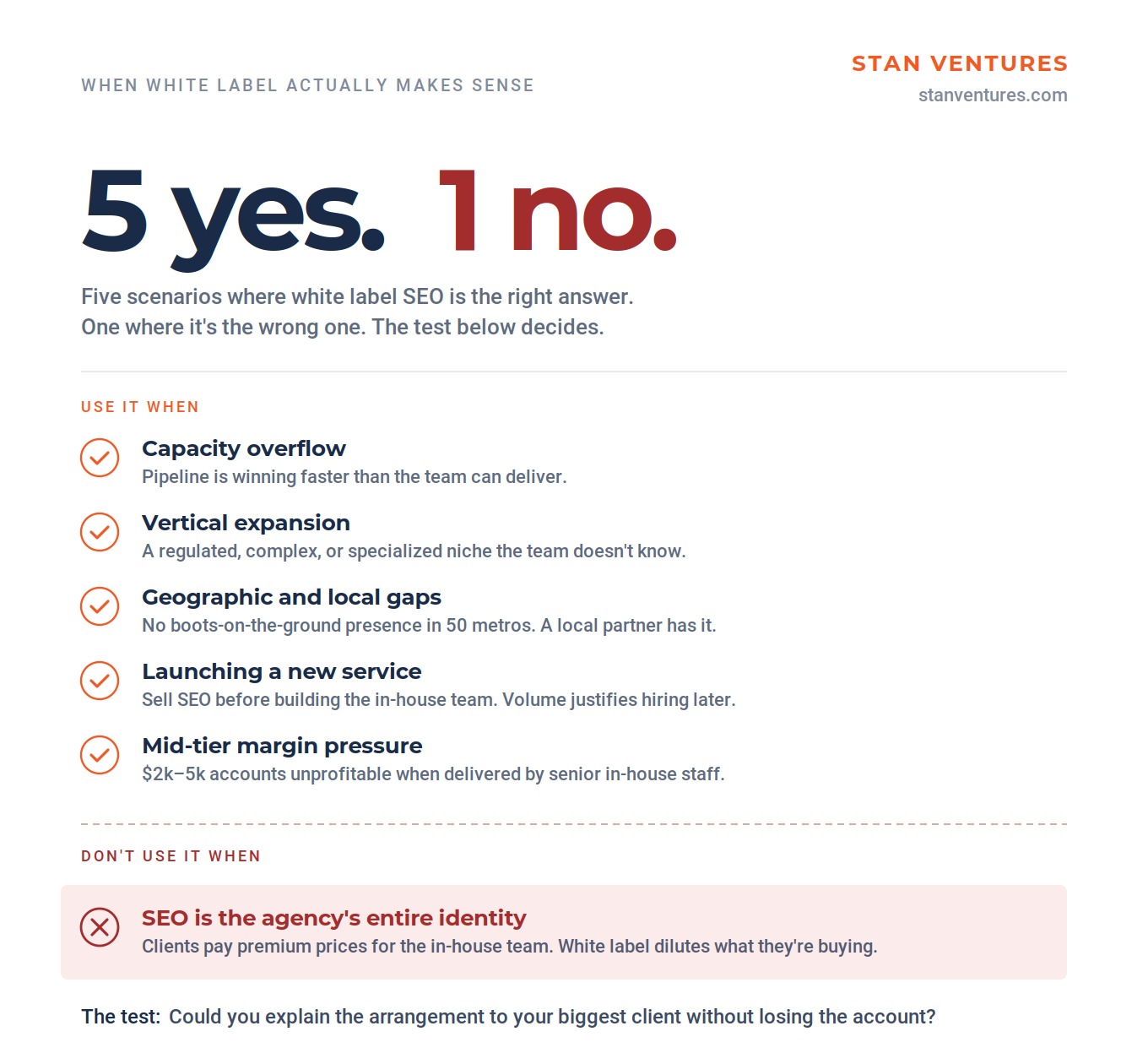
Capacity overflow: The pipeline is winning faster than the team can deliver. Hiring would take 90+ days. A white label partner absorbs the work in two weeks, and the math on a $5,000/month retainer makes the partnership math obvious.
Vertical expansion: A client needs SEO in a niche the team doesn’t know, a regulated industry, a complex B2B vertical, a specialized e-commerce category. The partner brings vertical experience the in-house team would take a year to build internally.
Geographic and local gaps: Local SEO in markets the agency doesn’t operate in: citation building, GBP optimization, regional link sourcing. Most agencies don’t have boots-on-the-ground presence in 50 metros. A white label local SEO partner does. This is one of the most common reasons agencies bring on white label local SEO for agencies. Geography is a real constraint that doesn’t go away with hiring.
Launching a new service offering: The agency wants to add SEO as a service without building a team from zero. A white label partner is the on-ramp: sell first, build the in-house capability later if volume justifies it.
Margin pressure on mid-tier clients: Clients on $2,000–$5,000 retainers are often unprofitable when delivered by senior in-house staff. White label fulfillment can cut delivery cost 40-60% on those accounts while keeping the relationship and the strategy in-house.
The scenario where white label SEO is the wrong move: when SEO is the agency’s entire identity, and clients are paying premium prices specifically for the in-house team’s expertise. In that situation, white label fulfillment dilutes what the client is paying for, and the partnership creates more risk than capacity.
The test is whether the agency could explain the arrangement to its biggest client without losing the account. If the answer is no, it’s the wrong move for that account.
The Tier 1 Process: What a Real White Label SEO Engagement Looks Like
The reference for how a Tier 1 partnership operates day-to-day is worth seeing in detail, because most agency owners have only experienced Tier 2 reseller models. The mechanics are different.
Step 1: Discovery and Niche Analysis
Every engagement starts with a deep analysis of the client’s niche, competitive landscape, and existing SEO footprint, not a generic intake form. The partner reviews the current backlink profile, identifies content gaps, and maps the keyword opportunity before proposing scope.
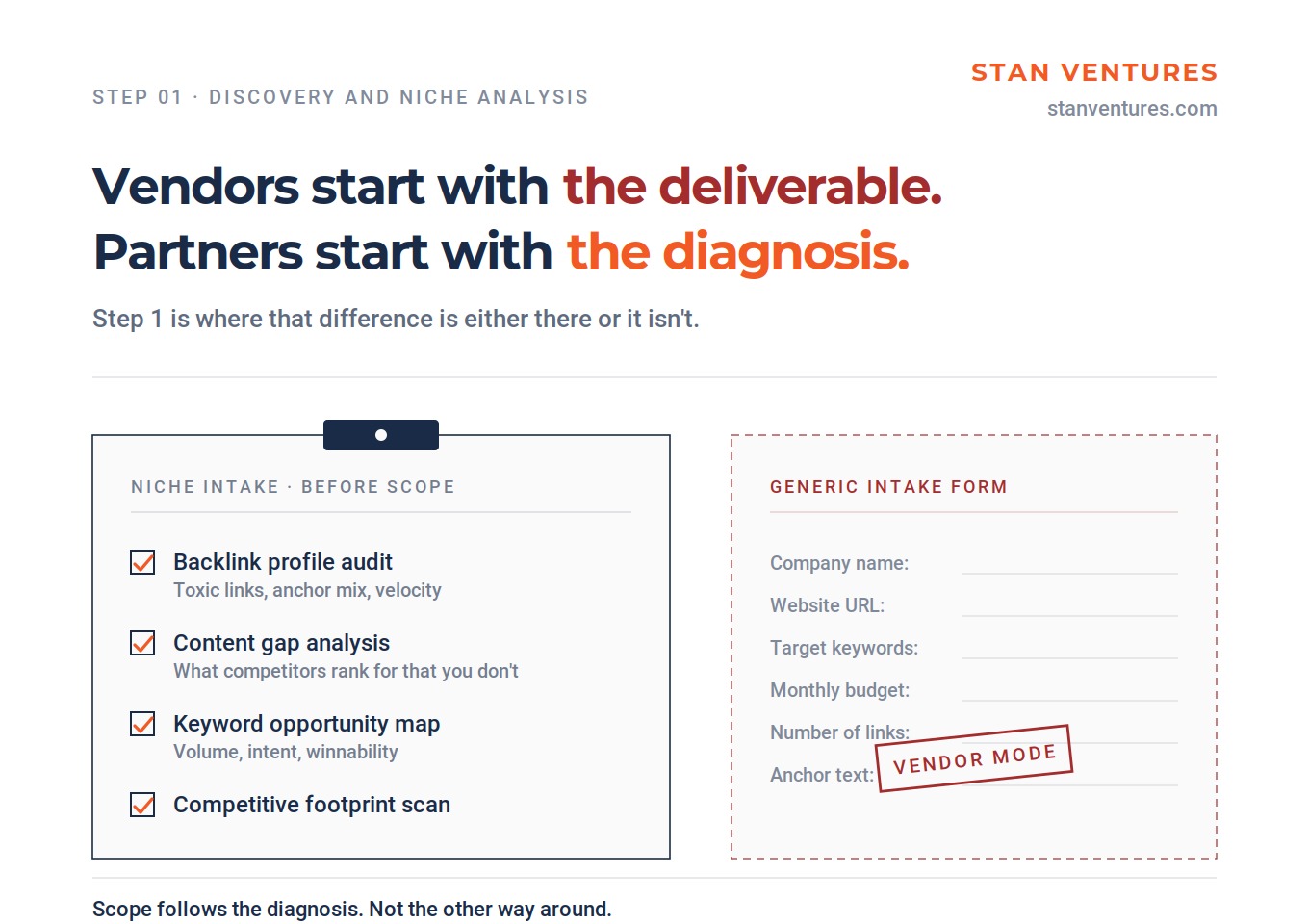
This step is what separates a strategic partnership from a vendor relationship. Vendors start with the deliverable. Partners start with the diagnosis.
Step 2: White-Label Onboarding and Asset Handoff
Before any work begins, the partner receives the agency’s brand voice docs, target keyword lists, target persona profiles, technical access (GA, GSC, CMS), and client communication preferences. The agency receives the partner’s SOPs, escalation contacts, and SLA documentation.
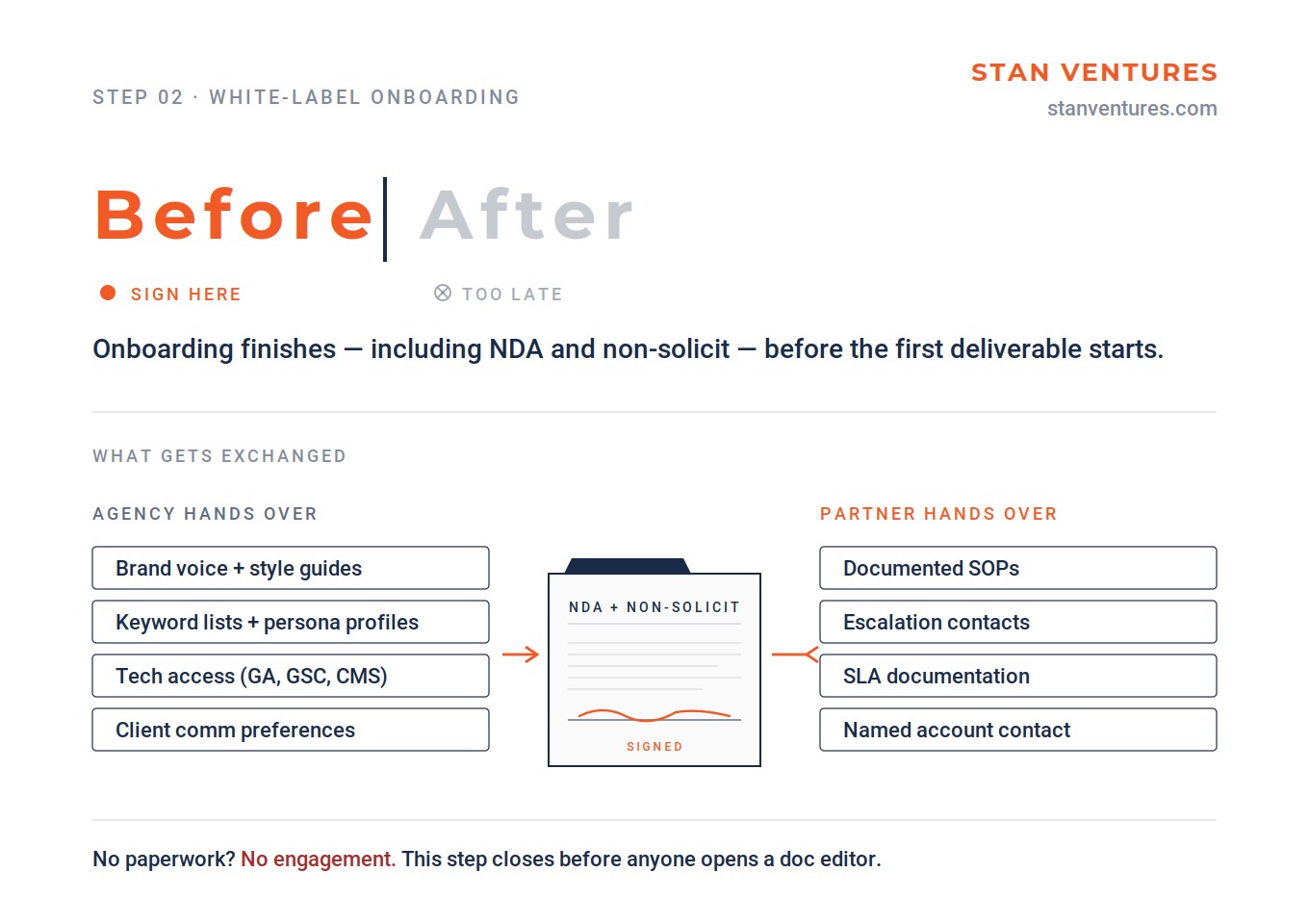
The NDA and non-solicitation paperwork is signed in this step, not after.
Step 3: Manual Outreach and Placement (For Link Building Work)
For white label link building engagements, the partner pitches relevant topics directly to real editors, without automated tools, without bulk templates. Every piece of content is built to be a genuine asset for the host site, meeting current E-E-A-T expectations.
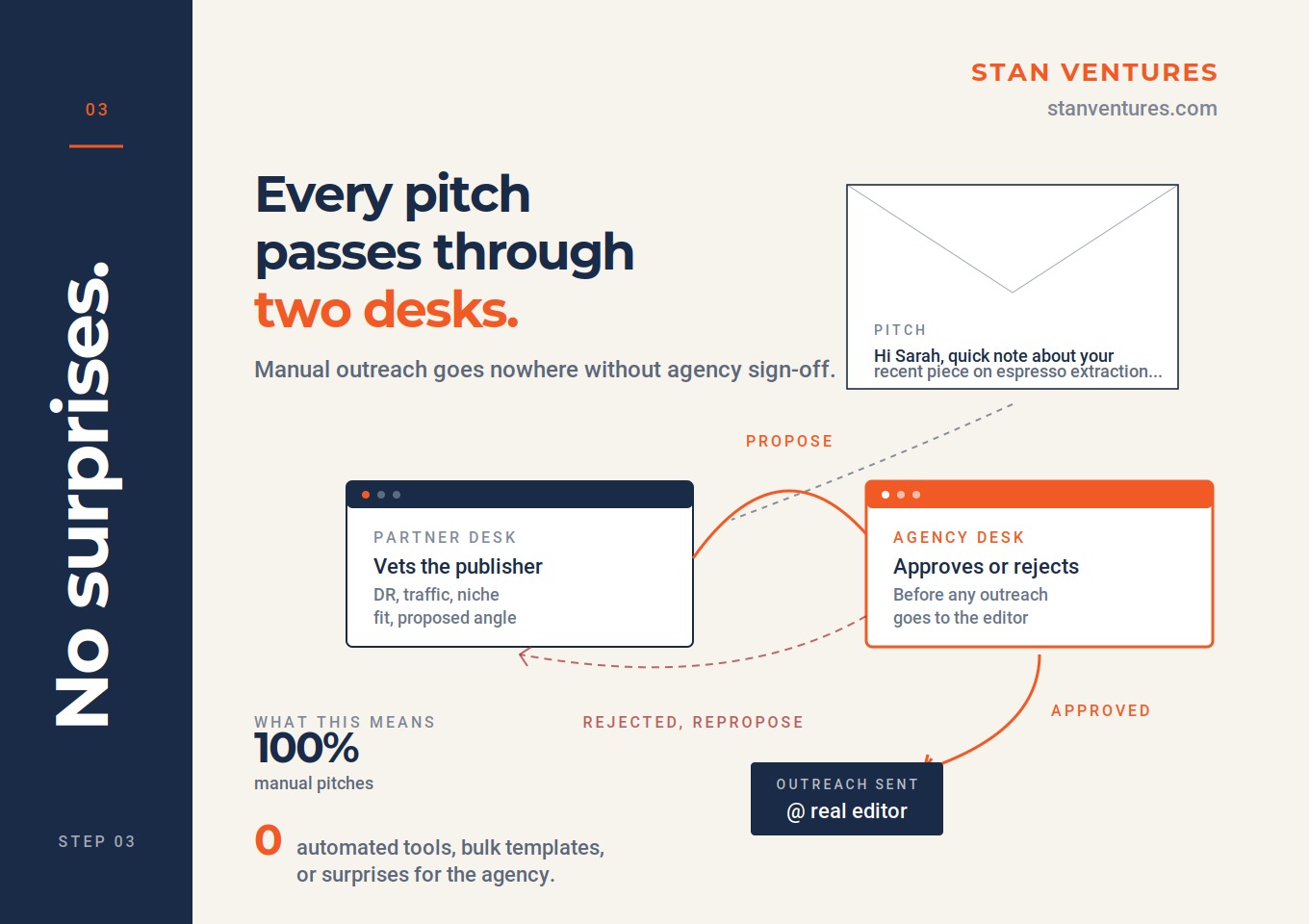
Crucially, every placement gets pre-approved by the agency before outreach goes out. The agency sees the publisher, the metrics, the niche fit, and the proposed angle. No surprises.
Step 4: In-Content Placement, Not Sidebar Filler
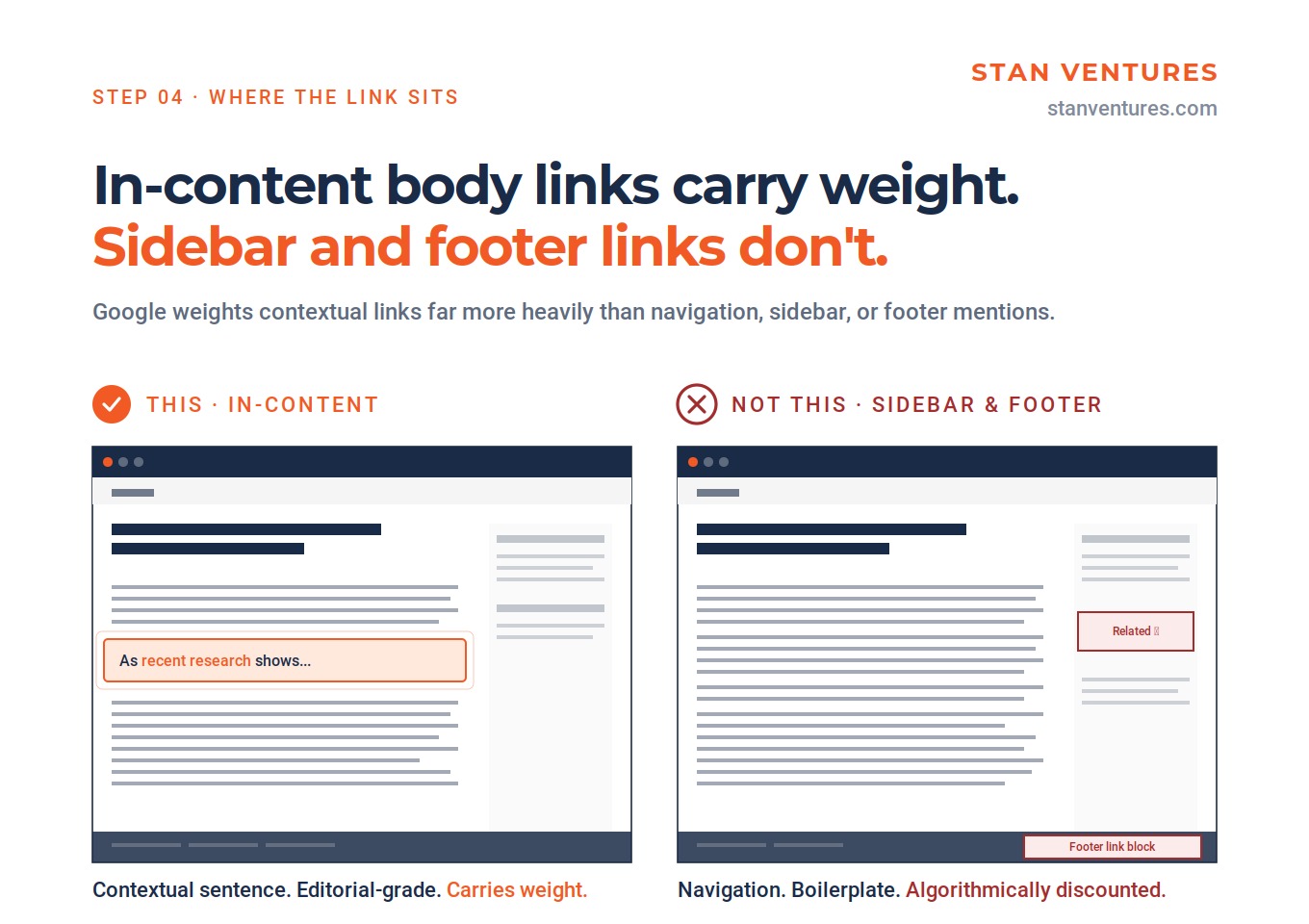
Sidebar and footer placements are avoided. Google weights contextual links within the main body content far more heavily than navigation or sidebar mentions. Tier 1 partners enforce this as a non-negotiable.
Step 5: Transparent Reporting Under the Agency’s Brand
Reports are fully white-labeled. The agency reviews everything, including domain, content draft, anchor placement, SEO metrics, before it goes live. Final reporting confirms exactly what was delivered, with screenshots, live URLs, and the metrics that matter to the client.
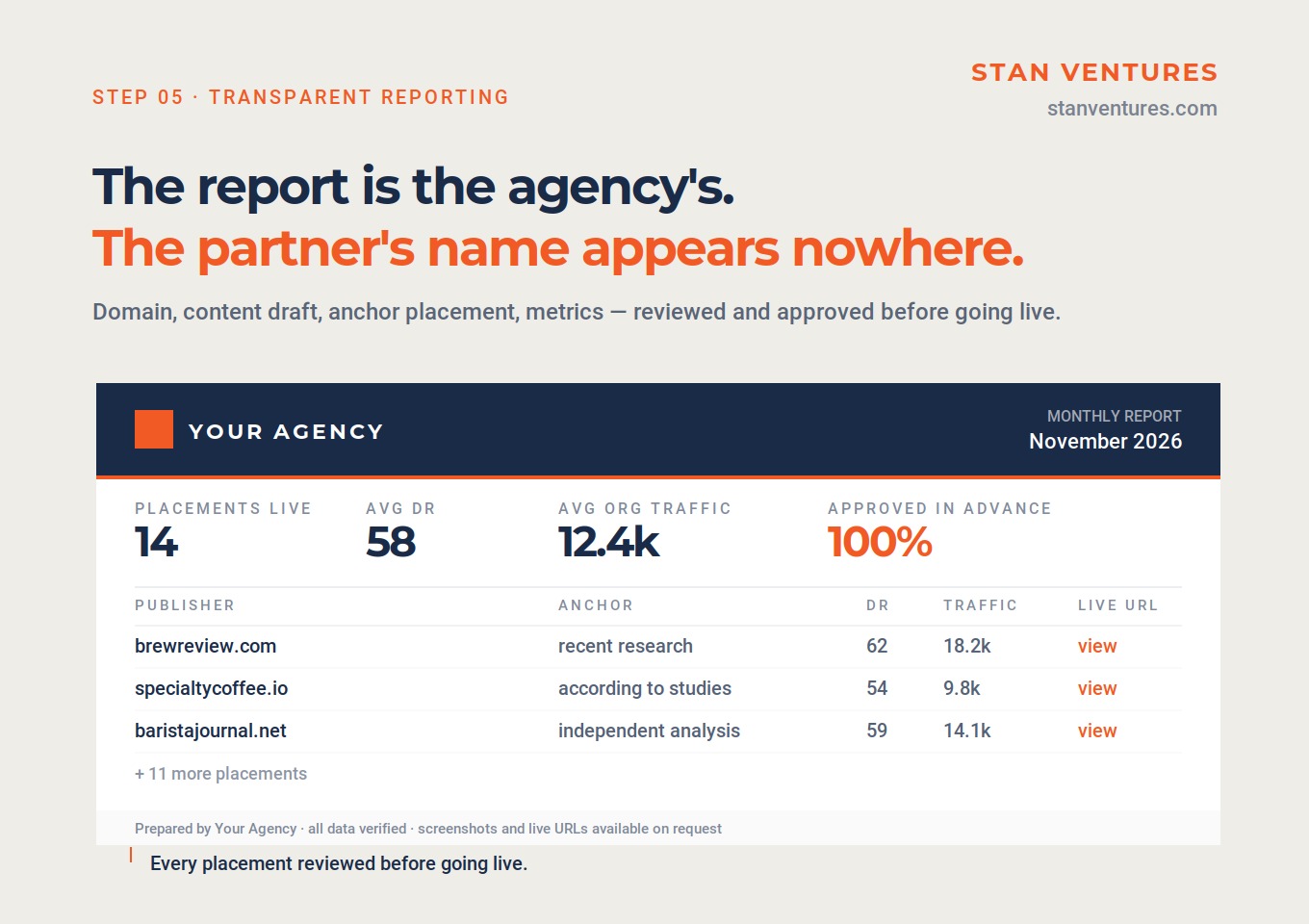
Stan Ventures runs this five-step process by default, and the benefits white label SEO arrangements deliver to agencies compound the most when it’s applied consistently from week one.
How to Test a Partner Before Committing to a Long Engagement
Even with a perfect framework, the only reliable test of a white label SEO partner is a real engagement on a real client. The structured pilot is the single best risk-management tool an agency has.
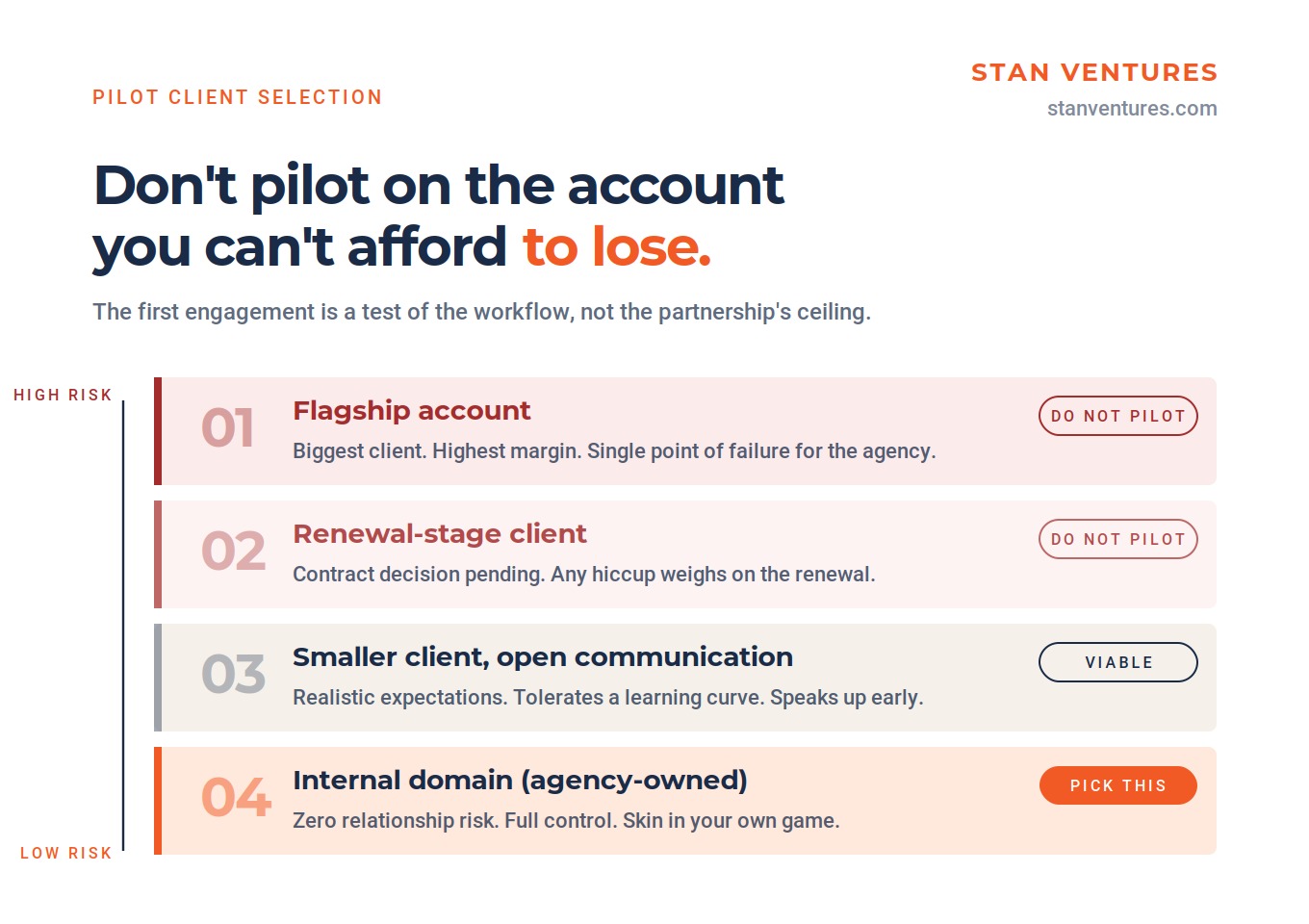
Pick a Low-Risk Client (Or an Internal Domain)
The pilot client should not be a flagship account, a renewal-stage client, or a relationship-sensitive client. Either an internal domain owned by the agency or a smaller client with realistic expectations and an open communication style.
Define a Specific 60–90 Day Scope
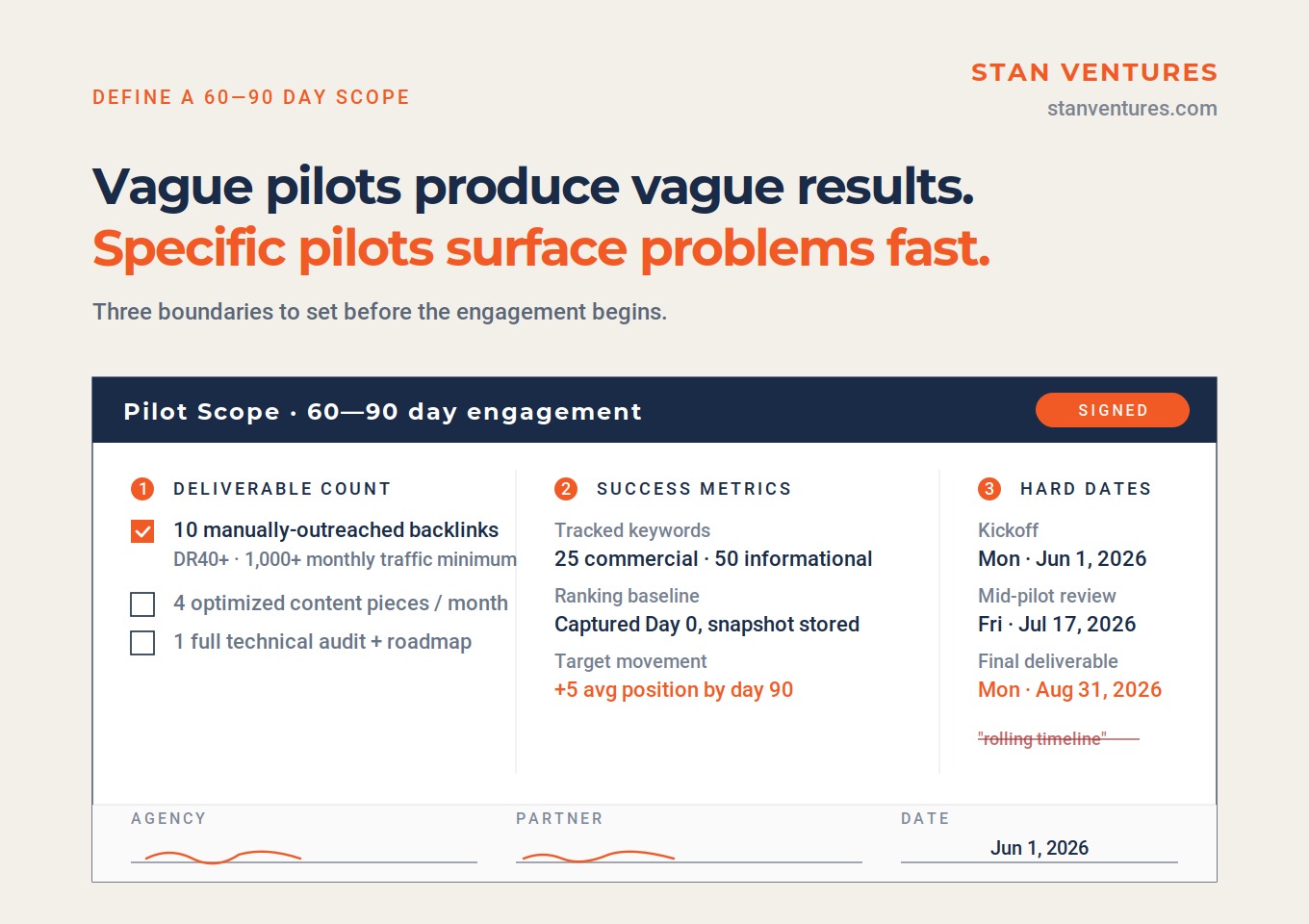
A serious pilot has measurable boundaries:
- Defined deliverable count (e.g., 10 manually-outreached backlinks at DR40+ with minimum 1,000 monthly traffic, or 4 optimized content pieces per month, or one full technical audit with implementation roadmap)
- Specific success metrics agreed up front (keywords being tracked, ranking baseline, target movement)
- Hard delivery dates, not “rolling timelines”
Vague pilots produce vague results. Specific pilots surface problems quickly.
Ask for the Deliverables That Will Matter at Scale
A pilot is also a stress test of the partner’s operations. Request the things that will matter in month 12, not just month one:
- A sample monthly report at full quality
- A strategy document the partner would normally produce for a paying client
- A live link prospect list with reasoning for each pick
- A recorded client-facing call (if the partner offers white-label call attendance)
Real partners accommodate. Sales-driven partners deflect. The exercise reveals which one is across the table.
Audit the Partner’s Own SEO
This step matters more than most agencies realize. A white label SEO provider that doesn’t rank for its own service keywords is a signal worth taking seriously. Plug the partner’s domain into Ahrefs or Semrush. If they’re not ranking for white-label-related queries, ask why.
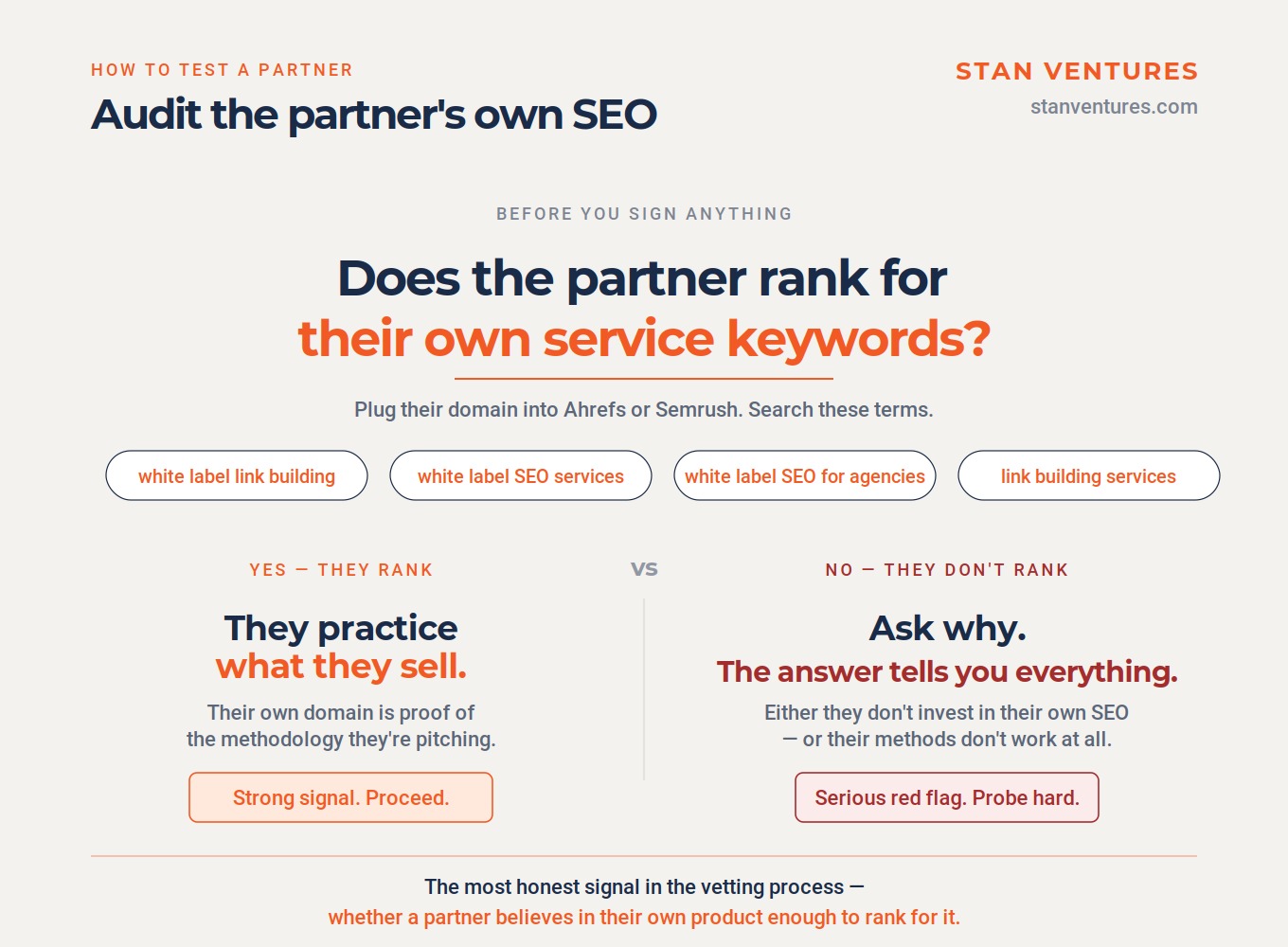
The answer is usually informative either way, and sometimes the most honest signal in the entire vetting process.
Talk to Actual Agency References
Not the testimonials on the partner’s website. Three real agency owners willing to spend 20 minutes on a call. If a partner can’t produce three references, that itself is the answer.
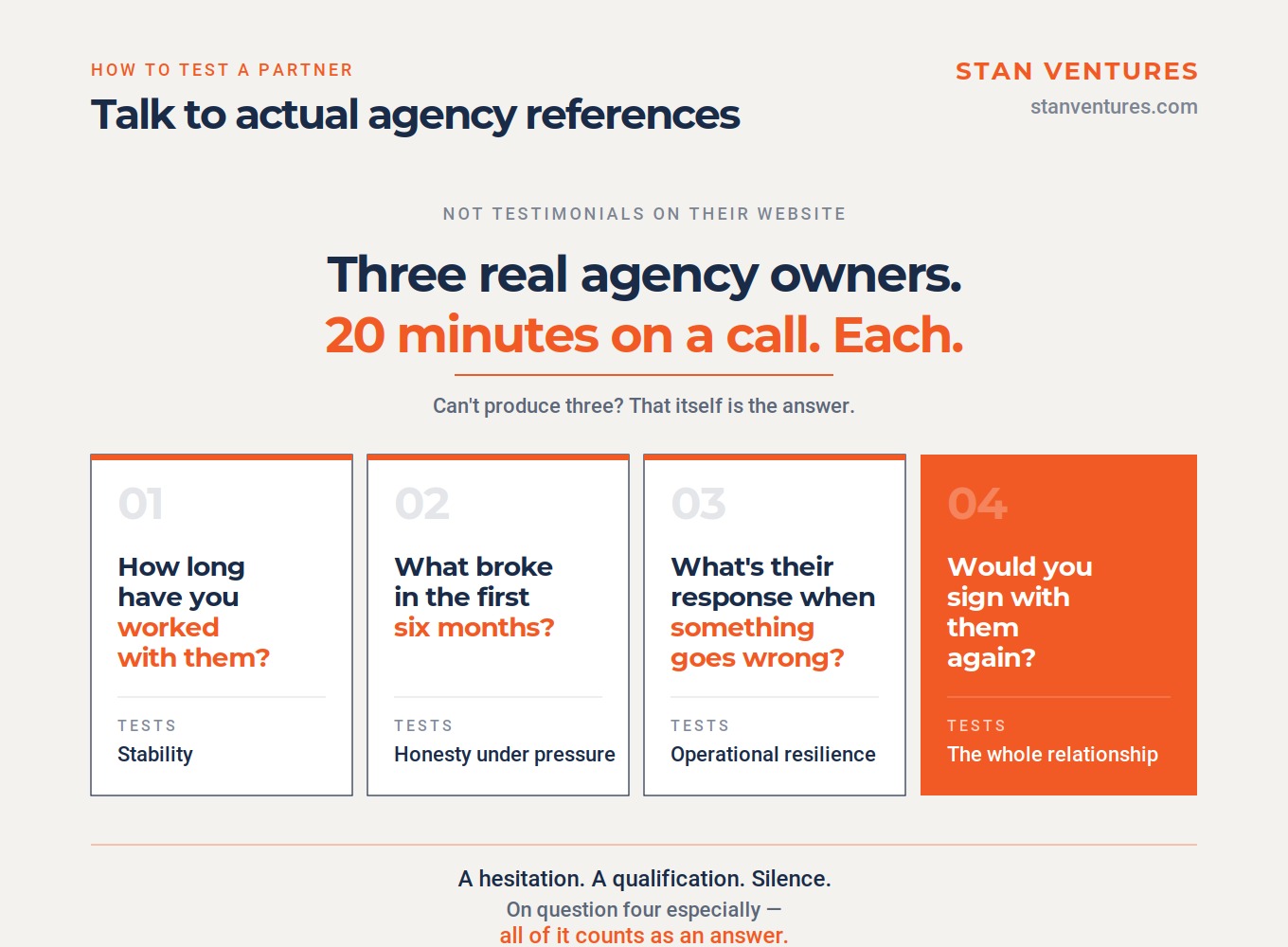
The questions that produce the most useful reference calls:
- How long have you worked with them?
- What broke during the first six months?
- What does their account management look like when something goes wrong?
- Would you sign with them again knowing what you know now?
Structuring the Relationship for the Long Term
Signing the contract is the easy part. The partnership succeeds or fails in the operational details over the next 12-24 months.
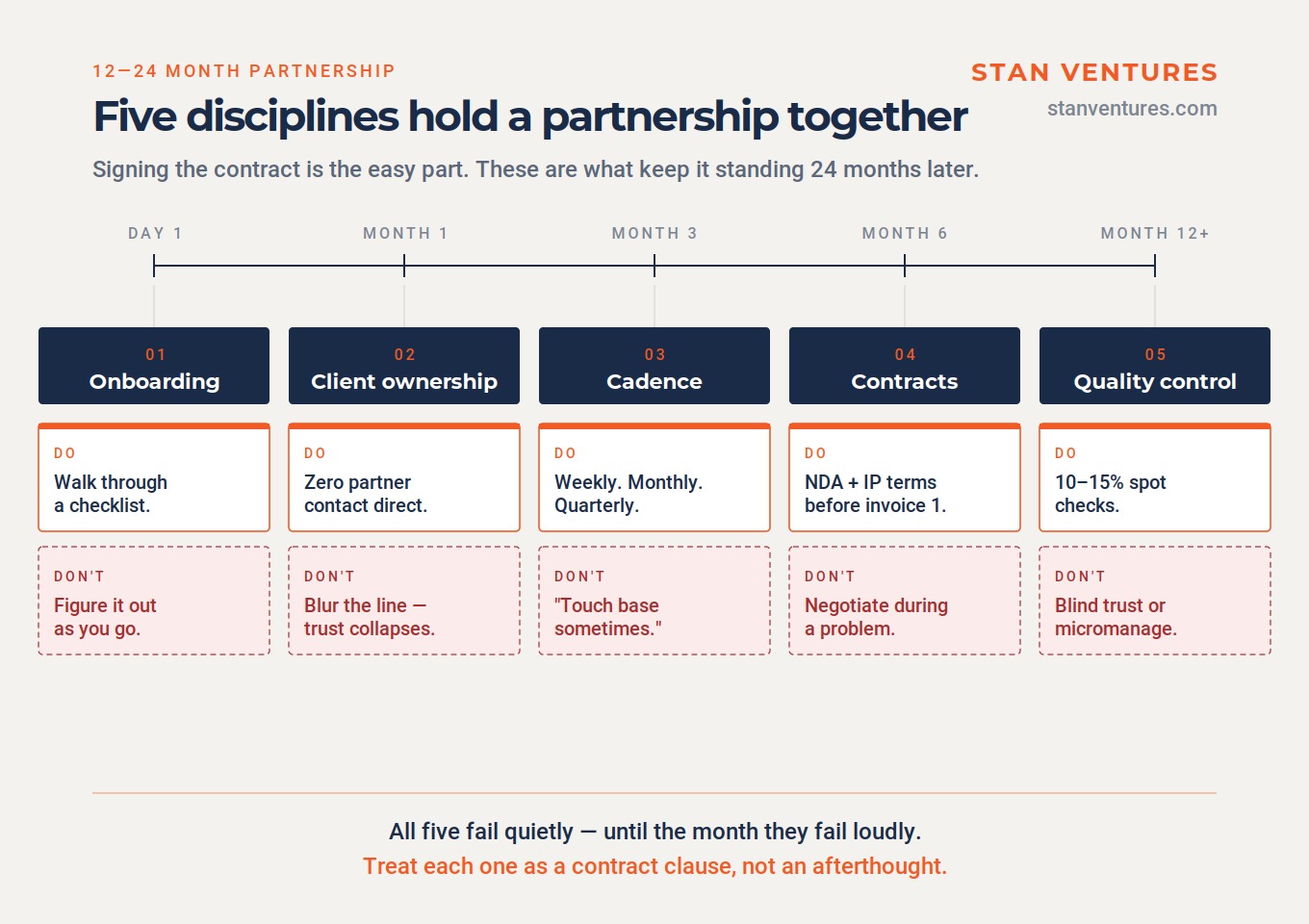
Onboarding discipline: Define the handoff process clearly: what context the partner needs on every new client, in what format, by when. Tier 1 partners have an onboarding checklist they walk through. Ad-hoc partners figure it out as they go and create problems both sides absorb.
Client ownership stays with the agency: Always. The partner has zero direct contact with the end client unless explicitly invited into a specific conversation, and even then, under the agency’s brand. When this line blurs, clients start asking the partner questions directly, the agency loses control of the narrative, and trust erodes faster than it can be rebuilt.
Cadence that holds: Weekly status updates, monthly performance reviews, quarterly strategy resets. Specific, calendared, documented. Not “we’ll touch base sometimes.”
Contractual protections that survive the first crisis: Standard items: NDA, non-solicitation (typically 12–24 months post-engagement), clear IP ownership of any custom assets produced, off-boarding terms covering what happens if either side terminates. These get negotiated before the first invoice, not when a problem surfaces.
Quality control without micromanagement: Too little oversight and quality drifts. Too much and the agency does the work twice. A reasonable middle ground: random spot checks on 10–15% of deliverables, plus a quarterly deep review of one account end-to-end. Anything more is doing the partner’s job. Anything less is blind trust.
The broader operational discipline around scaling — systems, hiring decisions, financial visibility — is covered in the companion guide on SEO agency growth and scaling best practices, which sits alongside the partnership decision rather than replacing it.
What “Buying” White Label SEO Actually Means in 2026
When agency owners search for “buy white label SEO services” or “white label SEO outsourcing,” the framing implies a transaction; a unit of work for a unit of money. That framing is part of why so many white label arrangements fail. It produces vendor relationships, not partnerships.
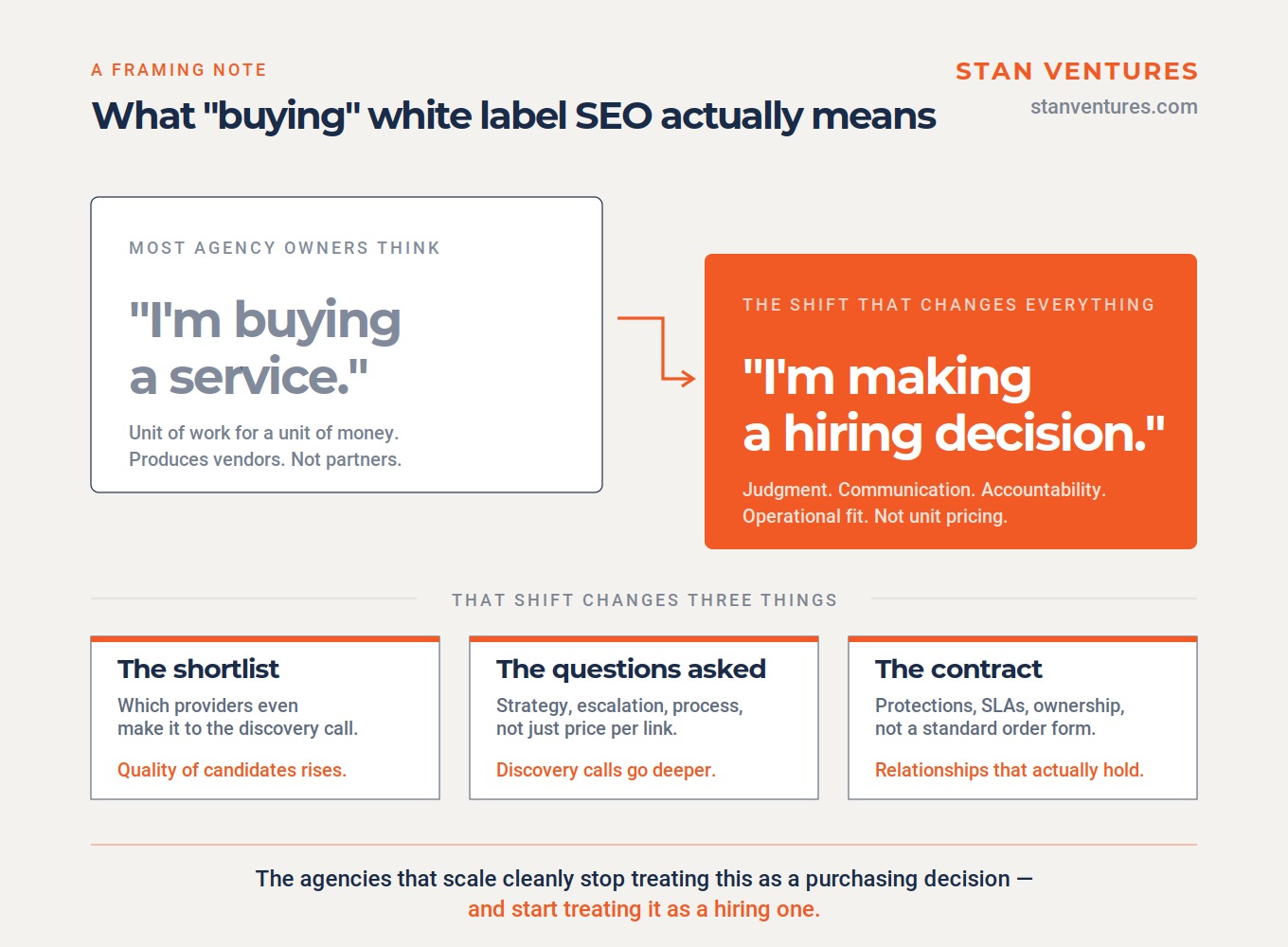
The agencies that scale cleanly through white label SEO have stopped thinking of it as a purchasing decision and started thinking of it as a hiring decision. They evaluate the partner the way they’d evaluate a senior internal hire, for judgment, communication, accountability, and operational fit, not for unit pricing on a price sheet.
That shift in framing changes which providers make the shortlist. It changes the questions asked on the discovery call. And it changes what gets put in the contract.
How to Measure the Return on a White Label SEO Partnership
When investing in a white label SEO partner, the agency needs to see real returns, and on a timeline that matches how SEO actually works, not how paid ads work.
The Lag Time Is Real
A new backlink gets crawled within days, but the authority it passes typically takes 4 to 10 weeks to fully impact rankings. A new piece of optimized content takes 8 to 16 weeks to mature in the SERPs. A technical SEO fix on a complex site can take 30 to 90 days to be fully reprocessed by Google.
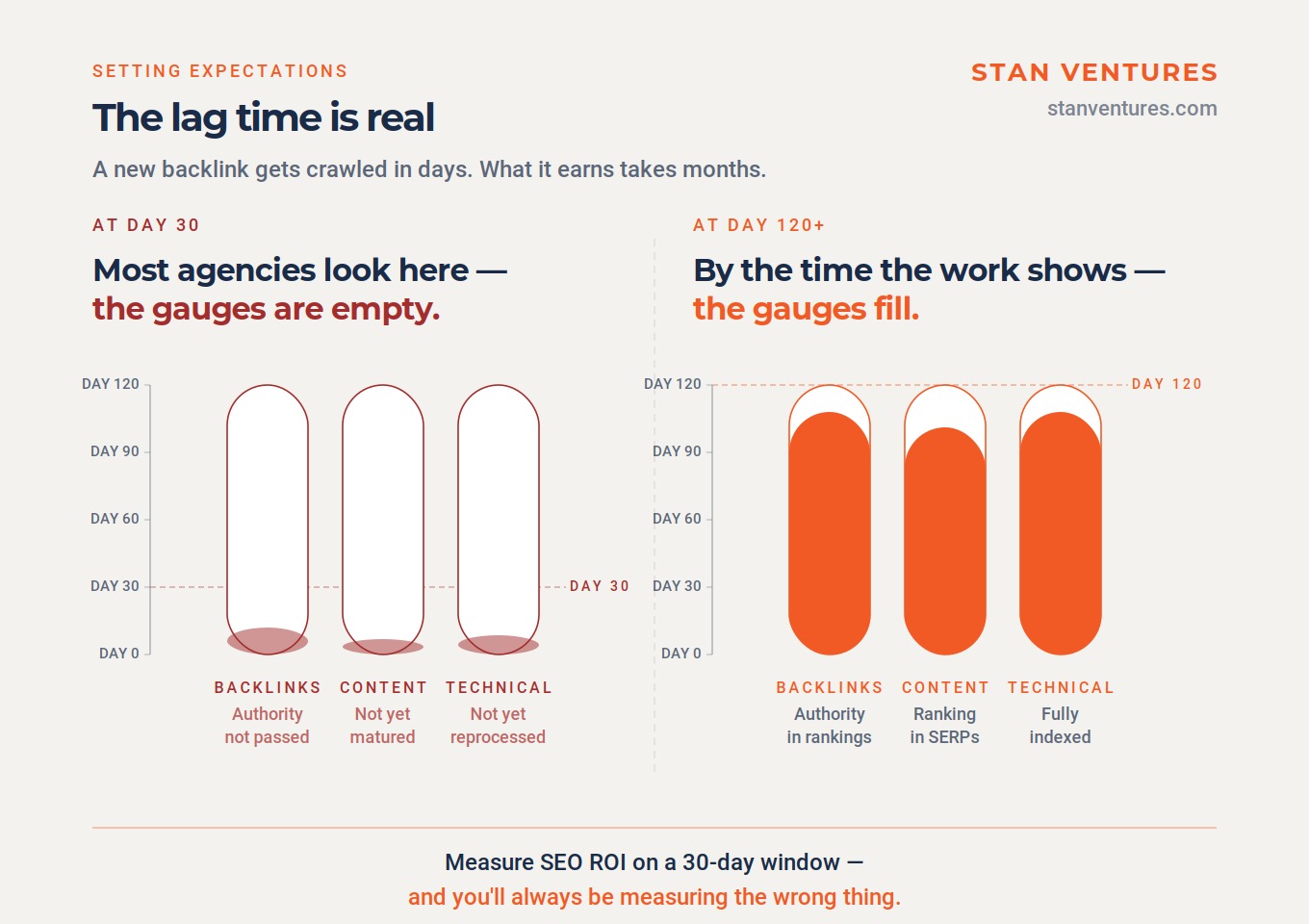
Agency owners who measure white label SEO ROI on a 30-day window are measuring the wrong thing.
The Metrics That Actually Matter
For agencies tracking the value a white label SEO partner is producing, the meaningful indicators are:
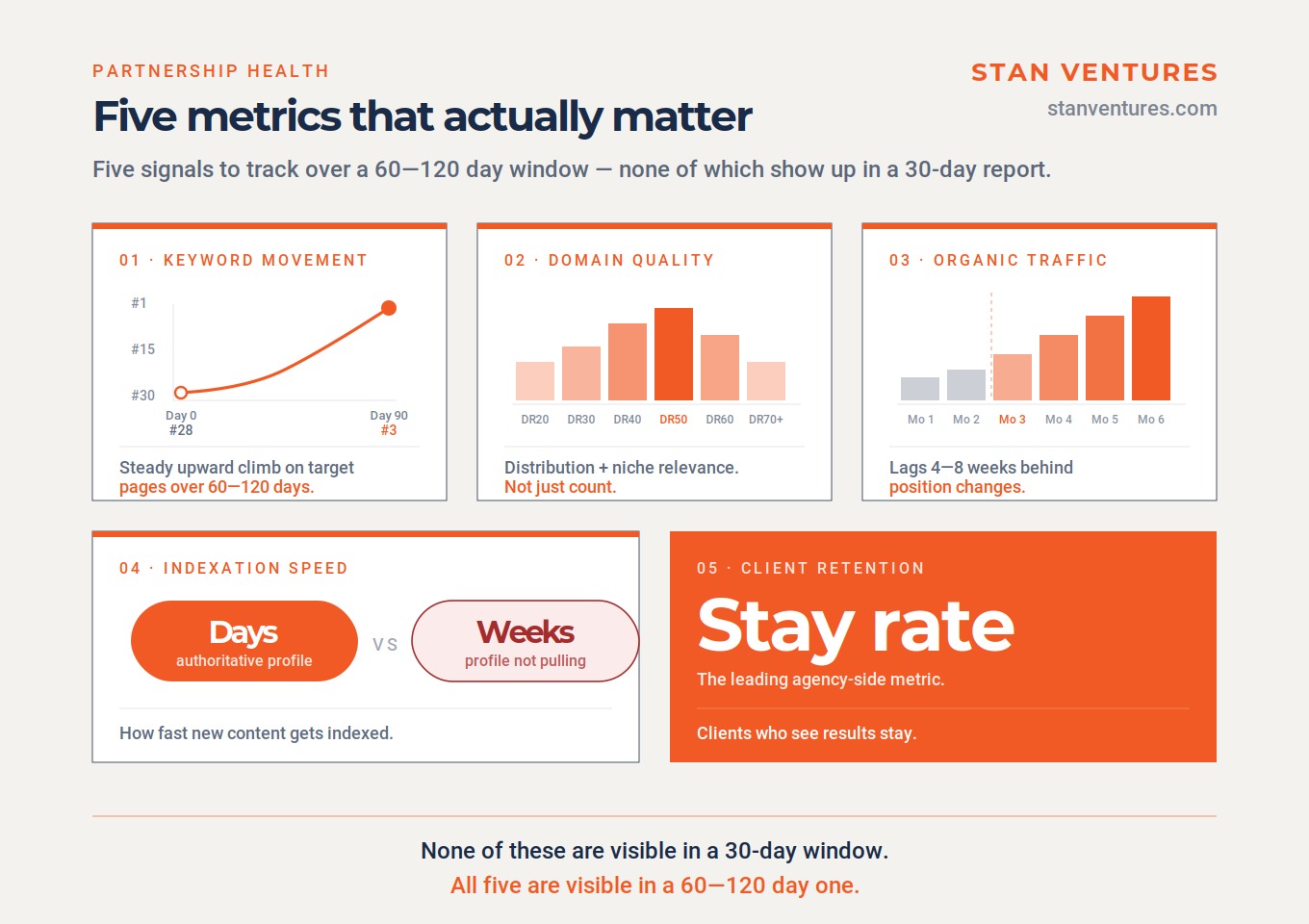
- Keyword movement on target pages. Steady upward movement over 60-120 days indicates the work is compounding.
- Referring domain growth and quality. Not just count. distribution across DR ranges, niche relevance, and traffic quality of the linking domains.
- Organic traffic to the optimized pages. Direct ranking signal, lagging by 4-8 weeks behind position changes.
- Indexation speed. Faster indexation of new content on the client’s site indicates the link profile is being treated as authoritative.
- Client retention. The leading agency-side metric. Clients who see results stay. Stay-rate is the cleanest indicator of whether the partnership is producing real value.
The Margin Math
The partnership is also a financial decision. The simplified math:
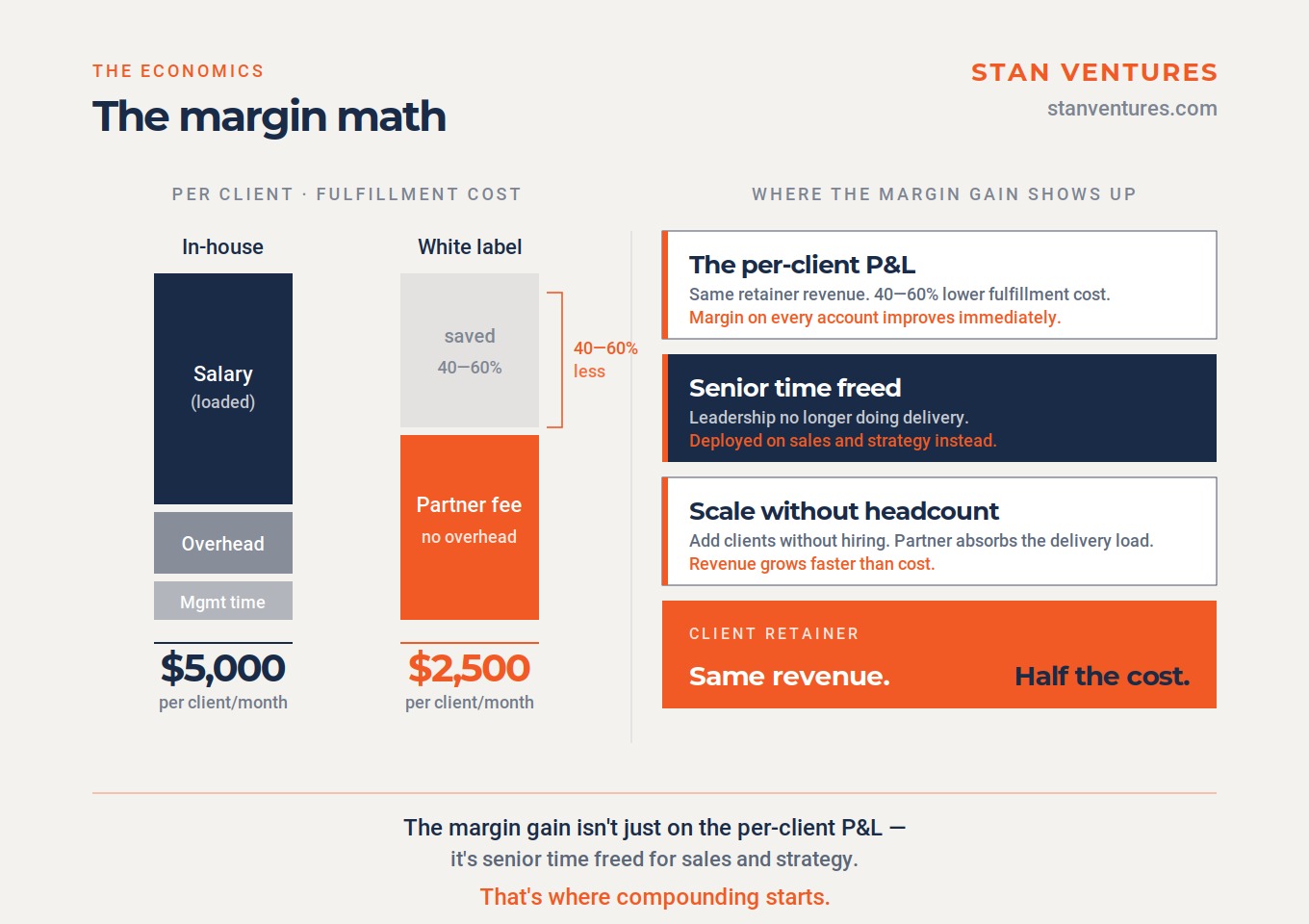
- Cost of in-house fulfillment per client (salary loaded cost ÷ client capacity) compared to
- White label cost per client (partner fee, no overhead) compared to
- Revenue per client (retainer)
Tier 1 white label SEO partnerships typically cut fulfillment cost 40-60% versus in-house delivery on mid-tier accounts, while freeing leadership attention for sales and strategy. That’s where the margin gain shows up, not just on the per-client P&L, but in the agency’s ability to deploy senior time on growth instead of delivery.
The Reputation on the Line Is the Agency’s
The white label SEO partner is invisible to the end client. The results are not.
Every report, every ranking, every link, every content piece carries the agency’s name. The partner’s mistakes become the agency’s mistakes. The partner’s quality bar becomes the agency’s quality bar. The partner’s response time becomes the agency’s response time.
The right partner multiplies capacity without multiplying risk. The wrong one creates a churn problem that takes 18 months to unwind, and a reputation problem that can take longer.
The framework above, including seven criteria, the red flags, the paid pilot, the operational structure, is the work that separates an agency that scales cleanly from one that scales painfully. Most agencies skip it. Most agencies regret skipping it.
In 2026, with Google’s quality signals tightening and AI noise rising, the difference between a strong white label SEO partner and a weak one isn’t a 10% efficiency gap. It’s the difference between a profitable, durable agency and one that has to rebuild client trust every few quarters.

Ananyaa
AuthorAnanyaa Venkat is a seasoned content specialist with over nine years of experience creating industry-focused content for diverse brands. At Stan Ventures, she blends SEO insight with strategic storytelling to shape a compelling brand voice. She has contributed to several leading SEO publications and stays attuned to evolving trends to ensure her content remains authoritative, relevant, and high-quality.


