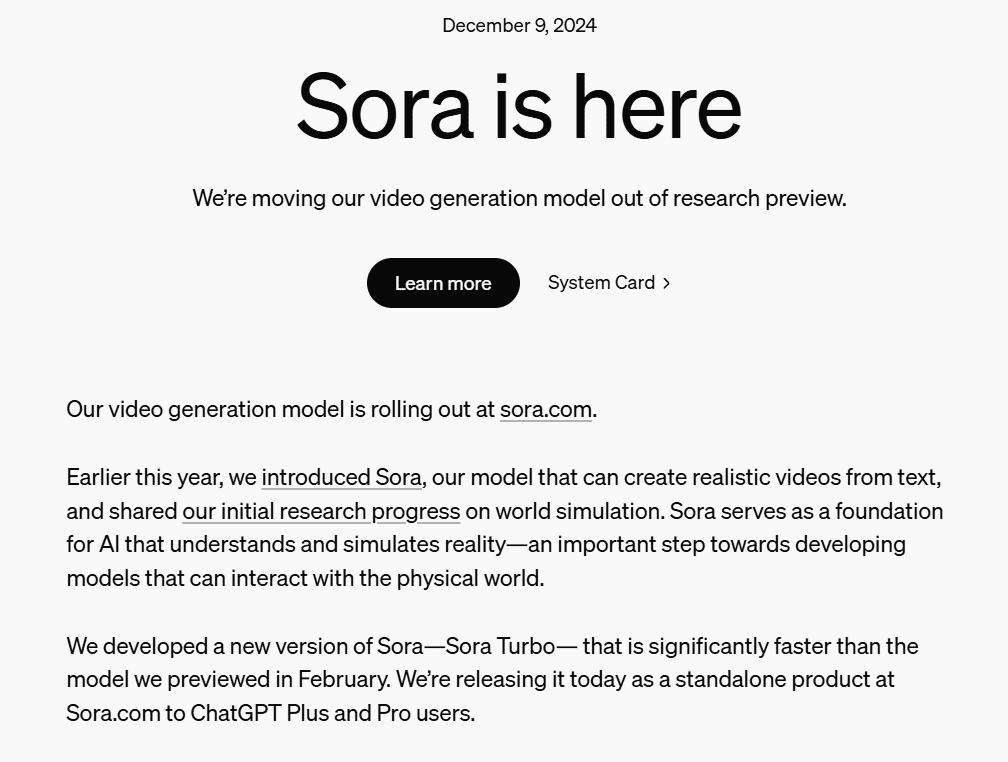
OpenAI has officially launched Sora, its revolutionary AI-powered text-to-video tool, making it available to the public for the first time.
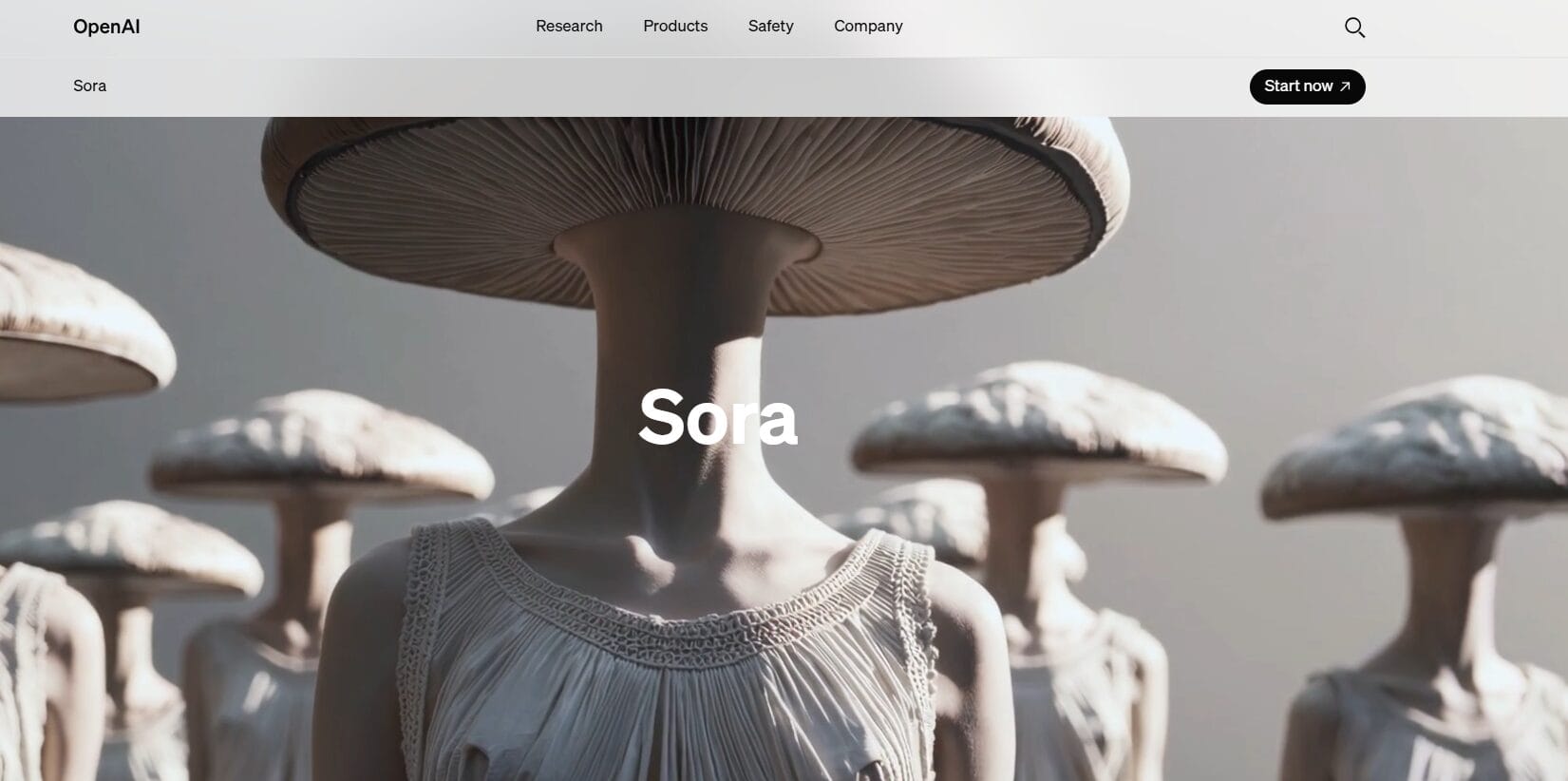
Announced as part of OpenAI’s “12 Days of Ship-mas” rollout event, this tool aims to simplify video creation by allowing users to generate videos from just a few lines of text.
Our holiday gift to you: Sora is here. https://t.co/UhdmYuGHtT pic.twitter.com/ljoruQsfO0
— OpenAI (@OpenAI) December 9, 2024
The news was confirmed by tech YouTuber Marques Brownlee, who called the tool’s capabilities both “horrifying and inspiring.”
What is Sora?
Sora is an advanced AI platform that allows users to create videos simply by describing what they want to see. Whether you’re an artist looking to bring a story to life, a marketer needing quick visuals, or just someone experimenting with creative ideas, Sora is designed to make video production accessible to everyone.
Sora offers a variety of tools to help users fine-tune and customize their creations:
- Remix Feature: This lets users tweak their videos by adding new prompts or adjusting existing ones, giving greater control over the final result.
- Photo-to-Video Transformation: Static images can be turned into animated visuals, enabling creators to breathe life into photographs.
- Storyboarding: A standout feature that allows users to string multiple prompts together, creating a cohesive sequence of scenes.
These features position Sora as a versatile tool for beginners and professionals alike, whether for storytelling, advertising, or creative experiments.
The Hype and Challenges
OpenAI first revealed Sora in February but initially only made it available to a small group of filmmakers, designers, and visual artists.
Introducing Sora, our text-to-video model.
Sora can create videos of up to 60 seconds featuring highly detailed scenes, complex camera motion, and multiple characters with vibrant emotions. https://t.co/7j2JN27M3W
Prompt: “Beautiful, snowy… pic.twitter.com/ruTEWn87vf
— OpenAI (@OpenAI) February 15, 2024
Now, with it’s public launch, OpenAI has signaled that Sora is ready to meet the demands of a larger audience. This release follows other major updates from OpenAI, including a $200/month subscription for its ChatGPT Pro and enhancements to its reasoning models.
However, there are still some areas where Sora needs improvement.
For example:
- Sora struggles with creating realistic physics in videos like objects interacting naturally.
- It can’t generate videos involving public figures or copyrighted characters, which limits some creative options.
Despite these limitations, Sora’s potential is enormous. Brownlee demonstrated how the tool could quickly create imaginative and engaging videos that would take traditional creators much longer to produce.
Why Sora’s Launch is a Big Deal
Sora is launching as part of OpenAI’s “12 Days of Ship-mas,” where the company is rolling out exciting updates and tools. This marks another step forward in making artificial intelligence tools more accessible to everyone, not just tech experts.
This tool builds on OpenAI’s earlier successes like ChatGPT and DALL·E, which transformed how people use AI for writing and image creation. Now, with Sora, the focus shifts to video—a medium that has historically been more difficult and time-consuming to produce.
A Glimpse Into the Future
Sora is just the beginning. As AI technology continues improving, we expect future versions of Sora to address its current limitations. More realistic physics, greater customization options, and expanded use cases are likely on the horizon.
Beyond that, tools like Sora hint at a future where resources no longer constrain creativity. Video production, once limited to those with expensive equipment and technical know-how, is now within reach of anyone with an idea and a keyboard.
Why Sora Stands Out
From my perspective, Sora represents a massive leap forward. It puts creativity into the hands of anyone with an idea, breaking down traditional barriers like cost and technical skills. Sure, there are bugs to fix and ethical concerns to address, but the fact that a beginner can turn their imagination into a video in minutes is a game-changer.
Key Takeaways
- OpenAI’s tool for turning text into videos has been launched for public use.
- It includes text-to-video generation, photo-to-video transformation, and storyboarding.
- Issues like unrealistic physics and restrictions on certain prompts still exist.

Dileep Thekkethil
AuthorDileep Thekkethil is the Director of Marketing at Stan Ventures, where he applies over 15 years of SEO and digital marketing expertise to drive growth and authority. A former journalist with six years of experience, he combines strategic storytelling with technical know-how to help brands navigate the shift toward AI-driven search and generative engines. Dileep is a strong advocate for Google’s EEAT standards, regularly sharing real-world use cases and scenarios to demystify complex marketing trends. He is an avid gardener of tropical fruits, a motor enthusiast, and a dedicated caretaker of his pair of cockatiels.
