In a new round of multilingual SEO tests, major AI search platforms including ChatGPT, Perplexity, Claude, Gemini, and Copilot showed inconsistent performance when identifying the correct language URLs.
While Google and Bing continue to surface accurate localized versions, AI models often defaulted to US-English results even when users searched in French, Italian, or Spanish.
The findings from a recent GSQI blog raise concerns for publishers relying on translated content and hreflang signals for global visibility.
Are AI search systems truly ready for multilingual precision? That question set off a series of tests across languages, tools, and platforms and the results paint a clear picture of the current state of AI Search.
Why Does Multilingual Content Still Confuse AI Search Platforms?
This question has been echoing in my mind as I worked through site after site, query after query. Despite handling millions of multilingual pages, AI models still seem to stumble where Google and Bing excel.
Let’s break down what the latest testing reveals.
What Triggered This Round of Multilingual Testing?
It started with a recurring pattern: clients with globally distributed content kept asking whether ChatGPT, Perplexity, Claude, or Gemini were correctly pulling URLs in their users’ native languages.
From multilingual subdirectories to regional domains to same-language, different-country targeting. And with AI Search becoming a discovery channel, the stakes are higher.
As per Glenn Gabe report the test reveal scenarios:
- Content in different languages
- Content translated but centralized on one domain
- Hreflang-supported pages
- Regional variants of the same pages
The goal? See which URLs different platforms return when the query is made in another language including French, Italian, Spanish, and more.
How Did Google and Bing Perform Compared to AI Search Platforms?
Google and Bing crushed the AI platforms in accuracy. Decades of experience handling multilingual queries clearly paid off. Here’s the breakdown.
Example 1: Google’s Search Documentation – Did AI Tools Return the Correct Language?
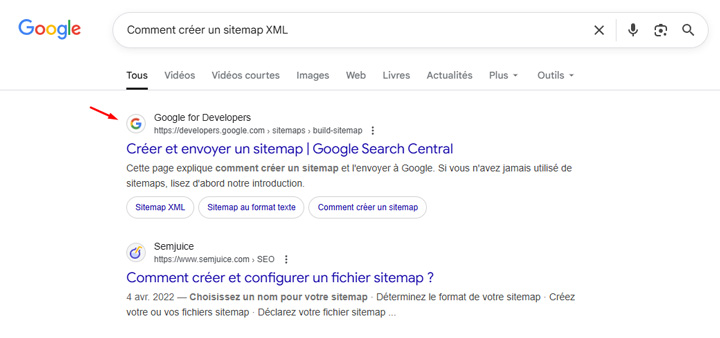
Query: Comment creer un sitemap XML (Language: French)
| Platform | Result Returned | Correct Language? | Notes |
| Google – 10 Blue Links | Correct French URL | Yes | Reliable multilingual handling. |
| AI Overview (France) | No AIO generated | — | AI Overview did not trigger. |
| AI Overview (US) | English URL | No | Returned US-English despite French query. |
| AI Mode | Correct French URL | Yes | Returned correct localized result with scroll-to-text. |
| Bing | Correct French URL | Yes | Accurate in every test. |
| ChatGPT | French answer, English URL | No | Response language correct, links incorrect. |
| Perplexity | French answer, English URL | No | Same mismatch as ChatGPT. |
| Claude | No links at first; English URL after request | No | Requires prompting, still returns wrong version. |
| Copilot | Correct French URL | Yes | Performs well due to Bing’s multilingual systems. |
| Gemini | No links initially; correct French URL when asked | Partial | Provides correct result only after explicit request. |
Net-net? Google, Bing, Copilot, and AI Mode did well. ChatGPT, Perplexity, and Claude consistently failed to return the correct localized URLs.
Example 2: Google Documentation in Italian — Did Tools Catch the Right Version?
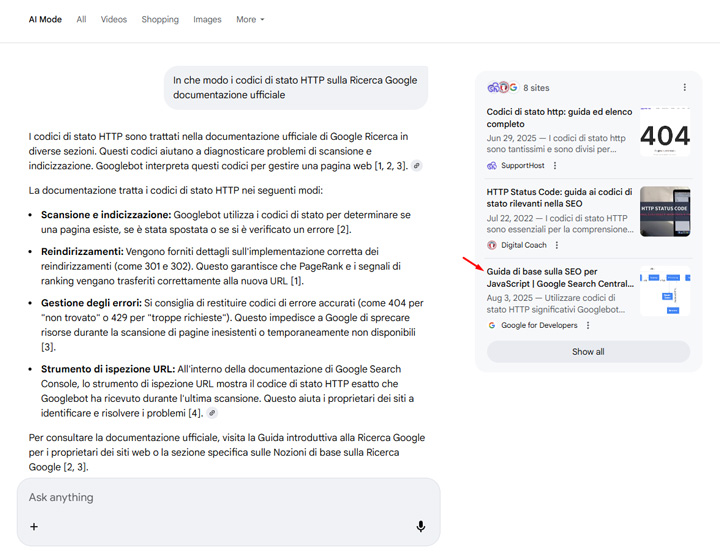
Query: In che modo i codici di stato HTTP sulla Ricerca Google
| Platform | Result Returned | Correct Language? | Notes |
| Google – 10 Blue Links | Italian URL | Yes | Consistently accurate. |
| AI Overview (AIO) | Italian URL | Yes | Correct interpretation of language intent. |
| AI Mode | Italian URL | Yes | Returned correct localized version. |
| Bing | Italian URL | Yes | Accurate across all tests. |
| ChatGPT | English URL | No | Returned wrong language version. |
| Perplexity | Italian URL | Yes | Correct this time, though rare overall. |
| Claude | English URL | No | Returned English version after asking for sources. |
| Copilot | Italian URL | Yes | Performs well due to Bing integration. |
| Gemini | No sources initially; Italian URL when asked | Partial | Needs prompting to show correct links. |
Summary: Again, traditional search > AI search.
Example 3: Cloudflare Blog – How Did AI Handle Translated Pages?
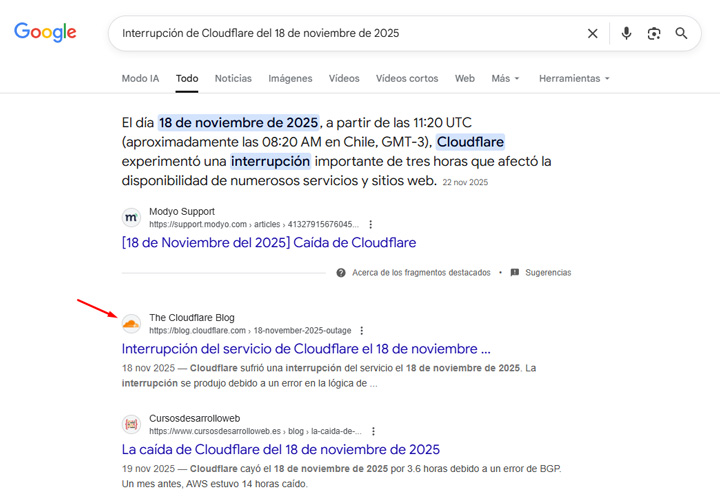
Query: Interrupción de Cloudflare del 18 de noviembre de 2025 (Language: Spanish)
| Platform | Result Returned | Correct Language? | Notes |
| Google – 10 Blue Links | Spanish URL | Yes | Correct localized version ranked. |
| AI Overview (AIO) | No AIO generated | — | AI Overview did not appear for this query. |
| AI Mode | Spanish URL and English URL | Partial | Displayed both versions; dual detection. |
| Bing | Spanish URL | Yes | Consistently accurate across languages. |
| ChatGPT | Spanish URL and English URL | Partial | Mixed results; included both versions. |
| Perplexity | English URL | No | Failed to detect Spanish version. |
| Claude | English URL | No | Returned wrong language version. |
| Copilot | Spanish URL | Yes | Performs strongly due to Bing backend. |
| Gemini | No links initially; English URL when asked | No | Inconsistent; correct Spanish URL only in mobile app testing. |
But in the mobile app (location set to Spain), returned the Spanish version. Consistency remains an issue.
So What Do These Results Really Mean?
After testing financial sites, media portals, press releases, and global blogs, the pattern became clear: AI Search platforms do not reliably understand multilingual intent. Hreflang support appears weak or absent across ChatGPT, Perplexity, and Claude.
Most important ? Google and Bing remain unmatched in multilingual accuracy.
And then there’s Copilot and Gemini: Copilot rides on Bing’s strengths are consistent.
Gemini mirrors Google, though its failure to automatically return sources is a major usability drawback.
If AI Search becomes a primary discovery medium, multilingual sites could risk misrepresentation and worse, traffic loss when AI returns the wrong version of the content.
Why Are AI Search Platforms Struggling With Multilingual Queries?
This question kept surfacing during the analysis. A few possibilities:
1. Limited or no use of hreflang signals
Hreflang is the multilingual backbone for Google/Bing. AI search engines seem blind to it.
2. Heavy dependence on US-English training data
Models default to English URLs even when responding in another language.
3. Weak geographical cues
Even after setting preferred languages, models still fallback to English.
4. Lack of structured multilingual indexing
AI search is still evolving, and indexing mechanisms differ from search engines.
The result? A fragmented experience for global users.
What Should Site Owners Do Now?
What actions truly matter if your content is multilingual. As per Glenn Gabe report here are some measurable key steps.
1. Audit Your Hreflang Setup Thoroughly
Even if AI tools are struggling, Google and Bing still get it right and they remain the largest traffic providers.
2. Test Your Multilingual Visibility Across AI Platforms
Search your multilingual queries across ChatGPT, Perplexity, Gemini, Claude, and Copilot. What users see in AI tools increasingly shapes discovery.
3. Strengthen Your Core Search Visibility
Because as the data shows, traditional search still dominates and performs consistently better.
4. Keep an eye on AI Search evolution
These platforms will improve but right now, this inconsistency is creating risk.
Is AI Search Ready for Multilingual Accuracy?
As per report, After dozens of tests, hours of comparisons, and repeated cross-checking, the answer is clear: No, not yet.
Google and Bing remain unmatched in multilingual detection, URL selection, and hreflang interpretation.
But ChatGPT, Perplexity, Claude, and even Gemini still struggle to identify the correct regional pages, often defaulting to English despite user intent.
For brands, publishers, and international businesses, this gap matters. It affects visibility. It affects reach. And ultimately, it affects trust.
The solution? Gabe mentioned to stay vigilant, test across platforms, perfect your hreflang, and monitor AI Search developments closely.
AI search will evolve but understanding its limitations today is the key to staying ahead tomorrow.

Dipti Arora
AuthorDipti Arora is a Senior Content Writer with over seven years of experience creating impactful content across Digital Marketing, SEO, technology, and business domains. She has a strong background in managing news verticals and delivering editorial excellence. Dipti has contributed to leading publications such as The Times of India and CEO News, where her research-driven storytelling and ability to simplify complex subjects have consistently stood out. She is passionate about crafting content that informs, engages, and drives meaningful results.
