
Google’s AI-generated summaries are displacing branded organic results across recipes, product comparisons, SaaS pricing, and retail queries. Here is what every brand needs to know — and do — right now.
- ~40% – Average CTR decline on informational keywords when AIOs appear (Ars Technica)
- 44% – More likely to surface negative sentiment vs. other AI tools
- 83% – Zero-click rate on AIO-triggered queries (Bain–Dynata, Dec 2024)
- 115% – Growth in AIO appearances since Google’s March 2025 Core Update (Ahrefs)
For years, brands invested heavily in earning the top organic result on Google — a position that signalled authoritativeness, trust, and relevance to millions of users. That hard-won real estate is now under sustained threat. Google’s AI Overview (AIO) feature is increasingly surfacing comprehensive, AI-generated summaries at the very top of the search engine results page, pushing even the highest-quality brand content below the fold — or out of the user’s attention altogether.
The consequences are measurable. According to analysis aggregated by Click Vision, searches that trigger AI Overviews now show an average zero-click rate of 83%, while traditional queries without AIOs average around 60%. Research tracked by OutpaceSEO found that when Google introduced AI Overviews in May 2024, organic CTR for affected queries fell from 1.76% to 0.61% — a 61% decline.
Brands that have spent years building credible, helpful content aligned with Google’s own E-E-A-T standards — Experience, Expertise, Authoritativeness, and Trust — are now seeing their reliable, accurate pages bypassed in favour of AI-assembled answers. The irony is sharp: Google’s own quality standards reward trustworthy, original content, yet its AI layer frequently scrapes and repurposes that very content, delivering a summarised verdict that satisfies the user’s informational intent without a single click.
“The AI Overview doesn’t just compete with your brand — it wears your content as a costume, while keeping the user on Google’s property.”
This isn’t a niche technical concern. Bain & Company’s December 2024 survey of 1,117 US consumers found that roughly 80% of consumers now rely on zero-click results in at least 40% of their searches, reducing organic web traffic by an estimated 15% to 25%. Understanding where and how AIOs hijack branded queries is the first step toward building a defensible, comprehensive content strategy.
Five Ways AI Overviews Are Displacing Branded Traffic
Branded Recipe & “How-To” Blogs
Major recipe destinations — Inspired Taste, Simply Recipes, AllRecipes — have seen AI Overviews scrape and display full ingredient lists and step-by-step instructions for their most famous, traffic-driving dishes. When a user searches for a specific brand’s signature recipe, Google frequently delivers what practitioners have begun calling a “Frankenstein” summary: a synthesised set of instructions pulled from multiple sources, presented with no meaningful attribution.
By far, the highest priority needs to be removing full Frankenstein recipes as default on AI Mode and AI Overviews for recipe intent queries, especially branded, like this example recorded minutes ago. 🧵(2/4) pic.twitter.com/RQH7hNhaZg
— Inspired Taste (@inspiredtaste) March 4, 2026
The result is a user who gets a complete, helpful answer without ever clicking through to the brand’s page. This is the zero-click scenario at its most direct. WPBeginner’s 2025 AIO trend analysis confirms that recipe and how-to queries are among the categories seeing the steepest AIO prevalence growth since Google’s March 2025 Core Update — with a 115% rise in AIO appearances overall.
Product Comparisons & “Is It Worth It?” Queries
Consumer tech and appliance brands — Dyson, Samsung, Apple — are seeing AI Overviews hijack branded comparison keywords with particular aggression. A query like “Dyson V15 vs V12” now routinely triggers an AI-assembled summary listing full specifications, pros, cons, and a verdict. The user receives a summarised assessment without visiting the brand’s own comparison landing page — a page designed not just to inform, but to guide purchase intent.
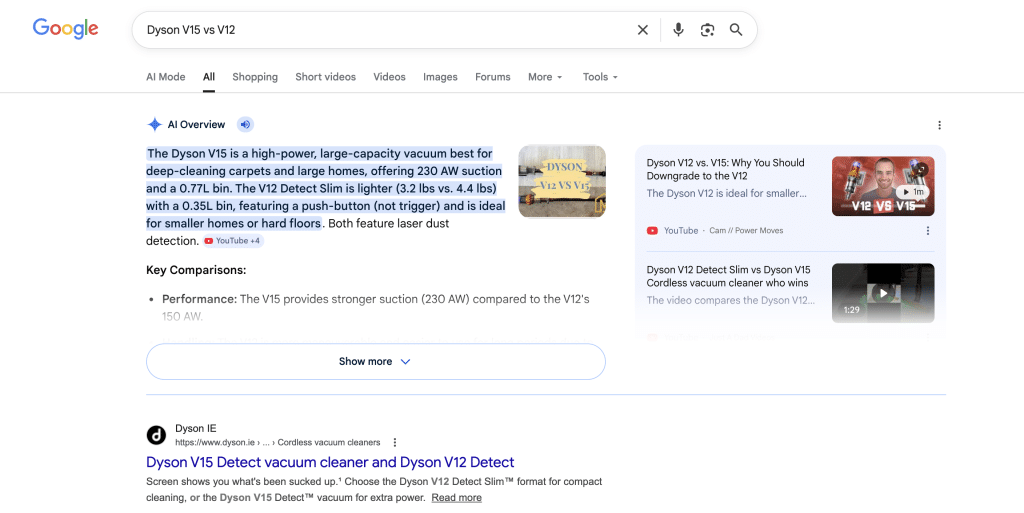
The risk is compounded by a critical credibility issue. Research cited by OutpaceSEO has found that AI Overviews are 44% more likely to surface negative sentiment compared to other AI tools. For brands with any public controversy in their history, this creates a hostile and uncontrolled top-of-funnel experience that users encounter before reaching any brand-owned content.
For SaaS companies like Salesforce or HubSpot, branded pricing and feature queries have become a significant reliability risk. When a user searches “[Brand] pricing”, an AI Overview may pull pricing tiers from third-party review sites, comparison platforms, or blog posts that are two or more years out of date — rather than from the brand’s own current, accurate pricing page.
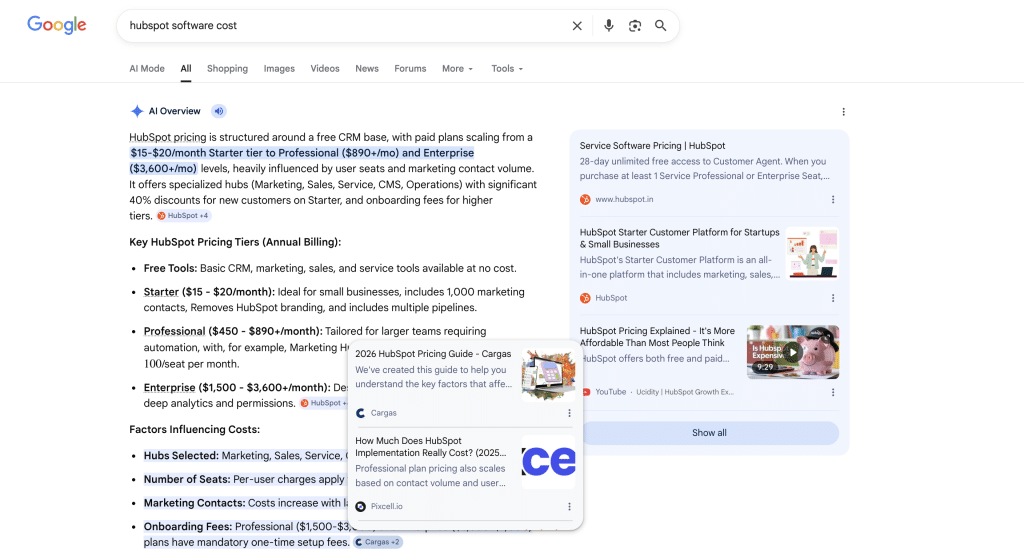
The user sees potentially incorrect pricing information before they ever reach the official source. TrialGuides’ analysis of AIO content sourcing notes that 89% of AIO citations now come from beyond the top 10 organic results — meaning Google’s AI is frequently pulling from less authoritative, less up-to-date third-party sources over official brand pages.
For large corporations navigating reputational sensitivity, the stakes are highest. When a brand has experienced a recent lawsuit, recall, or public controversy, searches combining the brand name with terms like “news” or “reviews” increasingly lead with an AI Overview that surfaces and summarises the negative event — drawing from news articles, regulatory filings, and forum discussions.
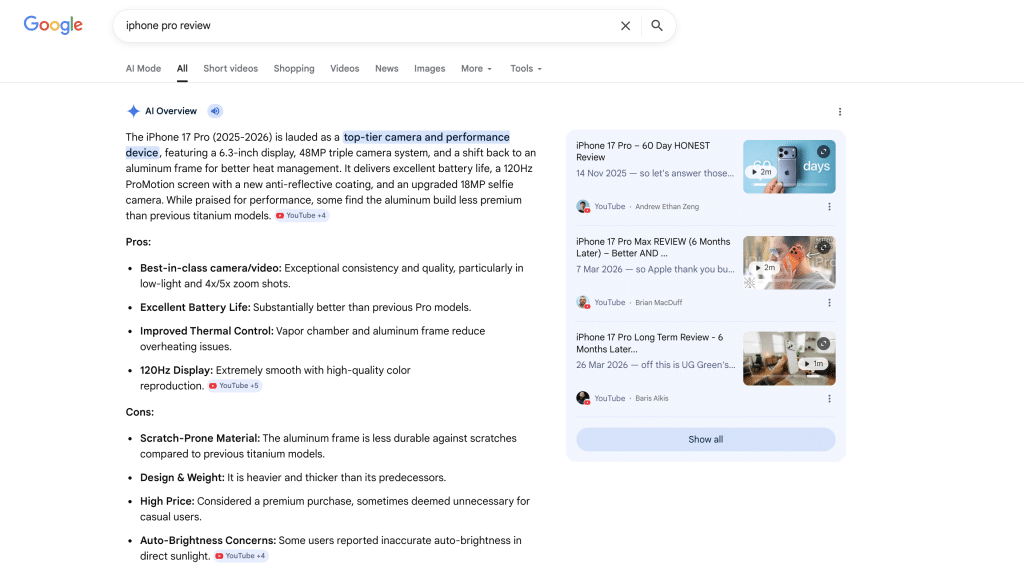
Google’s AI systems lean heavily into controversy indexing for branded informational queries. eMarketer’s coverage of Google’s AIO expansion warns that users could feel fully informed by the AI interaction — with answers synthesised from multiple publishers — eliminating the interest in further research on branded sites. This places negative sentiment at the top of the brand’s funnel before any brand-controlled content is encountered.
Major retailers like Target and Walmart are experiencing a subtler but equally significant displacement: AI Overviews triggered by branded + local queries, such as “Target [Product] in stock” or availability and store-hours lookups. The AI box summarises exactly the information the user wanted — stock status, opening times, nearby locations — with no need to enter the brand’s digital ecosystem.
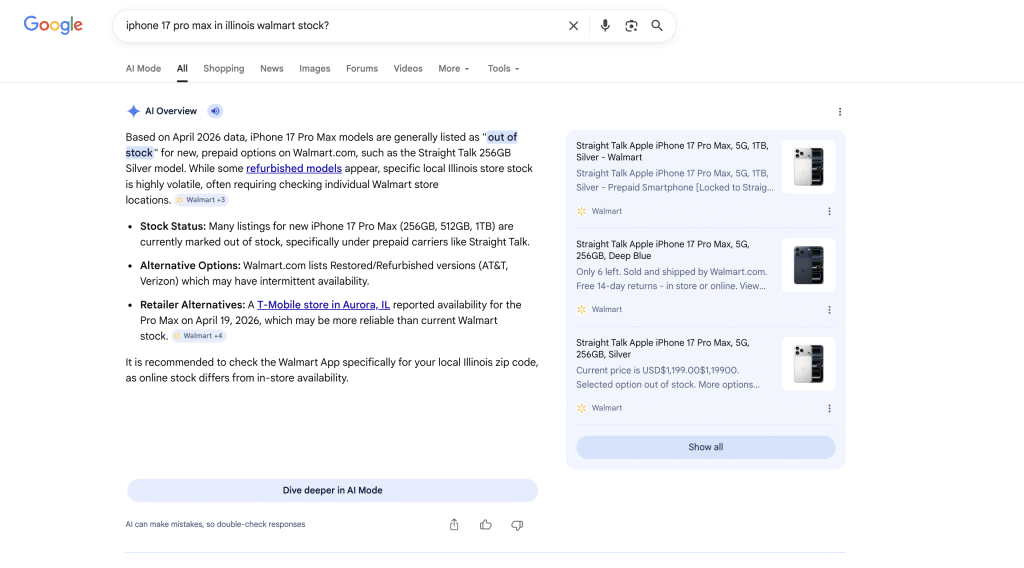
This creates pure zero-click behaviour at the transactional level. Ekamoira’s 2025 zero-click analysis, drawing on Semrush data, shows that 58.5% of US searches and 59.7% of EU searches now conclude entirely within Google’s results page — meaning the brand gets no session, no engagement signal, and no opportunity to begin a loyalty relationship.
58.5% of US searches end without a click — Semrush 2025
The Branded Traffic Impact at a Glance
| Query Type | Typical Branded Example | AIO Impact | Risk |
|---|---|---|---|
| Navigational | [Brand] login / [Brand] website | Low — official site usually still cited in AIO. AIO shows in only 4.79% of branded SERPs | Low |
| Informational | [Brand] how to use X / [Brand] recipe | Full instructions displayed on SERP; user need fully met without a click | High |
| Commercial | [Brand] reviews / [Brand] vs competitor | Pros, cons and verdict summarised; negative sentiment 44% more likely to surface | High |
| Transactional | [Brand] discount code / [Brand] buy | Coupon aggregators and deal sites pulled ahead of the brand’s own page | Medium |
| Local / Availability | [Brand] in stock near me / [Brand] hours | Availability and hours surfaced directly; no brand ecosystem entry point | Medium |
What Brands Can Do: A Six-Step Navigation Strategy
The menace of AI Overviews is real, but it is not insurmountable. Brands that approach this challenge with the same rigour they apply to earning authoritative organic rankings — and align their strategy with Google’s own published quality standards — are best positioned to protect their search equity. Here is a framework built for 2025.
Build genuinely unskimmable contentAI Overviews scrape content that can be easily distilled into a list or summary. Create content with deep, first-hand experience, original research, proprietary data, and expert insight that resists easy summarisation. When a page demonstrates true E-E-A-T — real expertise, verifiable authoritativeness, and honest, accurate information — it becomes harder to replace with a synthesised answer. Inner Spark’s verified AIO statistics confirm that experience-rich content — original data, tools, interactive demos — is the category AI Overviews struggle most to replicate or displace.
Pursue AIO citation, not just organic rankingBeing cited within the AI Overview — as a reliable source in its footnotes — is now as strategically valuable as ranking at position one. Structure content with clear, crawlable facts, specific data points, and authoritative statements that AI systems can attribute with confidence. Use structured data markup, concise factual paragraphs, and comprehensive coverage of the user’s intent. BrightEdge data cited by TrialGuides shows that 89% of AIO citations come from beyond the top 10 organic results — meaning quality and authority of content matters more than current ranking position alone.
Own your pricing and specification pages — and keep them currentFor SaaS and product brands, the most immediate defensive action is ensuring that official pricing, features, and specification pages are technically impeccable: structured data markup, regular updates, clear authoritativeness signals, and strong internal links pointing to these pages. If Google’s AI pulls from a third-party review site, it is because it judged that source to be more reliable or more up-to-date than your own. Remove that justification by making your official pages the most trustworthy, comprehensive, and current source available.
Address branded controversy proactively with on-site contentIf your brand has reputational vulnerabilities — past controversies, negative press, product recalls — create comprehensive, accurate, honest, and current on-site content that addresses these topics directly. eMarketer recommends that brands focus on building strong affinity so users seek them out directly, even if initial discovery happens inside an AI summary. A brand that publicly and credibly demonstrates transparency and a commitment to users is more likely to be surfaced as the trustworthy source — rather than having the narrative controlled by news aggregators.
Diversify beyond search-dependent acquisitionThe deepest strategic response to AIO displacement is reducing dependence on search as a single acquisition channel. Build direct relationships through email lists, community platforms, owned media, and social. Bain & Company advise that winning brands will “bold experiment” to understand how to influence visibility in both search engine AI summaries and LLM engines, while also diversifying content formats — video, interactive tools, downloadable resources — that AI summaries cannot easily replicate or displace.
Monitor AIO triggers for your branded keywords weeklyNot every branded query triggers an AI Overview. Use systematic SERP monitoring to understand exactly which of your branded queries are being overshadowed, what sources the AIO is citing, and the sentiment of those summaries. TrialGuides recommends building a weekly dashboard tracking impressions vs. clicks, AIO citation count, branded search growth, and assisted revenue — so that your strategy is grounded in current, reliable data rather than assumption.
Key Takeaways
Google’s AI Overviews are not a bug — they are the intended outcome of a system designed to fully satisfy user needs directly on the SERP. For brands, the winning response is not to fight the system, but to become its most reliable, authoritative, and comprehensive source — so that when Google’s AI answers a query, it is citing you, using your accurate data, and directing users to your ecosystem for the experience only you can provide.
The brands that will maintain search equity in the AI era are those that demonstrate, at every touchpoint, that they are the most trustworthy, helpful, and experienced source in their niche. That is the standard Google has always rewarded — and one its AI is now applying at greater speed and scale. Zero-click search does not eliminate brand value from search — it relocates it. Visibility in AI responses is the new top-of-funnel.

Dileep Thekkethil
AuthorDileep Thekkethil is the Director of Marketing at Stan Ventures, where he applies over 15 years of SEO and digital marketing expertise to drive growth and authority. A former journalist with six years of experience, he combines strategic storytelling with technical know-how to help brands navigate the shift toward AI-driven search and generative engines. Dileep is a strong advocate for Google’s EEAT standards, regularly sharing real-world use cases and scenarios to demystify complex marketing trends. He is an avid gardener of tropical fruits, a motor enthusiast, and a dedicated caretaker of his pair of cockatiels.
