
With Google undergoing a sea change over the last decade, the relevance of Google’s disavow tool has become a focus of SEO discussions.
Introduced in October 2012, a few months after the penguin update, the disavow tool has been part of the search console for over 12 years.
However, recent discussions by industry experts have sparked renewed interest in the tool’s utility and future.
Here’s a roundup of the latest developments and expert opinions about Google’s Disavow tool.

Glenn Gabe’s Perspective
Glenn Gabe, the founder of G-Squared Interactive, shared his thoughts on the disavow tool on X, highlighting an experiment by Cyrus Shepard. Gabe stated:
“Ah, the disavow tool. You already know how I feel about this. 🙂 Well, @CyrusShepard just ran another experiment where he disavowed every link to his site. He did this before, but now did it again. So what happened? Nothing. Literally nothing.”
Ah, the disavow tool. You already know how I feel about this. 🙂 Well, @CyrusShepard just ran another experiment where he disavowed every link to his site. He did this before, but now did it again. So what happened? Nothing. Literally nothing.
Note, Cyrus covers how link count… pic.twitter.com/TI9R7Xwn2m
— Glenn Gabe (@glenngabe) July 10, 2024
Gabe’s insights suggest that unless there is a critical reason, such as a manual action or involvement in a link scheme, using the disavow tool is unnecessary for most site owners. He speculates that Google’s algorithms might continue to count link signals even after they are disavowed, indicating that the tool’s impact on rankings might be minimal.
Cyrus Shepard’s Disavow Experiment
Cyrus Shepard of ZyppY SEO conducted an experiment where he disavowed every link to his website. In a detailed blog post, Shepard described the process and results:
“Nearly two months ago, I disavowed every link to this website listed in Google Search Console and every link listed by Ahrefs. Trust me, it was a lot of good links. Links from high-authority sites like Moz, Ahrefs, Semrush, Backlinko, and more were all disavowed.”
Shepard reported that disavowing all these links had no significant impact on his website’s traffic or rankings. He observed a slight increase in traffic shortly after the disavowal, but attributed this to regular updates and new backlinks rather than the disavow process itself.
Shepard concluded that Google’s disavow tool might not substantially impact search rankings, aligning with Gabe’s observations.
John Mueller’s Take on the Disavow Tool
John Mueller, Search Advocate at Google, has previously provided insights into the limited necessity of the disavow tool. Mueller stated:
“If you have a manual action for link-spam, or if you’re certain you’ll get one when someone looks, then disavowing can make sense. Most spammy / paid / placed / swapped links are just ignored nowadays. It’s rare you’d need it.”
Mueller also cautioned against SEO tools that market a few backlinks as toxic, indirectly referencing SEMrush’s Toxic Backlink feature:
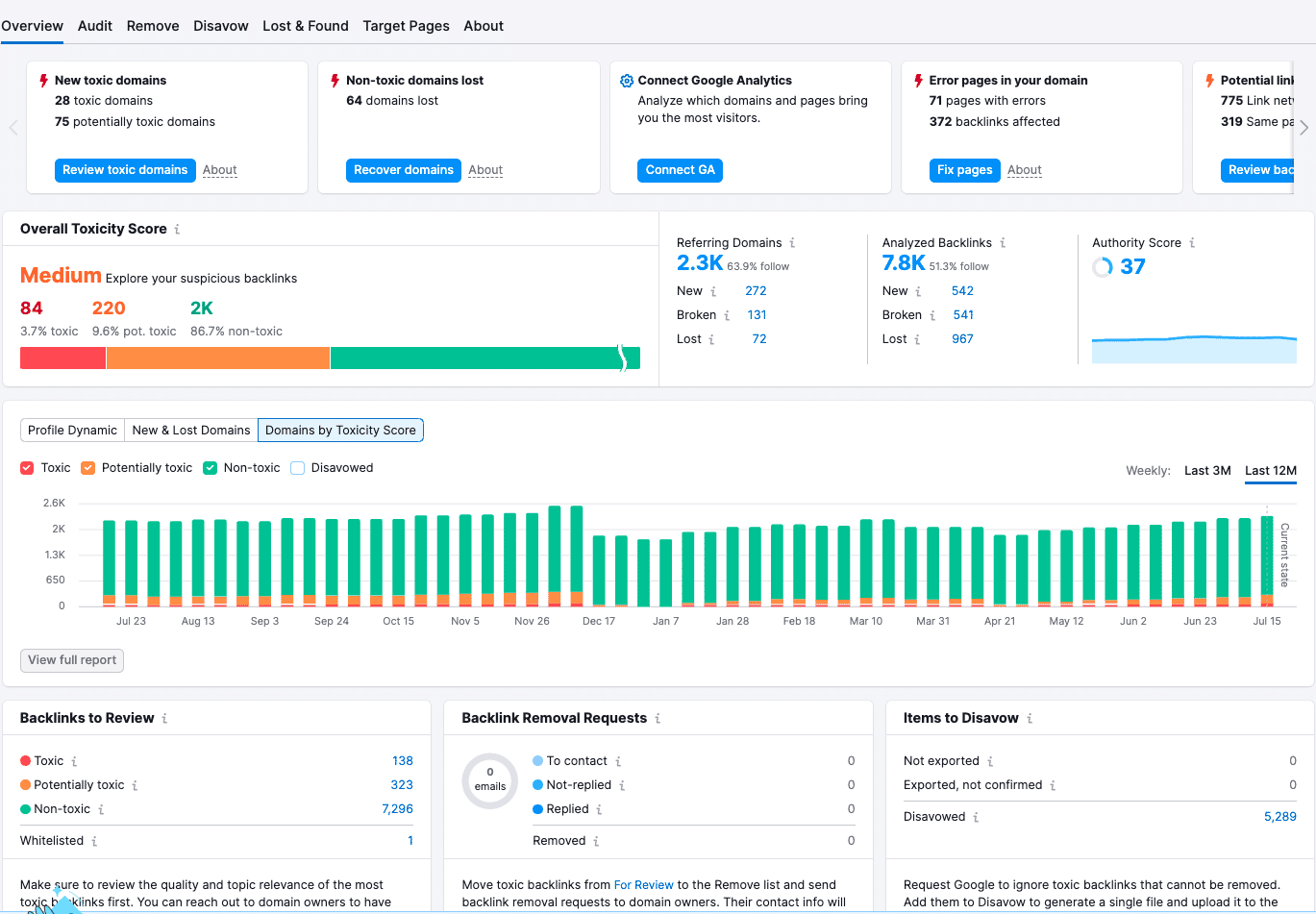
“In particular, the disavow links tool is not something you’d ever need on a regular basis. I’d consider it a big red flag if any SEO tool reported on ‘toxic links’ and suggested you need to clean it up regularly – that’s been wrong for many years now. Don’t fall for it.”
Speaking at the recent Google Search Central NYC 2025 event, Mueller addressed the most common concern from SEOs about the so-called “toxic backlinks.” He responded by clarifying that:
“So internally we don’t have a notion of toxic backlinks. We don’t have a notion of toxic backlinks internally. So it’s not that you need to use this tool for that.”
He explained that random foreign or low-quality links pointing to a website are not necessarily harmful and are typically ignored by Google’s systems. Instead, the disavow tool is primarily intended for very specific scenarios:
“I would mostly use the disavow tool for situations where you’ve been actually buying links and you’ve got a manual link spam action and you need to clean that up… the disavow tool kind of helps you to resolve that, but obviously you also need to stop buying links.”
Mueller further clarified that the tool was originally created after the 2012 Penguin update, when Google penalized a large number of sites for participating in paid link schemes. SEOs needed a method to disassociate their sites from purchased backlinks—often because link sellers were charging money to remove them. The disavow tool was built in response to this specific need.
Mueller also cautioned against using the tool routinely:
“The disavow tool is not something that you need to do on a regular basis. It’s not a part of normal site maintenance. I would really only use that if you have a manual spam action.”
The takeaway from Mueller’s position is that unless a site has a manual action related to link spam or knowingly engaged in manipulative link-building practices, there is no reason to disavow links. Google’s algorithm is designed to ignore low-quality or spammy backlinks without penalizing the site.
Majestic’s New Stance on the Disavow Tool
Majestic, a prominent SEO tool provider, has removed its direct support for the disavow feature from its platform. In a blog post, Majestic elaborated on their position:
“The Majestic tool does not highlight or report on Toxic Links. We don’t pretend to be able to identify links to disavow without significant manual intervention. Despite this, we have an ‘export as disavow’ feature in the bucket. We don’t sing and dance about it, but we do receive questions from concerned customers on toxic links and disavow.”
This means Majestic will soon remove the export links in the disavow format feature and stop telling its customers if their websites have toxic links, forcing them to disavow such links in panic.
Majestic’s decision is influenced by internal discussions and respect for industry expert Glenn Gabe’s observations on the limited utility of the disavow tool. The company acknowledges the historical context of the tool’s development and its role in combating link spam but asserts that its utility has significantly diminished over time. Majestic’s decision to remove the feature reflects a broader industry trend towards de-emphasizing the importance of disavowing links.
Industry Implications and Future of the Disavow Tool
The recent discussions and experiments highlight a growing consensus in the SEO community that the disavow tool is becoming less relevant. Google has been moving towards algorithmically ignoring low-value links, reducing the need for manual disavowal.
Bing removed the disavow option from its Webmaster Tools in October 2023. Mueller recently hinted at the possibility of its removal entirely, reinforcing that its use is exceedingly rare and often unnecessary for most site owners.
As the SEO landscape evolves, tools and strategies must adapt to changing algorithms and industry best practices. The recent developments around the disavow tool underscore the need for SEO professionals to stay informed and critically evaluate the tools and techniques they use. While disavow might still have specific use cases, its relevance appears to wane in 2024.

Dileep Thekkethil
AuthorDileep Thekkethil is the Director of Marketing at Stan Ventures, where he applies over 15 years of SEO and digital marketing expertise to drive growth and authority. A former journalist with six years of experience, he combines strategic storytelling with technical know-how to help brands navigate the shift toward AI-driven search and generative engines. Dileep is a strong advocate for Google’s EEAT standards, regularly sharing real-world use cases and scenarios to demystify complex marketing trends. He is an avid gardener of tropical fruits, a motor enthusiast, and a dedicated caretaker of his pair of cockatiels.
