
German media and digital organizations have officially filed a complaint against Google’s AI Overviews with the country’s Federal Network Agency (Bundesnetzagentur).
Yes, the same AI-generated answer feature that pops up at the top of search results is now facing its toughest challenge yet in Europe.
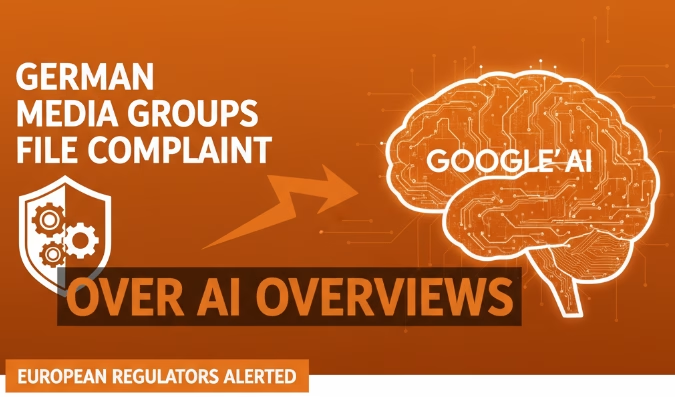
And the charge is serious: violating the European Union’s Digital Services Act (DSA).
If you have been following AI and publishing tug-of-war lately, this complaint is another entry in the long list of pushbacks against big tech.
Why Did German Media Groups Move Against Google’s AI Overviews?
So, why the uproar?
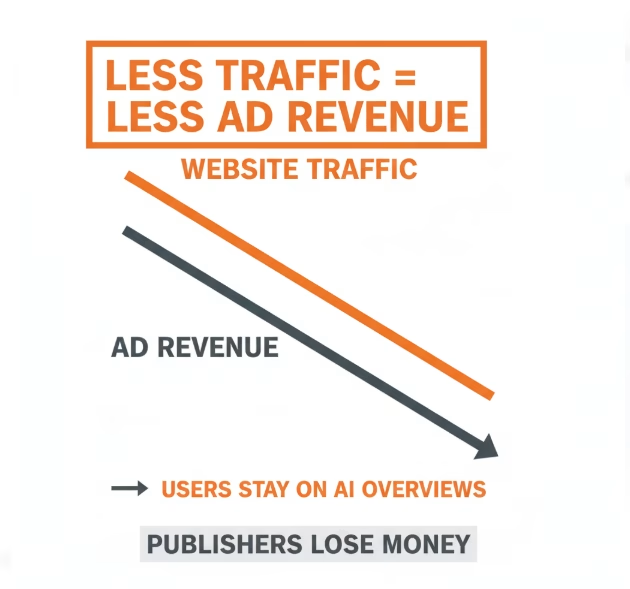
The complaint argues that Google’s AI-generated answers, integrated directly into search results. It prevents users from clicking through to original publishers’ websites.
That means fewer eyeballs on articles, fewer ad impressions and ultimately, less revenue for publishers who rely on traffic.
The alliance behind this complaint includes some of Europe’s most influential media bodies:
- BDZV – representing more than 300 German media brands.
- DJV (German Journalists’ Association).
- European Federation of Journalists.
- European Magazine Media Association.
- European Newspaper Publishers’ Association.
- AlgorithmWatch.
Together, they have painted a grim picture: by answering queries upfront, Google effectively competes with the very news and editorial content it crawls.
As the signatories wrote, this threatens not only revenue streams but also media diversity, freedom of expression and democratic discourse.
And that is the heart of the matter. If readers don’t need to click through, will independent journalism survive?
Another AIO complaint filed. They claim Google AI Overviews is a ‘traffic killer’ -> German media groups file complaint against Google AI Overviews
“The German complaint says Google’s integration of AI-generated answers into search violates key provisions of the EU’s Digital… pic.twitter.com/EyPBsd5RDp
— Glenn Gabe (@glenngabe) September 19, 2025
Is Google’s AI a “Traffic Killer”?
The term “traffic killer” might sound dramatic, until you hear it directly from industry leaders.
Daniela Beaujean, managing director of Vaunet (Germany’s audio media association), didn’t mince words:
“Google is placing its AI answers ahead of third-party content and is thus becoming a ‘traffic killer’.”
Her point? When AI Overviews dominate the top of the page, independent publishers slip into invisibility.
Less reach, less discovery and by extension, less public awareness of journalism that underpins democratic societies.
And the concern is not just about money. It is about control of information. If Google’s AI decides what’s worth showing, what happens to media pluralism?
What Does the Digital Services Act Have to Do With This?
The Digital Services Act (DSA) which passed in 2022 was Europe’s bold attempt to rein in Big Tech.
Its aim? To ensure accountability, transparency and fairness in how large online platforms operate.
Under the DSA, companies like Google must:
- Avoid practices that unfairly favor their own services.
- Ensure transparency about how information is presented.
- Protect fundamental rights, including freedom of expression.
German media groups claim Google’s AI Overviews breach these principles by prioritizing its own AI-generated content over journalistic work.
That is why they have urged the European Commission to step in and launch proceedings against Google.
So the bigger question becomes: Is Google undermining European digital sovereignty by reshaping how news is consumed?
What Do Other Media Leaders Say?
The outcry does not stop with Vaunet.
Dr Christine Jury-Fischer, managing director of Corint Media, warned:
“Google is once again pushing back competing offerings, in order to consolidate its own position of power. If media diversity and democratic discourse are to be preserved, regulatory intervention is urgently needed.”
Her statement echoes a sentiment widely shared across Europe: Google is too powerful to self-regulate.
Without strong oversight, journalism risks being sidelined in favor of convenient, AI-packaged snippets.
And this is not the first time publishers have raised the alarm.
Back in July, the Independent Publishers Alliance lodged an antitrust complaint with the European Commission, asking for interim measures to stop the harm caused by AI Overviews.
In the UK, a similar appeal landed at the Competition and Markets Authority, urging it to prevent Google from “stealing journalism” through AI-generated responses.
So yes, Germany’s complaint may be the latest but it is hardly isolated.
What Could Happen Next?
Let’s step back and think about where this might lead.
If the European Commission takes up the case, Google could face:
- Regulatory investigations under the DSA.
- Financial penalties if found in violation.
- Potential restrictions on AI Overviews in European markets.
This could set a precedent for how AI-driven search tools are allowed or restricted globally. Remember, when the EU makes a move, the ripple effects are felt worldwide.
They save time, simplify complex queries, and reduce friction for users.
But should they come at the cost of journalism, the very institution that holds power accountable?
Are We Seeing the Beginning of a Global Battle?
What is fascinating here is how this fight is not confined to Germany or even Europe.
In the US, Penske Media Corp publisher of Variety and The Hollywood Reporter has already sued Google, citing the same concerns about lost traffic and revenue.
In the UK, publishers are pushing for urgent regulatory intervention.
The narrative is strikingly similar everywhere: Google’s AI Overviews are too powerful, too opaque and too damaging for independent journalism to ignore.
So maybe this is not just a European story. Maybe it is the opening chapter in a global reckoning over AI and the future of news.
Can Journalism and AI Coexist?
Google is not going to abandon AI. The company has made it clear that AI integration is its future. From AI Overviews in search to AI Mode in Chrome, the direction is set.
If democracy depends on a free and diverse press, then this is not just a fight about traffic or clicks. It’s a fight about who gets to control knowledge in the digital age.
And right now, Germany’s media groups are saying loud and clear: it shouldn’t be left in the hands of one tech giant’s algorithms.

Dileep Thekkethil
AuthorDileep Thekkethil is the Director of Marketing at Stan Ventures, where he applies over 15 years of SEO and digital marketing expertise to drive growth and authority. A former journalist with six years of experience, he combines strategic storytelling with technical know-how to help brands navigate the shift toward AI-driven search and generative engines. Dileep is a strong advocate for Google’s EEAT standards, regularly sharing real-world use cases and scenarios to demystify complex marketing trends. He is an avid gardener of tropical fruits, a motor enthusiast, and a dedicated caretaker of his pair of cockatiels.
