
Google has officially become the number one company in the world when it comes to filing patents for generative AI, overtaking IBM, which had been the leader for many years. This news comes from new data shared by IFI Claims, first reported by Axios.
But what exactly does that mean?
In simple terms, a patent is like a legal right that protects a new idea or invention. So when a company files a patent and they are making sure no one else can use their idea without permission. And when a company like Google files thousands of patents in a growing field like AI, it shows they are working hard to build new technology and protect it.
Patent data may not signal innovation, but it is the blueprint for the next AI power structure, and Google has taken the lead.
AI Patent Race- Google Takes The Lead
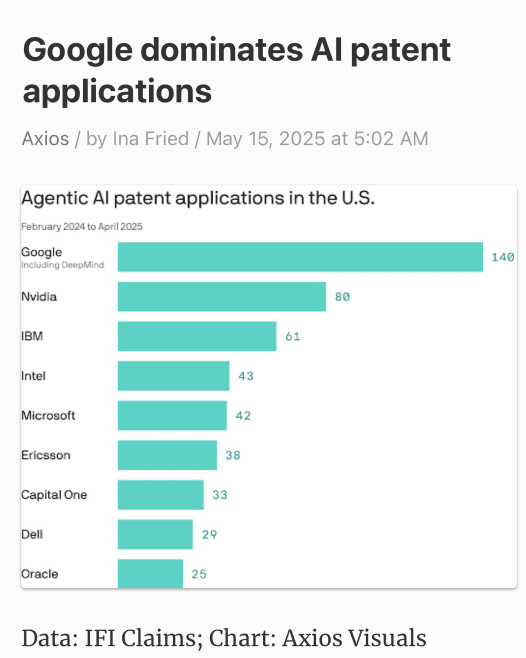
We all know that IBM held the reins as a leading patent filer in AI. But in 2023, Google surged ahead both in generative AI and agentic AI patents. All this reflects the company’s aggressive investment in AI R&D, which positions it at the center of the evolving AI ecosystem.
IFI Claims’ data shows that U.S. patent applications related to generative AI skyrocketed 56% in 2023, which overall reached over 51,000 filings.
“The surge in applications for AI-related patents is a sign companies are actively seeking protection for their AI technologies which leads to an increase in grants as well,”
—said IFI Claims spokesperson Lily Iacurci in a statement to Axios.
What is Generative AI and Why Patents Matter
Generative AI refers to models that can create content, including text, images, audio and even code, based on training data.
With tools like Google’s Gemini, OpenAI’s ChatGPT and Adobe Firefly capturing headlines, the real battle is now happening in the background: patent ownership.
Patents may not directly translate to product superiority, but they indicate areas of high research intensity, give legal usages and open doors to high-end licensing deals.
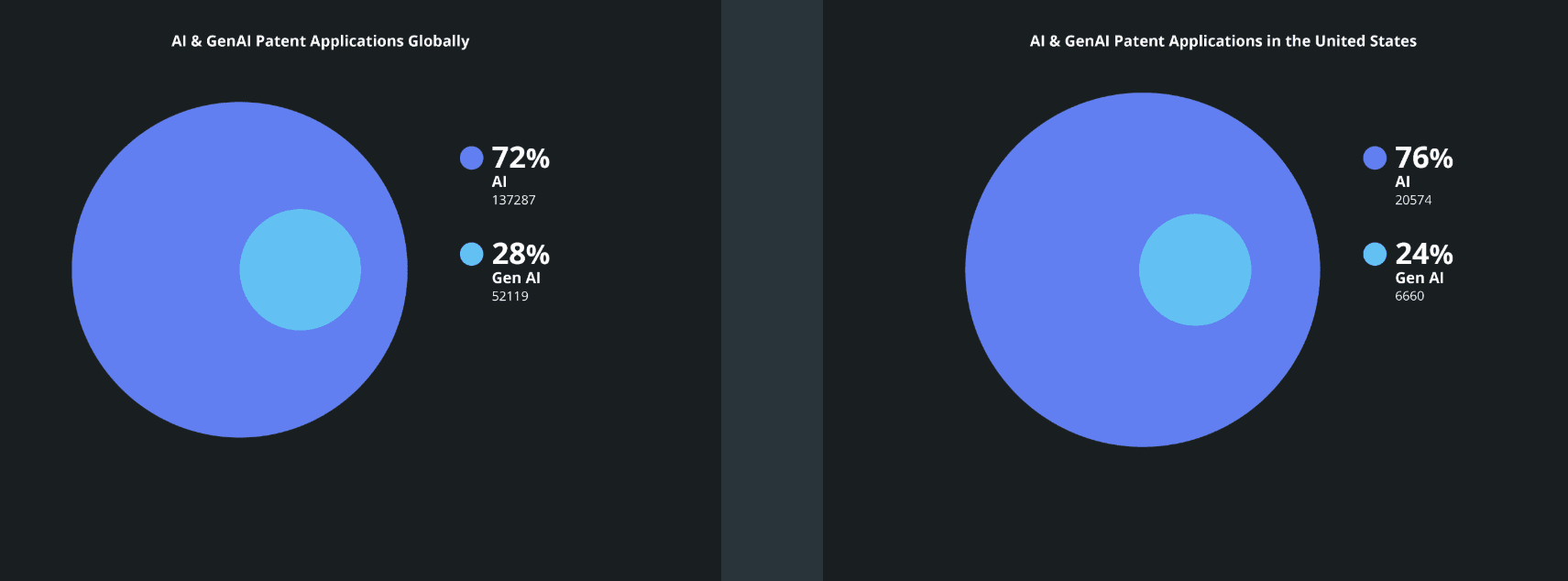
In 2023, generative AI made up 17% of all AI-related U.S. patent applications, while agentic AI, which is AI agents capable of decision-making accounted for 7%.
Globally, the numbers were 23% for generative AI and 5% for agentic AI, which overall highlights their growing importance.
Exclusive:
Google dominates AI patent applications https://t.co/SsrglS5A4I @axios @inafried
— Spiros Margaris (@SpirosMargaris) May 15, 2025
The Next Big Leap in Agentic AI Innovation
Agentic AI is growing as the next phase of intelligent automation, where systems not only respond to commands but make decisions independently. Now think AI assistants that book appointments, manage projects and optimize workflows with minimal human input. Sounds interesting, right?
In this category, Google and Nvidia lead globally, followed by IBM, Intel and Microsoft. Chinese universities are also quickly climbing the ranks, with three of them landing in the global top 10 for agentic AI patents overall, underscoring China’s growing influence in foundational AI research.
Top Companies Leading the Generative AI Patent Race
Let’s understand that in the U.S., the top applicants for generative AI patents in 2023 were:
- Microsoft
- IBM
- Nvidia
- Capital One
- Samsung
- Adobe
- Intel
- Qualcomm
Chinese firms and universities dominate six of the top 10 spots, with Huawei and Samsung ranking just behind Google. The most interesting part is that it also intensifies the rivalry between the US and China.
Why Meta and OpenAI Are Missing from the Top 10
Despite their leadership in AI products, Meta and OpenAI are not in the top 10 for AI patent filings. But that is by design.
OpenAI has stated it pursues patents only for defensive purposes, while Meta is focused on open-source AI development, with initiatives like LLaMA. Google’s patent sprint is no surprise. They are creating not only AI but also the legal framework to regulate it.
China’s Growing AI Patent Footprint
While the US currently leads but China is also catching up. Six Chinese entities are in the top 10 for global generative AI patents.
Though DeepSeek, a major AI model developer from China, had just one patent filing related to training data construction which broader state-driven efforts are powering AI research and patent output.
China’s government has announced initiatives to double AI patent filings by 2026, signaling strong policy support and investment in becoming a global AI leader.
The Strategic Value of AI Patents
AI patents are more than legal paperwork; they are strategic assets. Companies use them to:
- Secure exclusive rights to AI models and techniques.
- Gain a competitive advantage in licensing and M&A
- Establish leadership in emerging AI fields
- Mitigate litigation risks
Will this patent race accelerate progress or slow it down with legal battles? That remains to be seen. But one thing is sure, who controls the patents today may control the platforms, tools and digital agents of tomorrow.

Dileep Thekkethil
AuthorDileep Thekkethil is the Director of Marketing at Stan Ventures, where he applies over 15 years of SEO and digital marketing expertise to drive growth and authority. A former journalist with six years of experience, he combines strategic storytelling with technical know-how to help brands navigate the shift toward AI-driven search and generative engines. Dileep is a strong advocate for Google’s EEAT standards, regularly sharing real-world use cases and scenarios to demystify complex marketing trends. He is an avid gardener of tropical fruits, a motor enthusiast, and a dedicated caretaker of his pair of cockatiels.
