Google has built a retrieval system called FastSearch that makes Gemini faster by pulling fewer documents than the full Google Search.
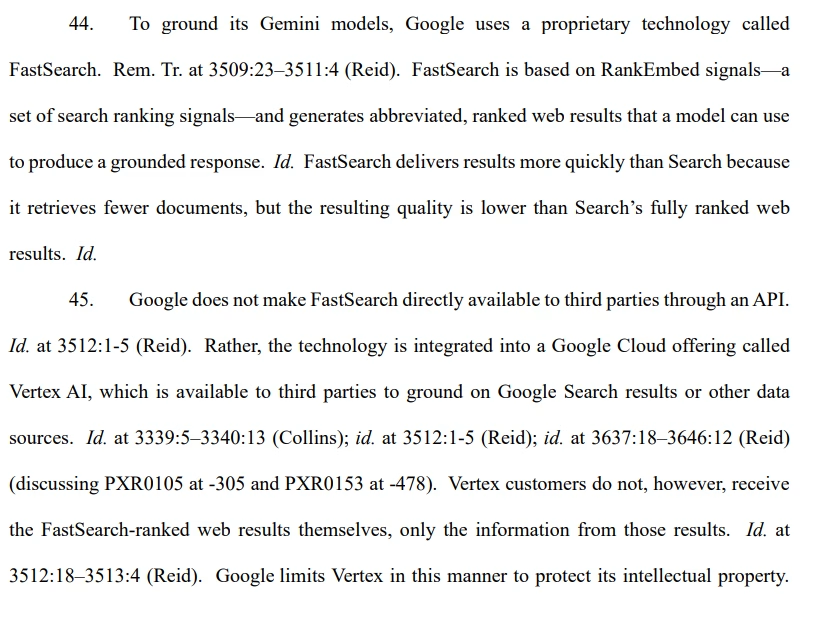
When the federal court dropped its dense antitrust filings recently, I didn’t expect a single paragraph buried in those pages to spark a storm of questions. Yet, there it was, a description of something called FastSearch, a Google-built retrieval system that feeds Gemini its grounding data.
It runs more quickly than Google Search by retrieving fewer documents, trimming ranking stages, and providing just enough evidence for Gemini to respond.
At first glance, it sounds like a technical footnote. But the more I read, the more it felt like the kind of detail that changes how we think about speed, trust, and control in AI-powered search. I kept asking myself, Why is Google building a faster search behind the scenes, and why keep it out of public reach?

What Exactly Is FastSearch?
The court filings describe FastSearch as a lightweight retrieval layer using Google’s RankEmbed ranking technology. Instead of sweeping through the web like a full Search, it fetches a small, high-confidence set of documents fast.
One sentence from the filing says it all: “FastSearch delivers results more quickly than Search because it retrieves fewer documents, but the resulting quality is lower than Search’s fully ranked web results.”
Well, that’s blunt and revealing. Speed takes priority when the audience is a model, not a person.
Why It Matters Now
FastSearch came to light during the remedies phase of Google’s antitrust case. Regulators are probing whether Google uses exclusive infrastructure to maintain dominance. This feature aligns perfectly with that conversation. It gives Gemini an advantage that competitors can’t easily replicate, because they can’t access the same retrieval layer.
That raises uncomfortable questions. Should regulators force Google to share access? Would that boost competition or compromise trade secrets? How far should openness go when intellectual property is at stake? These questions are no longer theoretical—they’re in court filings shaping future policy.
How Google Provides It—and What It Withholds
Developers using Vertex AI benefit from FastSearch indirectly. Their queries tap into it, but the ranked output stays hidden. They see grounded responses, not the raw list of sources.
Google says this secrecy protects proprietary technology, such as RankEmbed. From an IP standpoint, it’s logical. From a transparency perspective, it creates blind spots. For businesses in regulated sectors (finance, law, healthcare), the lack of visibility makes audits and error tracing harder.
The Trade-Off: Speed vs. Thoroughness
FastSearch is quick because it limits depth. That works for most casual prompts, but the risk shows up when precision matters. If an answer relies on too few sources, subtle errors can creep in.
Think of it like taking notes from the first paragraph of three different articles and skipping the rest. You’ll get the gist, but you might miss a critical fact that changes the meaning. For AI models, that gap isn’t obvious—it just appears to be a confident response.
How the Discovery Spread
The detail didn’t go viral by chance. SEO expert Marie Haynes spotted it first and posted on X, drawing attention to the filing.
Gemini is grounded by a proprietary Google technology called FastSearch.
FastSearch is based on RankEmbed signals which is faster but not as high quality as a full web search. pic.twitter.com/QCCbSD2XxE
— Marie Haynes (@Marie_Haynes) September 3, 2025
Why Developers Should Care
If your product depends on grounded LLM outputs, this isn’t background noise. It’s a design factor. Here’s what responsible teams should do:
- Ask the right questions. Find out how many documents your vendor retrieves, what ranking method they use, and whether it varies by query type.
- Build redundancy. Add a deeper retrieval step for sensitive queries where gaps aren’t acceptable.
- Demand evidence trails. Logs with snippets, URLs, and timestamps are critical for auditing. Don’t settle for a black-box answer stream.
- Use human review when needed. For high-risk cases, layer in expert checks before finalizing outputs.
- Review contracts. Ensure agreements specify access rights to logs and compliance documentation. That small detail can prevent bigger problems later.
Competition and Policy Questions
FastSearch sits at the center of a regulatory dilemma. Should a system this important stay exclusive? On one side, forcing access could level the playing field and spur competition. On the other hand, it might hand away the edge that drove Google’s innovation in the first place.
These aren’t easy choices. They are structural decisions that will define how AI infrastructure evolves over the next decade.
Why This Stands Out
FastSearch isn’t just an internal feature. It’s a sign of what’s coming next. Retrieval, once a hidden technical step, is now a competitive advantage. Whoever controls faster, smarter retrieval controls the foundation for AI experiences.
For now, Google has that advantage. Whether regulators will change that is a story still unfolding.
Key Takeaways
- FastSearch speeds up retrieval for Gemini by fetching fewer documents.
- Its quality doesn’t match the full Google Search results.
- It lives inside Vertex AI, where customers never see ranked output.
- Regulators are debating whether exclusivity stifles competition.
- Developers should plan for transparency, redundancy, and compliance.

Dileep Thekkethil
AuthorDileep Thekkethil is the Director of Marketing at Stan Ventures, where he applies over 15 years of SEO and digital marketing expertise to drive growth and authority. A former journalist with six years of experience, he combines strategic storytelling with technical know-how to help brands navigate the shift toward AI-driven search and generative engines. Dileep is a strong advocate for Google’s EEAT standards, regularly sharing real-world use cases and scenarios to demystify complex marketing trends. He is an avid gardener of tropical fruits, a motor enthusiast, and a dedicated caretaker of his pair of cockatiels.
