
Have you recently Googled and noticed an AI-powered answer box at the top, neatly summarizing what you were looking for, without even needing to click a single link? Or perhaps you’ve seen the option to switch into an “AI Mode” for even deeper dives?
Google suddenly seems to know the perfect answer to your complex questions. But have you ever paused and asked what is actually happening under the Google Engine?
At the core of this lies a highly strategic method called the Query Fan-Out Technique. This technique is the behind-the-scenes powerhouse in Google’s latest search innovation: AI Overviews (formerly known as SGE—Search Generative Experience) and the more recently launched AI Mode.

For SEO professionals, the game has changed. It is no longer just about ranking #1 in the traditional sense, but about being the right answer, at the right time, and in the right format.
If your content is not structured and optimized for Google’s fan-out logic, you risk losing visibility and valuable traffic, even with high traditional rankings.
But what exactly is query fan-out? Why is Google betting big on it? And critically, how can you adapt your SEO strategy to thrive in this new landscape? Let’s find out.
What Is the Query Fan-Out Technique?
Let us start with the beginning. When you type a long question into Google today, say, “Is oat milk better than almond milk for weight loss considering lactose intolerance and environmental impact?” at that time you are not sending a single query into the void to be matched against a simple index.
Instead, Google’s systems, powered by advanced AI like Gemini, first work to deeply understand the intent and nuances of your request.
Then, it “fans out” your complex query into multiple, more specific sub-queries, each targeting a different facet or angle of your original question.
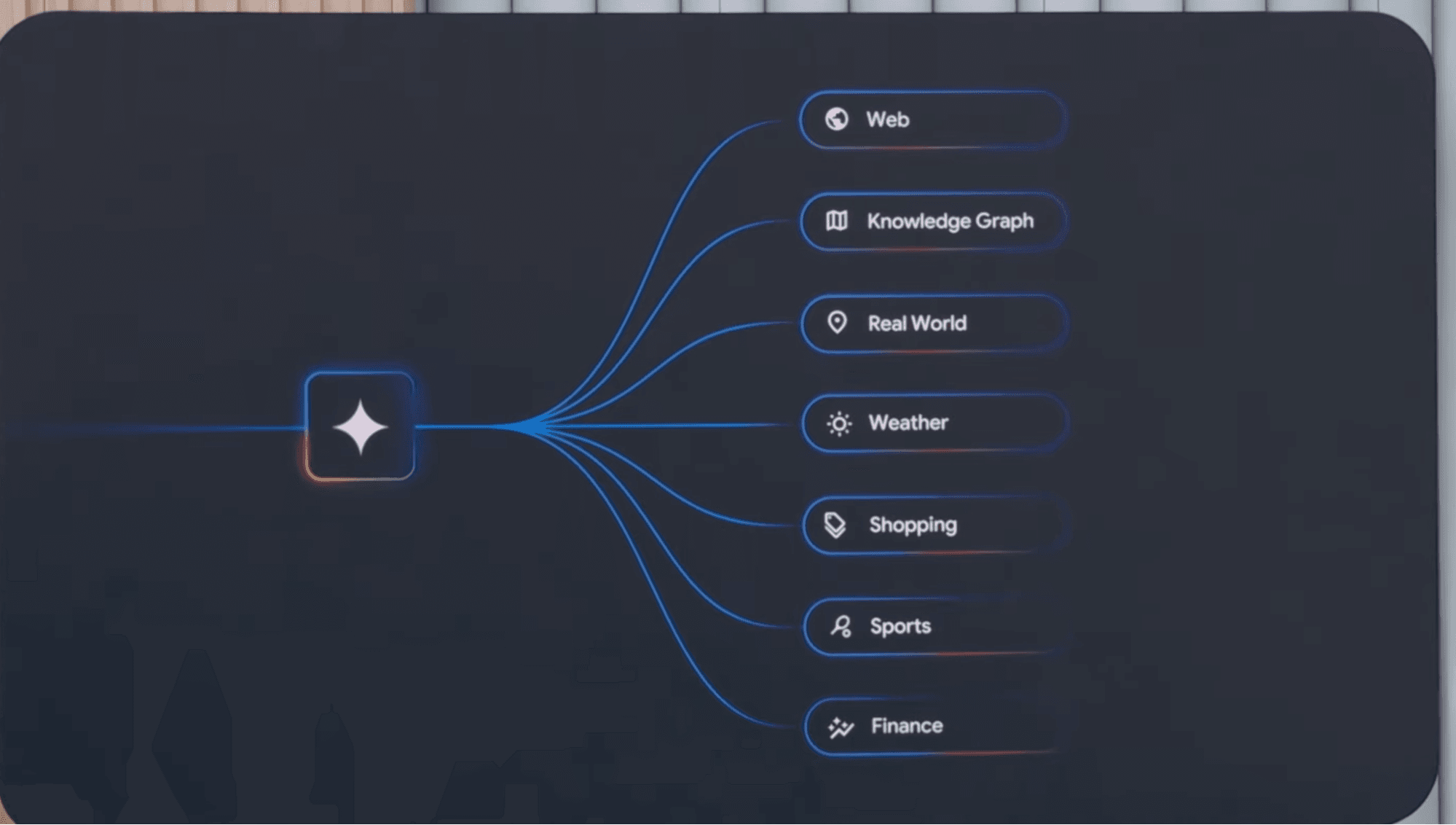
Think of it like a news editor receiving a complex story request. Instead of assigning it to one journalist, the editor sends out simultaneous requests to specialized reporters: one for nutritional comparisons, one for allergen information, one for environmental data, and another for recent studies.
This process of query decomposition means Google is no longer just searching for keywords. Now, it is searching for comprehensive answers and perspectives.
The original query is intelligently split into its thematic or functional components. These sub-queries are then dispatched in parallel to several systems.
This includes traditional web search indexes, vertical engines (like Google Shopping for product-related facets or Google News for current events), Google’s vast Knowledge Graph (for established facts and entities), and, most significantly, various Large Language Models (LLMs) and other AI systems.
These models don’t just fetch information; they help in reasoning, comparing, and understanding context.
Each of these systems processes its assigned sub-query and returns relevant information “shards.” All these pieces are then pulled together, analyzed for relevance and reliability, and synthesized by AI into the cohesive, AI-generated overview or AI Mode response you see.
This is not a minor tweak in processing. It is a fundamental architectural shift in how Google handles search, designed for speed and comprehensiveness despite the complexity.
According to Google, this fan-out logic is already being applied to a significant volume of searches, especially those that are complex, comparative, or layered with nuance, fundamentally changing how users receive information.
Why Is Google Using Fan-Out Technique?
Let us see why this matters and especially now. The way people search has evolved.
Users no longer always search in basic, fragmented terms. Instead of just “electric cars,” they now ask, “What are the most affordable electric cars for city driving with low maintenance and good range for under $30,000 in 2025?”
The increasing specificity and complexity of modern search queries mean Google has to move beyond basic keyword-matching.
It needs to understand intricate intent, context, user preferences, and how different pieces of information relate to each other – and do it all in real time, at scale.
The fan-out approach provides exactly that. By breaking a complex query into smaller, focused components, Google can:
- Search More Deeply and Broadly: It can explore a wider range of its data landscape, pulling from niche sources that might be relevant to one aspect of the query but not all of it. This allows Google to provide “greater breadth and depth of information,” as they put it.
- Improve Relevance: By addressing individual facets of a query, the synthesized answer is more likely to be highly relevant to the user’s overall need.
- Handle Nuance: It can tackle multi-faceted questions, comparisons, and queries that require planning (e.g., “plan a 3-day itinerary for Rome focusing on ancient history and local food”).
- Incorporate Diverse Perspectives: It can gather information from various types of content and sources, potentially leading to more well-rounded answers.
How Query Fan-Out Works in Action
Let’s check an example: “How can I naturally lower cholesterol without medication?”
Google doesn’t just run that exact sentence through one monolithic algorithm. Instead, its AI interprets the multifaceted intent and initiates a fan-out process, potentially running multiple queries in parallel, such as:
- “List of foods that reduce LDL cholesterol” (tapping into nutritional databases and health sites)
- “Best exercise routines for lowering cholesterol” (accessing fitness and medical information)
- “Scientific studies on natural cholesterol reduction methods” (querying scholarly articles and research repositories)
- “Lifestyle changes for cholesterol management” (looking for expert advice from health organizations)
- “Are there risks to natural cholesterol reduction?” (exploring safety and contraindications)
- “What does ‘natural’ mean in the context of cholesterol management?” (LLM-based interpretation)
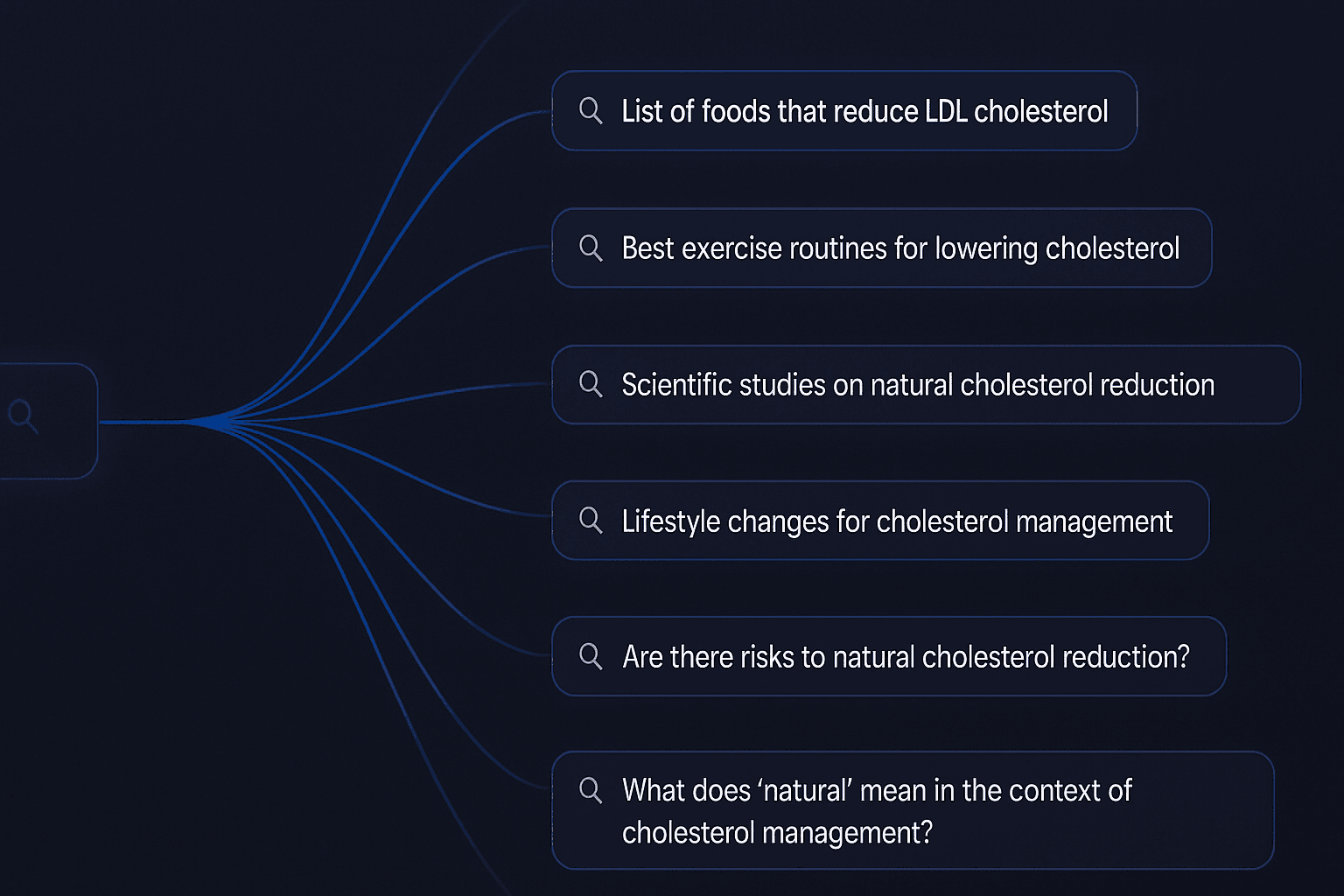
These sub-queries tap into different systems—some hit medical databases, some scan general web content, some access user-generated content like forums for anecdotal experience (where relevant and corroborable), and some run through models like Gemini for reasoning and summarization.
Then, Google’s AI engine performs the critical step of synthesis. It weighs the information from these diverse paths, attempts to filter out inconsistencies or low-quality information, evaluates the E-E-A-T (Experience, Expertise, Authoritativeness, Trustworthiness) signals of the sources, and then composes the final AI Overview or AI Mode response, complete with links to supporting web pages.
This complex process of multi-path retrieval, analysis, and synthesis is computationally intensive, but thanks to advancements in AI, model acceleration, and hardware, it happens remarkably quickly, often in just a couple of seconds.
What Does This Mean for the Future of Search?
With Google doubling down on fan-out and AI-driven synthesis, we are all witnessing a fundamental shift from “search engine” to “answer engine” and even a “conversational problem-solving partner.”
It’s no longer just about indexing documents and providing a list of links. It’s about understanding intent deeply, gathering diverse information, and constructing direct answers and solutions.
And if you think this is just a Google phenomenon, think again. Microsoft’s Copilot, Perplexity AI, and other emerging AI-powered search and information systems are increasingly using similar fan-out-like architectures to deliver comprehensive results.
This is the direction the industry is heading. For SEOs, this means adapting to a world where being part of a synthesized answer is as important, if not more so, than simply holding a top organic link position for a broad keyword.
Key Takeaways & Actionable SEO Strategies for the Fan-Out Era
The rise of query fan-out and AI-generated search results isn’t a signal to abandon SEO; it’s a call to evolve it. Here’s how to adapt your strategy:
Embrace the “Answer a Facet” Mentality
Your content might not rank #1 for a broad, complex query in the traditional sense, but it can still be prominently featured within an AI Overview or AI Mode response if it comprehensively and authoritatively answers a key sub-query or facet that Google’s fan-out process identifies.
Actively predict the various sub-questions your core topics might spark. If you’re writing about “home solar panel installation,” anticipate fanned-out queries like “average cost of solar panels,” “best solar panel brands 2025,” “how long do solar panels last,” “DIY vs professional solar installation,” “solar panel maintenance tips,” etc. Create distinct, in-depth content sections or dedicated pages addressing these specific facets.
Double Down on E-E-A-T (Experience, Expertise, Authoritativeness, Trustworthiness)
Google will favor information from sources it deems highly credible for the specific sub-query. This is where E-E-A-T becomes paramount.
Showcase first-hand experience (e.g., case studies, original research, personal stories where appropriate), highlight author expertise (clear author bios, credentials), build site authority (quality backlinks, industry recognition), and ensure trustworthiness (transparent sourcing, accurate information, secure site).
Prioritize Content Clarity, Depth, and Directness
Google is looking for content that provides clear, concise, and direct answers to those fanned-out sub-queries. Get to the point quickly, then elaborate.
While directness is key for individual facets, overall topical authority requires comprehensive coverage. Ensure your site thoroughly explores a subject area from multiple angles.
Use simple language, short sentences, bullet points, numbered lists, and clear headings to make your content easily digestible for both users and AI.
Leverage Semantic SEO and Topical Authority
Shift focus from targeting isolated keywords to building comprehensive topical authority. Cover a subject area exhaustively.
Strategically link related content within your site to help Google understand the depth of your expertise on a topic and how different pieces of information connect. This reinforces semantic relationships.
Master Structured Data and On-Page Optimization
Use relevant structured data (e.g., FAQPage, HowTo, Article, Product, LocalBusiness schema) meticulously. This provides explicit clues to search engines about your content’s meaning and helps them extract information accurately for AI Overviews.
Use a logical heading hierarchy (H1, H2, H3, etc.) to structure your content. This makes it easier for AI to parse and understand the different sections and the specific questions they answer.
Don’t Neglect Technical SEO and Page Experience
Ensure your site is easily crawlable, indexable, mobile-friendly, and loads quickly. AI systems need efficient access to your content. A poor page experience can hinder your chances of being used as a source.
Make sure important information is in HTML text format. While media is good for engagement, AI relies heavily on parsable text.
Understand No Special “AI Optimization” is Needed (Yet)
Google has stated that no new machine-readable files, “AI text files,” or special AI-specific markup are required to appear in these features.
The focus remains on creating helpful, reliable, people-first content optimized with established SEO best practices.
The Opportunity and The Challenge
The fan-out technique powering AI Overviews presents both an opportunity and a challenge.
The opportunity lies in gaining visibility within these prominent AI-generated summaries, potentially driving highly qualified traffic from users who click through for more details.
Google itself has noted that links in AI Overviews can lead to a “wider and more diverse set of helpful links” being presented and that users clicking these are often more engaged.
The challenge is that users might get their answers directly from the overview, potentially reducing clicks to individual websites for some types of queries.
Furthermore, becoming a consistently cited source requires a sustained commitment to quality and depth.
By understanding the mechanics of query fan-out and proactively adapting your SEO strategies, you can position your content to be a valuable contributor to Google’s evolving search experience, ensuring you remain visible and relevant in an AI-driven future

Dileep Thekkethil
AuthorDileep Thekkethil is the Director of Marketing at Stan Ventures, where he applies over 15 years of SEO and digital marketing expertise to drive growth and authority. A former journalist with six years of experience, he combines strategic storytelling with technical know-how to help brands navigate the shift toward AI-driven search and generative engines. Dileep is a strong advocate for Google’s EEAT standards, regularly sharing real-world use cases and scenarios to demystify complex marketing trends. He is an avid gardener of tropical fruits, a motor enthusiast, and a dedicated caretaker of his pair of cockatiels.
