Key Takeaways
- Time is Wasted on Unqualified Leads: Agency owners spend significant time on discovery calls for leads that were never going to close, often due to disqualifying information that was available beforehand.
- SEO Sales are Different: Unlike transactional sales, SEO is a retainer-based business with a results lag, meaning a bad fit on day one might not be realized until months later after significant resources have been spent.
- High Qualification Bar: The qualification bar for an SEO agency must be higher than for other services because you are qualifying for a long-term relationship where the client’s patience is a key deliverable.
- The B2B Buying Journey: According to Gartner, buyers spend only about 17% of their purchase process meeting with potential suppliers, meaning leads often have pre-formed opinions before they even speak to you.
- Budget Must Match the Niche: A qualified lead’s budget must be relative to the market they are competing in; a budget that works for a local plumber will not work for a national insurance keyword set.
The average agency owner loses about 10 hours a month to discovery calls that were never going to close. A $500 budget asking for page one in 30 days. A site with no content asking why it doesn’t rank. A “decision maker” who has to check with three other people.
None of those calls needed to happen. The information that disqualified each lead was available before anyone picked up the phone.
That’s the whole point of lead qualification: deciding who deserves your sales time before you spend it.
This guide covers the criteria that matter for SEO specifically, a scoring framework you can run in five minutes, the discovery questions that surface bad fits fast, and the red flags that predict churn before the contract is signed.
Why SEO Lead Qualification Is Different From Other Sales
Generic lead qualification advice assumes a transactional sale. You qualify, you close, you deliver, you’re done. SEO doesn’t work that way.
SEO is a retainer business with a results lag. Most campaigns take four to six months to show meaningful movement. That lag creates a unique risk: a client who was a bad fit on day one doesn’t reveal it until month three, after your team has burned dozens of hours on audits, content, and outreach.
By then, the churn is expensive in three directions at once: the lost retainer, the unbillable hours, and the bad review they leave on the way out.
So the qualification bar for an SEO agency has to be higher than it is for, say, a web design shop. You’re not qualifying for a single transaction. You’re qualifying for a 12 month relationship where the client’s patience is a deliverable.
There’s a second reason to be strict. Gartner’s research on the B2B buying journey found that buyers spend only about 17% of their purchase process actually meeting with potential suppliers.
The rest happens without you in the room. If a lead reaches your calendar, they’ve usually already formed opinions about pricing, timelines, and what SEO “should” cost.
Your job in qualification isn’t to educate them from zero. It’s to find out whether the opinions they walked in with are compatible with how you actually work.
What a Qualified SEO Lead Looks Like: 5 Criteria
Strip away the frameworks and acronyms, and a qualified SEO lead comes down to five things. Score a lead against all five and the decision usually makes itself.
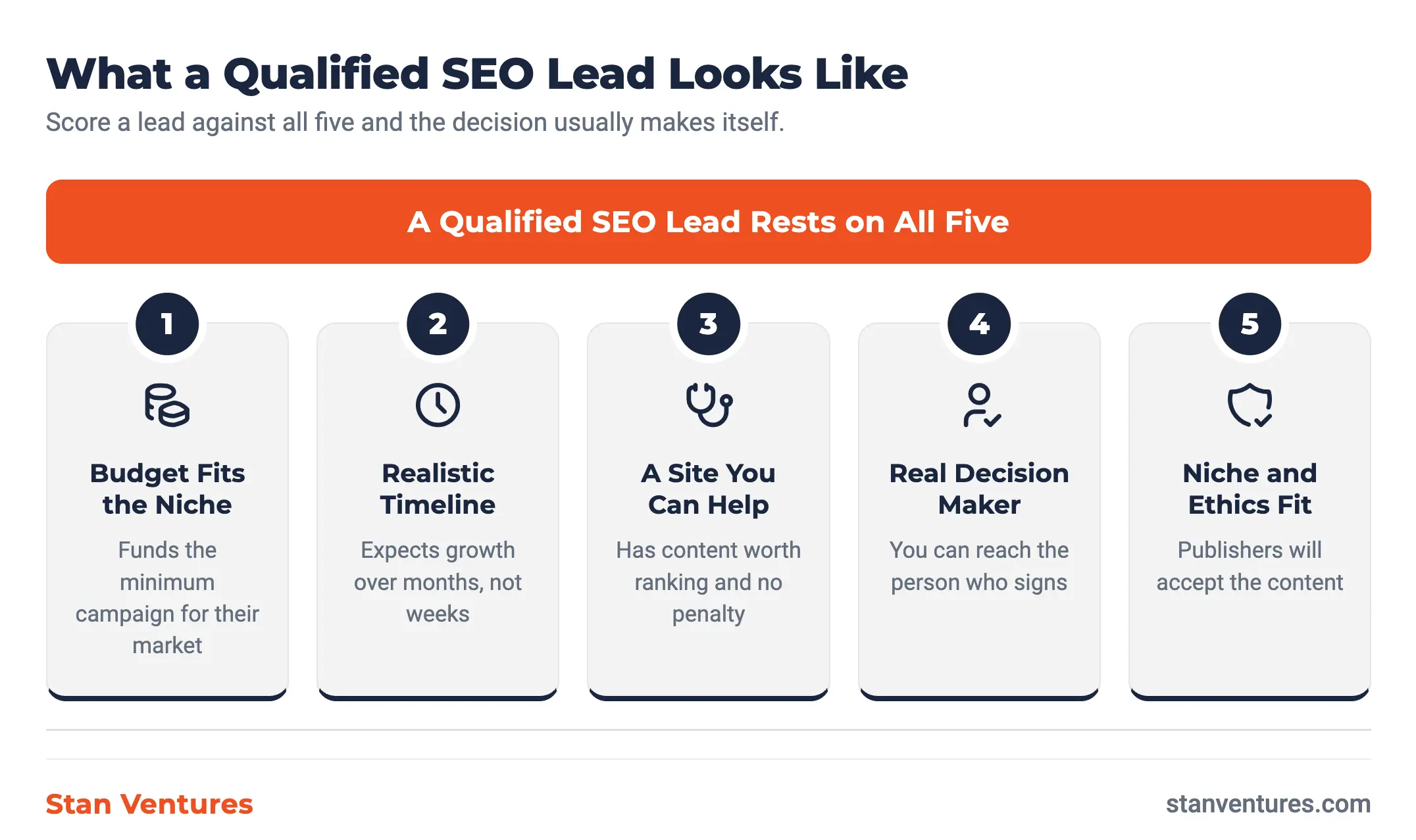
1. Budget that matches the niche
The budget isn’t a single number. It’s a number relative to the market the client is fighting in. A $1,500 monthly retainer can rank a local plumber. The same budget is a rounding error for a national insurance keyword set.
Ahrefs surveyed hundreds of SEO providers on pricing, and the most common monthly retainer bracket landed between $501 and $1,000, with agencies in competitive verticals charging several times that.
Know your own floor by niche. If a lead’s budget can’t fund the minimum viable campaign for their market, no amount of strategy talk fixes that math.
2. Realistic expectations on timeline
Ask every lead one question early: “What results do you expect, and by when?” The answer tells you more than any form field. A lead who says “steady growth over the next year” is workable. A lead who says “page one by next quarter or we walk” is pre-churned. You’re just choosing whether to collect the deposit first.
3. A site that can actually be helped
Look at the asset before the call. Five minutes in a crawler or even a manual click-through answers most of it. Does the site have content worth ranking? Is it hit by a manual action? Is it a two page brochure site in a content-heavy niche? Some sites need a rebuild before they need SEO, and selling SEO to a site that can’t absorb it is how agencies earn refund requests.
4. Access to the real decision maker
Gartner’s same buying research puts the typical B2B buying group at six to ten people. For small business SEO it’s smaller, but the pattern holds: the person who filled out your form is often not the person who signs. Qualify for authority early. “Who else is involved in this decision?” is a polite question that saves you from pitching enthusiastic middle managers with no budget control.
5. Niche and ethics fit
Some leads are disqualified by what they sell, not how much they’ll pay. Industries that violate publisher guidelines or platform terms make link building and content placement nearly impossible, and content built for them tends to get filtered by Google’s helpful content systems anyway. If your agency outsources fulfillment, this matters twice: your white label SEO partner has the same publisher constraints you do.
A Scoring Framework Built for SEO Agencies
BANT is the classic qualification framework. IBM developed it decades ago to score leads on Budget, Authority, Need, and Timeline, and it still works as a skeleton.
But applied raw to SEO, BANT misses the two factors that actually predict retainer churn: site condition and expectation fit.
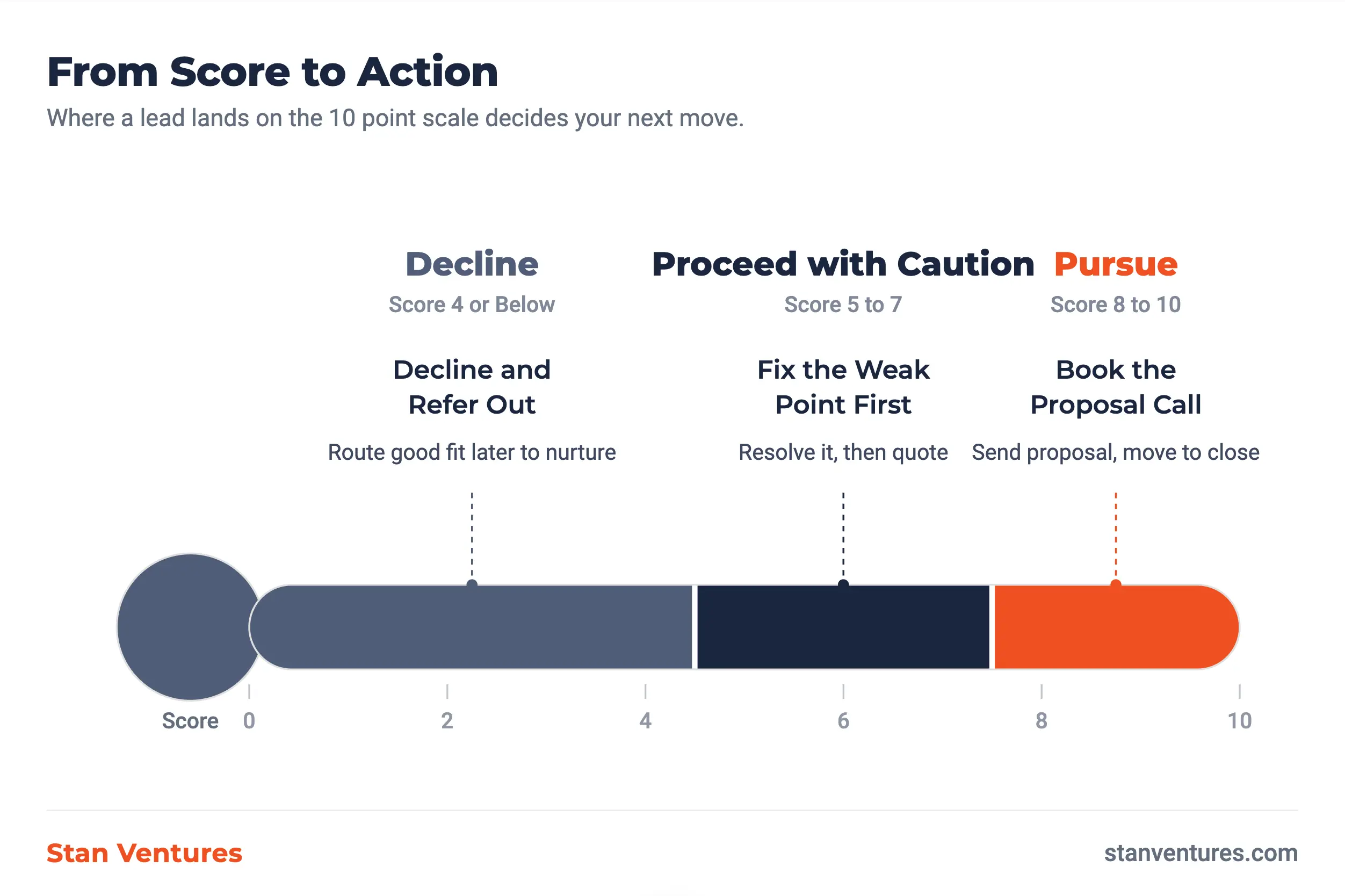
Here’s the adjusted version. Score each criterion 0, 1, or 2. Maximum score is 10.
| Criterion | 0 points | 1 point | 2 points |
| Budget vs. niche | Below your floor for their market | At your floor, no room | Funds the full recommended scope |
| Expectations | Guarantees or 30 day demands | Impatient but coachable | Understands the 4 to 6 month lag |
| Site condition | Penalized, broken, or unbuildable | Needs heavy fixes first | Healthy foundation, clear upside |
| Decision authority | Contact can’t reach the signer | Influencer with signer access | You’re talking to the signer |
| Niche fit | Restricted or guideline-violating industry | Workable but outside your experience | A vertical you’ve ranked before |
Read the totals like this: 8 to 10 means book the proposal call. 5 to 7 means proceed, but address the weak criterion directly on the next call before quoting. 4 or below means decline politely and refer them out.
The five minute rule: every input this scorecard needs is available from the lead form, a quick site review, and one short reply email. If you can’t score a lead in five minutes, your intake form isn’t asking the right questions.
12 Discovery Call Questions That Qualify Fast
The scorecard filters before the call. These questions finish the job during it. You won’t ask all 12 on every call; pick the ones that probe whichever criterion scored weakest.
- What prompted you to look for SEO help right now?
- Have you worked with an SEO agency or freelancer before? How did it end?
- What did that previous provider do, specifically? Can you share their reports or fill in a quick SEO questionnaire?
- What does success look like for you in six months? In twelve?
- What’s your monthly budget range for this?
- How does your business make money from the website today?
- Who else is involved in approving this engagement?
- Who handles changes to your website, and how fast do they turn things around?
- Are you open to publishing new content, or does everything need legal review?
- Have you ever received a penalty notice in Google Search Console?
- If we recommended fixing site issues before starting link building, how would you react?
- What would make you cancel an SEO engagement?
Question 2 and question 12 do the heaviest lifting. A lead who has fired three agencies in two years is telling you who the constant in that equation is.
And a lead who answers question 12 with “if I don’t see rankings in 60 days” just handed you their churn date.
Red Flags: When to Walk Away
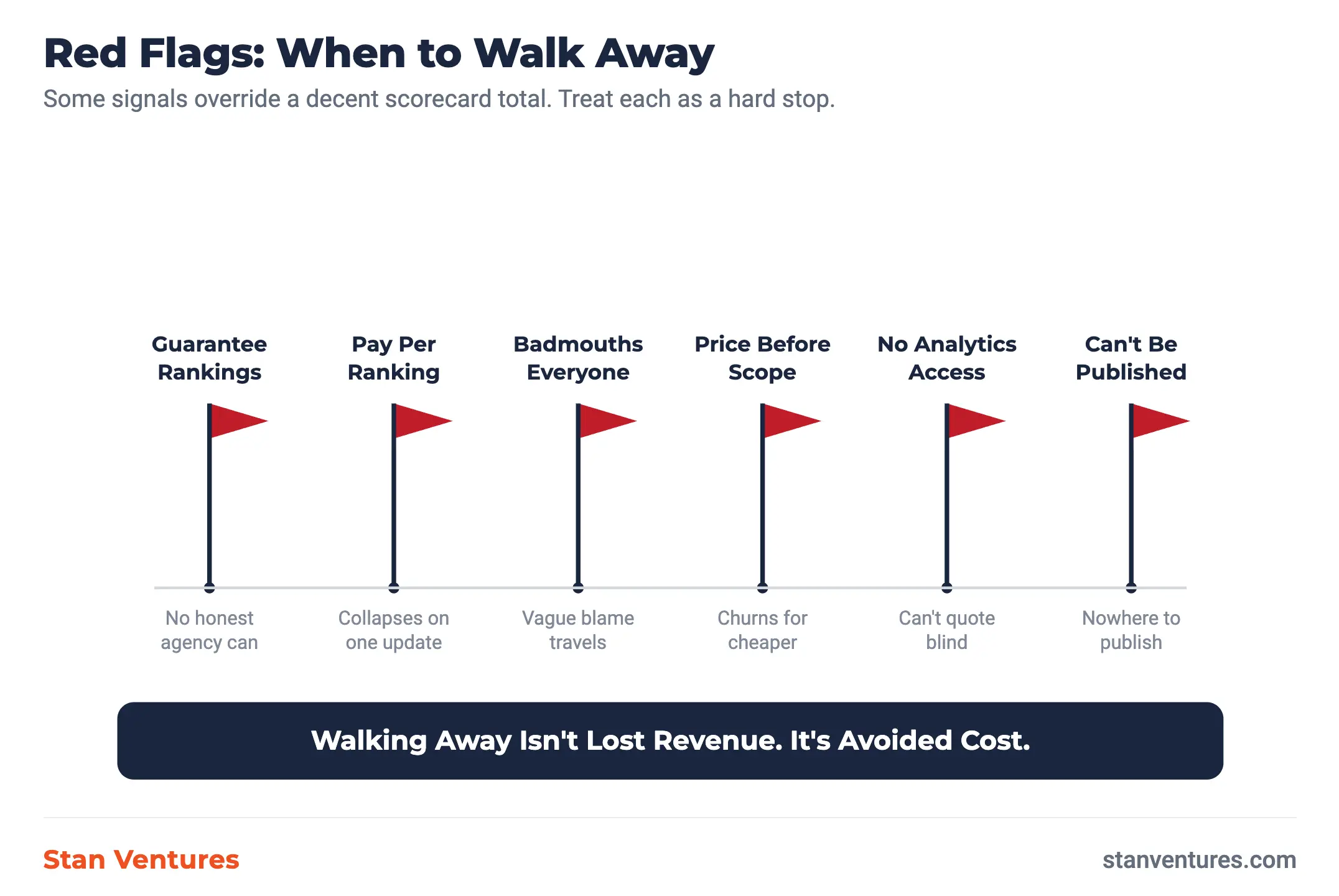
Some signals override a decent scorecard total. Treat any of these as a hard stop, or at minimum a reason to pause and dig deeper.
Walk away signals:
- They ask you to guarantee rankings. No honest agency can, and the lead either knows that and is testing you, or doesn’t know it and will hold you to it.
- They want to pay per ranking achieved rather than a retainer. This model collapses the moment an algorithm update shuffles positions.
- They badmouth every previous provider with no specifics. Vague blame travels. You’re next.
- They negotiate hard on price before hearing the scope. Price-first buyers churn the moment a cheaper option appears.
- They refuse access to analytics or Search Console “until the contract is signed.” You can’t quote what you can’t see.
- Their industry can’t get published. If reputable sites won’t accept content about their product, your blogger outreach options shrink to nothing, and the campaign fails through no fault of the strategy.
Declining these leads isn’t lost revenue. It’s avoided cost. The retainer you don’t sign can’t churn, can’t demand refunds, and can’t eat 30 fulfillment hours before it leaves.
Automate the First Pass
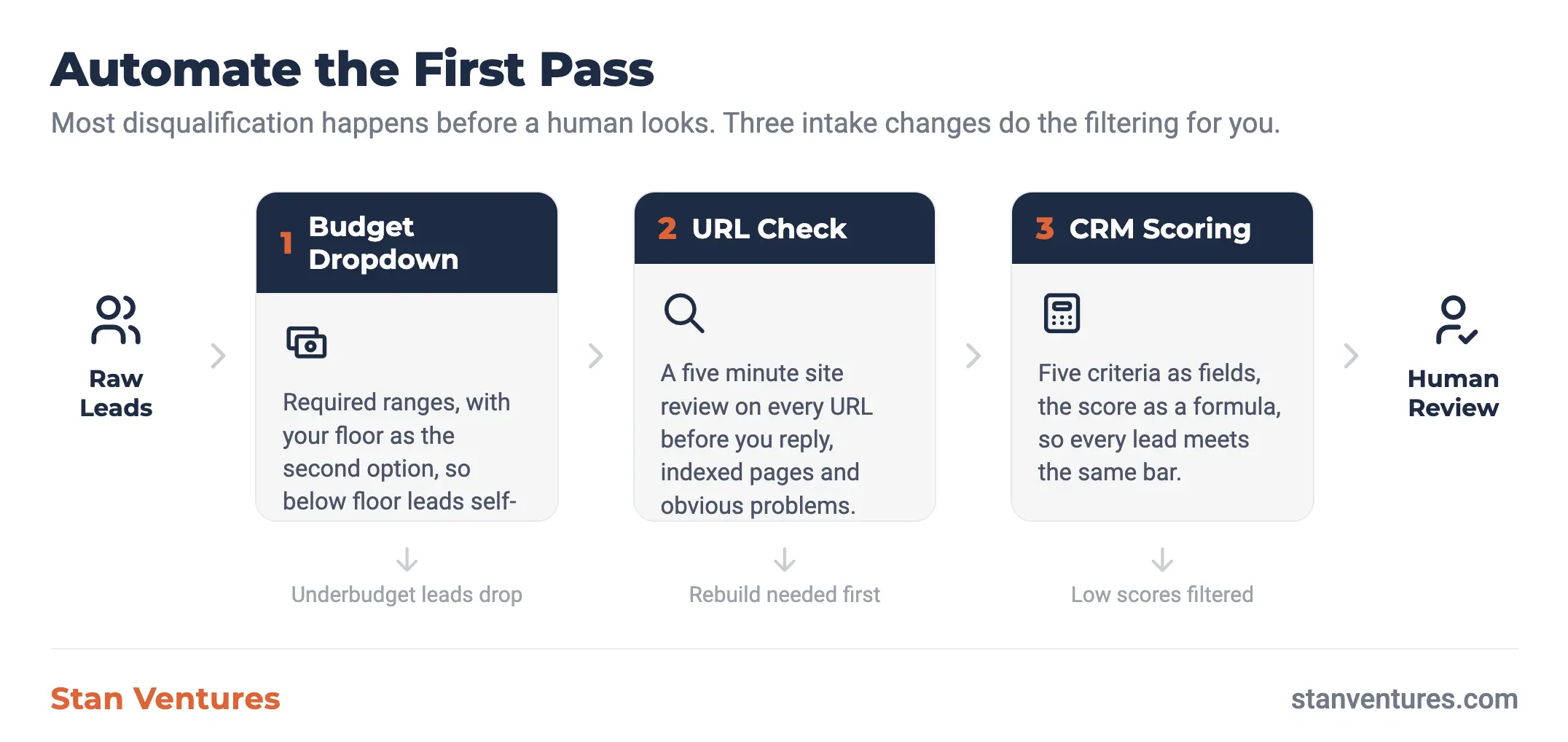
Most disqualification can happen before a human looks at the lead. Three changes to your intake process get you most of the way there.
Make the budget a required dropdown. Not a free text field. Give ranges, and make your real floor the second-lowest option so leads below it self-identify. Agencies resist this because they fear scaring leads off. That’s the feature, not the bug. HubSpot’s sales research consistently finds that prospecting and qualifying eat more seller time than any other activity, and a budget dropdown does that work for free.
Ask for the URL and check it before replying. Build the five minute site review into your workflow. A quick look at indexed pages, organic history, and obvious technical problems sorts leads into “ready for SEO” and “needs a different conversation first.”
Score in the CRM, not in your head. Put the five criteria into your CRM as fields and make the score a formula. When qualification lives in one person’s intuition, it leaves when they do. When it lives in the pipeline, every lead gets the same bar, and you can audit which criteria actually predicted your churned accounts a year later.
What to Do With Disqualified Leads
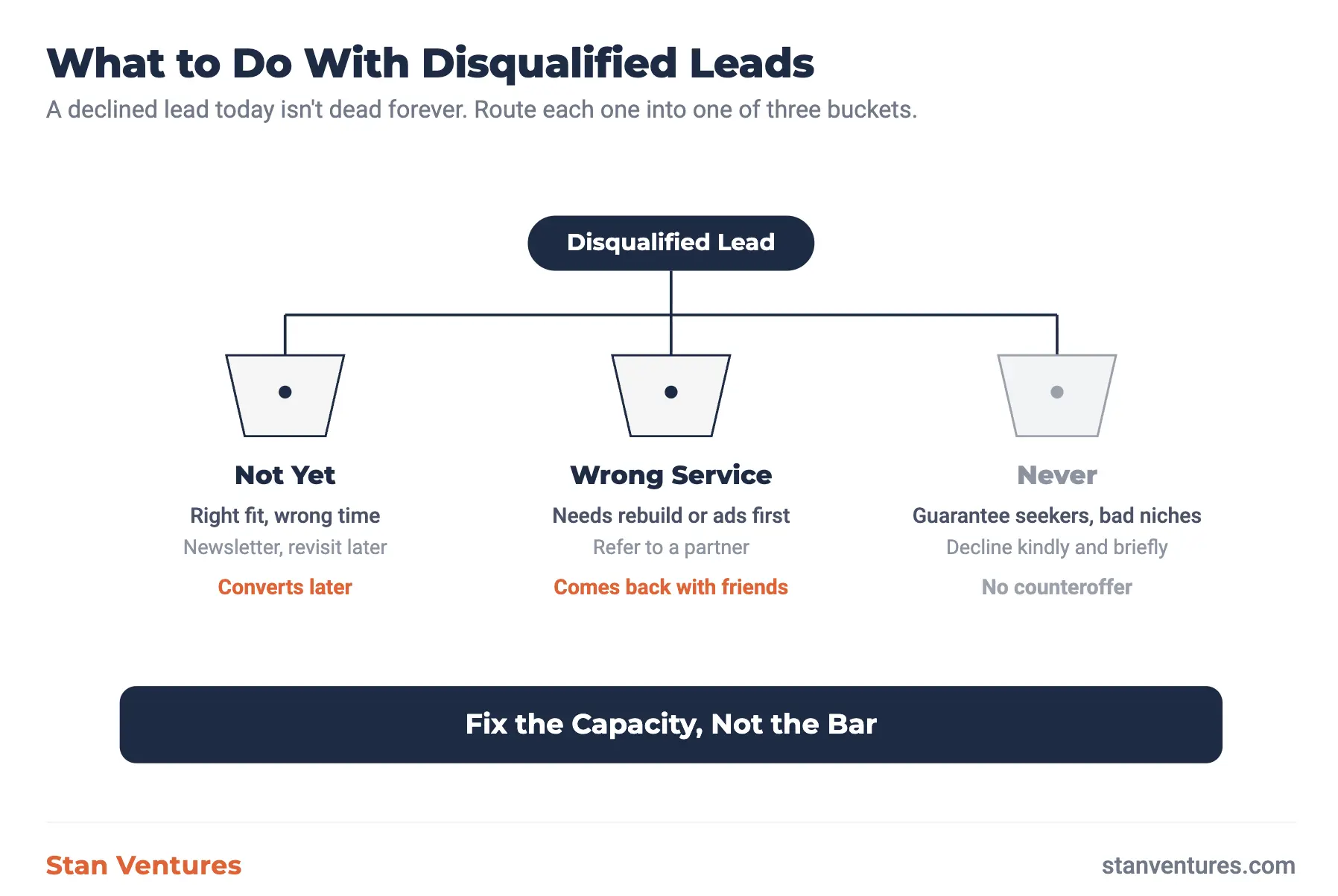
A disqualified lead today isn’t a dead lead forever. Budget grows. Sites get rebuilt. Decision makers change. Route declined leads into three buckets:
Not yet: good fit, wrong timing or budget. Drop them into a monthly newsletter and check back in two quarters. These convert at surprising rates because you were honest when everyone else was hungry.
Wrong service: they need a site rebuild, paid ads, or a content team before SEO makes sense. Refer them to a partner. Referred-out leads come back, and they bring friends.
Never: guarantee-seekers, guideline-violating niches, serial agency-hoppers. Decline kindly, briefly, and without a counteroffer.
One more thing worth saying. Qualification standards only hold if your delivery can keep the promises your sales process makes. Agencies that qualify hard and then under-deliver have solved the wrong problem. If fulfillment capacity is the bottleneck that’s tempting you to take bad-fit clients just to smooth revenue, fix the capacity, not the bar. That’s the problem white label link building partners exist to solve: you keep the client relationship and the qualification standards, and the delivery scales underneath you.
Frequently Asked Questions
What does it mean to qualify a lead for an SEO agency?
Qualifying a lead means evaluating whether a prospect is worth your sales time before investing in calls and proposals. For an SEO agency, that means checking five things: whether their budget matches their competitive niche, whether their timeline expectations are realistic, whether their website can actually benefit from SEO, whether you’re talking to the real decision maker, and whether their industry is one you can publish content for.
What is the best lead qualification framework for SEO agencies?
BANT (Budget, Authority, Need, Timeline) works as a starting point, but SEO agencies should extend it with two additional criteria: site condition and expectation fit. Scoring each of the five criteria from 0 to 2 gives a 10 point scale where 8 or above means pursue, 5 to 7 means proceed with caution, and 4 or below means decline.
How long should it take to qualify an SEO lead?
About five minutes for the first pass. A well-built intake form with a required budget dropdown, the website URL, and a goals question gives you enough to score a lead before any call. The discovery call then confirms or corrects that score rather than starting from zero.
What are the biggest red flags in SEO leads?
The strongest churn predictors are demands for guaranteed rankings, pay-per-ranking payment models, vague blame directed at every previous provider, price negotiation before scope discussion, refusal to share analytics access, and industries that reputable publishers won’t accept content from.
Should an SEO agency turn down paying clients?
Yes, when the engagement is set up to fail. A bad-fit retainer costs more than it pays: unbillable fulfillment hours, refund risk, negative reviews, and team morale. Declining a lead that scores 4 or below on a qualification scorecard protects margin better than signing it.

Dileep Thekkethil
AuthorDileep Thekkethil is the Director of Marketing at Stan Ventures, where he applies over 15 years of SEO and digital marketing expertise to drive growth and authority. A former journalist with six years of experience, he combines strategic storytelling with technical know-how to help brands navigate the shift toward AI-driven search and generative engines. Dileep is a strong advocate for Google’s EEAT standards, regularly sharing real-world use cases and scenarios to demystify complex marketing trends. He is an avid gardener of tropical fruits, a motor enthusiast, and a dedicated caretaker of his pair of cockatiels.


