If you’ve ever worried that adding new topics to your website might hurt your SEO, you’re not the only one. At the recent Google Search Central Live NYC, Danny Sullivan addressed this very concern—and the good news is that you don’t need to panic.
Expanding your content won’t tank your rankings, but it also won’t guarantee success overnight.
This insight comes from the Search Engine Journal, which covered Sullivan’s explanation in depth.
No SEO Penalty, But No Overnight Success Either
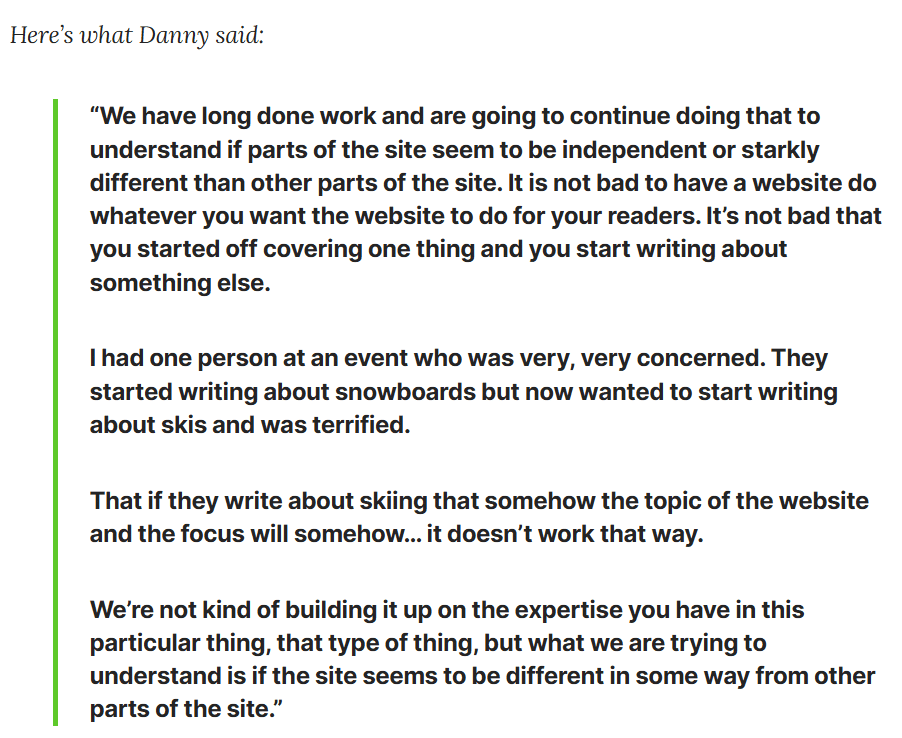
Sullivan reassured website owners that diversifying their content isn’t a bad thing. “It’s not bad that you started off covering one thing and you start writing about something else,” he explained.
However, it’s important to keep in mind that Google may not immediately recognize your fresh content with the same authority as your well-established subjects.
Google’s “Mini-Site” Effect
Think of your website as a restaurant known for its legendary burgers. If you suddenly start serving sushi, your regulars might give it a try, but they won’t instantly see you as a sushi expert. Google works the same way.
If your tech blog starts covering fitness, Google may treat that new section as separate, meaning it has to earn its own credibility over time.
Sullivan calls this the “mini-site” effect, where Google evaluates new topics independently instead of letting them ride on the reputation of your existing content.
How to Make New Topics Rank Well
Since Google assesses different topics separately, your new content needs to prove itself. Here’s how you can help it succeed:
Create Topic Hubs: Group new content into dedicated sections so Google can easily understand what it’s about.
Show Your Expertise: Publish in-depth, high-quality content that demonstrates knowledge and authority in the new topic.
Connect the Dots: Use internal links to tie new content back to related topics you’ve already covered.
Earn Credibility: Get backlinks from authoritative websites in your new niche.
Keep an Eye on Performance: Monitor rankings and user engagement to see what’s working.
Key Takeaways
- Adding new topics won’t hurt SEO, but they won’t automatically rank well either.
- Google may treat vastly different topics as separate, meaning they must build their own authority.
- Ranking well in a new niche requires the same effort as launching a new site—quality content and strong SEO tactics.
- Internal linking helps Google understand how new topics fit within your existing site.
- SEO success in new topics takes time, consistency, and relevance.

Dileep Thekkethil
AuthorDileep Thekkethil is the Director of Marketing at Stan Ventures, where he applies over 15 years of SEO and digital marketing expertise to drive growth and authority. A former journalist with six years of experience, he combines strategic storytelling with technical know-how to help brands navigate the shift toward AI-driven search and generative engines. Dileep is a strong advocate for Google’s EEAT standards, regularly sharing real-world use cases and scenarios to demystify complex marketing trends. He is an avid gardener of tropical fruits, a motor enthusiast, and a dedicated caretaker of his pair of cockatiels.
