OpenAI has just made a major move that could reshape how we defend digital systems. On 30 October, the company announced “Aardvark”
It is a GPT-5-powered autonomous cybersecurity agent designed to detect, explain, and even help fix vulnerabilities in codebases without constant human oversight.
Can AI truly become the ultimate digital defender? Or is this the next chapter in a growing debate about giving AI more autonomy in security-critical environments?
What Is Aardvark and Why Did OpenAI Build It?
OpenAI describes Aardvark as an autonomous cybersecurity researcher. It is an agent capable of analyzing source code repositories, identifying vulnerabilities, explaining their implications, and generating potential patches to fix them.
Built on the GPT-5 architecture, Aardvark combines large language model reasoning with sandboxed testing and tool-based validation. It is an approach that moves beyond simple code scanning to more research-grade vulnerability analysis.
The idea behind Aardvark is simple yet profound: there are tens of thousands of vulnerabilities discovered every year across enterprise and open-source ecosystems, far too many for human teams to address manually.
OpenAI believes automation can close that gap.
According to Matt Knight, OpenAI’s VP of Security, Aardvark was originally developed as an internal tool to help OpenAI engineers safeguard their own systems.
“Our developers found real value in how clearly it explained issues and guided them to fixes. That signal told us we were on the path to something meaningful,” Knight said.
In short, Aardvark wasn’t born as a research experiment; it emerged from a real operational need.
How Does Aardvark Work? Step-by-Step Breakdown
OpenAI says Aardvark takes a multi-stage approach to cybersecurity analysis that mirrors how human security researchers work but with machine-level speed and consistency.
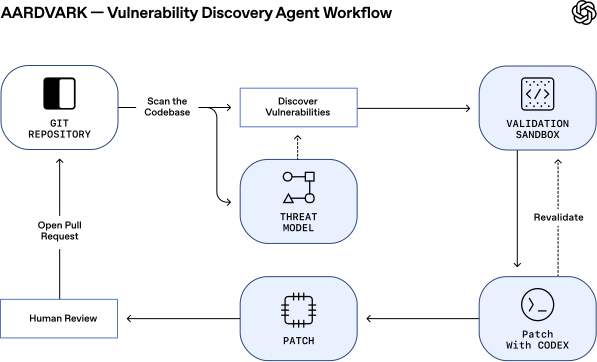
Here’s how the process unfolds:
- Repository Understanding
Aardvark first connects to a code repository and analyzes the structure, dependencies and intended functionality. It does not just look at lines of code, it tries to understand the purpose behind the system, its design goals, and potential weak points.
- Vulnerability Detection
Next, the agent scans both historical and newly committed code to spot potential security issues. This includes analyzing patterns, functions and dependency interactions that might expose exploitable flaws.
- Annotation and Explanation
Unlike traditional scanners that output technical logs, Aardvark uses natural language annotations to explain each issue directly within the code. Developers can see, in plain English, why something is risky and how it could be abused.
- Proof of Vulnerability
To confirm its findings, Aardvark moves the suspicious code into a sandboxed environment, a secure, isolated virtual space where it attempts to trigger or exploit the potential flaw. If successful, it tags the issue as a confirmed vulnerability and attaches metadata for classification.
- Patch Recommendation
Once a vulnerability is validated, Aardvark integrates with Codex, OpenAI’s code-writing assistant, to generate a proposed fix. This patch is then reviewed and re-analyzed by Aardvark to ensure it resolves the issue without introducing new ones.
The human developer still has final oversight including reviewing, testing, and approving any patch before it’s applied.
It is not replacing human security experts, it is augmenting them, giving teams a digital researcher that works around the clock.
What Makes Aardvark Different from Traditional Security Tools?
Static code analyzers, vulnerability scanners, and threat detection platforms already exist. So what makes Aardvark stand out?
The difference lies in autonomy and reasoning.
Traditional tools rely on rule-based pattern matching, they can identify known vulnerabilities, but they struggle with contextual logic or novel attack vectors.
Aardvark, powered by GPT-5, does not just look for specific patterns, it reasons about why a piece of code might be insecure, much like a human analyst would.
For example, instead of just flagging an outdated library, Aardvark might identify a chained exploit, where a combination of harmless-looking dependencies could be exploited together.
Moreover, its explanatory layer transforms raw findings into actionable intelligence. Developers no longer have to decode cryptic scanner outputs.
Aardvark provides clear, narrative-style explanations of each vulnerability, its impact, and suggested remediation steps.
That’s a huge step toward making cybersecurity accessible, explainable, and collaborative.
How Secure Is an Autonomous Security Agent?
Interestingly, while Aardvark aims to make systems safer, its very existence highlights a paradox, AI agents themselves can become attack surfaces.
A recent study cited by ZDNET found that 96% of IT professionals believe AI agents pose new security risks, even as they continue deploying them.
This means OpenAI has to ensure that Aardvark, a system with access to sensitive codebases, does not itself introduce vulnerabilities or become a vector for exploitation.
That’s why the company has restricted its availability to private beta partners only. The initial rollout will help OpenAI refine detection accuracy, strengthen sandbox validation, and collect feedback before broader deployment.
As Knight noted, OpenAI is working closely with early adopters to enhance “validation workflows and detection precision.”
In essence, Aardvark isn’t just learning how to find vulnerabilities, it is also learning how to avoid becoming one.
Why the Name ‘Aardvark’?
OpenAI has not given an official explanation, but the name fits the metaphor perfectly. The aardvark is a nocturnal animal that hunts quietly and persistently for hidden insects beneath the surface.
A fitting symbol for a cybersecurity agent designed to root out unseen vulnerabilities before attackers can exploit them.
How to Access Aardvark (and Who Can Use It Right Now)
At this stage, Aardvark is in private beta, available only to select partners and security teams invited by OpenAI.
The company is encouraging enterprise users, research labs, and development organizations to participate, providing real-world feedback that will shape how Aardvark evolves.
Participants will gain early access to:
- Vulnerability scanning and annotation tools.
- Sandboxed proof testing.
- Integration with OpenAI’s Codex patching assistant.
- Continuous update cycles as GPT-5’s security reasoning improves.
There’s no confirmed timeline for a public release, but OpenAI hinted that broader access could follow once it achieves consistent, human-comparable detection accuracy.
What Does Aardvark Mean for the Future of Cybersecurity?
Does Aardvark signal the start of a new era of AI-driven defense?
It might. The cybersecurity industry is facing an unprecedented challenge: a shortage of skilled professionals combined with an explosion in vulnerabilities.
AI systems like Aardvark could fill the gap by handling repetitive, time-consuming analysis, allowing human experts to focus on strategic defense and complex exploit research.
But there is also a broader implication. Just as AI can help secure systems, it can also empower cybercriminals, as OpenAI itself recently acknowledged. Adversaries are already using generative AI to write better phishing emails, automate malware obfuscation, and even generate exploit code.
That means the cyber battlefield is now AI vs AI, attackers using automation to break systems, defenders using it to fortify them.
Aardvark, in that sense, is a statement of intent from OpenAI: that autonomous AI can be a force for good in cybersecurity, not just a threat.
And as this new AI-driven era unfolds, organizations will need not just stronger tools, but also smarter visibility online.
That is where Stan Ventures’ SEO for cybersecurity companies becomes essential. By combining technical SEO expertise with deep industry insight, we help cybersecurity firms amplify their authority, rank for high-intent keywords, and reach businesses actively seeking AI-driven protection solutions.
Because in the world of modern cyber defense – visibility, trust, and expertise matter as much as firewalls and encryption.
Aardvark’s Promise and Precaution
OpenAI’s Aardvark feels like a natural next step after the company’s AI coding assistant, Codex, and its research-driven focus on responsible AI. But this time, it is about protection.
If it delivers on its promise, Aardvark could become an indispensable member of every security team, tirelessly scanning, explaining, and recommending fixes and doing so at a scale no human team could match.
Still, the same principle applies to AI as to cybersecurity itself: trust, but verify.
As Aardvark continues its private beta, OpenAI’s challenge will be balancing power with restraint, ensuring its agent remains a guardian, not a potential liability.
TL;DR – Key Takeaways
- OpenAI has launched “Aardvark,” a GPT-5-powered autonomous cybersecurity agent.
- Purpose: To identify, explain, and help fix vulnerabilities across codebases.
- Functionality: Scans repositories, annotates findings, verifies them in sandboxes, and suggests patches via Codex.
- Status: Currently in private beta with select partners.
- Goal: Automate security research while enhancing transparency and developer collaboration.
- Broader impact: Marks a major milestone in the race toward AI-driven cybersecurity defense.

Dipti Arora
AuthorDipti Arora is a Senior Content Writer with over seven years of experience creating impactful content across Digital Marketing, SEO, technology, and business domains. She has a strong background in managing news verticals and delivering editorial excellence. Dipti has contributed to leading publications such as The Times of India and CEO News, where her research-driven storytelling and ability to simplify complex subjects have consistently stood out. She is passionate about crafting content that informs, engages, and drives meaningful results.