
Can claiming your business profile in the newly launched ChatGPT Business Hub make you appear more often in AI recommendations?
Over the last couple of days, discussion forums and SEO communities have been debating this in detail, and a handful of experts say that claiming the business will help it get cited more.
But we at Stan Ventures read the documentation released by OpenAI, and nowhere does it say that just claiming the profile can boost the citation count.
When ChatGPT Business Hub launched on November 10, 2026, most experts hailed it as the Google Business Profile of AI search, and most of them urged businesses to claim the profile immediately.
We recommend the same. Go ahead and claim it. And why wouldn’t you? It’s a no-brainer for any business whose customers use ChatGPT, and there is zero cost involved.
However, keeping your hopes high about getting the business cited or recommended more often may lead to disappointment. In the initial days you may see a benefit, as only a few businesses will be verified. Down the line, most of your competitors will get verified too, and the exclusivity around the blue tick is not going to last long.
Remember what happened with X soon after Elon Musk made the blue tick a feature anyone could purchase?
Business Hub Gives You a Profile, a Feed and 28 Days of Data
So what do you get once you claim the profile? Everything runs through a new dashboard called Business Hub, and the audience on the other side is not small. OpenAI says ChatGPT now reaches 1.2 billion people each week.
Once your business is verified and carries the blue tick, you can:
- Update the details ChatGPT shows: website, description, logo, and delivery and return policies
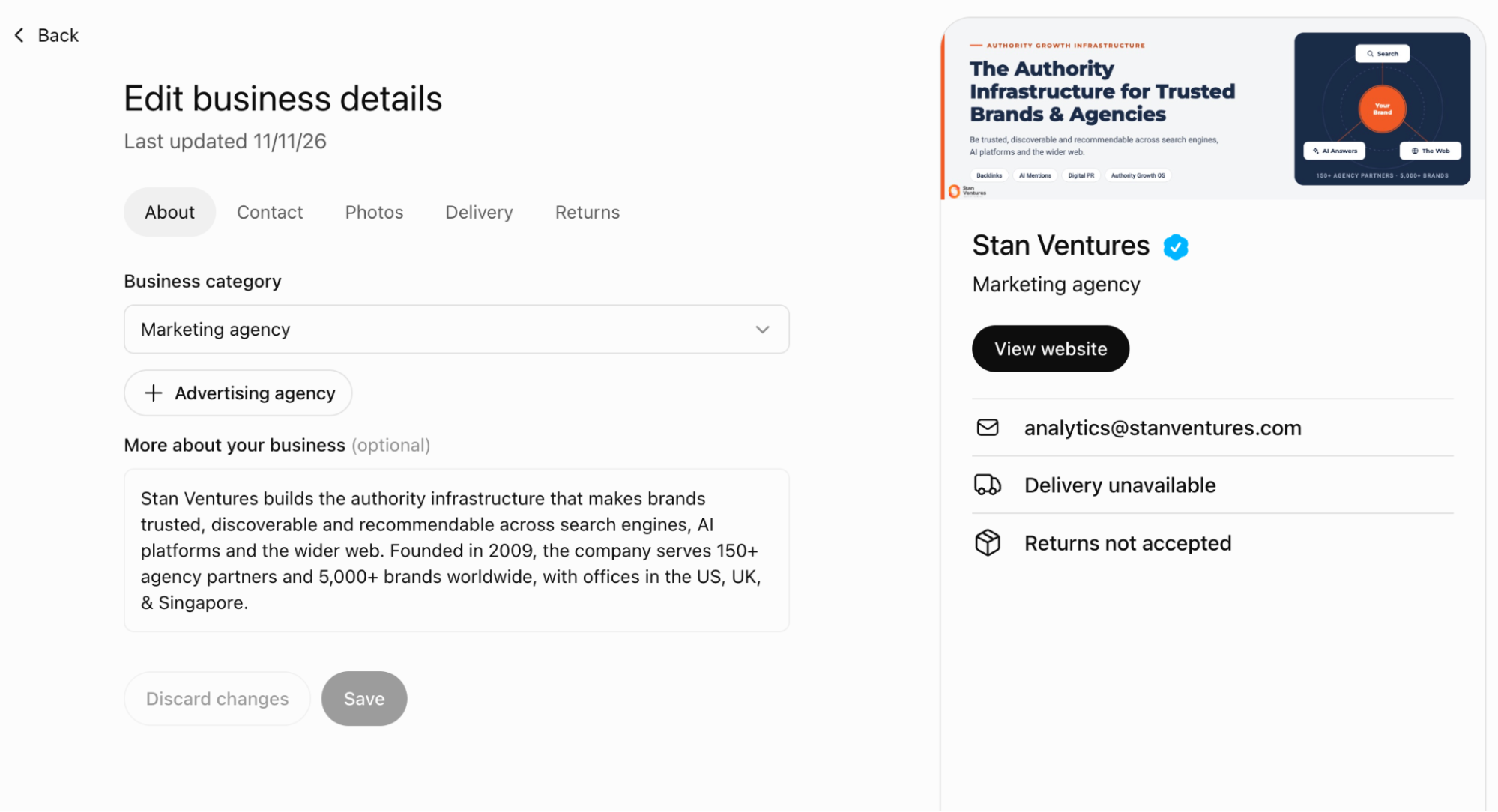
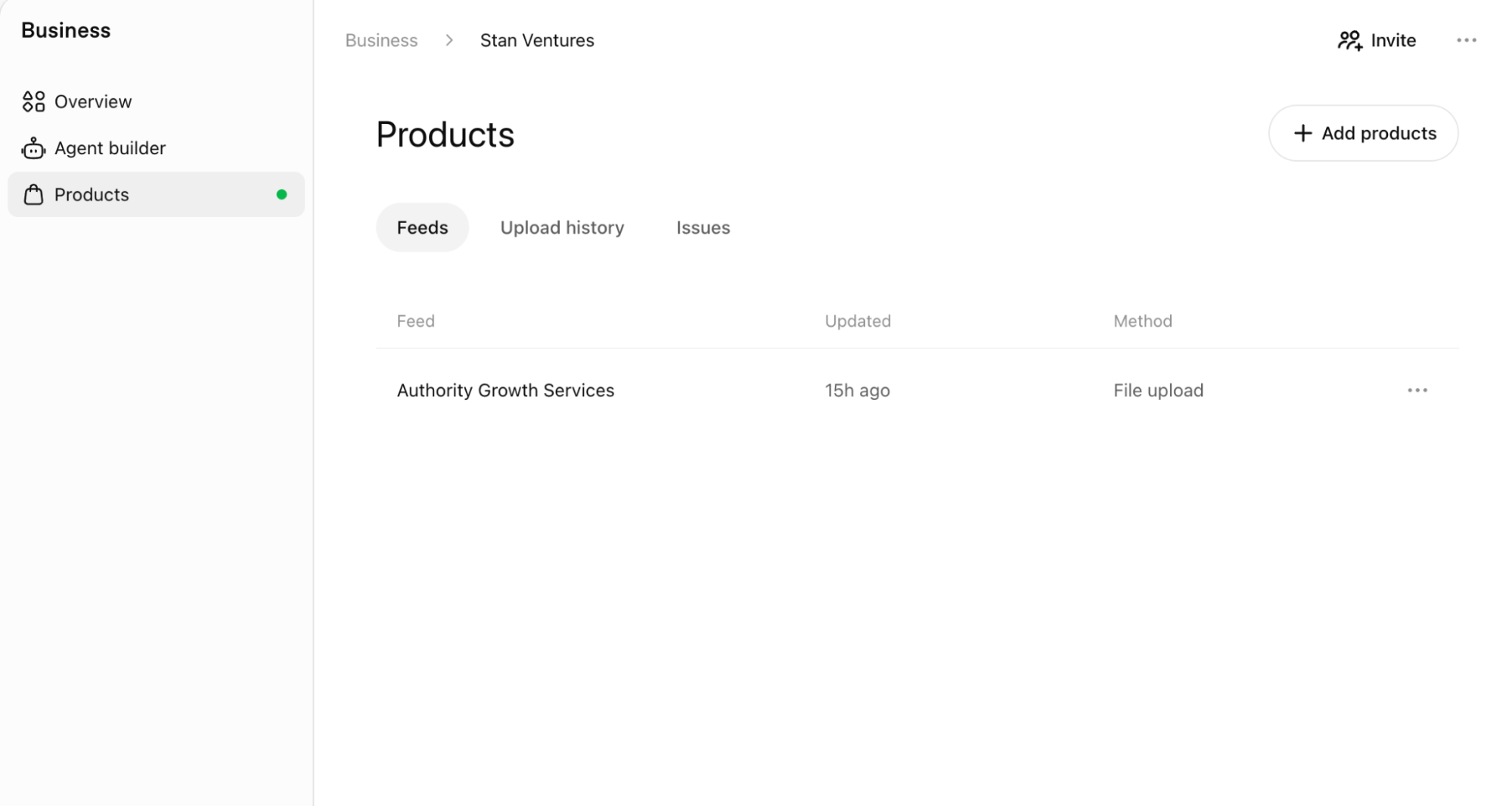
- Add product feeds with pricing and availability
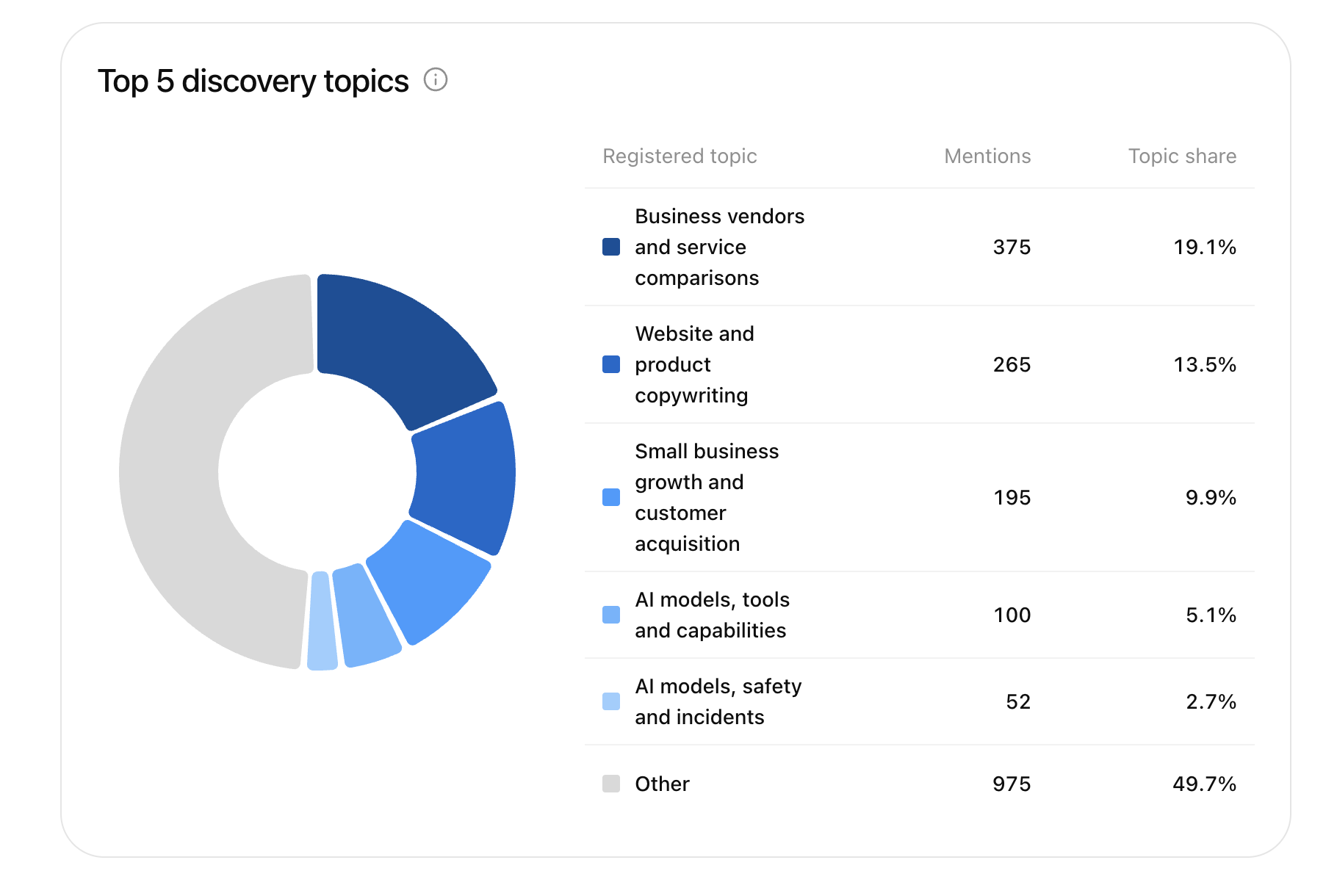
- See insights for the past 28 days: mentions, profile views, website clicks and discovery topics (the common themes in conversations where ChatGPT cites the business’s site)
- Publish a Business Agent, a branded assistant shoppers can chat with inside ChatGPT. This one is limited to eligible US ecommerce and online service businesses

However, not every business can walk in and claim a profile today. It depends on the kind of business you run.
| Business type | What’s available at launch |
|---|---|
| Online business with a website | Claim a profile wherever ChatGPT is available |
| Local store or restaurant | Claim an existing listing, United States only |
| Service business (serving customers remotely or at their premises) | Marked as coming soon |
| US ecommerce or online service business | Claim a profile and apply for a Business Agent |
If you are outside the US, the options are thinner. For most businesses in India and the UK, including local ones, only the online business route is open for now.
Business Hub Doesn’t Rival Google Business Profile for Local Search Yet
Is this the end of the road for Google Business Profile? We don’t think so, at least not for local search.
Google Business Profile has had competitors for years. Bing Places for Business and Apple Business both let owners claim and manage their listings. ChatGPT’s Business Hub is the newest entrant, and it works differently from all three.
| Platform | Where listings appear | What it gives businesses | AI connection |
|---|---|---|---|
| Google Business Profile (launched 2005 as Local Business Center) | Google Search and Google Maps | Listing management, reviews, performance insights | Google’s own AI search features |
| Bing Places for Business (now at bing.com/forbusiness) | Bing Search and Bing Maps | Listing management, Google Business Profile import, bulk editing | Feeds local results in Microsoft Copilot |
| Apple Business (formerly Business Connect) | Apple Maps, Siri, CarPlay | Listing management, Showcases for offers, insights | Siri answers for nearby businesses |
| ChatGPT Business Hub (beta, November 2026) | ChatGPT answers | Profile details, product feeds, mention and click insights, Business Agents | Is the AI platform |
If you ask us, the closer comparison is Google Business Profile and Google Search Console put together. This is the first time OpenAI has given businesses a first-party count of how often they appear in unpaid ChatGPT answers.
Until now, most of us were estimating it, either with outside tools that run sample prompts or by looking at ChatGPT referral traffic in Google Analytics.
A word of caution about Bing. It is usually described as the second largest traditional search engine, but its share is far behind Google’s. The reason it still matters today is that Copilot draws on it.
ChatGPT’s Local Answers Run on Yelp, Not Google Business Profile
Where does ChatGPT get its local business data from? Not from Google Business Profile, at least not the way Google Search does. OpenAI says ChatGPT may use unnamed trusted third-party providers for nearby business listings, and may show restaurant availability from OpenTable, Resy or Yelp.
And independent research points the same way:
- OpenAI announced a non-exclusive data licensing deal with Yelp for ChatGPT’s local answers on July 23, 2026.
- A BrightLocal study in August 2026 found Yelp in 80% of ChatGPT local answers. A second study in September 2026 found Google Business Profile hardly used.
- ChatGPT’s local results are unstable. In one BrightLocal test, only 23% of the businesses mentioned overlapped between repeated runs of the same question.
So the way we see it, the real contest is over who controls the data that AI answers draw from, and the profile dashboards are only a small part of it. For local businesses, that means review platforms, directories and third-party coverage matter as much as any claimed profile.
89% of the Citations Behind AI Recommendations Point to Third-Party Sites
Now back to the question we started with. OpenAI itself states that claiming a business in ChatGPT does not guarantee more visibility, higher placement or sales. ChatGPT continues to make its own recommendations and comparisons, and OpenAI says advertising does not influence those answers either.
Think of the profile as your business card. It makes sure ChatGPT has your details right. However, it does not make ChatGPT hand that card to anyone.
So what gets a business recommended? It’s what other people say about you. A study by Digital Authority Partners found that when AI engines recommend a brand by name, 89% of the supporting citations point to third-party sources such as news articles, reviews and roundups. Only 11% point to the brand’s own website.
We track buyer questions in ChatGPT for our client projects. Across 10 active projects, ChatGPT cited 23,135 sources in the last 30 days while answering those questions. Only 371 of them, or 1.6%, were the tracked brand’s own website. The other 98.4% went elsewhere, and we want to be clear that not all of it is media coverage. It includes roundups and review platforms, but also competitor sites, directories, government pages and forums.
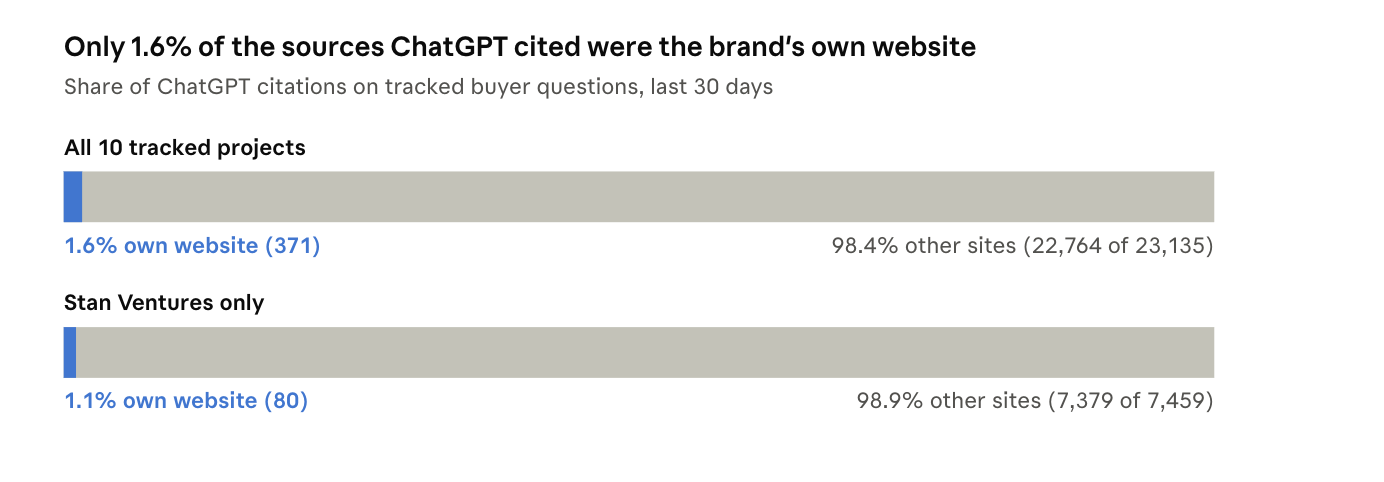
Our own numbers look no different. For the link building questions we track, ChatGPT cited 7,459 sources from 1,307 different domains, and stanventures.com accounted for only 80 of them. Among the pages it cited most were third-party roundups of the best white label link building agencies.
The Dashboard Undercounts Online Businesses
There is one more thing you should know before you start trusting the numbers in Business Hub. For online businesses, OpenAI counts a mention only when ChatGPT references the business’s own website. If ChatGPT only names your brand, or recommends you and cites a review site, it is not counted.
For local businesses it works differently, and a mention counts when ChatGPT shows a result for the location.
“There’s a blind spot in the new dashboard that businesses need to know about. For online businesses, Business Hub only counts a mention when ChatGPT references the business’s own website. If ChatGPT recommends a brand and cites a review site instead, that recommendation never appears in the brand’s numbers. A business could be recommended regularly and still see a dashboard that says it’s barely visible.”
Dileep Thekkethil, Director of Marketing, Stan Ventures
Business Hub also leaves out the prompts behind each mention, competitor comparisons, and data from other AI platforms such as Gemini, Claude, Copilot, Perplexity and Google AI Overviews.
And if you open the dashboard and see nothing, don’t panic. Data only appears once enough conversations meet a threshold, so an empty dashboard does not mean zero mentions.
Five Things to Do Now
- Go ahead and claim the profile. It’s free, and it makes sure ChatGPT has accurate details about you. If you run an online business, choose the online store option when claiming.
- Keep your details consistent everywhere. Your business name, address and phone number should match across Google Business Profile, Bing Places and Apple Business. When they don’t match, AI systems become less confident about who you are.
- Claim Bing Places and Apple Business too. Bing Places feeds Copilot, and Apple Business feeds Siri and Apple Maps.
- Measure beyond the dashboard. Use prompt tracking tools and your website analytics to see the mentions Business Hub does not count, and to cover the other AI platforms.
- Earn third-party coverage. If you ask us where most of the effort should go, it’s here. Getting featured on the publications, review sites and roundups that ChatGPT already cites remains what gets a business recommendation.
So go ahead and claim your profile, but don’t stop there. If you want ChatGPT and other AI platforms to recommend your business, you need more authority sites talking about your brand, because those are the sources AI answers draw from. That is the work we do every day at Stan Ventures. Book a consultation call with us, and we’ll put together a free strategy to increase your brand mentions on the authority sites that matter in your industry.

Deepan Paul
AuthorDeepan Paul is a Team Lead of the Internal Marketing Department at Stan Ventures, with four years of experience helping brands recover, grow, and hold on to organic traffic across global B2B, B2C, and D2C markets. He's known as a ranking revival expert. When traffic drops, pages fall out of the index, or visibility disappears after an update, he finds the cause and fixes it. Today he runs Stan Ventures' own organic presence, and that goes well past Google. He tracks and grows how the brand shows up in AI Overviews and across AI tools like ChatGPT, Perplexity, and Gemini, where citations decide who gets mentioned and who doesn't. His work covers technical SEO, content strategy, indexing, and building growth systems that hold up when algorithms shift. He has managed international clients and led cross-functional teams, keeping every SEO decision tied to what the business actually needs. Outside of client work, Deepan trains SEO professionals, speaks at industry events, and contributes insights to digital marketing publications. His approach is simple: build systems that keep working, instead of chasing quick wins.
