
Apple is building a new version of Siri, powered by the same kind of large language models that fuel ChatGPT. Engineers are testing the assistant through a private app, with a public release set for 2026. Will SEOs have to learn Siri Optimization strategies to deliver AI SEO Services?
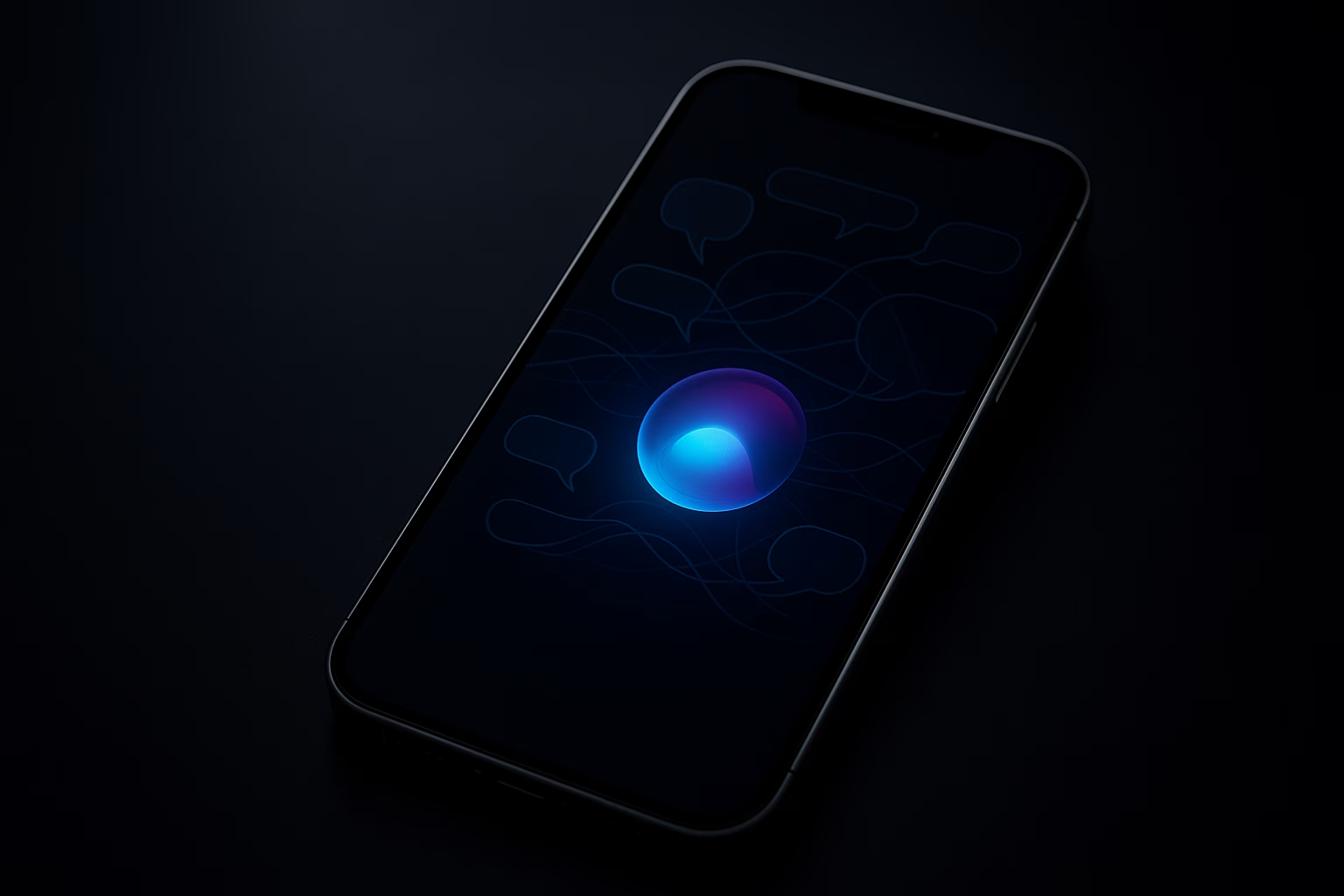
Back in 2011, when Siri first answered a question out loud, it felt like a glimpse of the future.
You could ask your iPhone about the weather, set a reminder on the go, or tell it to call your mom without lifting a finger. That was enough to spark headlines and plenty of excitement.
Fast forward more than a decade, and the shine has worn off. Siri is still around, but too often it’s the butt of jokes rather than a trusted assistant.
Competitors like Alexa and Google Assistant raced ahead, and the arrival of generative AI chatbots made Siri look even further behind.
Apple hasn’t ignored the problem.
Deep inside its labs, the company has been experimenting with a ChatGPT-style app that its engineers use to test a completely rebuilt Siri.
According to Bloomberg, the app works much like popular chatbots: you can keep multiple conversations going, switch topics naturally, and even have it remember what you said before.
It isn’t designed for the public. Instead, it’s a testing ground where Apple’s team can experiment with what a smarter, more capable Siri might finally feel like.
Why Siri Needs Saving
The story of Siri is one of promise left unfulfilled. Apple bought the technology in 2010, racing to integrate it into the iPhone. It arrived with great fanfare, and for a while, competitors scrambled to catch up. But the assistant quickly stagnated.
While Alexa was learning to control smart homes and Google Assistant was parsing complex questions, Siri remained best at setting timers.
The rise of ChatGPT in late 2022 made the gap even more obvious.
Suddenly, people were having natural, context-rich conversations with AI. They were asking follow-up questions, getting detailed answers, and even enjoying the occasional joke. Siri, meanwhile, was still sending users to Safari searches when it got confused.
Apple planned to address this with “Apple Intelligence” in iOS 18, a project meant to give Siri a long-overdue upgrade.
However, by 2025, the company scrapped that effort, admitting it had not met internal standards.
Instead of patching the old system, Apple tore it down and started over with large language models at the core.
What the New Siri Could Do
The internal testing app hints at the possibilities.
Engineers can push Siri into longer conversations, switching topics while still being understood. The assistant doesn’t just spit out short answers; it can hold context, make connections, and complete more complicated tasks.
That means in the future, you might not just ask Siri to book a table at a restaurant. You could ask it to check your calendar, find a time that works, send an invitation to a friend, and pick a place that suits your past dining preferences.
Instead of breaking each step into separate commands, you’d talk to Siri almost like you would with another person.
Apple also plans to give Siri a new look.
Toward the end of 2026, the assistant may take on a more “humanoid” design, possibly inspired by the Finder face icon on Mac. It’s a symbolic move, suggesting Apple wants Siri to feel less like a background tool and more like a presence you interact with.
Apple’s Balancing Act
Rebuilding Siri around large language models is no small task. These models require massive amounts of data and computing power, and they’re notoriously tricky to manage. They can produce brilliant responses one moment and nonsense the next. They also raise tough questions about privacy.
Apple has built its reputation on protecting user data. Siri has historically done much of its processing on-device rather than in the cloud, keeping personal information private but limiting what the assistant could do. With LLMs, Apple faces a trade-off: more powerful features usually mean more reliance on external servers.
The company is reportedly in talks with OpenAI, Google, and Anthropic about potentially licensing their models. That alone is remarkable.
Apple is known for keeping its core technologies in-house, but the scale of the challenge may force it to work with outside partners.
How Apple integrates those tools while maintaining its privacy-first stance will be one of the most closely watched parts of the rollout.
The Timing Problem and Advantage
The revamped Siri won’t arrive until early 2026, likely in iOS 26.4. That’s a full year later than Apple wanted.
Some critics see this as proof that Apple is lagging behind. Microsoft is already rolling out Copilot across its products.
Google is pushing Gemini into Android and Workspace. OpenAI keeps evolving ChatGPT with features that go beyond text.
But Apple’s late arrival may not be all bad.
Early chatbots have faced criticism for inaccuracy, hallucinations, and ethical missteps.
By watching competitors stumble, Apple can learn what to avoid. The company has a history of entering markets later but redefining them once it does.
The iPod wasn’t the first MP3 player, the iPhone wasn’t the first smartphone, and the Apple Watch wasn’t the first smartwatch. Each reshaped its category. Apple is clearly betting Siri can follow the same path.
The Stakes for Users
If Apple succeeds, the difference could be felt in everyday life.
Just think of starting your morning by asking Siri to brief you on your schedule, flag any conflicts, summarize your unread emails, and suggest when you can fit in a workout.
Instead of a series of disconnected commands, it would be one seamless conversation.
The assistant could also become a stronger bridge between Apple’s devices.
An updated Siri might draft a message on your Mac, set a reminder on your iPhone, and adjust your Apple Watch activity goals—all in one interaction. That level of integration is Apple’s biggest advantage, and the company will likely lean on it heavily.
Looking Ahead
Right now, the internal app is only for Apple’s engineers. But if the company stays on track, the rest of us will see a new Siri in early 2026, with an updated design later that year. It will mark the most significant overhaul of Apple’s voice assistant since its debut.
Whether users embrace it will depend on more than clever engineering.
People will want accuracy, reliability, and above all, trust that their private data isn’t being mishandled.
If Apple can deliver that, Siri could finally move beyond being a gadget demo and become something people depend on.
What Users Should Keep in Mind
Let’s break down the most important things to keep in mind as Siri changes.
- The first release may not have every feature Apple is testing. Expect a gradual rollout.
- Privacy settings will be crucial. Users should check how data is handled once the new Siri arrives.
- Integration across devices is where Apple shines. Expect the assistant to connect iPhone, iPad, Mac, and Apple Watch in smarter ways.
- Partnerships with AI companies could shape how capable Siri is from the start.
- A new look for Siri may change not just how it works, but how people feel about interacting with it.
Key Takeaways
- Apple has built a private ChatGPT-like app to test a new Siri.
- The assistant will launch in early 2026, delayed from its original target.
- Features include better memory, more natural conversations, and deeper app integration.
- Apple may partner with AI companies like OpenAI or Google to power the system.
- Privacy will remain the defining challenge for Apple’s approach.

Dileep Thekkethil
AuthorDileep Thekkethil is the Director of Marketing at Stan Ventures, where he applies over 15 years of SEO and digital marketing expertise to drive growth and authority. A former journalist with six years of experience, he combines strategic storytelling with technical know-how to help brands navigate the shift toward AI-driven search and generative engines. Dileep is a strong advocate for Google’s EEAT standards, regularly sharing real-world use cases and scenarios to demystify complex marketing trends. He is an avid gardener of tropical fruits, a motor enthusiast, and a dedicated caretaker of his pair of cockatiels.
