Similarweb has released a data-packed report analyzing billions of interactions, and the numbers signal a definite shift. A +76% YoY growth in Gen AI monthly visits. A staggering 319% increase in Gen AI app downloads. A 7% conversion rate from Gen AI referrals to transactional sites.
Are we watching the early signs of a new SEO era? And more importantly, are brands even ready for this?
Let’s break down what Similarweb uncovered, what the experts are saying.
How Is Gen AI Expanding Beyond Early Adopters?
One of the strongest signals in the report is the shift in who is actually using Gen AI.
The assumption was always: Gen AI is for the young, the digital-native, the tech-comfortable. But the numbers challenge that.
In 2023, 61% of Gen AI usage came from users aged 18–34.
Fast-forward to 2025, that share dropped to 53%. The gap didn’t vanish, it widened because new audiences entered, especially older ones.
Users aged 45+ now represent nearly 30%. That’s not a marginal shift. That’s mainstream adoption.
Why does this matter from an SEO or web-traffic perspective?
Older audiences traditionally search differently. They rely more on informational resources.
They compare more. They cross-verify more. And now they’re doing this inside Gen AI platforms. It changes the competitive landscape.
Aleyda Solis puts this shift simply and powerfully:
“Purchasing decisions are happening inside LLMs, even if conversions take place elsewhere. That’s why businesses must rethink how they attribute influence in this evolving space.”
And she’s right. If decisions start inside Gen AI, then SEO no longer begins at Google’s search bar.
How Is Gen AI Rewriting Search Intent?
Search intent, traditionally viewed through Google’s keyword lens, looks totally different when we compare Google queries to ChatGPT prompts.

Google’s intent landscape (Oct 2024 – Sep 2025):
- Informational: 63.8%
- Navigational: 25.2%
- Transactional: 8.7%
- Other: 2.3%
ChatGPT’s prompt intent (May 2024 – Jun 2025):
- Seeking Information: 19.2%
- Purchasable Products: 2.1%
- Creative & Writing Ideation: 32%
- Practical Guidance: 24.4%
- Technical & Other: 22.4%
The contrast is striking.
Google remains an engine of information retrieval. People ask questions. Google points them outwards.
But ChatGPT? It absorbs these needs and responds within its own environment. Only 1 in 5 prompts seeks information. Instead, users want ideation, guidance, creation, interpretation.
Google has high navigational intent because users still go there to reach websites. ChatGPT has almost none because it isn’t a routing engine.
This is where SEO strategy must change. Ranking on Google meets user intent. But being “mentioned” inside an AI conversation influences user decisions before they ever think of clicking a website.
Is Gen AI Referral Traffic Slowing Down After Explosive Growth?
The report shows something unexpected. After a massive rise through 2024 and early 2025, Gen AI outbound referrals began to plateau by late 2025.
Referrals from Gen AI platforms are smaller in quantity but higher in value.
Kevin Indig explains it sharply:
“AI traffic is not the leading metric. AI mentions and influence are. ChatGPT is closer to TikTok than Google.”
His research aligns with Pew studies: less than 1% of users click links from AI Overviews.
This means SEO should not chase AI clicks. It should chase AI presence, citations, mentions, inclusion in AI responses.
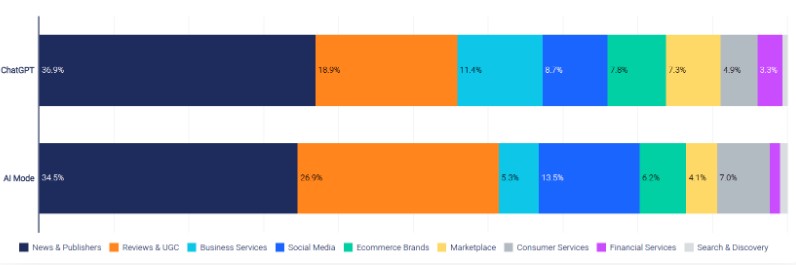
Because when users do click from Gen AI, they arrive with intent. Clear, purchase-ready intent.
Why Do Gen AI Referrals Behave Differently from Google Referrals?
This part of Similarweb’s report is one of the most compelling.
Google is a traffic machine. Designed to push billions of visits outward.
But AI platforms? Their entire model is to keep users in the system. So whenever a referral does occur, it carries unusual depth.
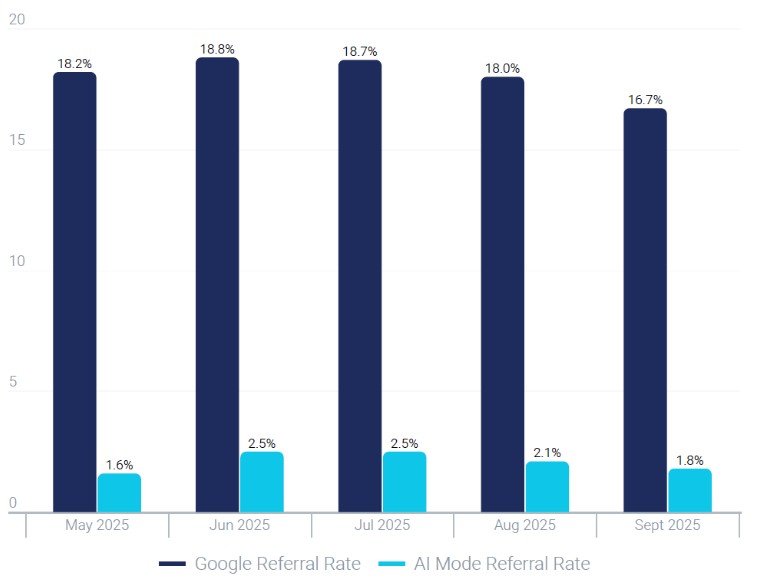
Minutes spent on site after referral
ChatGPT referrals: longer
Google referrals: shorter
Average pageviews after referral
ChatGPT visitors: more
Google visitors: fewer
Conversion rate to transactional sites
ChatGPT: 7%
Google: 5%
The difference may look small on paper, but in conversion economics, that gap is huge. So what does this mean?
- AI platforms produce fewer visits.
- But the visits they produce are high-intent, deep-engagement, likely-to-convert visits.
- And brands not optimized for AI SEO visibility risk losing this new segment entirely.
This is what makes AI the new “premium discovery channel.”
What Does This Mean for Web Strategy and SEO?
If this data is correct and Similarweb’s scale leaves little doubt businesses need to rethink their entire search and discovery playbook.
Here’s the new landscape in simple terms:
- Google = volume
- Gen AI = influence + high-intent visitors
- Older demographics = rising adopters
- Intent distribution = reshaped
- Referral traffic = high quality, low quantity
- User journeys = starting inside AI tools
- SEO = shifting from “rank” to “presence inside LLMs”
Brands must now create content not just for search engines but for AI comprehension models.
This means:
- Better structured data.
- Clear entity definitions.
- Stronger brand signals.
- Reputable citations.
- High authority mentions.
- Content that AI systems prefer: clear, factual, contextual.
The old “keyword-heavy SEO” is fading. The new SEO is AI-friendly contextual authority.
How Should Brands Prepare for the Next Phase of AI-Driven Discovery?
The answer begins with acknowledging a fundamental shift: people aren’t just searching. They are asking, consulting, comparing, evaluating, and choosing inside AI systems.
Aleyda’s advice is spot-on: measure both brand and performance KPIs. That means adding new metrics:
- AI citation share
- AI sentiment
- AI visibility index
- AI recommendation patterns
This is where SEO meets branding. And where influence becomes measurable.
Are We Entering a Post-Search Era?
The Similarweb report certainly hints at it. Google isn’t disappearing, of course. But Gen AI is reshaping the earliest stages of search intent.
It is rewriting expectations, compressing decision cycles, and becoming a quiet but powerful gatekeeper of influence.
The data suggests one thing clearly: The future of discovery is conversational, contextual, and AI-powered and it has already begun.
Key Takeaways
- Gen AI usage is booming with +76% YoY growth in visits and 319% growth in app downloads.
- Older audiences (45+) now make up nearly 30% of Gen AI users, showing mainstream adoption.
- Search intent is shifting: Google remains info-heavy, while ChatGPT drives creation, guidance, and ideation.
- Gen AI referrals have plateaued but deliver higher-intent, deeper-engagement traffic.
- ChatGPT referrals convert better, with a 7% CVR vs Google’s 5%.

Dipti Arora
AuthorDipti Arora is a Senior Content Writer with over seven years of experience creating impactful content across Digital Marketing, SEO, technology, and business domains. She has a strong background in managing news verticals and delivering editorial excellence. Dipti has contributed to leading publications such as The Times of India and CEO News, where her research-driven storytelling and ability to simplify complex subjects have consistently stood out. She is passionate about crafting content that informs, engages, and drives meaningful results.
