
Google has confirmed that every website link included in its AI Overviews shows up as having the same rank in Search Console. No matter where your link is placed in the summary, it’s counted the same.
If you’re thinking that sounds odd, you’re not alone.
This revelation, while buried in support documents and a few tweets, has the SEO world buzzing.
Could Google’s most advanced search feature be masking real performance data? And what does that mean for your site’s traffic, visibility, and value in search?

One Rank to Rule Them All
SEO consultant Gianluca Fiorelli asked Google’s John Mueller how Search Console handles rankings for links inside AI Overviews.
Hi @johnmu.com! I hope everything’s fine.
I know you’re a busy man, but on LinkedIn I asked you a question that also a few others seem to have: www.linkedin.com/posts/gianlu…When you can 😀
— Gianluca Fiorelli (@gfiorelli1.bsky.social) May 13, 2025 at 11:38 AM
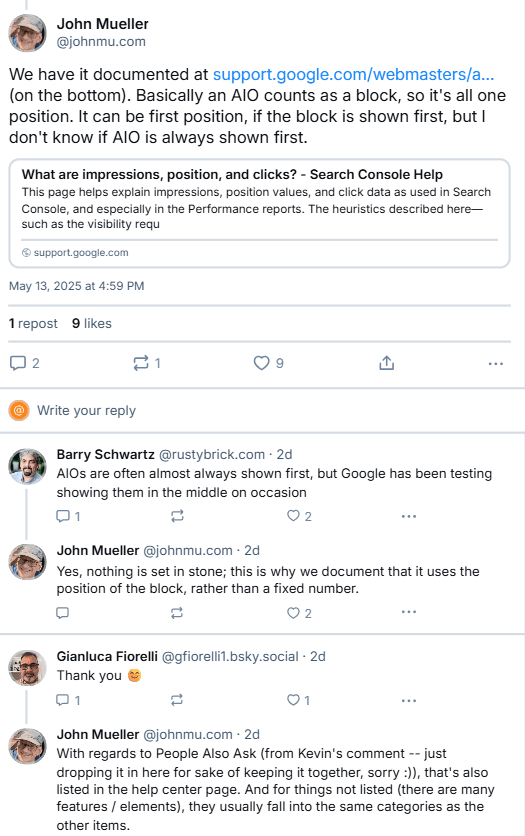
Mueller answered that all links are treated as part of a single unit regardless of their position.
If the AI Overview appears first on the search results page, every link inside it is recorded as position one.
It doesn’t matter if your link is the first visible one or hidden behind a “show more” button. They all get the same rank.
That might sound like an efficient way to report data. But for anyone who actually needs to know which content is working and why, it raises a red flag.
What the Official Docs Reveal
Google’s own documentation confirms it:
- Position: Every AI Overview counts as one block. Every link inside is tagged with the same ranking.
- Clicks: Clicking any link inside the overview is recorded as a click.
- Impressions: A link doesn’t count unless it’s scrolled into view or expanded by the user.
There’s more. The data includes nothing from Google’s Search Labs, where new layouts and experiments are being tested. So if your site is featured in one of those tests, you won’t see it in your reports at all.
The Data Gap That Won’t Go Away
Google has asserted for a long time that AI Overviews benefit websites by increasing clicks and enhancing visibility. Yet, evidence supporting this claim remains elusive.
Lily Ray recently called that claim into question. She challenged Google to show even a single Search Console report supporting it.
“We see that the links included in AIO get more clicks than if the page had appeared as a traditional web listing for that query.”
I would love to see a single GSC report that confirms this statement, because every study so far has shown the opposite.https://t.co/I1MVzr0vVi
— Lily Ray 😏 (@lilyraynyc) May 14, 2025
Her comment touched a nerve in the community. Because in study after study, professionals have seen the opposite. When a summary gives users everything they need, they don’t click. And that summary might include your content, without actually sending any visitors your way.
So while your Search Console may show a top-ranking position, you could be getting little or no traffic from it. That’s a problem.
What This Means for Your Strategy
Think of it like this: Your content ranks highly on Google, yet it receives no clicks since the answer is already provided on the page. Now picture that you’re unaware of this issue because the reporting system groups your link with many others.
That’s the situation many site owners are facing. The numbers look great, but the impact is unclear. And without more precise data, it’s hard to know what to fix or where to focus.
How You Can Respond
Until better transparency is offered, website owners and marketers need to be resourceful. Here’s what you can do:
Tag Your Links: Use tracking parameters (like UTM tags) to monitor incoming traffic more accurately.
Watch Your Analytics: Look for clues (bounce rates, session times, and conversions) to gauge the value of traffic from search.
Compare Before and After: Watch for traffic changes when AI Overviews start showing your site.
Spread Out Your Reach: Relying too heavily on search is risky. Build up traffic from social media, email, and other sources.
Speak Up: Join the ongoing discussion in the SEO community. Collective pressure has influenced Google before.
Key Takeaways
- All links in an AI Overview share the same rank, even hidden ones.
- Clicks and impressions are tracked, but only under limited conditions.
- Google hasn’t shared data proving that AIO links help websites.
- Experts suspect AI summaries may reduce actual site traffic.
- You need extra tracking tools to understand your real performance.

Dileep Thekkethil
AuthorDileep Thekkethil is the Director of Marketing at Stan Ventures, where he applies over 15 years of SEO and digital marketing expertise to drive growth and authority. A former journalist with six years of experience, he combines strategic storytelling with technical know-how to help brands navigate the shift toward AI-driven search and generative engines. Dileep is a strong advocate for Google’s EEAT standards, regularly sharing real-world use cases and scenarios to demystify complex marketing trends. He is an avid gardener of tropical fruits, a motor enthusiast, and a dedicated caretaker of his pair of cockatiels.
