
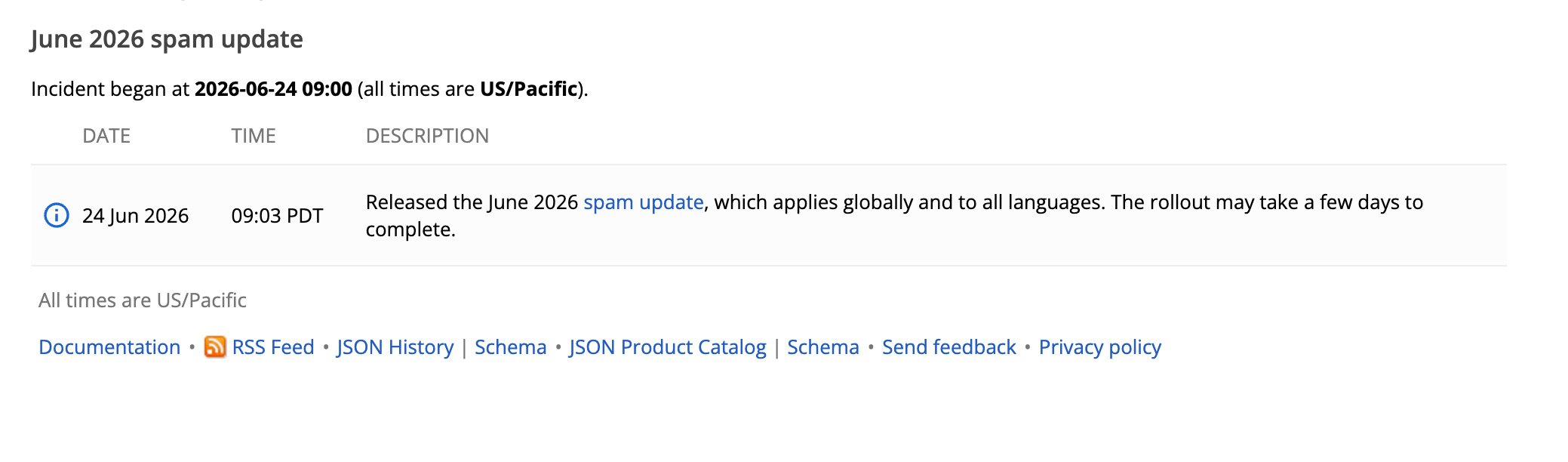
Google rolled out the June 2026 spam update today, June 24. The announcement landed on Google Search Status Dashboard a little after midday Pacific, and it’s already live across every language and location.
No big warning. No two-month heads up like Google gave for the back button policy. Just a post that says it’s rolling now and might take a few days to finish.
If your rankings start jumping around this week, this is probably why. Don’t panic and don’t start ripping pages apart yet. Wait for the rollout to finish before you read anything into the numbers.
What Google Actually Said
The post is short. Google calls it a “normal spam update,” says it’s rolling out for all languages and locations, and notes the rollout may take a few days to complete. They’ll mark the ranking release history page once it wraps.
That’s it. No new spam category named. No mention of links, reviews, or any specific tactic. When Google labels something a standard spam update, it usually means SpamBrain, their AI spam system, got sharper at catching stuff it was already built to catch. Not a brand new rulebook. A tuned one.
This Is The Second Spam Update Of 2026
The first was the March 2026 spam update, and that one made history for how fast it moved. It started March 24 and finished March 25, under 20 hours start to finish, the quickest confirmed spam rollout Google has ever logged on its status dashboard.
So if you’re expecting weeks of grinding volatility, the recent pattern says maybe not. Google’s enforcement has gotten faster and tighter. The March update was over before 24 hours. This one could be similar, though Google’s own note leaves room for a few days.
For context, the gaps between updates keep shrinking. Discover core update in February. Spam update in March. March core update. May core update, done June 2. Now a spam update on June 24. Google isn’t slowing down.
The Backdrop Nobody Should Ignore
Two things happened in the last six weeks that give this update some teeth.
On May 15, Google updated its spam policies page to spell out, for the first time, that spam includes trying to manipulate generative AI responses in Search. That’s a direct shot at the people gaming AI Overviews and AI Mode with junk content built only to get cited.
Then on June 15, enforcement kicked in on the back button hijacking policy. If your site (or a script in your ad stack) blocks users from hitting the back button to leave, that’s now an explicit spam violation that can trigger manual actions or automatic demotions.
Neither of those is the same thing as today’s update. But they tell you where Google’s head is at. And there’s one more piece.
Around June 19, SEOs in black-hat and spam-heavy forums started reporting a wave of ranking movement that the usual volatility trackers barely picked up.
Barry Schwartz at Search Engine Roundtable flagged it. The signal was loud in the communities running risky tactics and quiet everywhere the tools sample. Google never confirmed it. But a movement that quietly demotes spam while leaving mainstream sites alone would look exactly like that.
Today’s confirmed update may be Google formalizing what those forums already felt.
Should Link Builders Worry?
Fair question, and here’s the honest read.
The March 2026 spam update explicitly did not target link spam or site reputation abuse. Schwartz confirmed that one directly. If this June update follows the same playbook, agencies running clean white-label link building have nothing to lose sleep over.
But Google didn’t say what this one targets. So treat it the way you’d treat any update. If your client portfolio leans on expired domain abuse, PBNs, cloaking, doorway pages, or mass-generated filler dressed up as content, that’s the stuff SpamBrain hunts. Clean editorial links earned on real sites with real audiences sit on the right side of every spam update Google has ever shipped.
The tactics that get burned in these rollouts are the shortcuts. The ones that survive are the boring, durable ones, which we endorse.
What To Do Right Now
Open Google Search Console and annotate today’s date so you can isolate the window later.
Then wait. Seriously. Don’t make changes mid-rollout. Volatility during a rollout is noise, not signal. You can’t diagnose anything until the dust settles, which based on the March pace could be a day or two.
Once Google confirms completion, pull your before-and-after on impressions, clicks, and average position. Look at the page level and the query level. If something moved, figure out whether the pages that lost ground match what spam updates go after. If they don’t, you’re probably looking at unrelated volatility, and there’s plenty of that floating around right now with World Cup coverage flooding news and sports results.
For most agencies doing the work properly, this update is a non-event. For anyone leaning on tactics they already know are sketchy, it’s a bill coming due.
We’ll update this piece once Google marks the rollout complete.

Dileep Thekkethil
AuthorDileep Thekkethil is the Director of Marketing at Stan Ventures, where he applies over 15 years of SEO and digital marketing expertise to drive growth and authority. A former journalist with six years of experience, he combines strategic storytelling with technical know-how to help brands navigate the shift toward AI-driven search and generative engines. Dileep is a strong advocate for Google’s EEAT standards, regularly sharing real-world use cases and scenarios to demystify complex marketing trends. He is an avid gardener of tropical fruits, a motor enthusiast, and a dedicated caretaker of his pair of cockatiels.
