Google is using artificial intelligence to clean up fake reviews, suspicious business edits, and scam listings on Google Maps.
The company revealed that in 2024 alone, it removed over 240 million fake reviews, 12 million fraudulent business profiles, and blocked 70 million policy-violating edits.
This aggressive cleanup marks one of Google’s most extensive crackdowns on local content abuse to date.
“We’re committed to keeping the information on Google Maps helpful and trustworthy,” said Ian Leader, Director of Product Management for User Generated Content, in a statement published by Search Engine Journal. “AI is now playing a critical role in achieving that goal.”
Gemini AI Targets Deceptive Edits at Scale
Gemini plays a vital role in this strategy! Unlike traditional rule-based systems, Gemini leverages machine learning to spot suspicious activity through nuanced patterns of behavior. It’s impressive that it only needs a few examples to start recognizing threats on a larger scale.
For instance, a legitimate name change from “Zoe’s Coffee House” to “Zoe’s Cafe” might be harmless. But a sudden switch from “cafe” to “plumber” in the business category? That’s a red flag. Gemini now quickly catches these inconsistencies, scanning changes across industries and languages.
Google says the model helped block thousands of questionable edits in 2024 alone. But the AI’s effectiveness doesn’t stop there — it improves with every incident.
A Locksmith Scam Leads to Major Takedown and Legal Action
One particularly notable case involved a network of scammers who impersonated locksmiths. They took control of unclaimed business profiles, presented themselves as legitimate service providers, and then charged customers exorbitant fees for emergency services.
In response, Google not only removed more than 10,000 fake listings linked to the group but also filed a lawsuit to hold the perpetrators accountable.
The incident served as both a warning to future bad actors and a training dataset for Gemini, making the model more effective at spotting similar scams in the future.
Cracking Down on Fake Reviews
Fake five-star reviews remain one of the most pervasive forms of local content fraud. Businesses have been known to pay for glowing reviews from users who never visited their location — a clear violation of Google’s policies.
AI is now being used to revisit older reviews to detect abuse patterns that weren’t visible at the time of posting. This means fraudulent reviews can be removed even months later.
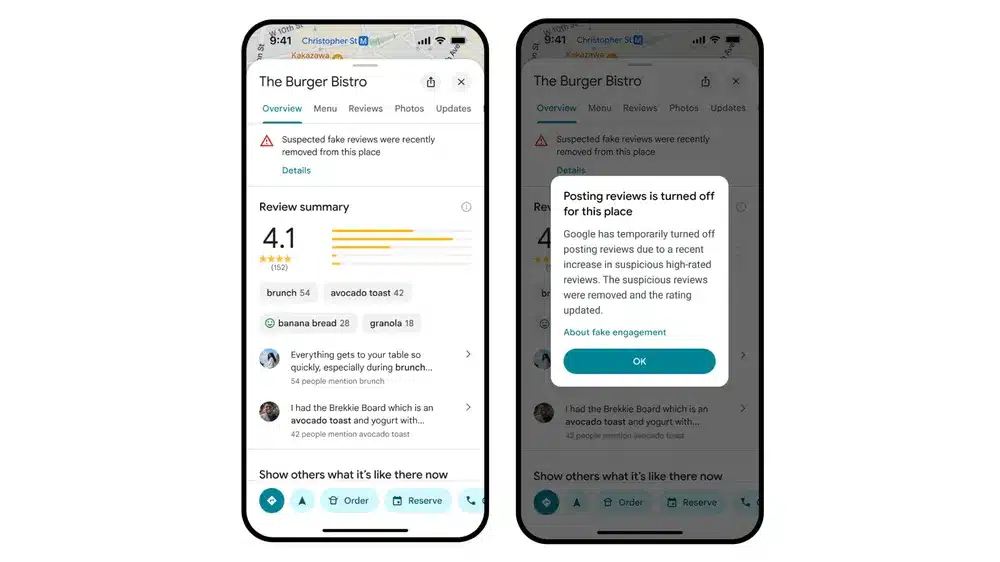
In 2024, Google also launched review removal alerts in the U.S., U.K., and India, with global rollout planned in 2025. These alerts notify users when suspicious five-star reviews have been taken down, offering greater transparency and giving users more context when evaluating a business.
Policy Enforcement Backed by Data and Human Oversight
AI is only part of the equation. Google continues to rely on a combination of automation and human moderation. In 2024, more than 900,000 user accounts were restricted for repeatedly violating the platform’s content policies.
Improved detection algorithms now enable the system to act faster and with greater precision, often blocking harmful edits before they ever appear to users. The end result is a cleaner, more trustworthy map that better serves both users and honest business owners.
Trust, Transparency, and the Future of Local Search
Google Maps is more than a tool for directions — it’s a global marketplace where millions of consumers find restaurants, repair services, healthcare providers, and more. The reliability of business profiles directly affects how users make purchasing decisions.
But with the rise of AI-generated content and digital scams, misinformation on platforms like Maps has become more sophisticated and harder to detect — making AI-driven enforcement not just beneficial but necessary.
Google’s aggressive cleanup effort is a sign of things to come. As the company invests more heavily in AI to safeguard its products, users can expect better protection from scams — and fewer manipulative tactics that distort reality for profit.
How Businesses Can Stay Compliant
For businesses that rely on Maps for visibility, these changes mean it’s more important than ever to stay within the rules:
- Keep profile details accurate and consistent.
- Avoid paying for fake reviews or engaging in review exchanges.
- Encourage genuine customer feedback.
- Respond to reviews to show real engagement.
- Report suspicious activity using Google’s built-in tools.
Businesses that stick to authentic practices are likely to benefit as the system pushes out dishonest competitors.
Key Takeaways
- Google removed 240M fake reviews and 12M fake listings in 2024 as part of a broad cleanup of Google Maps.
- Gemini AI flags suspicious business edits, helping prevent category switches, impersonation, and other red flags.
- A major scam involving fake locksmiths led to legal action, with over 10,000 listings removed and Gemini trained using the data.
- AI now detects fake reviews retroactively and alerts users when suspicious reviews are removed.
- Over 900,000 accounts were restricted for policy violations, highlighting the scale of enforcement underway.

Dileep Thekkethil
AuthorDileep Thekkethil is the Director of Marketing at Stan Ventures, where he applies over 15 years of SEO and digital marketing expertise to drive growth and authority. A former journalist with six years of experience, he combines strategic storytelling with technical know-how to help brands navigate the shift toward AI-driven search and generative engines. Dileep is a strong advocate for Google’s EEAT standards, regularly sharing real-world use cases and scenarios to demystify complex marketing trends. He is an avid gardener of tropical fruits, a motor enthusiast, and a dedicated caretaker of his pair of cockatiels.
