Google’s Publisher Profiles have begun reappearing in Discover feeds. According to SEO expert Glenn Gabe, who reported that one of his accounts regained the feature after it had been missing for a while.
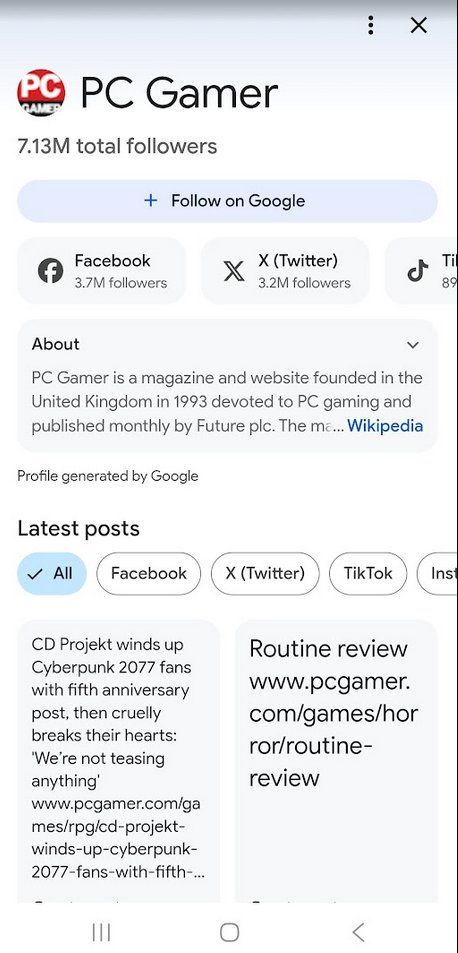
The restored feature allows users to tap a publisher’s name and favicon to open a dedicated profile showing their social links, bio, and latest posts across platforms.
However, Gabe noted that the update is not yet visible across all accounts, suggesting a gradual rollout.
When something quietly returns inside Google Discover, it usually signals a bigger shift brewing behind the scenes.
Why Is the Return of Publisher Profiles Significant Right Now?
The reinstatement of Publisher Profiles may look small on the surface but it hints at several broader trends.
Google has been tightening its focus on content credibility and authorship transparency, especially with the rise of AI-generated content.
So the return of a feature that showcases a publisher’s identity, followership, and multi-platform presence is not accidental.
If Google wants to reward authoritative brands and help users trust what they are reading, making publisher identity more visible feels like a strategic move, not a UI tweak.
And that is where the story really begins.
What Exactly Did Glenn Gabe Observe About Publisher Profiles?
In his update on X, Glenn Gabe shared that Publisher Profiles are now visible again in at least one of his Google Discover accounts. Here’s what the feature currently enables:
- Users can tap a publisher’s name or favicon inside Discover.
- This opens a dedicated profile page for that publisher.
- The page displays social links, a short about section, and recent posts from both the website and connected social platforms.
- Users can choose to follow the publisher from this profile.
Crucially, Gabe emphasized that the feature is not available across all accounts.
Publisher profiles are back in one of my accounts! After going missing for a while, I can tap on the publisher name and favicon in Discover to visit their profile. You can then follow that publisher, view their socials, read about them, and then view their latest posts (across… pic.twitter.com/7lKyhoC3SD
— Glenn Gabe (@glenngabe) December 2, 2025
Some users still do not see Publisher Profiles at all. This uneven availability is a typical sign of a slow Google rollout or an A/B test.
His exact observation: “Publisher profiles are back in one of my accounts! After going missing for a while… Note, I do not have this across all accounts.”
That final sentence is telling. Google could be quietly testing engagement metrics before pushing the feature wider.
Why Were Publisher Profiles Removed and Why Might They Be Returning?
Publisher Profiles first appeared years ago but disappeared unexpectedly for many users.
Google never formally announced their retirement, nor did it acknowledge their absence. So naturally, their quiet return raises questions.
Here are the likely reasons behind the reappearance:
1. Renewed focus on publisher authority
With AI-generated articles flooding the web, Google needs stronger mechanisms to help users distinguish trustworthy sources. Allowing users to explore a publisher’s identity helps reinforce credibility.
2. Strengthening the Discover ecosystem
Discover relies heavily on personalization. Offering a publisher follow button and a curated profile helps deepen user engagement and repeat visits.
3. Preparing for new AI-integrated discovery systems
AI Overviews, Search Generative features, AI SEO, and content recommendations all depend on understanding “who” is producing content. Publisher Profiles may serve as an authority anchor in this transition.
4. Multi-platform content indexing
The profile surfaces posts not just from a website but also from social accounts. This hints at Google’s increasing ability to unify a publisher’s content footprint across platforms.
If Google is building an ecosystem where publishers are recognized as unified entities rather than fragmented content sources, Publisher Profiles might become foundational.
How Do Publisher Profiles Actually Work Inside Discover?
A user browsing Discover might see a news card or article snippet.
Previously, tapping the favicon or publisher name simply opened the article or triggered no additional action.
With profiles restored, tapping now opens a structured “publisher card” that includes:
- Publisher logo and name
- Follow button
- About the publisher
- Social links (often X, YouTube, Instagram, etc.)
- Latest articles from the website
- Latest social media posts
This effectively transforms Discover from a passive content feed into a relationship-driven discovery hub.
It is similar to following creators on TikTok, Instagram, or LinkedIn.
Is This Feature Rolling Out to Everyone? Or Still Being Tested?
Based on Gabe’s comments, the rollout is clearly inconsistent. Some accounts have the feature fully restored, others do not see any trace of it.
This suggests one of three possibilities:
A/B Testing
Google often tests new features with controlled segments before scaling them.
Slow Phase Rollout
Profiles might be returning gradually across regions, account types or device categories.
Interest-Based Activation
It is possible profiles only surface when Google identifies high engagement patterns between a user and a publisher.
Until Google issues an official announcement, which it has not, Publishers must assume this is an early-stage return.
What Does This Mean for Publishers and SEO Professionals?
The return of Publisher Profiles impacts more than Discover alone. It affects how professional SEO and publishers present themselves across Google’s ecosystem.
Here is what it means strategically:
1. Publisher entities matter more than ever
Google is strengthening its identity graph. Clear branding, consistent naming, and clean entity structure across the web may influence profile visibility.
2. Social media connections now feed Google’s ecosystem
The profile’s integration of social feeds suggests Google is paying more attention to off-site authority signals. In other words: your social content strategy may influence your Discover presence.
3. Follow-based discovery is growing
If Google continues down this path, users might curate their Discover feed the same way they curate social feeds, via follows, not just algorithmic predictions.
4. Quality publishing becomes central
Profiles that showcase a steady output of high-quality content strengthen user trust. Thin or rarely updated sites may lose visibility.
Could Publisher Profiles Expand Beyond Discover?
This is the question many SEOs are already asking.
If Google is willing to surface publisher-level identity inside Discover, could the same identity layer appear:
- Inside AI Overviews?
- Inside Search results as enhanced snippets?
- Inside Google News?
- Inside YouTube recommendations?
Each of these ecosystems thrives on credibility and content relationships. A unified publisher profile could streamline Google’s ability to reward authoritative voices across formats.
And given the rise of AI and misinformation, transparency is more valuable than ever.
Key Takeaways
- Publisher Profiles are back in Google Discover for some users.
- Rollout is partial, Google appears to be testing it.
- Profiles show socials, latest posts, and a follow button.
- Signals stronger focus on publisher identity and credibility.
- Google may be moving Discover toward a follow-based model.
- Publishers should tighten branding, socials, and entity consistency.

Dipti Arora
AuthorDipti Arora is a Senior Content Writer with over seven years of experience creating impactful content across Digital Marketing, SEO, technology, and business domains. She has a strong background in managing news verticals and delivering editorial excellence. Dipti has contributed to leading publications such as The Times of India and CEO News, where her research-driven storytelling and ability to simplify complex subjects have consistently stood out. She is passionate about crafting content that informs, engages, and drives meaningful results.
