
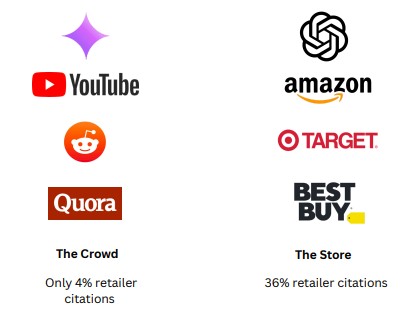
A new BrightEdge AI analysis of tens of thousands of holiday-season eCommerce prompts has revealed a visible divide. Google AI Overviews cite retailers only ~4% of the time. And ChatGPT cites retailers ~36% of the time, a 9x difference in how each AI engine guides shoppers.
The findings highlight that Google and ChatGPT rely on fundamentally different philosophies when answering shopping questions online.
As AI rapidly becomes the first stop for product research, the study’s results raise an important question: Who does AI actually trust when recommending what to buy and why?
Why Is This News Important for the Future of Shopping?
Consumers increasingly turn to AI instead of search engines, review sites, or marketplaces.
But if Google’s AI relies on community voices while ChatGPT points users to stores, does that mean people are being guided toward entirely different buying journeys depending on the AI they use?
This is the core tension BrightEdge uncovered, a tension that could reshape how people discover, evaluate and purchase products online.
The research analyzed citation sources across Google AI Overviews and ChatGPT.
It examines which domains they prefer, how they select sources for identical queries, and what these patterns reveal about the underlying design of each platform.
What Data Did the Researchers Examine?
BrightEdge AI Catalyst evaluated tens of thousands of prompts during the 2025 holiday shopping season, tracking:
- Which websites each AI cited
- How often retailers appeared vs. editorial or community sources
- What changed week-over-week
- How identical prompts produced different outputs
This was not a simple keyword study, it was a large-scale behavioral analysis of how two of the world’s most influential AI systems make sourcing decisions.
And the results were unmistakably different.
What Makes Google and ChatGPT Cite Such Different Sources?
Google AI Overviews: Are They Designed to Prioritize “The Crowd”?
According to the study, Google AI Overviews (AIOs) overwhelmingly cite:
- YouTube reviews
- Reddit discussions
- Quora Q&A
- Editorial review sites like CNET, Rtings, Serious Eats, and The Spruce Eats
With retailers making up only 4% of citations, Google clearly leans into what real people are saying across communities and expert editorial channels.
Why? BrightEdge suggests one simple explanation: Google’s AI Overview sits above a fully transactional SERP.
Below the AI Overview, users already see:
- Product listing ads
- Shopping carousels
- Organic retail links
- Price comparison modules
This means Google’s AI Overview doesn’t need to “sell” anything. It acts as a research companion, not a shopping assistant.
ChatGPT: Does It Behave More Like a Virtual Store Aisle?
ChatGPT, in contrast, prioritizes direct retail sources:
- Amazon
- Target
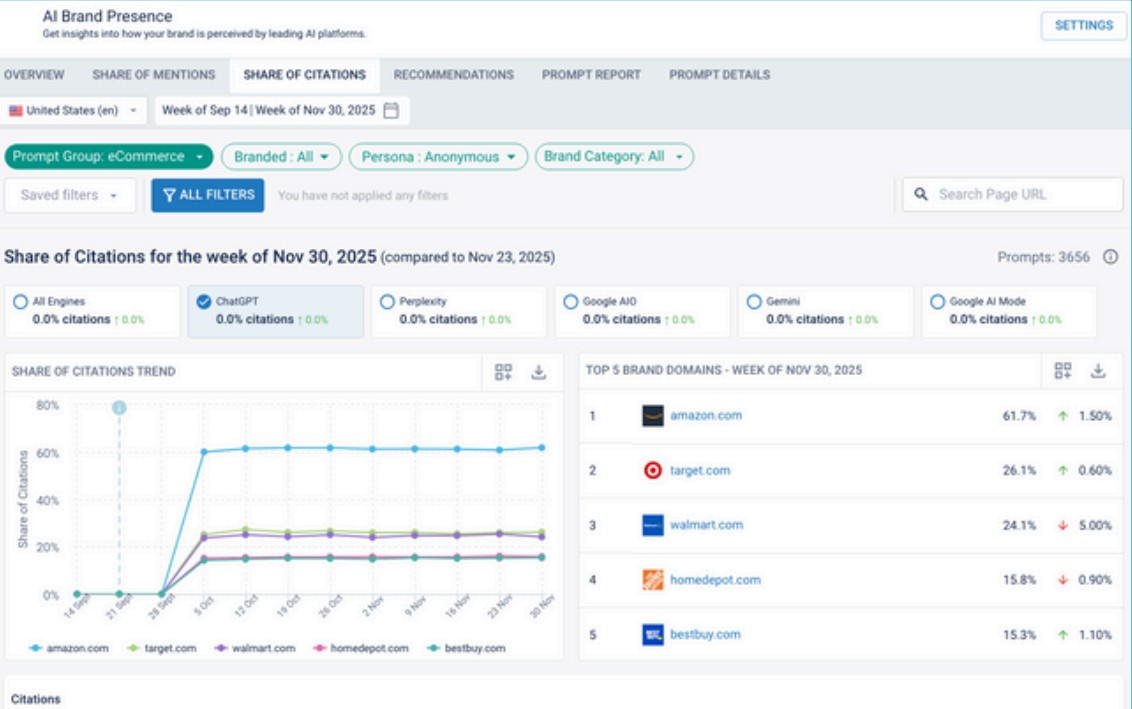
- Walmart
- Best Buy
- Home Depot
- Brand product pages
BrightEdge found that 36% of all ChatGPT citations went directly to retailers.
Why such a massive difference? Because ChatGPT’s response is the entire experience. There is no Shopping carousel to handle the conversion. No product ads. No organic retailer listings.
If ChatGPT doesn’t give users a path to purchase, no one else will.
As a result, ChatGPT blends research plus purchase into one consolidated answer.
The contrast is not accidental, it is architectural.
How Do Google and ChatGPT Respond to the Same Query?
The study compared identical prompts to see how each AI chooses citations.
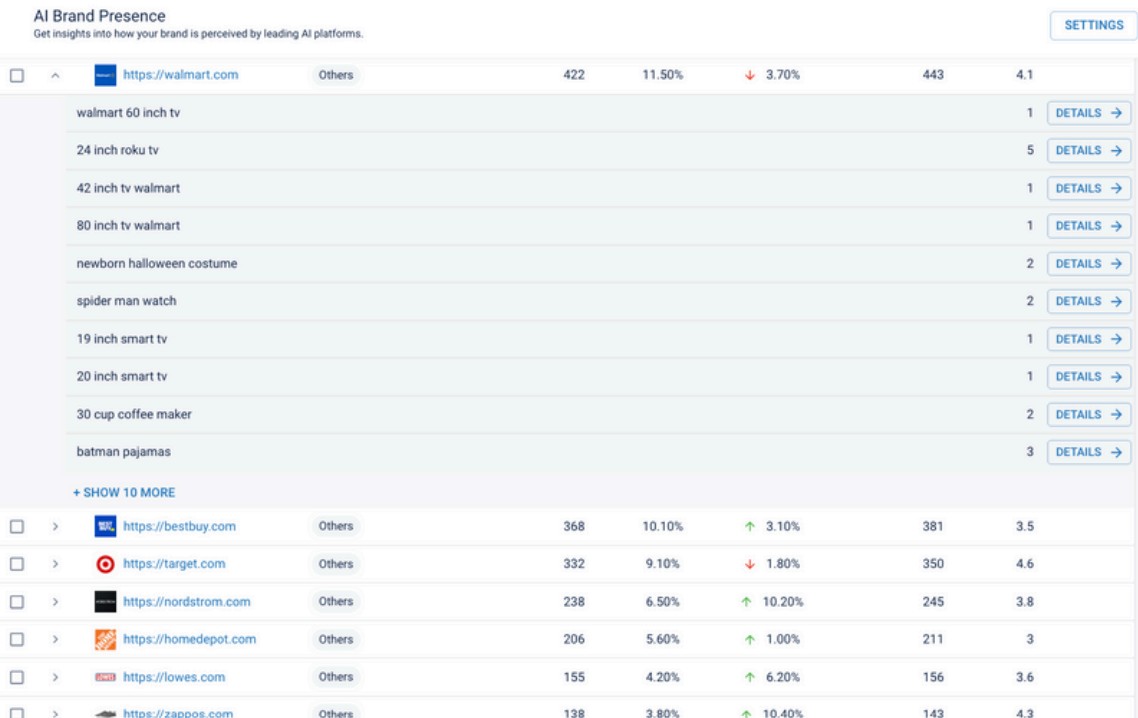
Example 1: “Costco TV Sale”
Google AI Overview cited:
- Reddit (most frequent)
- YouTube
- Costco’s official website (third)
ChatGPT cited:
- Costco’s website as the most frequent
- Limited secondary citations
Google interprets the query as research-focused (“What do people say about Costco TV deals?”). ChatGPT treats it as transactional (“Here’s Costco’s TV deals page.”).
Example 2: “Best Immersion Blender”
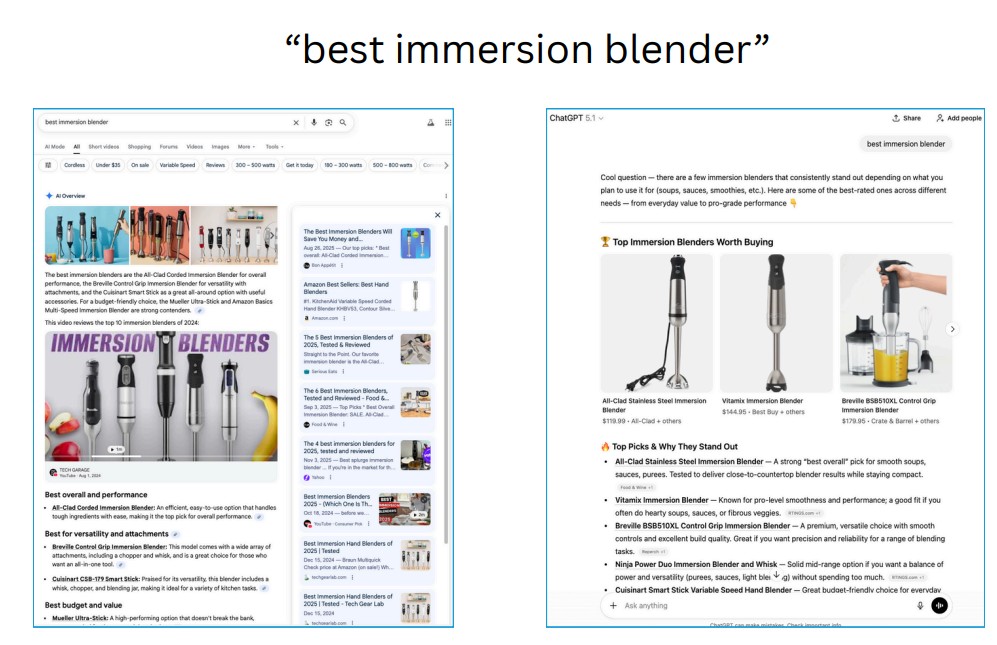
Google AI Overview cited:
- Serious Eats
- The Spruce Eats
- Food & Wine
- CNET
- YouTube reviews
ChatGPT cited:
- Amazon
- Consumer Reports
- Marketplace listings
Again, Google leans on cooking editors and product reviewers. ChatGPT jumps directly to where users can buy.
What Philosophies Are Driving These Opposing Strategies?
Google’s Philosophy: “What Do Real People Think?”
Google’s heavy reliance on UGC and editorial reviews suggests a focus on social proof, expertise, and research depth.
This aligns with Google’s long-standing role as a tool for exploration. The transactional intent is handled elsewhere on the page.
ChatGPT’s Philosophy: “Here’s Where You Can Get It.”
ChatGPT positions itself as a complete solution, answers the question, then connects the user to a product.
It reflects a model where the AI must deliver the entire shopping journey in one message.
The platforms aren’t just different, they are optimized for entirely different user expectations.
What Should Brands Do With This Insight?
If AIs cite different types of content, then brands need two separate visibility strategies.
Where to focus for Google AI Overviews:
- YouTube product reviews
- Reddit engagements
- Editorial coverage
- High-value expert content
Where to focus for ChatGPT:
- Retail listings
- Optimized Amazon/Target/Walmart pages
- Strong product pages on brand sites
- Up-to-date specifications and descriptions
Google rewards community and expertise. ChatGPT rewards availability and clarity.
Is “AI Search Optimization” Now Split Across Platforms?
This research suggests that AI search optimization is not a single discipline. Brands must now think in dual frameworks:
- AI Research Optimization → Google
- AI Commerce Optimization → ChatGPT
Even the same piece of content surfaces differently:
| Content Type | Google AIO Visibility | ChatGPT Visibility |
| YouTube Reviews | High | Low |
| Reddit Discussions | High | Low |
| Editorial Reviews | High | Medium |
| Retail Listings | Low | High |
| Product Pages | Low | High |
This creates a new marketing requirement: Brands must track their visibility on both AI engines separately.
What Does This Mean for the Future of AI Shopping?
The divide is widening. Google is doubling down on research. ChatGPT is shifting toward commerce. And as more users rely on AI instead of search engines, retailers and brands must learn to position themselves in both worlds.
What happens when millions of people get two different answers and two different recommendation sources, for the same product query?
That’s the future the BrightEdge study forces us to consider.
A Tale of Two AIs and Two Shopping Philosophies
Google trusts the crowd. ChatGPT trusts the store.
These are not just citation differences, they represent two opposing visions of AI’s role in consumer decision-making.
As we move toward the 2026 holiday season, understanding AI SEO, brand mention in AI, why it’s cited, and how each AI interprets your content will become as essential as traditional SEO once was.
The message for brands is clear: track both scoreboards, optimize for both journeys, and let each platform use your content where it fits best.
If this is the beginning, the next evolution of AI-driven commerce will be even more transformative.

Dipti Arora
AuthorDipti Arora is a Senior Content Writer with over seven years of experience creating impactful content across Digital Marketing, SEO, technology, and business domains. She has a strong background in managing news verticals and delivering editorial excellence. Dipti has contributed to leading publications such as The Times of India and CEO News, where her research-driven storytelling and ability to simplify complex subjects have consistently stood out. She is passionate about crafting content that informs, engages, and drives meaningful results.
