
Google has officially launched the August 2025 Spam Update and this one is already sparking discussions across the SEO community. The rollout began on August 26 at 9:00 AM Pacific Time, according to Google’s Search Status Dashboard and it will apply globally, across all languages.
The company has cautioned that the update may take several weeks to complete, which means site owners should expect fluctuations in rankings and traffic as the changes ripple through search results.
Now, the first question is: why now? Why another spam update in the middle of 2025? And more importantly, how different will this one be from the previous rounds we have seen over the past few years? Let’s see.
What Did Google Actually Confirm?
Google’s statement about the August Spam Update was characteristically brief.
Today we released the August 2025 spam update.
It may take a few weeks to complete, and we’ll post on the Google Search Status Dashboard when the rollout is done:https://t.co/VyY24LVujq
— Google Search Central (@googlesearchc) August 26, 2025
The official note read: “Released the August 2025 spam update, which applies globally and to all languages. The rollout may take a few weeks to complete.”
That was it. No breakdown of which specific spam tactics were targeted, no clear examples of what is at risk. And honestly, this is not surprising.
Google rarely spells out the mechanics of its spam-fighting updates, partly because it doesn’t want to hand spammers a playbook on how to avoid detection.
What we do know, however, is that spam updates are routine. They tend to roll out multiple times a year, each time refining Google’s ability to identify and suppress sites that are using manipulative or low-quality tactics.
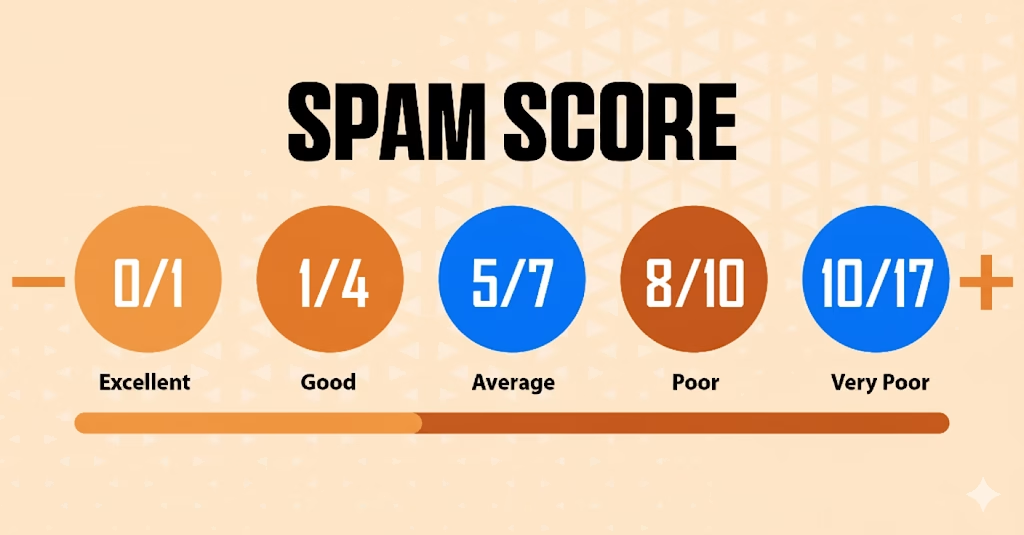
What Does Google Mean by “Spam” in 2025?
The word “spam” can sound vague, so it is important to clarify what Google means in this context. This is not just about sites infected with malware or shady domains pushing phishing scams.
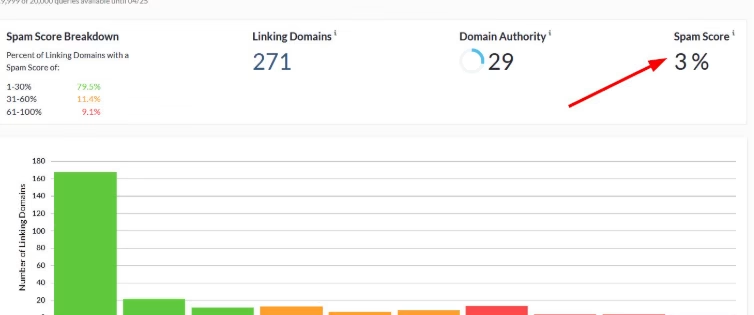
Spam, in Google’s evolving definition, also includes content practices that erode the user experience.
That means sites relying heavily on AI-generated text that adds no real insight, blogs recycling scraped or auto-translated articles without editorial oversight and publishers engaging in manipulative link-building schemes.
Keyword stuffing, doorway pages and cloaking remain in the spam category too.
And here is the thought that sticks with me: with the explosion of generative AI content in the past two years, is Google now doubling down on filtering out low-quality AI material? It seems likely.
We have seen countless sites scale up with hundreds of AI-generated posts per day, but quantity does not equal quality. Could this update be Google’s way of quietly saying: “we are watching and we are tightening the rules”?
What Should Site Owners Expect in the Short Term?
The most immediate impact of the August Spam Update will be volatility. Search rankings may swing wildly in both directions during the rollout window.
For some sites, impressions and clicks may spike or plummet overnight, only to reverse a week later.
This is why Google advises against making sudden changes during an update. Reacting too quickly to a drop in rankings could cause more harm than good.
Instead, site owners should carefully observe trends in Google Search Console watching impressions, clicks, and average position to identify whether changes are consistent across categories of pages or just isolated incidents.
Another factor to consider is competitor movement.
If everyone in your industry is experiencing turbulence, it is not a sign that your site is “broken” but rather that the entire ecosystem is being recalibrated. Patience becomes part of the strategy here.
Are Spam Updates Becoming More Aggressive?
Spam updates don’t always make the same headlines as core updates but they can be just as disruptive. Take, for example, the October 2023 Spam Update.
Many affiliate-heavy sites and AI-driven blogs lost a significant share of their visibility, while editorially curated sites benefited. That update reshaped several niches almost overnight.
The August 2025 rollout could prove to be equally consequential, particularly as Google faces mounting pressure to preserve the credibility of search results.
With misinformation and AI-generated spam on the rise, updates like this one are not just about punishing bad actors but they are about safeguarding the very trust that keeps billions of people using Google every day.
Why Does Google Keep Pushing Spam Updates Year After Year?
At first glance, it might seem like Google is constantly fighting the same battle.
But the reality is that spam evolves as quickly as Google’s algorithms. Each time Google closes one loophole, new ones open.
When link schemes fell out of favor, spammers pivoted to private blog networks. When keyword stuffing stopped working, they turned to spun content.
Now, the battleground has shifted to generative AI, with entire sites being mass-produced by bots.
Spam updates, then, are not one-time fixes.
They are ongoing recalibrations, necessary to keep pace with ever-changing spam tactics. That’s why they appear multiple times each year.
Who Is Most at Risk in This Update?
While it is too early to pinpoint winners and losers, past trends suggest that certain categories of sites are especially vulnerable. Thin affiliate sites that exist primarily to drive commission clicks, AI-driven blogs with little human oversight and recycled content portals are often the first casualties.
In the March 2024 spam update, for instance, several recipe sites that had been flooded with low-quality AI content saw traffic drops of more than 60% in just a few days.
Meanwhile, smaller but carefully curated blogs gained visibility. The same kind of reshuffling could play out again now.
Which leads me to think—if you have been leaning too heavily on automated publishing without adding originality or expertise, the August Spam Update may feel like a harsh but inevitable reality check.
How Should Businesses Respond?
The worst mistake site owners can make is scrambling to rewrite or delete content before the dust settles. Instead:
- Audit against Google’s spam policies. Check if your site has thin, duplicate, or manipulative practices.
- Prioritize E-E-A-T (Experience, Expertise, Authoritativeness, Trustworthiness). If content doesn’t have these, elevate it.
- Focus on users, not search engines. Spam updates are designed to reward long-term value, not short-term hacks.
- Stay calm during volatility. Rankings often “bounce” before settling after multi-week rollouts.
What Does This Update Signal for SEO in 2025?
The August Spam Update is more than just a technical tweak. It signals Google’s ongoing commitment to raising the bar for what qualifies as trustworthy content in a digital landscape increasingly shaped by AI.
For SEOs, this underscores an important shift: optimizing only for Google is no longer enough. Optimizing for users first with content that informs, guides, and provides real-world value is the strategy that stands the test of time.
Spam updates will continue to roll out, but sites that stay aligned with Google’s evolving expectations will not just survive them—they may actually benefit from them.

Dileep Thekkethil
AuthorDileep Thekkethil is the Director of Marketing at Stan Ventures, where he applies over 15 years of SEO and digital marketing expertise to drive growth and authority. A former journalist with six years of experience, he combines strategic storytelling with technical know-how to help brands navigate the shift toward AI-driven search and generative engines. Dileep is a strong advocate for Google’s EEAT standards, regularly sharing real-world use cases and scenarios to demystify complex marketing trends. He is an avid gardener of tropical fruits, a motor enthusiast, and a dedicated caretaker of his pair of cockatiels.
