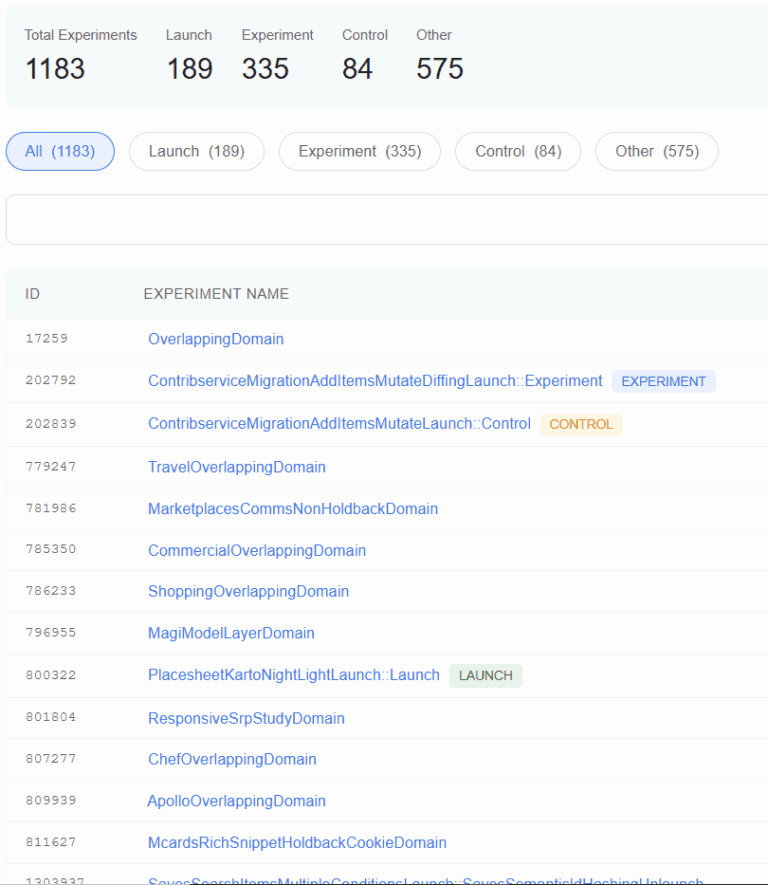
As of June 2025, Google has been quietly running nearly 1,200 search-related experiments with over 800 still active.
These are not just UI tweaks or A/B button tests. They are deep, infrastructural probes involving AI agents, entity recognition, user profiling, multimodal embeddings and even real-time geo-semantic tagging.
The world’s most powerful information engine is in a constant state of micro-evolution and we have just had our first real glimpse behind the curtain.
This investigation was conducted by Olivier de Segonzac & Damien Andell and first published by Search Engine Land on July 22, 2025.
So what exactly is happening inside the search engine we rely on every day?
And why should marketers, publishers, and users pay close attention to things like “ghost entities,” “Nephesh” or “MagitCotRev15”?
Over 1,200 Live Google Search Experiments Power Your Search
In a major update, a recent in-depth investigation has lifted the veil on the hidden mechanisms of Google’s search infrastructure.
As per Search Engine Land it is stated that at the core of this revelation is a staggering number: 1,200 live experiments—800 of which were active as of June 2025.
Forget the notion that Google periodically updates its algorithms.
Unlike most companies that release new versions every few years, Google quietly experiments, launches and iterates in near real time. It’s evolution, not revolution.
Each micro-change is tested in small batches. Some experiments are in their 15th iteration like MagiCotRev15Launch while others are barely a week old.
This layered ecosystem enables speed without chaos and precision without risking mass disruption.
Among the standout projects:
- DeepNow and NowBoost – successors to Google Now.
- SuperGlue – possibly replacing the older Glue/NavBoost architecture for universal search.
- Codenames like Whisper, Moonstone, and Solar, each operating in specific verticals such as shopping, travel, or finance.
This analysis also confirmed that codenames and systems first revealed in the 2024 Google leaks (like QRewrite, QUS, NavBoost, Mustang, and Tangram) remain actively in use.
In fact, more than 50 active experiments are solely focused on Shopping alone which ensures that vertical domains are not side projects anymore, they are core search experiences.
Entities: Google’s New Language
One term keeps popping up throughout these findings: entities.
And if you think that just means people or places then think again.
In a brilliant talk titled “Entities Everywhere,” researchers Damien Andell and Sylvain Deauré (1492.vision) reveal how the Knowledge Graph forms the very nervous system of Google.
This Knowledge Graph powers not just Search, but Discover, YouTube, Maps, Gemini and Google Assistant. And at its heart lies Livegraph, a verification engine that assigns confidence scores to every fact it sees.
These facts are classified across layered namespaces:
- kc: Highly trusted corpora like government records.
- ss: Web-scraped facts.
- hw: Human-curated data.
And they are more known as ghost entities.
These are transient data points Google creates in near-real-time to reflect breaking news or viral events. They do not live forever but they let Google act instantly, far faster than most AI models trained on static snapshots.
For businesses and SEO professionals, this means:
- Become a validated entity.
- Align with verified topics.
- Get cited across the web, consistently.
Google’s Knowledge Graph does not just read your site but it understands it.
Inside Google’s AI Mode: 90+ Projects and a Swarm of Smart Agents
What if Google search was not just a search bar? What if it could behave like a travel agent, a personal chef or a news editor?
That future is here and under the project name: AI Mode (AIM).
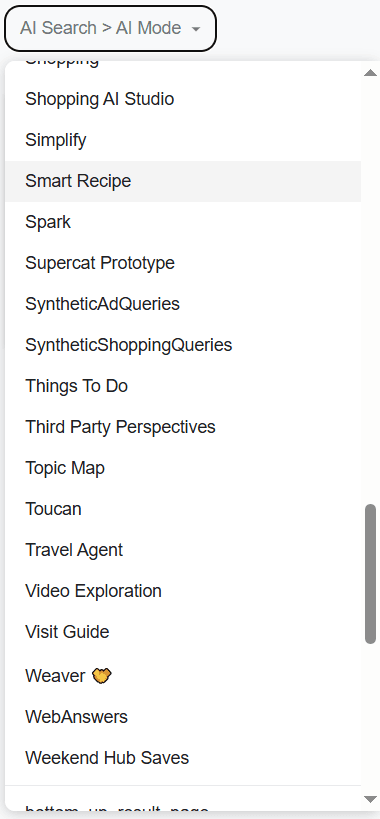
As of May 2025, a debug panel (visible only internally or via VPN) listed 90+ active AI projects. Among them are ultra-specialized agents, including:
- Travel Agent and Flight Deals
- Smart Recipe, Neural Chef and Food Analyzer
- News Digest, Daily Brief
- Shopping AI Studio
This is not one chatbot. It is a constellation of niche AI services. Most of these fall under Project Magi, which includes:
- MagiModelLayerDomain known as core infrastructure
- MagitV2p5Launch – connected to Gemini 2.5
- SuperglueMagiAlignment – similar to NavBoost for AI interactions
And then comes MagitCotRev15Launch, which implements a unique Chain-of-Thought (CoT) reasoning model:
Reflect → Research → Read → Synthesize → Polish
Yes, Google’s AI does not just answer you—it reasons through multi-step logic to deliver the best response.
The user interface is also transforming:
- AimLhsOverlay – AI sidebar
- SbnAimEntrypoints – a reinvention of “I’m Feeling Lucky”
- Even the Google logo itself now acts as an AI input gateway.
Your Identity as an Embedding: Meet Nephesh, Picasso and VanGogh
Here is where things get even more mind-bending.
Behind the scenes, Google is building mathematical representations of you called embeddings to power personalized experiences.
This system, named Nephesh, captures your interactions, searches, clicks and behaviors across Google’s ecosystem.

For Discover specifically, two embedding engines shine:
- Picasso known as your long-term memory (via STAT and LTAT models)
- VanGogh real-time, on-device behavioral analysis
Together, these profiles determine what appears in your feed based on scroll behavior, device state, even physical location like “Semantic Home” or “Semantic Work.”
And it does not stop there.
Google also tracks if you’re in motion, riding a bike, in a lift or even sleeping thanks to a project named HULK.
Understanding Queries: Expansion, Geo Mapping, and Real-Time Scoring
So, how does Google turn your messy, incomplete query into precise results?
Google uses tools like:
- QRewrite and QUS (Query Understanding Service) – to clean and interpret input.
- GWS → SuperRoot → QUS → QBST – the processing pipeline still active since the 2024 leaks.
- Query Expansion – which turns “cycling tour France” into “bike travel,” “cycling routes,” “trips,” and more.
It even uses geo-aware logic which transforms queries based on where you are, what language you speak, and what businesses are nearby.
Each term is then scored in real time on a 0–10 scale across URLs:
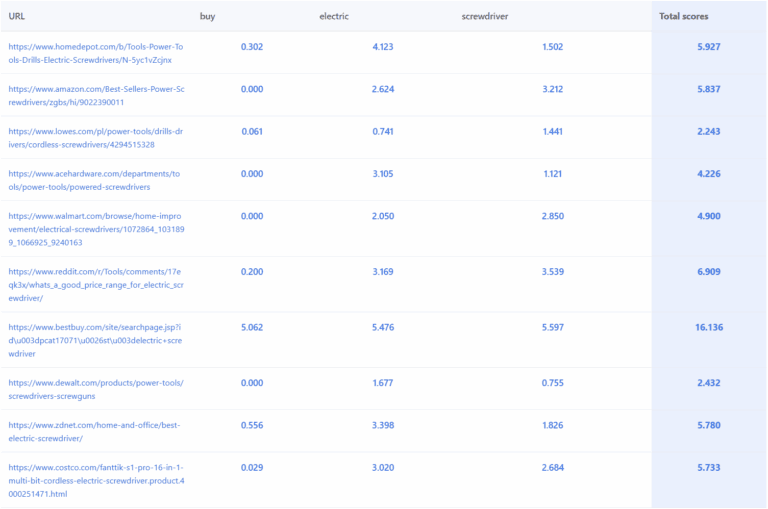
- Named entities? Max score.
- Title matches? Bonus.
- Stop-words? Ignored.
But the final ranking isn’t decided here alone. These scores blend into broader ranking factors like NavBoost, freshness and entity coherence.
Welcome to Google’s Parallel Universe
So, let’s see what does all this mean for users, businesses and marketers?
Google is no longer a static index of the web. It is a living, breathing constellation of experiments, agents, graphs and real-time intelligence.
The average user may never know that when they search for “best pasta in USA” or “AI lead gen tools,” a dozen agents, embeddings, experiments and entity graphs spring into action behind the scenes.
But now you know.
And if your business, brand or content strategy has not yet caught up and this might be the wake-up call you need.

Dileep Thekkethil
AuthorDileep Thekkethil is the Director of Marketing at Stan Ventures, where he applies over 15 years of SEO and digital marketing expertise to drive growth and authority. A former journalist with six years of experience, he combines strategic storytelling with technical know-how to help brands navigate the shift toward AI-driven search and generative engines. Dileep is a strong advocate for Google’s EEAT standards, regularly sharing real-world use cases and scenarios to demystify complex marketing trends. He is an avid gardener of tropical fruits, a motor enthusiast, and a dedicated caretaker of his pair of cockatiels.