
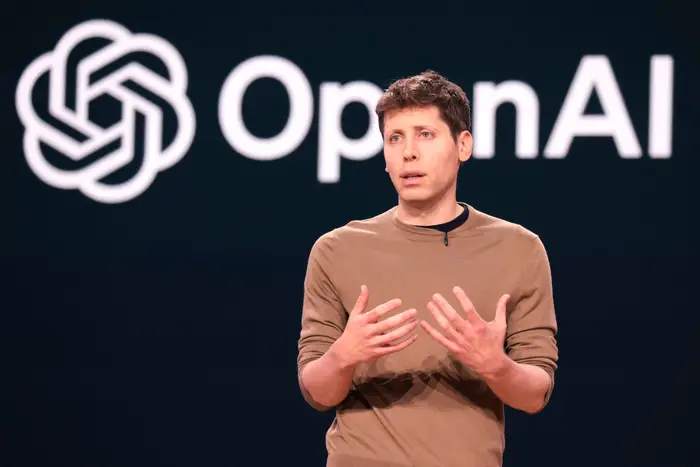
OpenAI CEO Sam Altman has defended the company’s aggressive spending on artificial intelligence infrastructure. He argued that mounting losses are the result of deliberate investment rather than a broken business model.
In a recent interview, Altman said OpenAI would already be profitable if it were not continuing to scale training costs so aggressively, framing the company’s financial trajectory as a calculated bet on future revenue growth.
The comments came during an appearance on the Big Technology Podcast, where Altman faced pointed questions about OpenAI’s reported losses, surging compute expenses, and the timeline for profitability.
What Prompted Questions About OpenAI’s Path to Profitability?
Concerns around OpenAI’s finances have intensified as reports suggest the company could lose tens of billions of dollars over the next several years before turning profitable.
During the interview, the host pressed Altman on widely reported figures indicating that OpenAI’s compute spending continues to outpace revenue growth, even as demand for its products accelerates.
At around the 36-minute mark, the interviewer put the issue directly: revenue is growing, but so are costs.
Particularly the cost of training increasingly large AI models. With estimates suggesting losses of more than $100 billion between now and the late 2020s, the interviewer asked where the inflection point lies.
How Does Sam Altman Explain OpenAI’s Current Losses?
Altman responded by linking OpenAI’s losses directly to its expanding training budget.
According to him, the company’s financials would look very different if training investment were held flat.
He said OpenAI’s strategy is to “spend a lot of money training” large models now, with the expectation that revenue from deploying those models.
And especially through inference, will eventually outweigh the upfront costs. In other words, training is front-loaded, while monetization ramps over time.
Altman emphasized that the losses are not driven by a lack of demand.
Instead, they stem from OpenAI’s decision to reinvest heavily in building more capable models, even when that delays near-term profitability.
When Would OpenAI’s Spending Actually Become a Problem?
Altman outlined a specific threshold for concern.
In his view, OpenAI’s spending would only be troubling if the company reached a point where it had large amounts of computing power that it could not monetize profitably.
As long as every unit of compute can be put to productive, revenue-generating use, Altman argues, high spending is not inherently a warning sign.
The real risk, he said, would be idle or underutilized compute that fails to generate sufficient returns.
This framing shifts the debate away from absolute loss figures and toward utilization.
For Altman, the key question is not how much OpenAI is spending, but whether the compute it brings online can be sold through products and services.
Why Did Altman Struggle With the Numbers Question?
When the interviewer escalated the discussion, contrasting reports of massive long-term spending commitments with comparatively modest current revenues, Altman initially appeared to stumble.
He described the difficulty many people have in intuitively grasping exponential growth, suggesting that modeling such dynamics mentally is inherently challenging.
His response at first came across as unfocused, but it underscored a broader point: OpenAI is operating under assumptions of sustained, steep revenue growth rather than linear scaling.
Altman suggested that traditional financial intuition may not map cleanly onto businesses built around exponential adoption curves.
How Did Altman Clarify OpenAI’s Revenue Assumptions?
After regrouping, Altman offered a more structured explanation.
He said OpenAI believes it can remain on a steep revenue growth curve for a long time, but only if it continues to expand compute capacity.
According to Altman, OpenAI is “compute constrained,” meaning limited infrastructure directly caps how much revenue the company can generate.
If more compute were available, he argued, OpenAI could immediately deploy it to meet demand across consumer and enterprise products.
This constraint, in Altman’s telling, is the central bottleneck, not pricing, not willingness to pay and not market demand.
What Role Does Inference Play in OpenAI’s Profitability Plan?
Altman repeatedly returned to the distinction between training and inference.
Training large models is expensive and largely upfront, while inference, the cost of running models for users, scales with usage and generates revenue.
As inference becomes a larger share of OpenAI’s overall compute workload, Altman expects it to “subsume” training costs.
In this scenario, the expensive training phase becomes a smaller portion of total spending relative to ongoing revenue from deployed models.
This transition, he said, is the core mechanism by which OpenAI expects to move from losses to profitability.
How Does OpenAI Expect to Make Compute Cheaper Over Time?
Altman also pointed to efficiency gains. He said OpenAI expects improvements in “flops per dollar.”.
It refers to the amount of computing work that can be done for a given cost. Advances in hardware, software optimization and model efficiency are all expected to reduce the marginal cost of compute over time.
These efficiency gains, combined with revenue growth, are meant to ease the tension between soaring infrastructure investment and financial sustainability.
Where Will OpenAI’s Future Revenue Come From?
The interviewer sought confirmation that OpenAI’s revenue growth would come from a mix of consumer subscriptions, enterprise adoption, and API usage.
Altman agreed, saying that this multi-pronged revenue strategy is central to the plan.
Beyond existing offerings, Altman hinted at additional business lines that have not yet launched.
He suggested that OpenAI sees opportunities for entirely new categories of products enabled by expanded compute capacity.
In his view, compute is the “lifeblood” that makes all of these opportunities possible.
Why Does Altman Say OpenAI is Always Compute Constrained?
Altman said OpenAI has “always been in a compute deficit,” meaning that demand has consistently outstripped available infrastructure.
While he expressed a desire to reduce this constraint over time, he acknowledged that it may never disappear entirely.
This persistent constraint shapes OpenAI’s strategy.
Rather than worrying about excess capacity, the company is focused on scaling infrastructure fast enough to keep up with user demand.
It is a problem Altman considers a good one to have.
What Does This Reveal About OpenAI’s Long-Term Bet?
Altman’s explanation boils down to a single wager: that OpenAI can continue to find customers for its computing power as quickly as it can build that capacity.
As long as compute can be monetized efficiently, high spending is justified under this model.
If that assumption holds, OpenAI’s current losses are a temporary byproduct of growth. If it fails, the strategy becomes far riskier.
Why This Interview Matters Now
The exchange offers rare insight into how OpenAI’s leadership views its finances at a time when AI infrastructure spending is under intense scrutiny. Rather than downplaying losses, Altman reframed them as evidence of ambition and constraint, not weakness.
By defining unused compute, not headline losses as the real danger signal, Altman laid out a clear metric by which OpenAI’s strategy can ultimately be judged.
Key Takeaways
- OpenAI’s losses are driven primarily by aggressive investment in model training.
- Altman says the company would be profitable already without continued training expansion.
- The real risk, in his view, is unmonetizable or idle compute, not current losses.
- Revenue growth is expected to come from consumer, enterprise, and API usage.
- OpenAI’s profitability bet rests on monetizing compute as fast as it can build it.

Dipti Arora
AuthorDipti Arora is a Senior Content Writer with over seven years of experience creating impactful content across Digital Marketing, SEO, technology, and business domains. She has a strong background in managing news verticals and delivering editorial excellence. Dipti has contributed to leading publications such as The Times of India and CEO News, where her research-driven storytelling and ability to simplify complex subjects have consistently stood out. She is passionate about crafting content that informs, engages, and drives meaningful results.
