New reports suggest that ChatGPT’s record-breaking rise may have hit a plateau. Downloads and engagement are falling, hinting that the AI frenzy might be settling into reality.
When ChatGPT first appeared, it felt like a glimpse of the future. Students used it to finish essays in minutes. Marketers churned out copy faster than ever. Social media was flooded with “prompt hacks” and “AI secrets.” It seemed unstoppable.
But less than two years later, the excitement appears to be cooling.
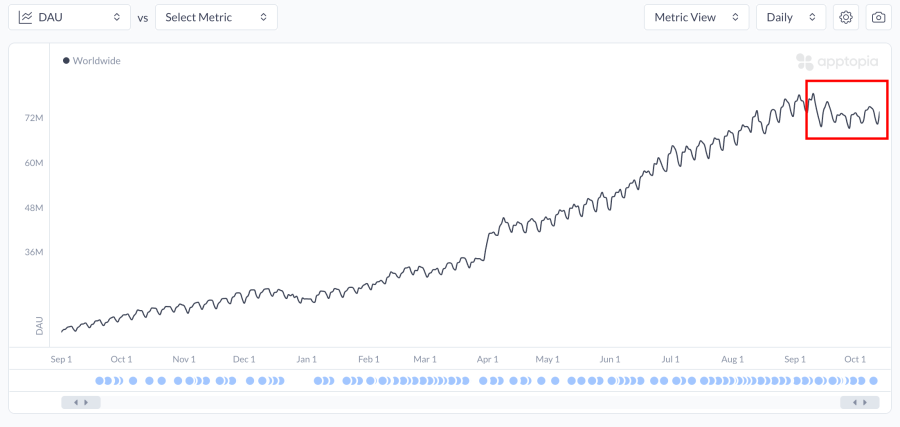
Data from Deutsche Bank and app analytics firm Apptopia shows a dip in the chatbot’s global momentum.
Downloads of the ChatGPT mobile app have fallen by more than 8% since early September. Even more telling, people are spending less time on it; the average time spent per user in the U.S. has dropped by about 22 percent since July.
According to Apptopia, both the time spent and the number of sessions are falling.
Why the Glow Is Fading
For many, ChatGPT was the first brush with what felt like real artificial intelligence—something that could write, explain, or think with us.
But as the months passed, the cracks began to show.
Users started noticing errors and weird answers. The tool could sound confident but be completely wrong. And as those quirks piled up, fascination slowly turned into frustration.
Then came the much-anticipated GPT-5, which, instead of reigniting excitement, disappointed many early adopters.
A study found that it actually performed worse than GPT-4o on safety measures. Its release in August was messy, leading to a wave of backlash from frustrated users who expected something revolutionary.
Behind the scenes, OpenAI faces a more complicated problem. Investors who once believed in endless AI growth are beginning to wonder whether the boom has peaked.
Even insiders have started to question whether large language models like ChatGPT can really keep evolving or if they’ve already hit their ceiling.
The Business Strain Beneath the Buzz
Despite Sam Altman’s claim that 800 million people use ChatGPT, only around 5 percent pay for a subscription. Yet those subscribers contribute nearly 70 percent of OpenAI’s yearly revenue, according to Financial Times.
That imbalance is worrying.
OpenAI is spending enormous sums maintaining the infrastructure that powers ChatGPT. Keeping that engine running costs millions, which means the company needs new ways to make money.
It’s testing new ways to make money, from adding advertising experiments to exploring paid versions of its video generator, Sora. The company has also hinted at loosening some content restrictions, a move that’s already stirring debate among users and industry watchers.
At the same time, competition is heating up.
Google’s Gemini is improving rapidly, Anthropic’s Claude is quietly winning fans, and smaller AI tools are carving out niches in classrooms, offices, and creative industries.
OpenAI, once the symbol of untouchable innovation, suddenly has to fight for attention.
Maybe It’s Not the Tech—Maybe It’s Us
There’s also a human side to this slowdown. The first time people used ChatGPT, it felt magical. It answered instantly, sounded intelligent, and could write like a person. But that magic was always tied to surprise, and surprise fades quickly.
Once the excitement wore off, people started questioning what they were getting out of it. Was it really saving them time? Were its answers trustworthy? Was it worth paying for?
AI didn’t stop being impressive; people just stopped being amazed. That shift says as much about human nature as it does about technology. We get used to the extraordinary faster than we realize.
Add growing concerns about misinformation, privacy, and job displacement, and it’s easy to see why many have stepped back to re-evaluate how much they want AI in their daily lives.
What Happens Next
OpenAI’s challenge now is less about creating smarter models and more about earning back trust and attention. People need reasons to keep using ChatGPT beyond curiosity and reasons to pay for it.
That could mean building more accurate, personalized experiences or finding ways to make ChatGPT genuinely useful in daily work rather than just impressive in demos.
The AI race isn’t ending. But the tone has shifted. What was once a gold rush now feels more like a test of endurance, a reality check for an industry that’s been running on excitement and promise.
Lessons for Everyday Users
If you use ChatGPT regularly, remember to see AI as a partner rather than a replacement. It can help you brainstorm, summarize, or refine your ideas, but it’s still learning. What it offers are patterns, not true understanding.
The same goes for businesses. Relying completely on one AI tool is risky in such a fast-moving field. What’s popular today might fade tomorrow. The smarter move is to diversify both the tools you use and the skills you build.
Key Takeaways
- ChatGPT downloads have fallen over 8 percent since September, with engagement down 22.5% in the U.S.
- User fatigue and repeated inaccuracies are chipping away at enthusiasm.
- Only 5 percent of ChatGPT users pay for the premium plan, though they make up 70% of OpenAI’s revenue.
- Rivals like Google Gemini and Anthropic Claude are steadily catching up.
- The AI boom isn’t over, but users are starting to demand more substance than spectacle.

Zulekha
AuthorZulekha is an emerging leader in the content marketing industry from India. She began her career in 2019 as a freelancer and, with over five years of experience, has made a significant impact in content writing. Recognized for her innovative approaches, deep knowledge of SEO, and exceptional storytelling skills, she continues to set new standards in the field. Her keen interest in news and current events, which started during an internship with The New Indian Express, further enriches her content. As an author and continuous learner, she has transformed numerous websites and digital marketing companies with customized content writing and marketing strategies.
