
The Numbers In Thirty Seconds
- Small forums gained the most (median plus 60 percent under 10,000 daily visits). Reddit gained the least of the big platforms, at plus 10.
- Authority losses were sorted by topic, not size. Health, government, reference, home and finance fell. Retail and technology reviews held or gained.
- Everything went flat the day Google called the rollout complete. What held on October 8 is what sites will live with until the next update.
What We Tracked, And Why Forums
When Google’s September 2026 spam update started rolling out on September 24, most website owners thought it would only hit websites that defied Google’s spam policies. However, when it finished on October 8 at 1:00 a.m., some of the most trusted websites in various niche industries saw a major decline in rankings and traffic.
So, we watched a set of 210 websites. Four days into the rollout, we noticed something odd in the Ahrefs data: forums—the scrappy, volunteer-run, ad-supported discussion boards that most SEO people wrote off years ago—were seeing an incremental increase in both rankings and traffic.
We first thought this could be an anomaly caused during the rollout, so we informed our readers but asked them to wait until the completion of the rollout. The startling finding was that it was not one or two forums that saw a massive increase in traffic, but nearly all of them.
We wrote a preliminary note on September 28 and decided to come back when the rollout was done. This is the finished version.
Here is what we measured.
100 forums. Independent discussion communities across 40 subjects: cars, shooting sports, home repair, personal finance, bread baking, gaming, college admissions, boating, aviation, woodworking, knitting, pets, cruising, nursing, affiliate marketing and more. We picked them before looking at any traffic numbers. The set runs from forums with a few thousand daily visits up to Reddit, Quora, Stack Overflow and Stack Exchange, which we report but also break out so they do not swamp everything else.
110 authority sites. The sites Google holds up as the gold standard for expertise and trust. Fifteen health sites including Mayo Clinic, Healthline, WebMD, Cleveland Clinic, the CDC and NIH. Ten reference sites including Wikipedia and Britannica. Ten finance sites including NerdWallet, the IRS and Social Security. Government and university sites like NASA, NOAA, Harvard and MIT. Plus food, home, travel, retail, technology and consumer sites. Again, chosen by category before we looked at a single number, so this is not a list of known losers dressed up as a sample.
What we left out. News publishers. Their search traffic moves with the news cycle, so they tell you nothing clean about an algorithm change.
The data. Ahrefs estimated daily US organic traffic for every site, every day from September 24 to October 11. That is 210 sites, 18 days, 3,780 data points. It is an estimate, not Search Console. It is also the only way to get a consistent daily series across 210 sites we do not own. We report medians so that Reddit and Wikipedia cannot drag the averages around.
The full methodology, every caveat and the complete figures for all 210 sites are in the full research report (PDF).
One Curve Went Up As The Other Went Down
Here is the chart that made us write this up. Every day, we took the median change in traffic versus September 24 for forums, for authority sites and for the 15 health sites on their own.
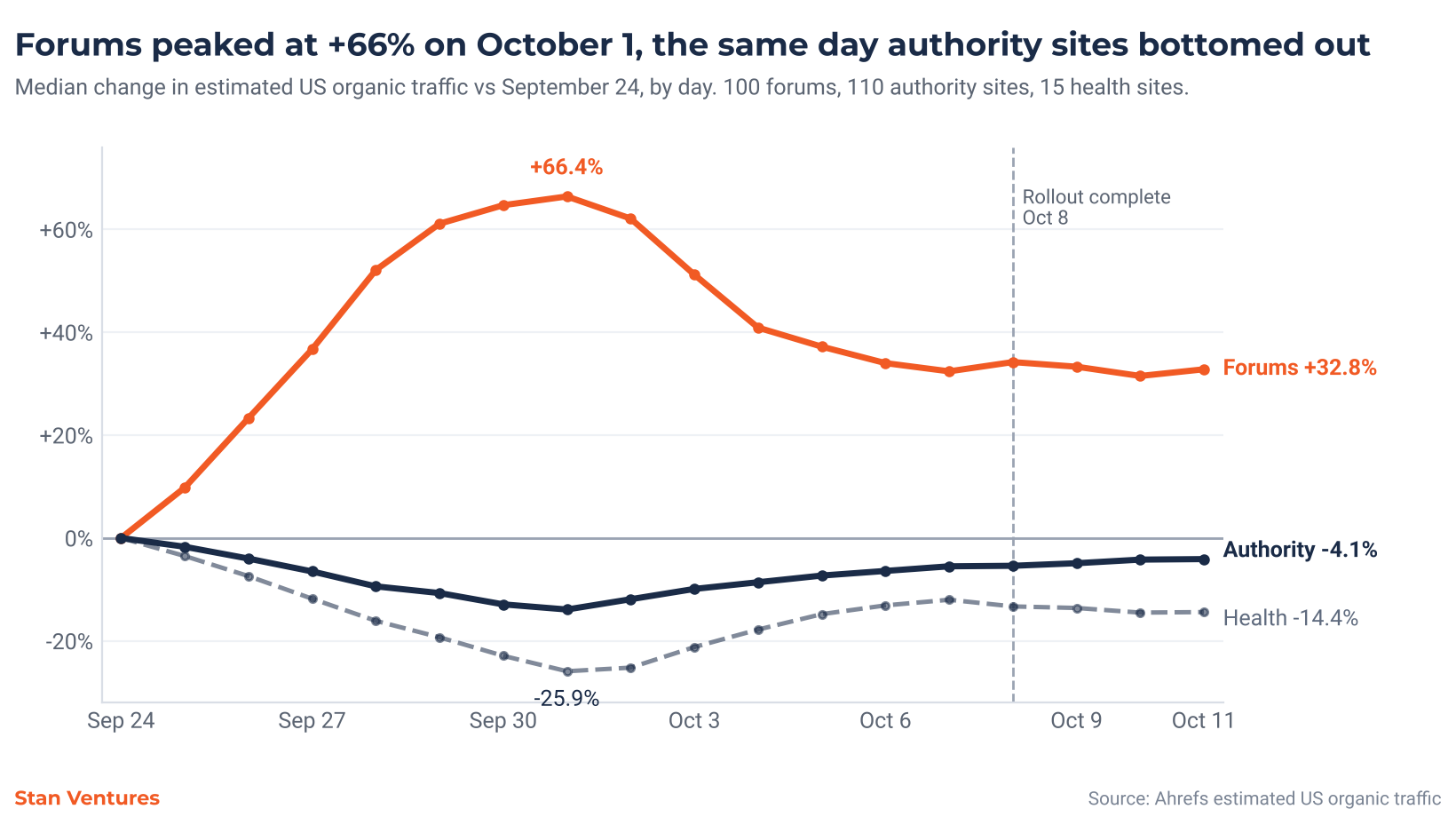
We found that the forums saw a significant increase in traffic every single day from September 24 to October 1, reaching a median gain of 66 percent on the eighth day. On the flip side, the authority sites we shortlisted fell every single day over the same period, to minus 14 percent. Health sites fell harder, to minus 26 percent.
Then, on October 2, both curves turned. Forums gave back about half of their peak gain over the next six days and settled at plus 34 percent. Authority sites clawed back from minus 14 to minus 5. Health sites recovered less, from minus 26 to minus 13.
And on October 8, the day Google declared the rollout complete, everything went flat. Over the next three days the median forum moved by half a percentage point. The median authority site moved by one. Whatever the update did, it was finished doing it on the day Google said it was.
Two things in that picture matter. The turn happened on the same day for both groups, which is what you would expect if one change was moving traffic from one kind of page to another. And the fall-back after October 1 is normal. Google rollouts overshoot and correct as later stages apply. If you read a day-four number from any Google update as the final result, you will be wrong by about half.
What Forums Kept After The Dust Settled
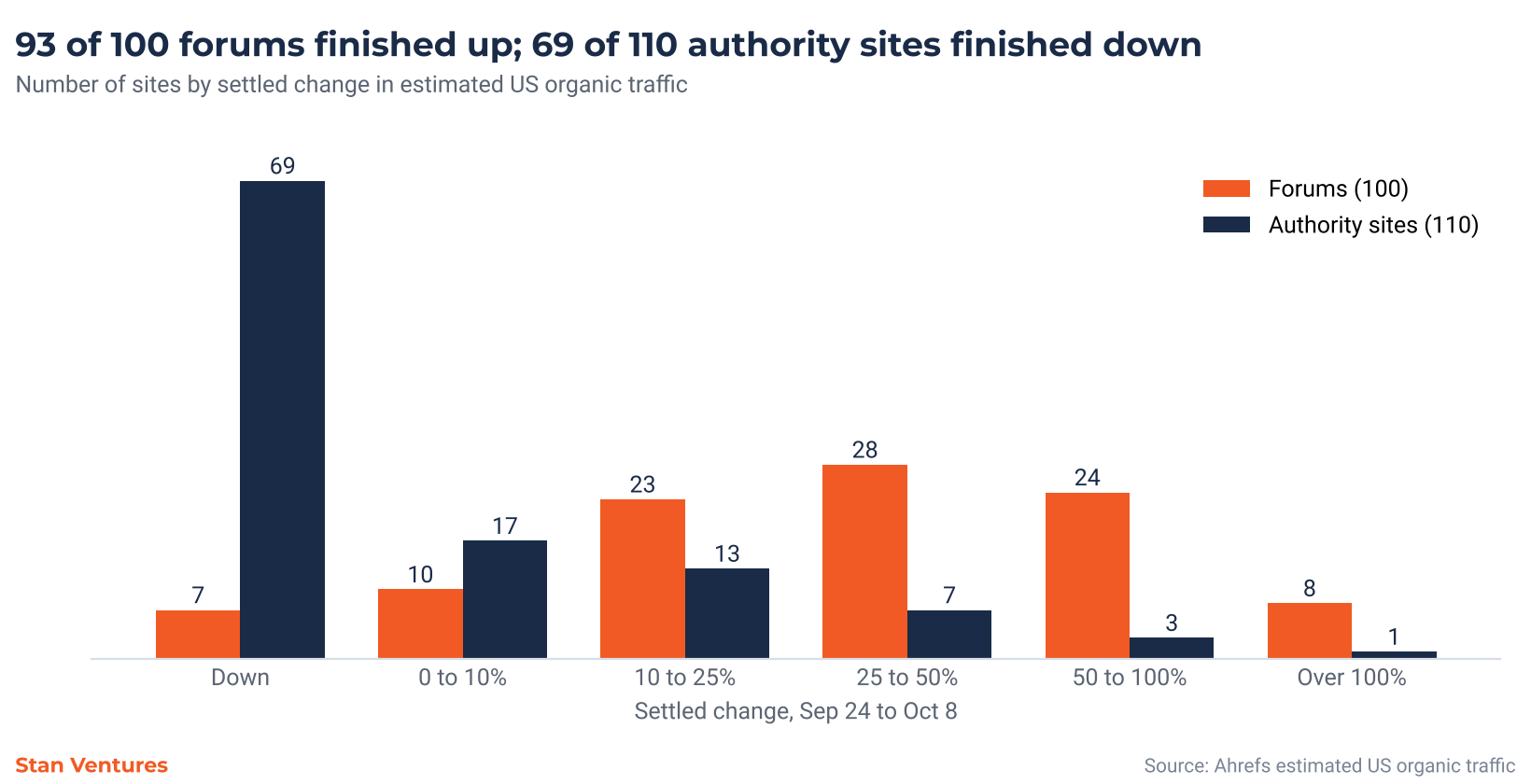
Of the 100 forums, 93 finished the rollout above where they started. The median gain was 34 percent. Sixty forums gained more than 25 percent, 32 gained more than 50 percent and eight more than doubled. Seven finished down. Take out the four giant Q&A platforms and the combined traffic of the other 96 forums still rose 21 percent.
Put the two groups side by side and the shape of it is hard to miss.
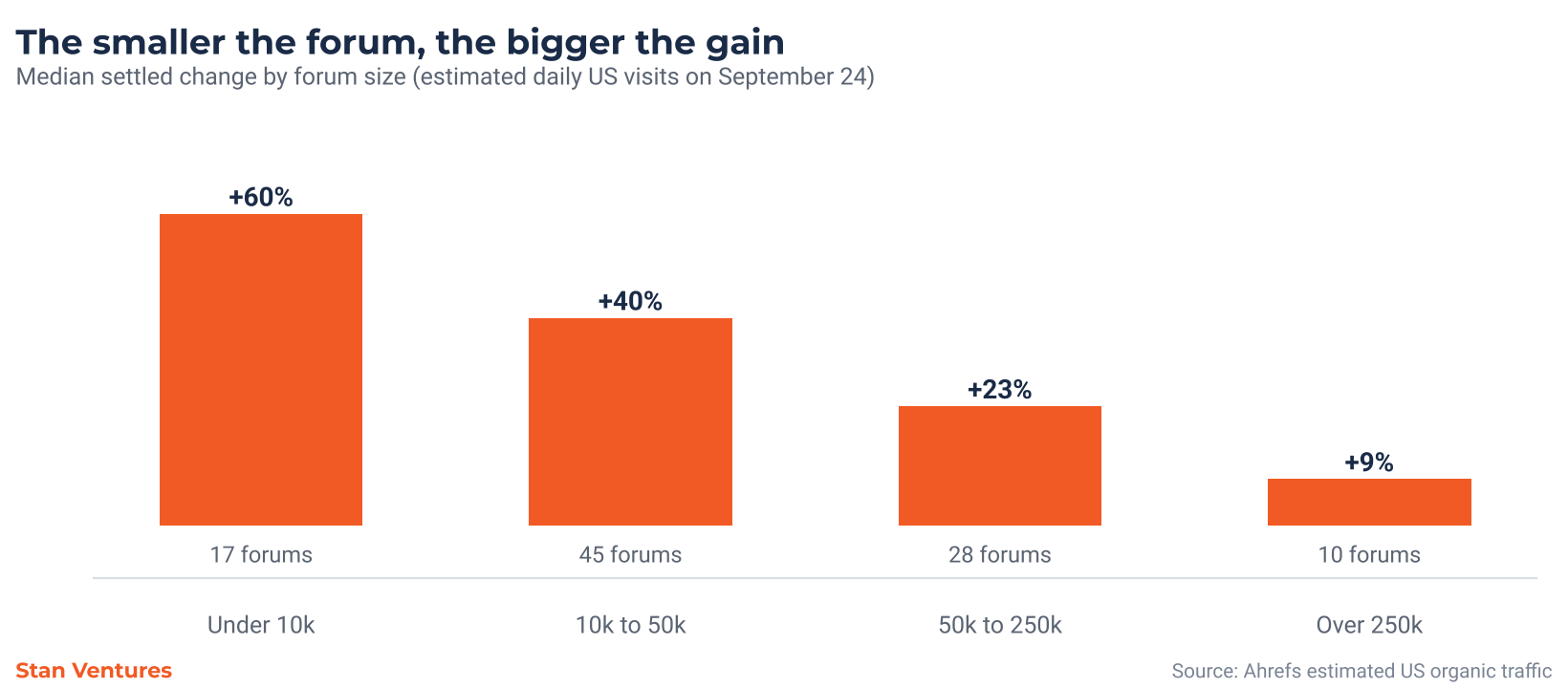
The smaller the forum, the bigger the gain. Forums with under 10,000 daily visits gained a median 60 percent. Forums between 10,000 and 50,000 gained 40. Between 50,000 and 250,000, 23. Over 250,000, just 9. The four giants sit at the bottom: Stack Overflow plus 27, Quora plus 11, Reddit plus 10, Stack Exchange plus 3. Reddit’s 10 percent is worth about 44 million extra estimated daily visits, so in raw numbers it is the biggest winner by a mile. But this was not a Reddit story. The update lifted small, specialist communities the most.
Every category finished positive. Hands-on, practical subjects led. These are the median settled gains for the 15 forum categories with three or more sites.
The biggest winners. Slowtwitch, a triathlon forum, plus 195 percent. The Fresh Loaf, where people argue about sourdough, plus 179. The Firing Line plus 143. Fred Miranda, a photography board, plus 127. City-Data plus 118. Rolex Forums plus 108. Top Law Schools plus 107. CoinTalk plus 104. Early Retirement plus 96. NASIOC, a Subaru forum, plus 91. Most of these had under 25,000 daily visits before the update. All of them cover subjects where the best answer to a search is a long thread of people who have done the thing, disagreeing about how to do it.
The give-backs. Some forums that led our day-four note gave most of it back. AudioKarma went from plus 196 to plus 16. Warrior Forum from plus 161 to plus 13. Pizza Making from plus 133 to plus 26. Rennlist from plus 147 to plus 56. This is the correction in the chart above playing out site by site, and it is why we waited for the rollout to finish before writing this.
The seven that fell. Ravelry minus 21, BigSoccer minus 11, Slickdeals minus 10, GolfWRX minus 5, MyAnimeList minus 2, BoardGameGeek minus 1, Democratic Underground flat. Three of those (Ravelry, MyAnimeList, BoardGameGeek) are really databases with a forum bolted on, and Slickdeals is a deals aggregator. Their search traffic comes from catalogue pages, not threads. The pattern holds best where discussion is the product.
What Happened To The Sites Google Told Us To Trust
Of the 110 authority sites, 69 finished the rollout below where they started. The median change was minus 5 percent, the group’s combined traffic fell 8 percent, and 40 sites lost more than 10 percent. It was not uniform. Twenty-four sites gained more than 10 percent, and that long tail of gainers is why we report the median and not the mean.
The losses were not random either. They clustered by category, and the categories that fell hardest are the ones Google has spent the better part of a decade telling the industry to treat as the benchmark for expertise.
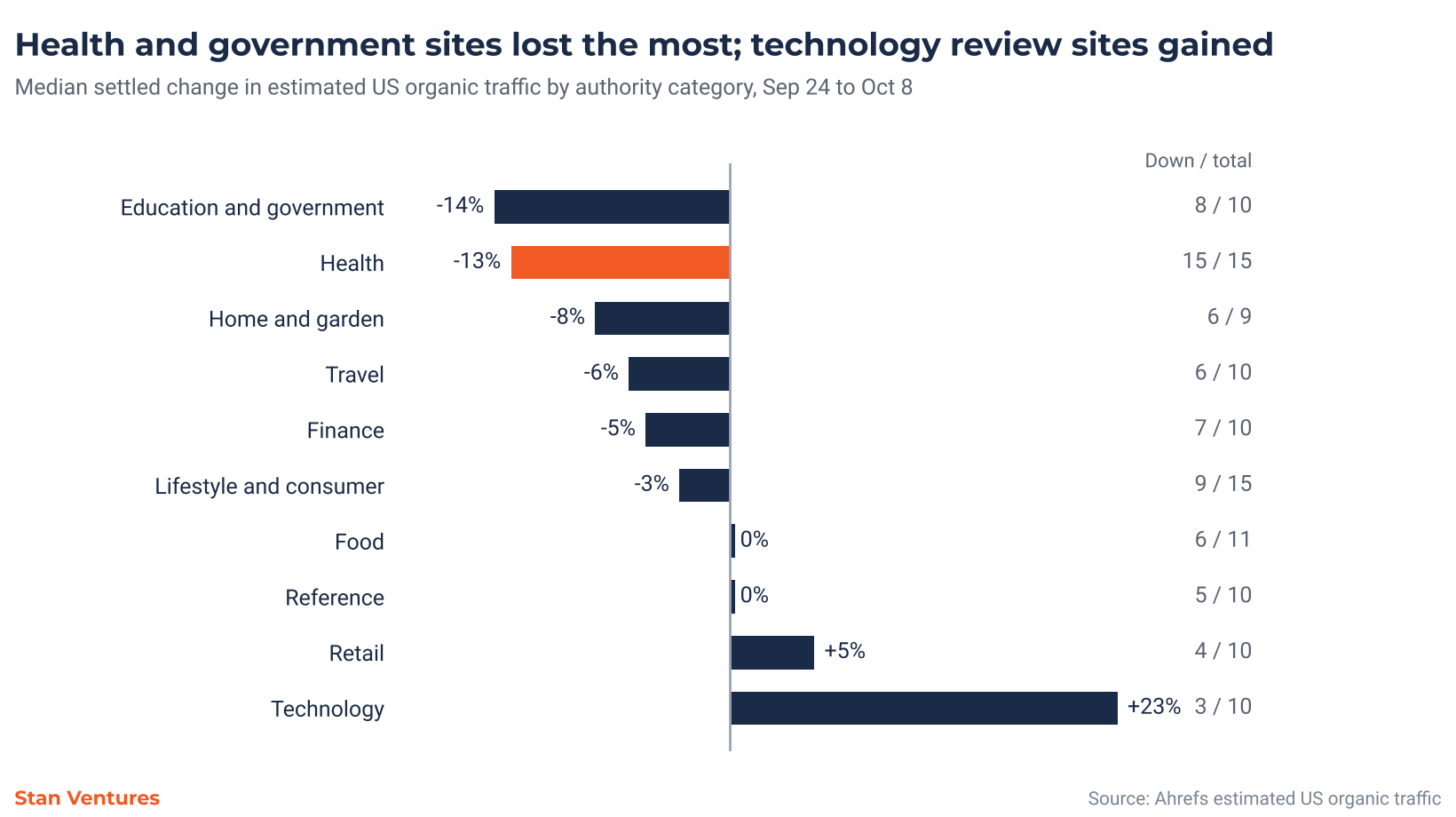
Health: 15 of 15 down. Median loss 13 percent, with a trough of minus 26 on October 1. Healthline fell 29 percent. Mayo Clinic 22. MedlinePlus 22. Cleveland Clinic 18. Drugs.com 15. Johns Hopkins Medicine 14. WebMD 14. Harvard Health 13. The CDC 10. NIH 9. Not one health site in the sample gained. This is the category Google most explicitly holds up as the standard for expertise, experience, authority and trust, and it was the most consistently hit group in the study.
Education and government: 8 of 10 down. Coursera minus 34. USGS minus 24. NOAA minus 17. Library of Congress minus 16. Harvard minus 14. NASA minus 14. MIT minus 10.
Reference. Wikipedia lost 15 percent. Merriam-Webster 19. Quizlet 15. Britannica was flat and Dictionary.com gained 21, so the category median is zero. But the largest reference site on the web lost roughly one visit in seven.
Food, home, finance, travel. Allrecipes minus 8. Serious Eats minus 11. Six of nine home and garden sites down. Seven of ten finance sites down. Six of ten travel sites down. Every one of these is a category where a forum thread (Bogleheads, FlyerTalk, Cruise Critic, DIY Chatroom, The Fresh Loaf) is a credible substitute for a publisher’s explainer.
Where authority held. Retail went up (median plus 5) and so did technology reviews (plus 23). Amazon gained 13 percent, Target 22, Home Depot 17. PCMag gained 118, Tom’s Hardware 23, CNET 23. Retail traffic comes from product and brand searches that no forum thread answers. Technology review sites already run on hands-on testing. The one authority category that is itself a first-hand source came out ahead.
Size did not matter here. Among forums, smaller meant bigger gains. Among authority sites, the 29 giants with over 10 million daily visits had a median change of minus 10, mid-sized sites minus 6, and smaller ones were flat or slightly up. The losses were sorted by what kind of question a site answers, not by how big it is.
Same Questions, Opposite Results
The cleanest way to see what the update did is to put a forum category next to the authority category that answers the same questions. In six of eight pairs, the forum side rose while the authority side fell.
The two exceptions tell you as much as the six matches. In technology, both sides gained and the authority sites gained more, because PCMag, Tom’s Hardware and CNET publish hands-on test results a forum cannot replicate. In shopping, retail won and the deals forum lost, because a product query wants a product page.
What The Data Says, And What It Does Not
We sell authority building for a living, so you should read our numbers with the same scepticism you would read anyone else’s. Here is where we draw the line.
What the data supports. During this spam update, a broad sample of forums gained traffic and a broad sample of authority sites lost it. The two movements happened on the same days, in opposite directions. The forum gains were widespread, large and held for three days after completion. The authority losses were concentrated in the categories where a forum thread competes for the same searches, and were absent in retail and technology reviews, where it does not.
What it suggests but cannot prove. The simplest explanation is that Google changed how it weighs first-hand experience against institutional authority for informational searches, and that forum threads and authority explainers were competing for the same positions. The mirror-image timing fits that. But we measured traffic, not rankings for specific queries. We cannot show that a visit moved from Healthline to a forum. That would need page-level ranking data for matched searches, and it is the obvious next study.
What it does not say. It does not say Mayo Clinic or anyone else was targeted by a spam update, or broke a spam policy. Google does not publish that, and losing traffic during a rollout is not evidence of it. It does not say forums are more accurate than medical institutions. It says Google sent more traffic to one and less to the other. And it does not say the losses are permanent.
“Sites that lose traffic in a Google update almost never get it back during that update. The reversal, when it comes, comes at the next one, and only for sites that made steady, incremental improvements in between. The worst thing an authority site can do right now is panic and rebuild. The second worst thing is to do nothing. Google also tends to tighten a few loopholes about two weeks after a rollout completes, so we will pull this data again on October 22 and publish what changed.”
Varun Joshi, Vertical Head – SEO, Stan Ventures
What Happened Next
On the morning this report was published, Adweek reported that Google has started testing ads for branded prescription drugs inside AI Mode and AI Overviews. A Google spokesperson confirmed the test to Adweek: it began in October, it is limited to the United States, and pharmaceutical advertisers can run standard text and Shopping ads in sections labelled “Sponsored.” Healthcare had been excluded from AI Overview ads since the format launched in October 2024.
Put that next to the health figures above. The 15 health publishers in this study, the sites that own the organic answer to “what is this drug for” and “what are the side effects,” lost a median 13 percent of their estimated traffic during a spam update that ran from September 24 to October 8. The following month, Google began selling branded drug ads on the AI surfaces that sit above those same answers. We also checked 16 pharmacy and drug-retail sites over the same period: they dipped a median 12 percent on October 1 and had recovered to roughly flat by October 11, so the lasting loss sits with the publishers who explain medicines, not the sites that sell them.
Sequence is not cause. The spam update started on September 24 and the ad test started in October, and nothing in our data shows that Google planned one for the other. We are not claiming it did. What we can say is that the organic space for health information got smaller in September, and in October the space above it went on sale. Health publishers planning their response to this update should plan for both.
What To Do With This
If You Run A Forum: Protect The Threads That Won
Check Search Console before you plan around it. Then look at which threads gained. In our sample the winners were long, specific, experience-led threads on practical subjects. Do not respond to a windfall by stacking ads, gating content or auto-generating summary pages. A spam update that rewarded you can take it back at the next one. Keep thread pages fast, crawlable and free of the low-quality posts a spam update is explicitly hunting for.
If You Run A Publisher That Lost: Find The Pages, Not The Excuse
Do not rebuild the site in reaction to a rollout that finished last week. Identify which pages lost. In our data the losses cluster on broad explainers, the “what is”, “how to” and “is it safe to” pages that compete directly with discussion threads. Then close the experience gap on those pages: named practitioners, first-hand testing, specific cases, honest uncertainty, writing that sounds like someone who has done it. And ask whether a community of your own belongs on the site. Several of the health and finance institutions in this study have audiences that would fill one.
If You Advise Clients: Audit Informational Pages Against A Forum Thread
The useful message is not “forums won.” It is that Google is rewarding demonstrated first-hand experience over institutional credentials for informational searches, and that this has now shown up in a spam update, not only in the helpful content and core updates where it first appeared. Go page by page. Start with the pages where a forum thread already outranks your client, and ask what the thread has that the page does not.
If You Are A Journalist Or Researcher: Take The Data
The site-level figures for all 210 sites are in the full report, and the daily series is available on request. We will publish a follow-up two weeks after completion. If you run a forum or an authority site and have Search Console data that confirms or contradicts these estimates, we would like to see it.
Frequently Asked Questions
Is this Search Console data?
No. It is Ahrefs’ estimate of daily US organic traffic, built from the keywords each site ranks for, their positions and search volumes. It is directionally reliable across a sample this size and less reliable for any single site. Trust the medians more than any one row.
Why do these numbers differ from your September 28 note?
Two reasons. Ahrefs revises recent history as its model updates, so the September 24 baseline shifted by a median of about 5 percent. And the rollout was only four days old on September 28; forums have since given back roughly half of their peak gain. Every comparison here uses the revised, consistent series.
Did you pick authority sites that you already knew had lost?
No. Both samples were chosen by category before we looked at traffic. That is why 41 of the 110 authority sites finished up, and why we report them. A list of known losers would have been a more dramatic chart and a worse study.
Why no news sites?
Their search traffic rises and falls with the news cycle. A busy news fortnight would look like an algorithm effect, and a quiet one would hide it. They tell you nothing clean about an update, so they are out.
Will the forum gains last?
They held flat for the three days after completion, which is a good sign but a short one. Google typically adjusts a few things in the weeks after a rollout, and the next core update will test them properly. We will re-pull the series on October 22 and publish the result.
Can I get the raw data?
Yes. The full report carries the figures for all 210 sites, and the daily series is available to journalists and researchers on request.
Is Your Client Losing To A Forum Thread?
We will show you which of your informational pages a forum already outranks, and what it would take to earn that position back across search and AI platforms.

Dileep Thekkethil
AuthorDileep Thekkethil is the Director of Marketing at Stan Ventures and an SEMRush certified SEO expert. With over a decade of experience in digital marketing, Dileep has played a pivotal role in helping global brands and agencies enhance their online visibility. His work has been featured in leading industry platforms such as MarketingProfs, Search Engine Roundtable, and CMSWire, and his expert insights have been cited in Google Videos. Known for turning complex SEO strategies into actionable solutions, Dileep continues to be a trusted authority in the SEO community, sharing knowledge that drives meaningful results.