Free Backlink Quality Checker!
Enter your website, and we’ll send you a comprehensive backlink analysis report with details of your link profile and strategies for boosting it.
Spam score is a health signal for your backlink profile. Knowing what it actually measures, and, just as importantly, what it does not, is the difference between fixing real problems and chasing a number no search engine ever reads.
Used well, it points you to genuine link-quality and site-quality issues before they turn into ranking trouble. This guide breaks down what spam score is, how Moz calculates it, what a healthy range looks like, and the practical steps that bring a high score down for good.
Website Spam Score vs. Email Spam Score: Two Different Metrics
Before anything else, clear up a common mix-up. Two unrelated metrics share the name “spam score,” and people regularly worry about the wrong one.
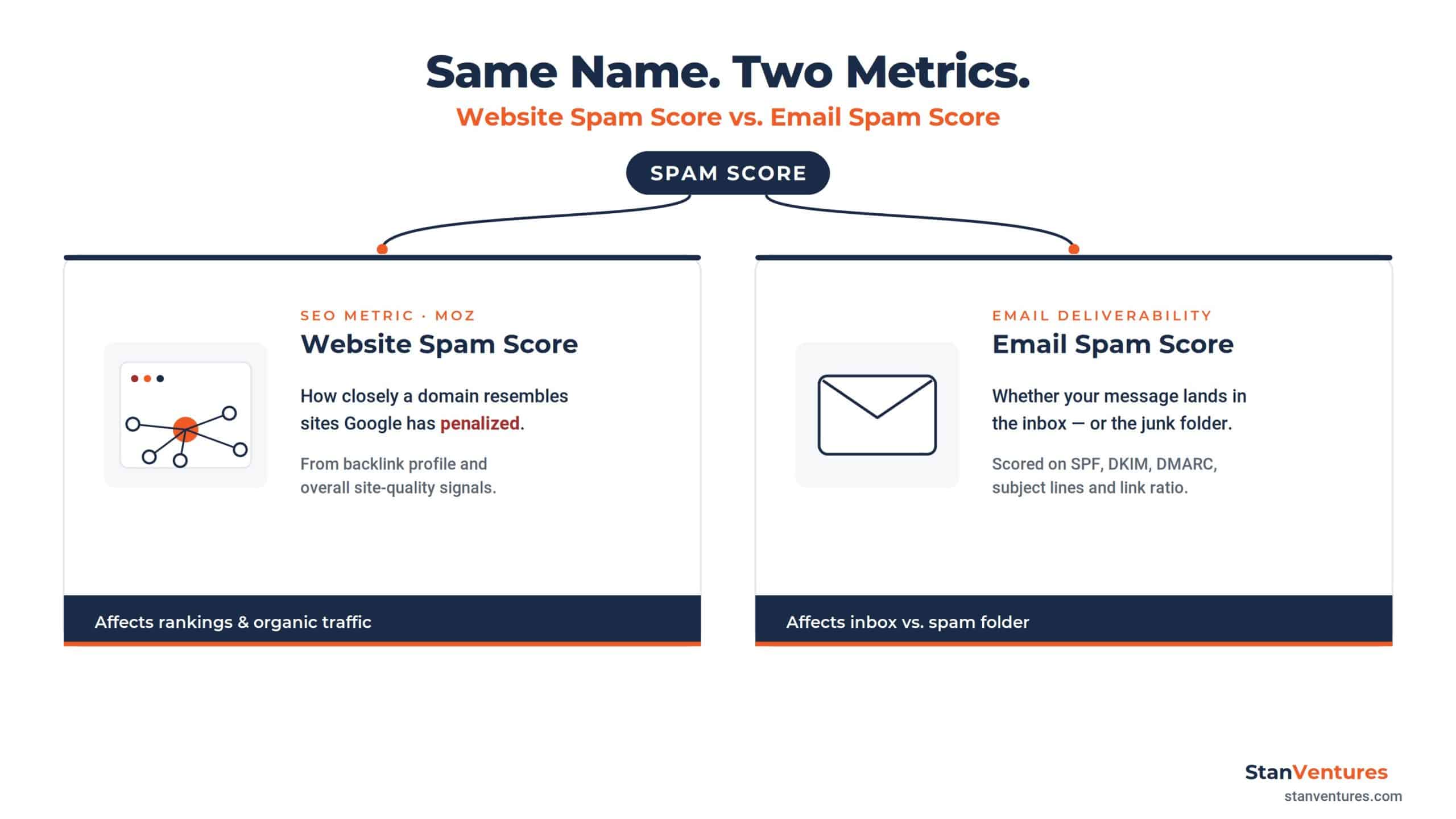
- Website (SEO) spam score evaluates how closely a domain resembles sites that search engines have penalized, based mostly on backlink and site-quality signals. This is the Moz metric SEOs talk about, and it is the focus of this article.
- Email spam score is a deliverability metric. Tools that test newsletters and cold outreach score a message on factors like authentication (SPF, DKIM, DMARC), spammy subject lines, and link-to-text ratio to predict whether it lands in the inbox or the junk folder.
If your concern is rankings and organic traffic, you want the website metric below. If your concern is emails bouncing into spam folders, that is a separate deliverability topic entirely.
What Is Spam Score?
Spam score is a third-party SEO metric that estimates how likely a website is to look spammy to search engines, based on how closely it resembles sites that have already been penalized or banned. A low score signals a clean, trustworthy profile.
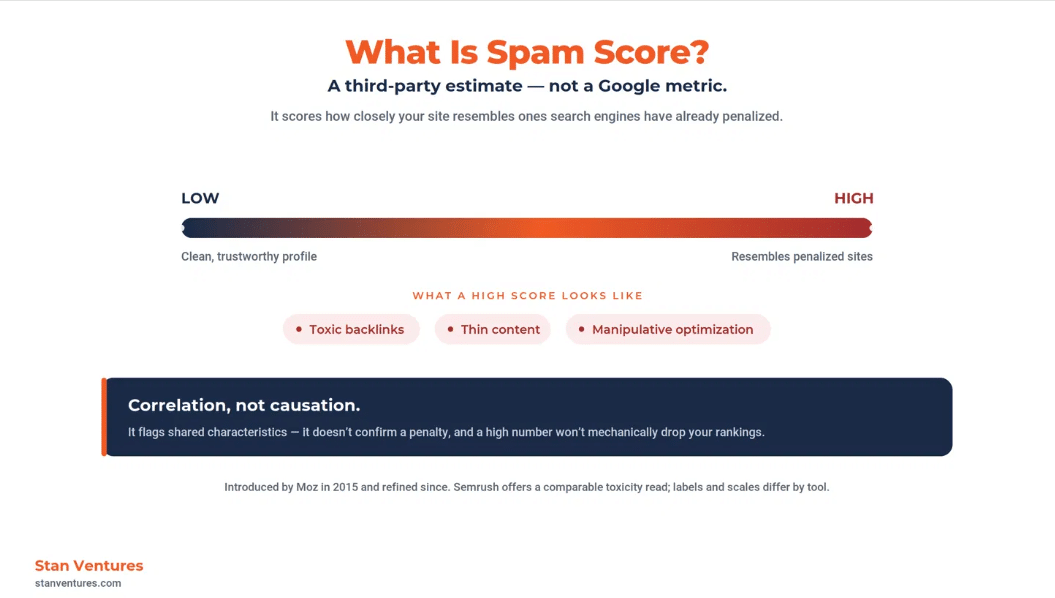
A high spam score suggests the kind of patterns, including toxic backlinks, thin content, manipulative optimization, that tend to show up on low-quality sites.
The metric was created by Moz in 2015 and refined repeatedly since. Semrush offers a comparable read through its toxicity scoring, and the labels and scales differ from tool to tool. The single most important fact about all of them: these are proprietary, third-party estimates, not a Google metric.
Spam score is built on correlation, not causation. It tells you your site shares characteristics with penalized sites; it does not confirm a penalty, and a high number does not mechanically push your rankings down.
How Moz Calculates Spam Score (and Why the Number Isn’t What Most People Think)
Moz’s spam score is the output of a machine-learning model trained on millions of websites that Google has penalized or banned. Moz identifies a set of features those sites tend to share, then scores any domain by how many of those features it exhibits.
A few details change how you should read the number:
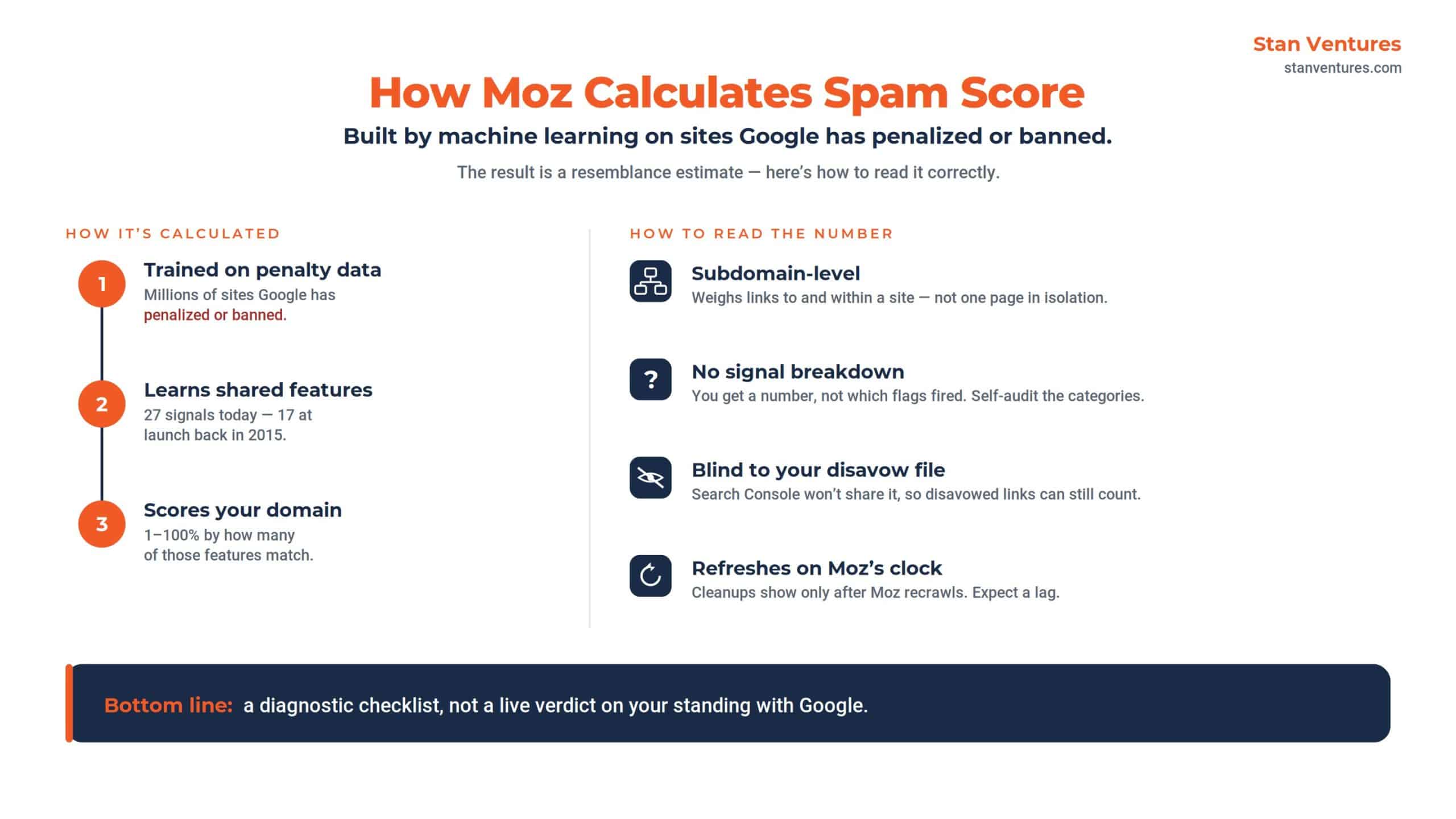
- It is a percentage, scored 1-100%:The higher the percentage, the more closely a site resembles penalized sites in Moz’s data set.
- It analyzes 27 signals: When Moz launched the metric in 2015, the model used 17 flags. It later expanded to 27 machine-learned signals and moved to the percentage scale. Older articles citing “17 signals” are simply describing the legacy version.
- Moz applies it at the subdomain level: It is designed to assess the quality and relevance of links pointing to and within a site, not to grade a single page in isolation.
- It won’t tell you which signals you triggered: You get a score with no itemized breakdown, which means the practical move is to self-audit against the known signal categories.
- It cannot see your disavow file: Google’s Search Console API does not expose disavow data, so links you have already disavowed can still count toward your Moz score.
- It refreshes on Moz’s schedule, not yours: Changes you make today only appear after Moz recrawls and recalculates, so expect a lag between cleanup and an improved number.
In short, the score is a diagnostic checklist, not a live verdict on your standing with Google.
What Is a Good Spam Score?
Moz groups scores into three bands:
- 1-30% (Low) A healthy, low-risk profile.
- 31-60% (Medium) Worth investigating, though not automatically a problem.
- 61-100% (High) A clear signal to audit your backlinks and site quality.
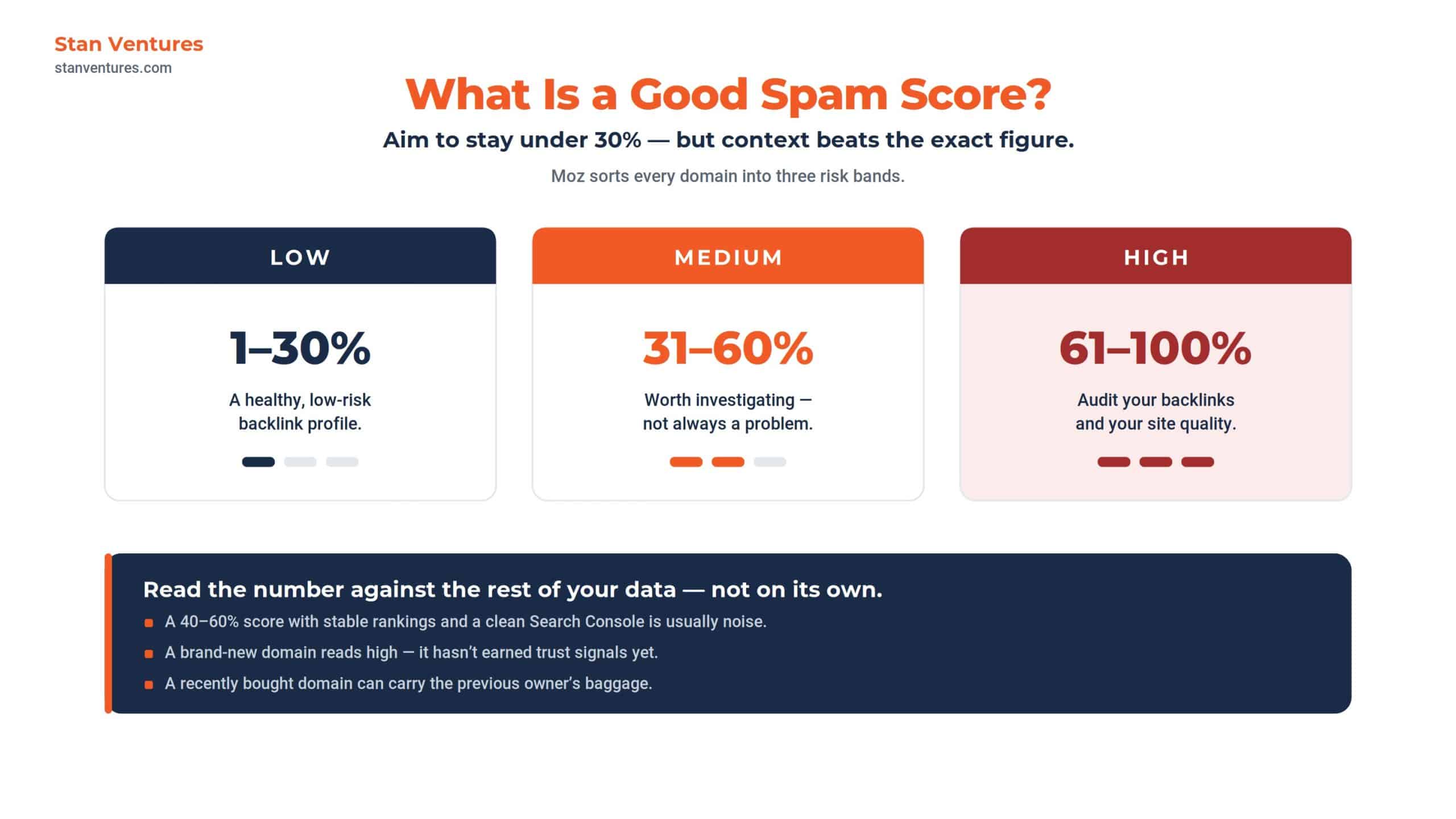
Aiming to keep a domain under 30% is sensible. But context matters more than the exact figure. A score in the 40-60% range with stable rankings and no warnings in Search Console is usually noise rather than an emergency.
A brand-new domain can show an elevated score simply because it lacks the trust signals established sites accumulate over time, and a recently purchased domain may carry over the previous owner’s baggage. Read the number against the rest of your data, not on its own.
Does Google Use Spam Score? What It Actually Measures Against
Google does not use Moz’s spam score. Google’s John Mueller has stated plainly that the metric neither affects your backlinks nor factors into ranking. So why watch it at all? Because the patterns Moz flags overlap heavily with the patterns Google’s own systems target.
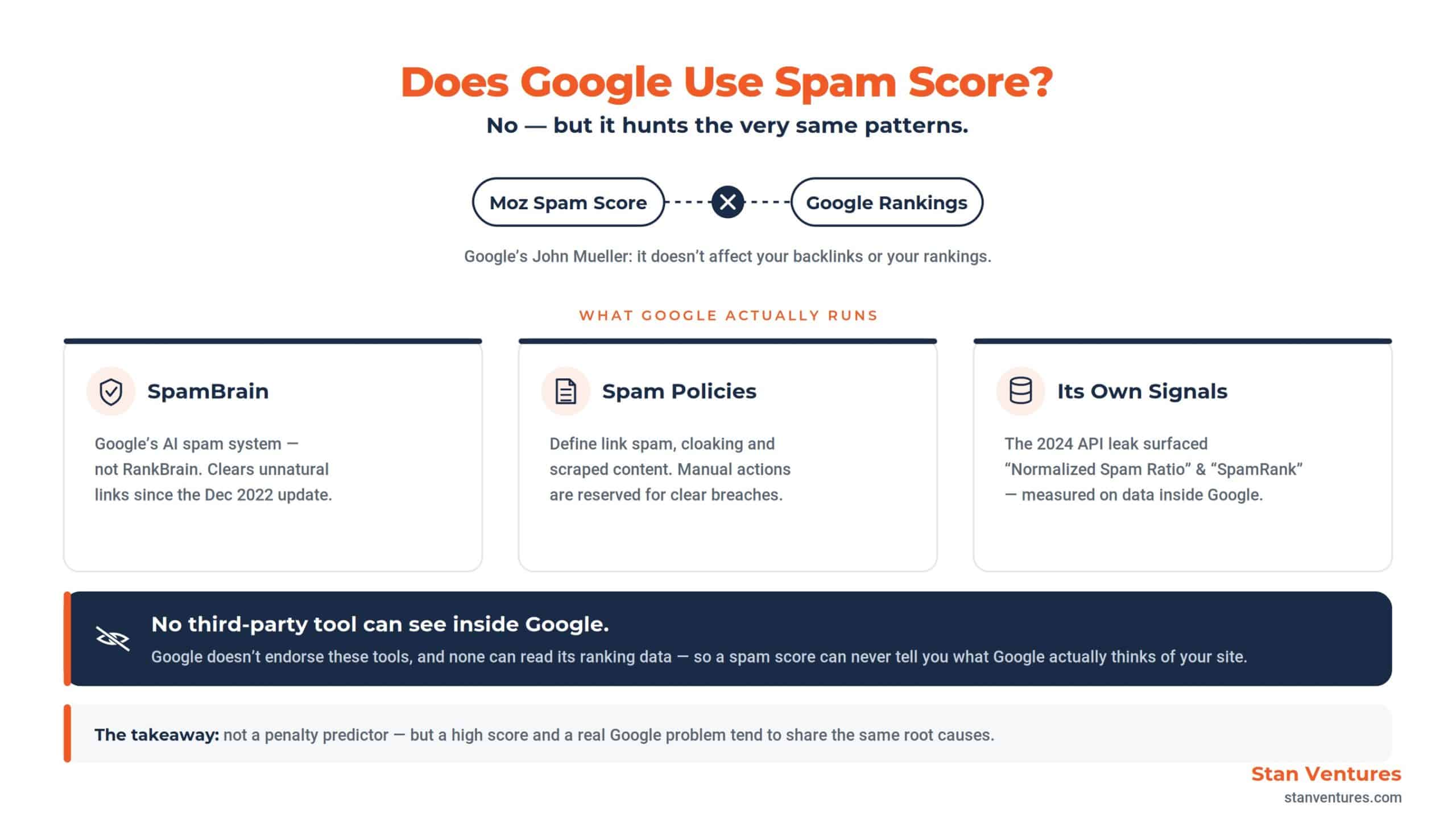
Google fights spam with SpamBrain, its AI-based spam-prevention system, which has been used to neutralize unnatural links since the December 2022 link spam update. (A quick correction to a myth that circulates widely: the link-spam system is SpamBrain, not RankBrain. RankBrain is a relevance system and has nothing to do with spam.)
Alongside that, Google’s spam policies define what counts as link spam, cloaking, scraped content, and other violations, with manual actions reserved for clear breaches.
Documents surfaced in the 2024 Google API leak added detail to what Google evaluates internally. References to a “Normalized Spam Ratio” (a site-level signal tied to dubious quality and trust) and “SpamRank” (a measure of the likelihood that a site receives links from known spammers) suggest Google maintains its own proprietary equivalents measured with data that lives entirely inside Google.
That boundary is now spelled out in Google’s own guidance on third-party SEO tools, which states plainly that Google does not endorse such tools and that none of them can see its internal ranking data. The practical consequence: a spam score can never tell you what Google actually thinks of your site. At best, it flags the same categories of problems Google’s systems are built to catch.
The takeaway is not that Moz’s number predicts a penalty. It is that a high score and a genuine Google problem tend to share the same root causes.
Does Ahrefs or Semrush Have a Spam Score?
This is one of the most common follow-up questions, and the answer has changed recently.
- Semrush surfaces link risk through its toxicity scoring within the backlink audit, expressed on a low/medium/high basis rather than a single percentage.
- Ahrefs historically avoided labeling links as “toxic.” That changed in early 2026, when Ahrefs introduced a “SPAM” label for referring domains and backlinks inside Site Explorer, giving auditors a native way to filter spammy links without third-party toxicity tools.
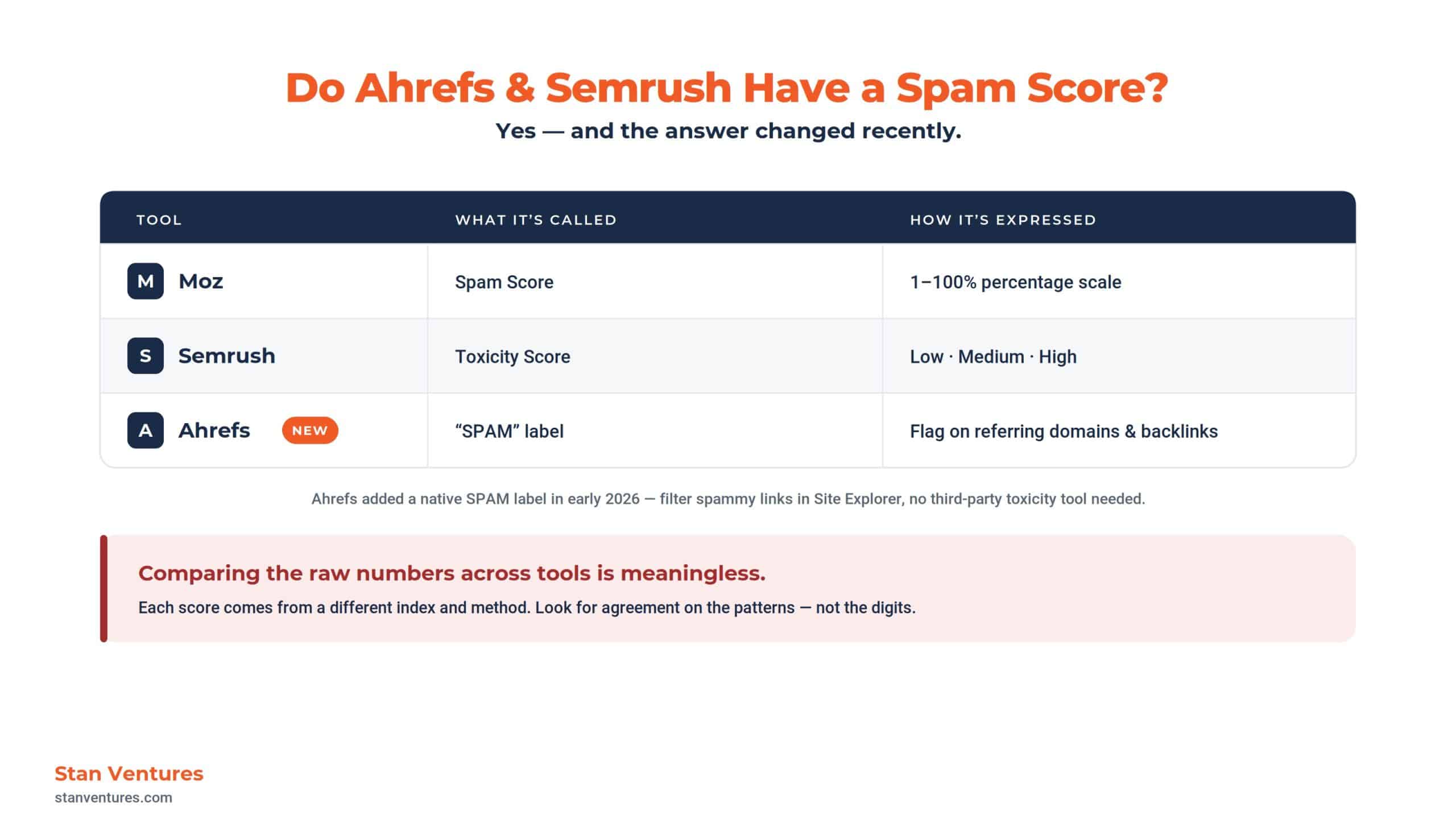
Every major tool now offers some equivalent, but each calculates it from its own index and methodology. Comparing the raw numbers across Moz, Semrush, and Ahrefs is meaningless. Use each within its own ecosystem and look for agreement on the patterns, not the digits.
How to Check Your Spam Score
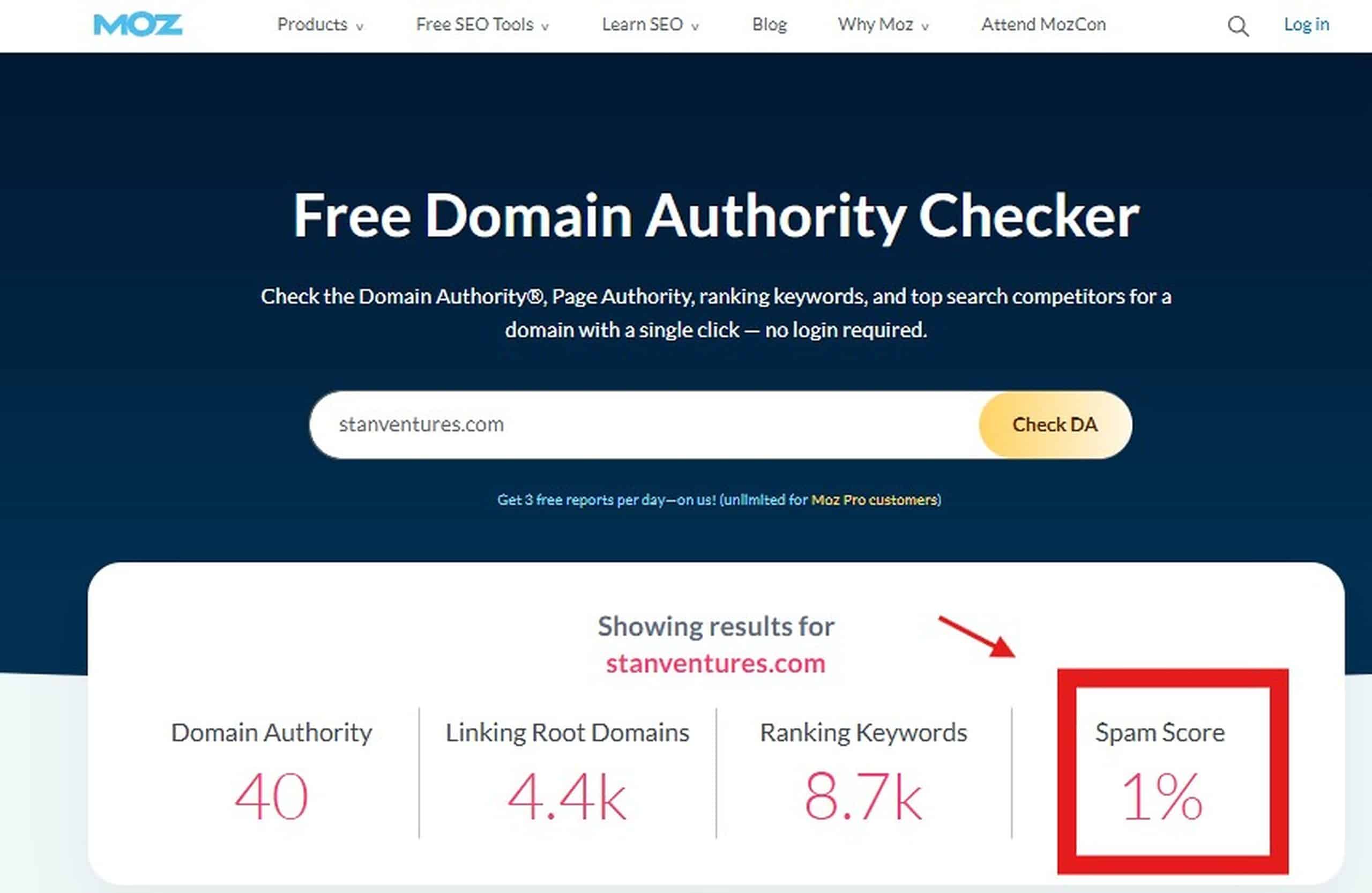
The fastest way to read a site’s spam score is through Moz:
- Open Moz Link Explorer or Moz Domain Authority Checker (or install the free MozBar browser extension).
- Enter the domain or URL and run the analysis.
- Read the spam score alongside the linking domains and authority metrics on the overview.
- Google Search Console is the only place that shows a real Google penalty. If there is a manual action against your site, it appears here, not in any third-party score. Search Console is also useful for spotting unusual linking domains, though it is best treated as a verification layer rather than a full audit tool, as covered in this walkthrough on checking backlinks in GSC.
- Semrush or Ahrefs give you the backlink detail to investigate why a score is elevated, such as anchor text patterns, referring-domain quality, and sudden spikes.
What Raises Your Spam Score
Spam score climbs when a site accumulates the characteristics Moz associates with penalized domains. The most common contributors:
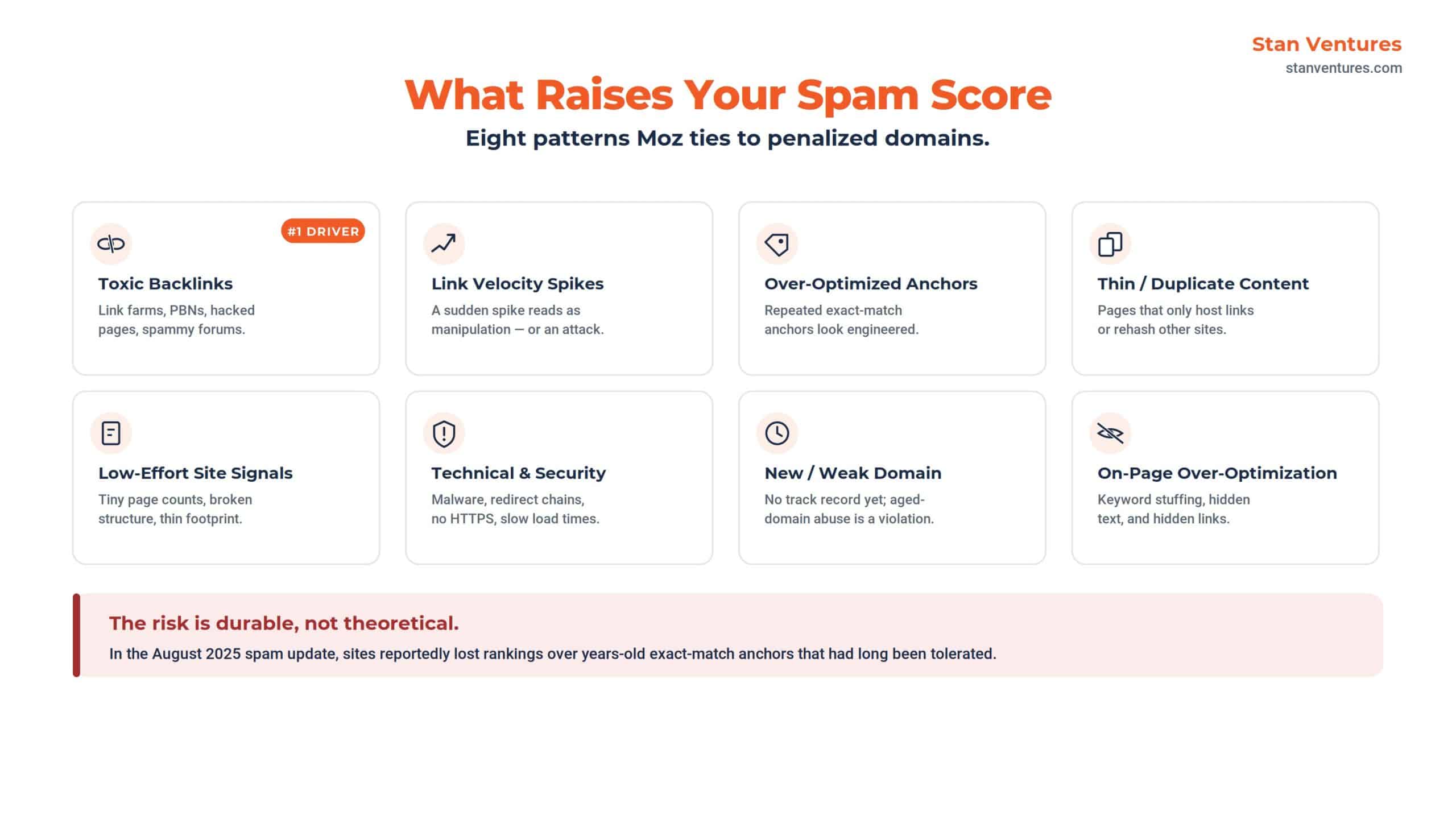
Toxic and low-quality backlinks: Links from link farms, private blog networks, hacked pages, irrelevant directories, and spammy forums are the single biggest driver. Learning how to spot toxic backlinks is the foundation of any cleanup. If you are associated with agencies that do manual blogger outreach, this is a metric that’s often part of their quality control checklist.
Unnatural link velocity: A sudden, inexplicable spike (hundreds of new links appearing at once) reads as manipulation, especially on a young domain. It can also be a sign of a negative SEO attack rather than anything you did.
Over-optimized anchor text: Repeating the same exact-match, keyword-rich anchor across many backlinks looks engineered. The risk is real and durable: in the August 2025 spam update, sites reportedly lost rankings over exact-match anchors from spammy links that were years old and had previously been tolerated. Varying anchors is core to anchor text optimization and this is something that reputed agencies consider when doing guest posting service.
Thin, duplicate, or low-value content: Pages that exist mainly to host links or rehash other sites add no value and drag down perceived quality.
Low-effort site signals: Very low page counts, broken structure, and a thin overall footprint can flag a site as low-effort.
Technical and security issues: Malware, hacks, broken links, redirect chains, missing HTTPS, and slow load times all degrade trust signals.
A new or low-authority domain: Fresh domains lack the track record established sites have built, and expired-domain abuse (buying an aged domain to piggyback on its reputation) is now an explicit spam violation.
On-page over-optimization: Keyword stuffing, hidden text, and hidden links are classic manipulation patterns.
How to Reduce Your Spam Score
Lowering the number durably means fixing the causes, not gaming the metric. Work through these in order.
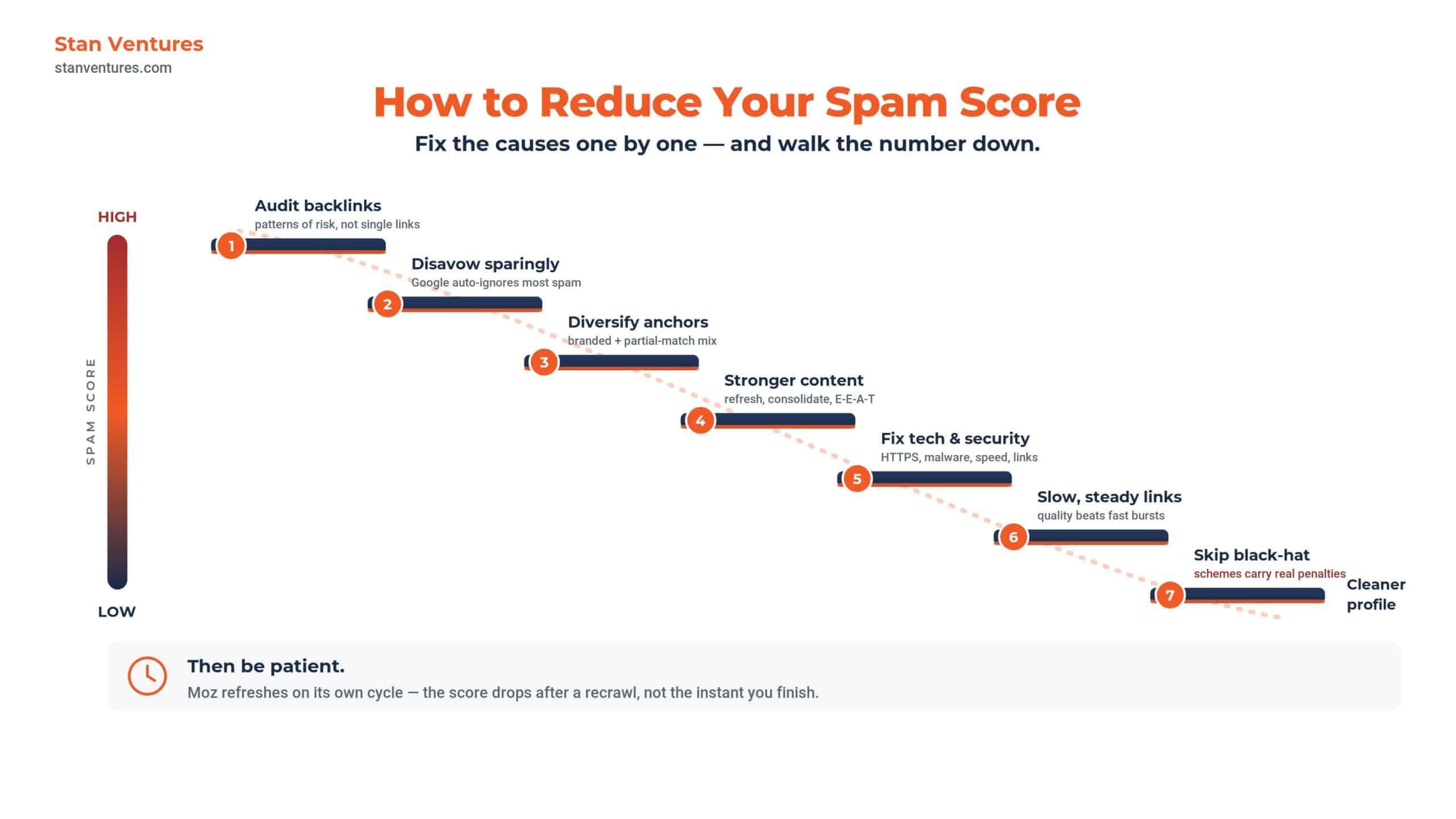
1. Audit your backlink profile for patterns
Pull your referring domains in Ahrefs or Semrush and look for clusters of risk, such as irrelevant TLDs, off-topic anchors, link-farm footprints, rather than reacting to individual low-DR links. A single weak link is rarely the problem; a pattern is.
2. Disavow only when it’s genuinely warranted
This is where most people overreact. Google’s algorithms ignore the vast majority of spammy links automatically, and Mueller has gone as far as to say that internally Google has “no notion of toxic backlinks” — a stance reinforced by Majestic retiring its disavow export and Bing dropping its tool entirely.
Reserve the disavow file for cases where you have a manual action for link spam, or you knowingly built manipulative links. When it is justified, follow a careful, manual disavow workflow so you cut only the genuinely harmful links.
3. Diversify your anchor text
Replace repetitive exact-match anchors with a natural mix: branded anchors, descriptive phrases, and partial-match variants relevant to the destination page. If “running shoes” is the target, anchors such as “running shoes for women,” “the best trail running shoes,” or a plain branded mention keep the profile looking earned rather than built.
4. Strengthen content quality and E-E-A-T
Original, genuinely useful content earns links naturally and signals quality to every system that evaluates your site. Refresh outdated pages, consolidate thin ones, and make sure each piece clearly demonstrates first-hand experience and subject expertise.
5. Fix technical and security issues
Secure the site with HTTPS, clear any malware or hacked pages, repair broken links and redirect chains, and improve load speed. A clean, well-structured site is easier for search engines to trust and crawl.
6. Earn links at a natural pace
Prioritize quality over volume and let your link velocity stay steady. Sustainable links from relevant, reputable sites (the kind covered in this link building guide) protect rankings far better than fast bursts.
7. Avoid black-hat tactics entirely
Link schemes, pure-spam patterns, and newer violations like site reputation abuse carry real, lasting penalties. Ethical SEO is the only approach that compounds.
One caveat on timing: As Moz refreshes on its own cycle, the score will not drop the moment you finish a cleanup. Make the fixes, then give the metric time to catch up.
Aligning With Google’s Quality Standards
The most reliable way to keep spam score low is to build the qualities Google’s own evaluators look for. Google’s Search Quality Rater Guidelines instruct human raters to assign the “Lowest” page-quality rating to deceptive, untrustworthy, or manipulative pages, precisely the characteristics that inflate a spam score. The framework raters apply is E-E-A-T: Experience, Expertise, Authoritativeness, and Trustworthiness.
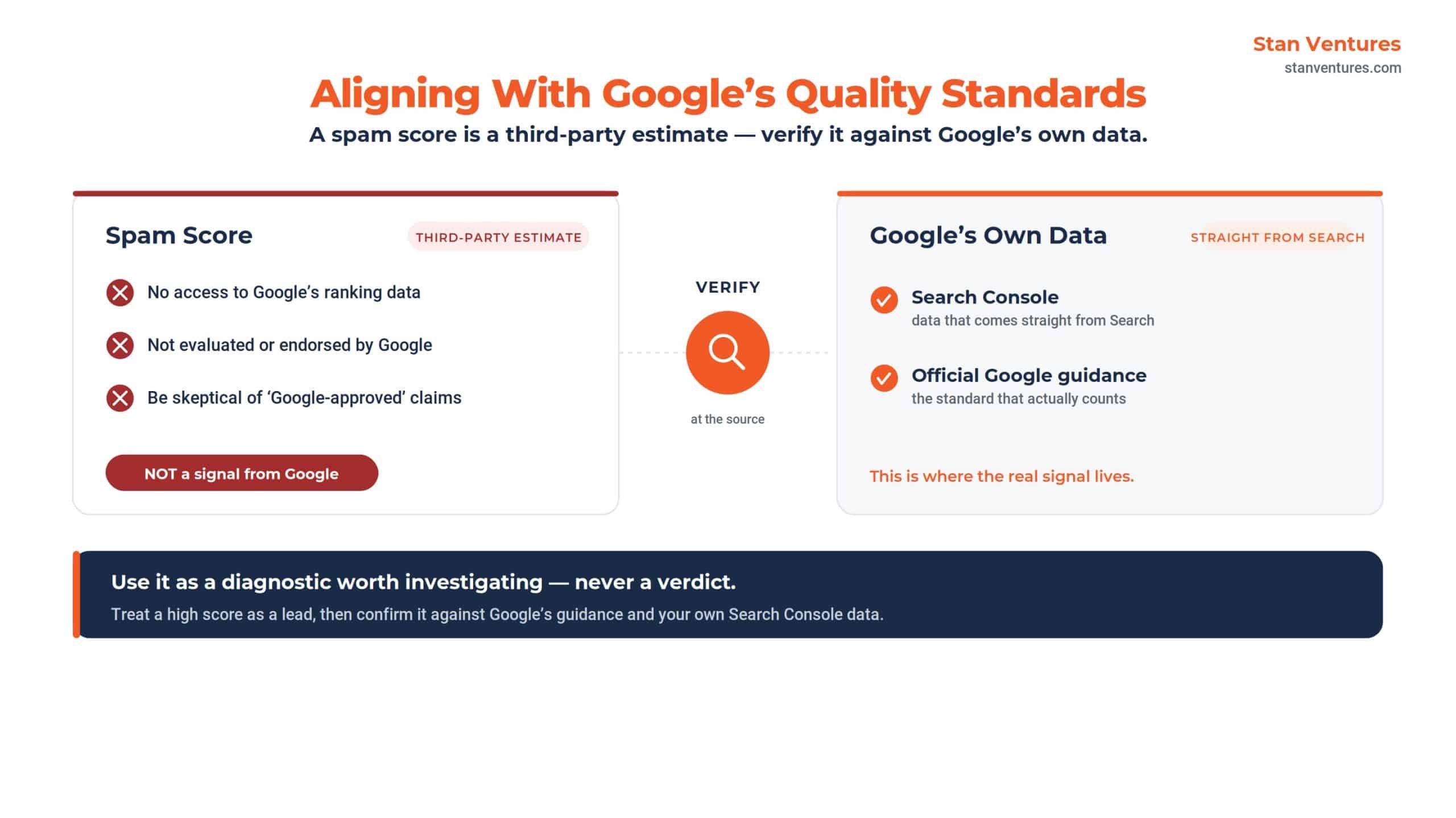
As mentioned earlier, Google has also drawn a line on third-party metrics. In its latest guidance on third-party SEO tools services and advice, Google states that it does not evaluate or endorse third-party services, and warns site owners to be skeptical of any tool that implies its data or methods are “approved” by Google.
It is explicit that third-party tools have no access to Google’s internal ranking data, so any figure they generate, including spam score, is the provider’s own estimate and prediction, never a signal from Google itself.
Google instead points site owners to Google Search Console, for information that comes straight from Search. That is precisely how a spam score should be used: a diagnostic worth investigating, checked against official Google guidance and your own Search Console data.
When to Act on Your Spam Score (and When to Ignore It)
Not every elevated score deserves a response. A useful rule of thumb is to act only when the signals stack up:
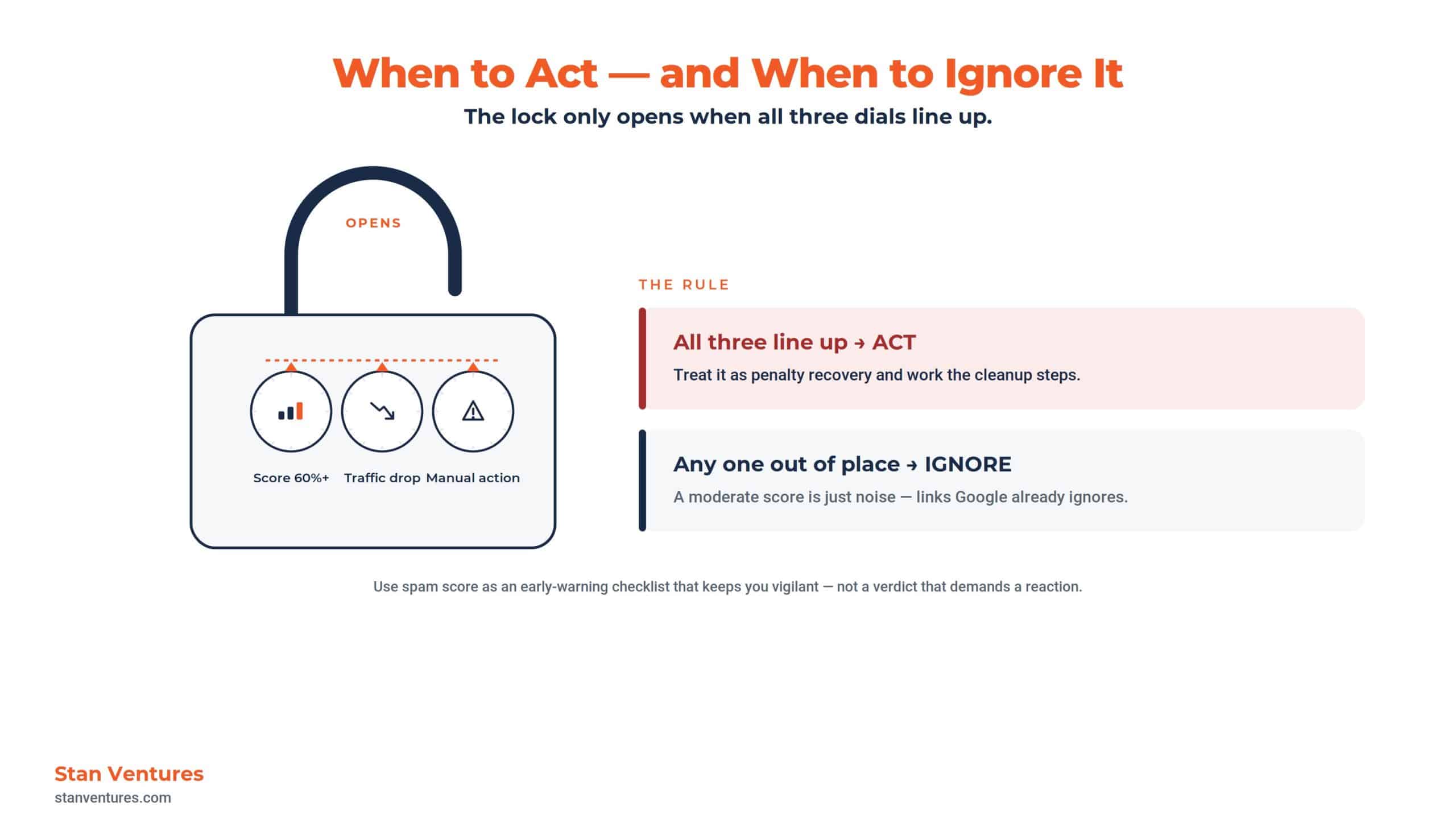
- The score is high (above 60%).
- You are seeing actual ranking or traffic declines
- Google Search Console shows a manual action.
When all three line up, treat it as a penalty-recovery situation and work the cleanup steps above. When your rankings are healthy and Search Console is clear, a moderate score is almost always noise, the metric reflecting links Google already ignores. Spam score is most valuable as an early-warning checklist that keeps you vigilant, not as a verdict that demands a reaction every time it ticks up.

Ananyaa
AuthorAnanyaa Venkat is a seasoned content specialist with over nine years of experience creating industry-focused content for diverse brands. At Stan Ventures, she blends SEO insight with strategic storytelling to shape a compelling brand voice. She has contributed to several leading SEO publications and stays attuned to evolving trends to ensure her content remains authoritative, relevant, and high-quality.