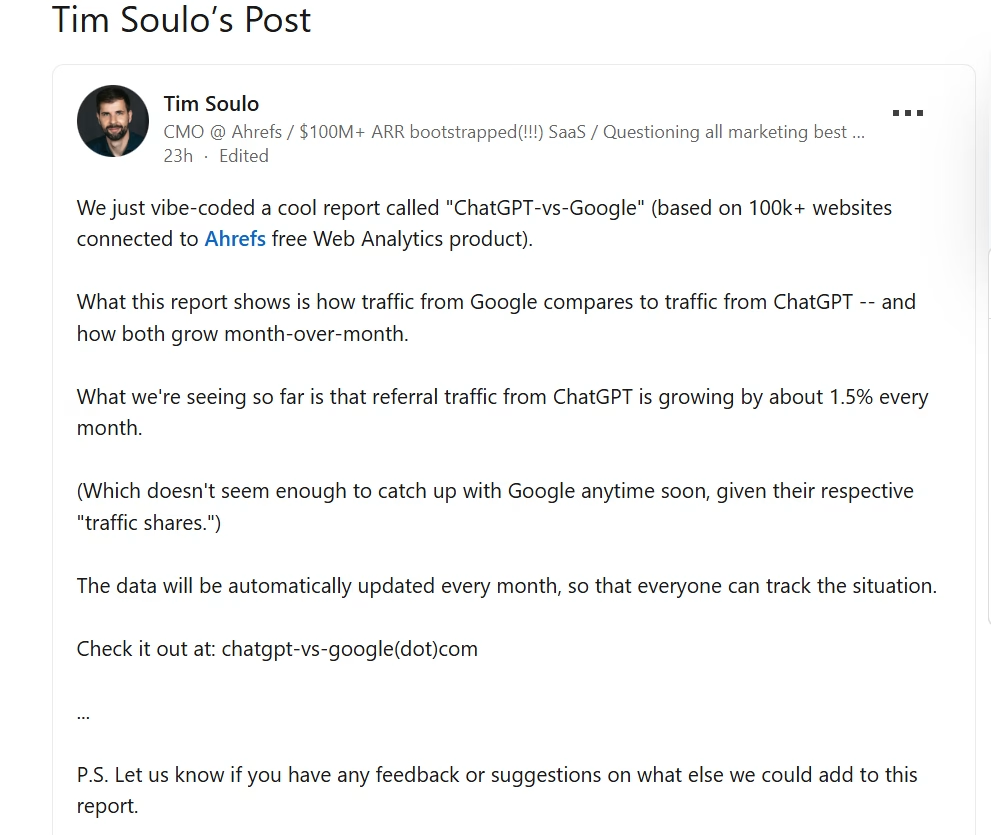
Ahrefs has launched a public dashboard tracking how much referral traffic websites receive from Google versus ChatGPT.
Yes, you read that right—Google, the traditional leader of referral traffic, is now officially being measured alongside an AI-powered assistant that did not even exist as a search channel two years ago.
The dashboard, which went live recently, updates monthly and gives us the first concrete look at how AI-driven search is beginning to show up as a measurable referral source.
So, what exactly does this mean for businesses, SEO professionals and marketers?
Google Still Rules But ChatGPT Enters the Game
The initial dataset covers three complete months across 44,421 sites connected to Ahrefs’ free Web Analytics tool. Here is what July 2025 looked like:
- Google: 41.9% of total web traffic across the cohort
- ChatGPT: 0.19% of total traffic
At first sight, Google’s dominance remains unshaken.
Nearly half of all web traffic in this dataset is coming directly from Google, while ChatGPT’s contribution seems tiny.
But here is the catch that the growth rates tell a very different story.

- Month-over-month, Google grew by 1.4%, while ChatGPT grew by 5.3%.
- In the previous month, the trend was reversed: Google grew +6.8% while ChatGPT slowed to +1.6%.
That is why the Ahrefs dashboard makes a striking claim:
“ChatGPT is growing 3.8x faster than Google.”
Now, does that mean ChatGPT will soon overtake Google? Not so fast.
But it does suggest that AI-powered search is no longer a fringe experiment but carving out a place in the digital ecosystem.
Why This Matters: A New Referral Channel is Emerging
Let us pause here. A question to ask ourselves—would we have even imagined, two years ago, that ChatGPT would be sending measurable referral traffic to websites?
This is exactly what’s happening now. The dashboard notes:
“ChatGPT now drives measurable referral traffic to websites, representing a new channel that did not exist 2 years ago.”
For marketers, publishers and SEO professionals, this means:
- Google is still the primary battlefield for visibility.
- But ignoring ChatGPT (and AI search generally) could mean missing out on an emerging traffic stream.
If you are running campaigns, building backlinks or optimizing content, the fact that AI assistants are starting to contribute traffic.
Even if it is under 1% should raise a strategic question: how long before this channel becomes significant?
How the Data Is Collected: A Transparent Methodology
Ahrefs has been careful about the methodology. To keep comparisons reliable, the tracker:
- Includes only sites that appear in all months, ensuring statistically significant results.
- Measures traffic where a referrer is present.
That last point is critical. Some AI systems and even in-app browsers strip referrers or add “noreferrer” tags, which means the actual AI-driven visits could be undercounted.
Ahrefs itself admits this analytics blind spot.
They have noted similar issues when measuring traffic from AI assistants or even Google’s experimental AI Mode in search.
So, while the numbers may not capture the entire picture, they are directionally consistent with earlier.
Ahrefs research that showed AI referrals at around 0.17% of average site traffic very close to the 0.19% we see here.
In other words: this is as accurate as it gets right now.
The Bigger Picture: Google’s Dominance vs ChatGPT’s Momentum
Let us step back to understand that 41.9% versus 0.19%.
The gulf is massive and no one is suggesting Google’s throne is in danger today. But what we are really seeing is a trend line.
Think of it like the early days of social media. Back in 2007, Twitter traffic was negligible compared to Google.
But fast forward and Twitter became a powerful driver of real-time news and engagement.
Could ChatGPT or other AI assistants like Claude, Gemini or Perplexity, play a similar role in the years ahead? That is the real question.
Right now:
- Google = the dominant source, a must-have for every SEO strategy.
- ChatGPT = an emerging source, small today but growing quickly.
The smart approach? Keep an eye on both.
Why Growth Rates Matter More Than Current Share
It is easy to dismiss ChatGPT’s 0.19% traffic share as insignificant. But when something grows at 3.8x the rate of Google, you have to ask: what happens if this trend continues?
Even if ChatGPT only doubles or triples its contribution in the next year, that would still mean millions of additional visits across the web that businesses could capture or miss out on depending on their readiness.
We have already seen how AI-powered answers are reshaping user behavior:
- Perplexity AI integrates citations directly, driving clicks to original publishers.
- Microsoft Copilot brings AI into the flow of Office tools, influencing B2B research.
- Google’s own AI Overviews experiment shows how AI could both cannibalize and distribute traffic.
In short, growth velocity is often a better indicator of disruption than current market share.
Real-World Implications: What Should Marketers Do?
So, what can you actually do with this information?
- Monitor AI referral traffic in analytics
Even if it looks small today, add it to your monthly traffic reports. Think of it as planting seeds for the future. - Experiment with AI-friendly content formats
Structured answers, concise explanations and clear authority signals (citations, backlinks, expert authorship) make your content more likely to be referenced by AI tools. - Keep investing in Google SEO
Google is still the heavyweight champion. Nothing in the Ahrefs data changes that. But just like we once learned to balance Google with social media, newsletters and direct traffic, AI might soon join the mix. - Be prepared for undercounting
Since some AI systems strip referrers, actual AI traffic may be higher than what you see in dashboards.
A Search Landscape in Transition
The Ahrefs tracker is not just a dashboard but a lens into the future of search.
For decades, SEO has meant one thing: optimize for Google. Now, we may be heading toward a more plural search environment, where AI-powered assistants sit alongside Google, Bing and even social platforms as meaningful discovery channels.
As an industry leader in SEO and digital growth strategies, Stan Ventures does not just optimize for Google today, we future-proof your presence for tomorrow’s AI-driven ecosystem .
Book a free consultation and let’s start building your AI-proof SEO strategy with Stan Ventures today.

Dileep Thekkethil
AuthorDileep Thekkethil is the Director of Marketing at Stan Ventures, where he applies over 15 years of SEO and digital marketing expertise to drive growth and authority. A former journalist with six years of experience, he combines strategic storytelling with technical know-how to help brands navigate the shift toward AI-driven search and generative engines. Dileep is a strong advocate for Google’s EEAT standards, regularly sharing real-world use cases and scenarios to demystify complex marketing trends. He is an avid gardener of tropical fruits, a motor enthusiast, and a dedicated caretaker of his pair of cockatiels.
