
Two Events, One Set Of Searches
- The sites that lost and stayed down are the ones that explain medicines. The sites that sell medicines dipped and came back.
- Branded drug ads in AI answers will appear on exactly the searches health publishers own: what a drug is for, its side effects, how it compares.
- Sequence is not cause. The spam update began September 24. The ad test began in October. Nothing in this data shows Google planned one for the other.
What Google Confirmed On October 12
On October 12, 2026, Adweek reported that Google is testing ads for branded prescription drugs in AI Mode and AI Overviews. A Google spokesperson confirmed it: “We’re testing standard text and Shopping ads in AI Mode and AI Overviews,” with those formats recently extended to certain pharmaceutical products. The test began in October, is limited to the United States, and the ads appear in sections labelled “Sponsored.”
That is a bigger step than it sounds. When ads first appeared in AI Overviews in October 2024, healthcare was on the list of sensitive categories kept out. It stayed out through the December 2025 expansion to eleven countries. Earlier in 2026, Google began a small test of general healthcare ads in AI Mode. Branded prescription drugs, the most tightly regulated category in advertising, are the last door, and it is now open.
We would normally file that under paid search news. We are writing about it here because of what we had just finished measuring.
What Happened To Health Sites In September
Google’s September 2026 spam update ran from September 24 to October 8. We tracked the estimated daily US organic traffic of 210 websites through the whole rollout for a separate study on forums and authority sites. Fifteen of those sites were health information publishers: Mayo Clinic, Healthline, WebMD, Cleveland Clinic, Medical News Today, Verywell Health, NIH, CDC, Drugs.com, Johns Hopkins Medicine, MedlinePlus, Harvard Health, Verywell Mind, Psychology Today and Everyday Health.
All fifteen lost traffic. Not most. All. The median loss was 13 percent from the start of the rollout to its completion, with a trough of minus 26 percent on October 1. It was the only category in the 110-site authority sample where every site finished down.
After the Adweek story, we pulled the same daily series for 16 sites that sell or price medicines: GoodRx, CVS, Walgreens, Rite Aid, SingleCare, Cost Plus Drugs, Blink Health, HealthWarehouse, WellRx, RxSaver, PharmacyChecker, Hims, Ro, OptumRx, Express Scripts and MedExpress. We wanted to know whether “sites that deal in medicine” lost in general, or whether the loss was specific to the sites that explain medicine.
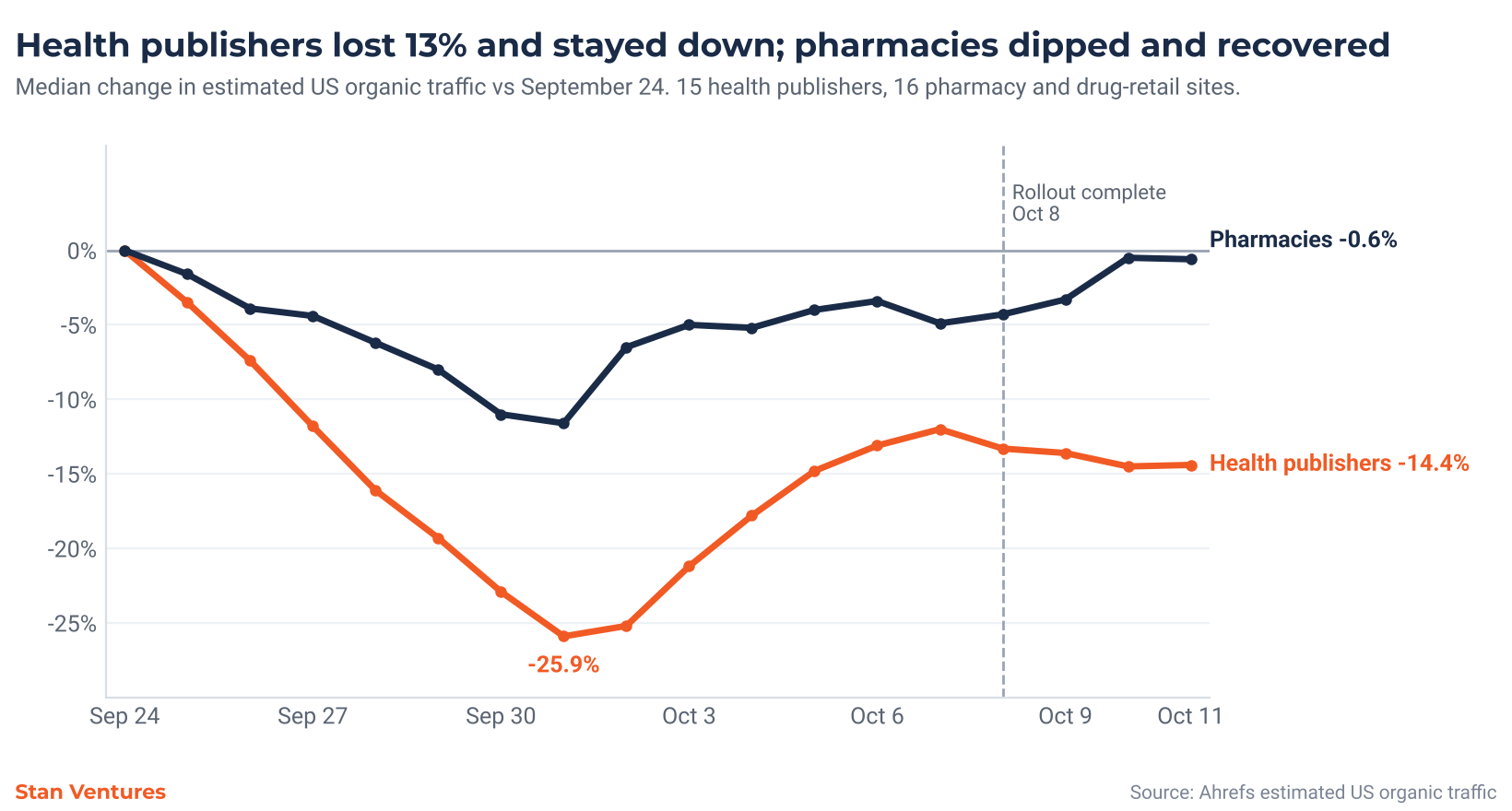
The answer is specific. Pharmacies dipped with everyone else, bottoming at minus 12 percent on October 1, then recovered to roughly flat (minus 0.6 percent) by October 11. Nine of sixteen finished slightly down, seven slightly up, and the exceptions cut both ways: Cost Plus Drugs minus 29, GoodRx minus 12, CVS minus 12, while SingleCare, Ro and OptumRx gained. Health publishers did not recover. On October 11 they were still a median 14 percent below where they started.
So the lasting loss is not “medicine.” It is the organic answer to “what is this drug for,” “what are the side effects,” and “is it safe to take this with that.” Those are the pages Healthline, Mayo Clinic, Drugs.com and MedlinePlus rank for. And those are the searches a branded prescription drug ad is built to appear on.
The Fifteen Health Publishers
Estimated daily US organic traffic on September 24 and October 8, with the settled change. Every figure is an Ahrefs estimate; trust the pattern more than any single row.
Sequence Is Not Cause
Let us be plain about what this is and is not. The spam update started on September 24. The prescription drug ad test started in October. Nothing in our data shows that Google planned one for the other, and we are not claiming it did. Spam updates target sites that break spam policies, and a traffic decline during a rollout is not evidence that a site broke one. Mayo Clinic did not get caught spamming.
What we can say is narrower and, we think, more useful. The organic space for health information got smaller in September. The most trusted sites on the web lost between a tenth and a third of their estimated search traffic, and three days after the rollout ended they had not got it back. Then, in October, Google started selling the space above those answers to the companies that make the drugs the answers are about.
Whether or not anyone intended it, that is the environment a health publisher now operates in. Less organic traffic to the drug information page, and a sponsored branded message sitting above it inside the AI answer.
What Health Publishers Should Do Now
Find Out Which Pages Lost, By Query
Pull Search Console for September 24 to October 8 and sort by lost clicks. In our data the losses cluster on broad drug and condition explainers. Make a list of the fifty queries that cost you the most, and note which of them name a branded drug. Those are the ones where a sponsored ad can now sit above you in AI Mode.
Do Not Rebuild The Site This Month
Sites that lose traffic in a Google update rarely get it back during that update. The reversal, when it comes, comes at the next one, and only for sites that made steady, incremental improvements in between. A panicked restructure now will not be measured until the next core update, and it will be measured against whatever you broke in the process.
Close The Experience Gap On The Pages That Lost
In the same update, forums where patients and clinicians talk to each other gained a median 34 percent. The pages that held were the ones that read like someone who has prescribed, taken or lived with the drug. Named clinicians, real cases, honest uncertainty, and patient voices on the page. A summary of the label is what the AI answer already does.
Measure Your Presence Inside The AI Answer, Not Just Below It
Put your fifty biggest lost queries into AI Mode and note two things: whether your site is cited in the answer, and whether a sponsored drug ad now appears with it. Track it monthly. The position that matters for a drug information page is no longer only the blue link. It is whether you are the source the answer is built from.
How We Measured It
All traffic figures are Ahrefs estimated daily US organic search traffic, pulled by API for each site for every day from September 24 to October 11, 2026. The 15 health publishers were chosen by category before any traffic was examined, as part of a 110-site authority sample for our forum study. The 16 pharmacy and drug-retail sites were chosen on October 12, after the Adweek report, to test whether the loss was specific to information publishers; they were also chosen before their traffic was examined. “Settled change” is September 24 to October 8, the day Google declared the rollout complete. Group figures are medians. Ahrefs traffic is an estimate, not Search Console, and it revises recent history as its model updates; every comparison here uses one consistent pull. The full 210-site dataset is in the forum study report, and the pharmacy series is available on request.
Are You Still The Source The AI Answer Cites?
We will map your fifty most valuable health queries across Google, AI Mode and the major AI platforms, and show you where you are cited, where you are not, and what it would take to change that.

Dileep Thekkethil
AuthorDileep Thekkethil is the Director of Marketing at Stan Ventures, where he applies over 15 years of SEO and digital marketing expertise to drive growth and authority. A former journalist with six years of experience, he combines strategic storytelling with technical know-how to help brands navigate the shift toward AI-driven search and generative engines. Dileep is a strong advocate for Google’s EEAT standards, regularly sharing real-world use cases and scenarios to demystify complex marketing trends. He is an avid gardener of tropical fruits, a motor enthusiast, and a dedicated caretaker of his pair of cockatiels.
