
Google has begun rolling out “Read more” links within some organic search result snippets, sending users directly to relevant sections of a webpage instead of the top.
Google is changing how some search results appear. After months of limited testing, the company is now rolling out “Read more” links at the end of certain organic search snippets, giving users a faster path to the exact information they are looking for.
The feature has started appearing across a wide range of searches, though not consistently on every result.
Many site owners and SEO professionals noticed the change around the same time, prompting questions about whether this was new or simply a test resurfacing.
@rustybrick looks like Google is testing something new with meta description.
A URL that days read more. pic.twitter.com/OnjPPews6n
— Krishna Murari (@bagwarikrishna) December 16, 2025
Is ‘Read more’ in the SERP a new feature? @brodieseo @rustybrick pic.twitter.com/1GmhWvvr4N
— Sachin Patel (@SachuPatel53124) December 16, 2025
Based on current visibility, it appears the experiment has moved into a broader rollout phase.
What’s New in These Search Results
Below is an example of Google showing a “Read more” link in a search snippet for the query “seo vanity metrics.”
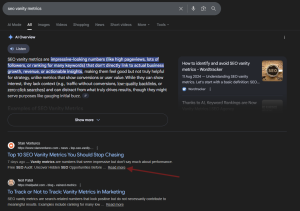
The “Read more” link appears directly within the search snippet. When clicked, it does not take users to the top of the page. Instead, Google anchors the visit to a specific section deeper within the content.
This saves users from scrolling and places them closer to the answer they searched for. It also reflects how Google continues to improve its understanding of content at a section level, rather than treating an entire page as a single unit.
Not every listing includes this link. Some results still follow the traditional snippet format, which suggests Google is applying the feature selectively rather than universally.
Why Google Is Making This Change
Google wants users to reach helpful information as quickly as possible, especially when a page clearly answers a question in a specific section.
This approach builds on earlier efforts such as passage-based ranking, where Google evaluates parts of a page independently.
The difference now is that users can clearly see and use that behavior from the search results themselves.
What It Means for Publishers
For publishers, the update puts more weight on content structure. Pages that are clearly organized, with descriptive subheadings and focused sections, are easier for Google to reference, which makes strong on-page optimization increasingly important.
It also changes how users enter a page. Instead of starting at the beginning, visitors may land midway through an article. That makes context, clarity, and internal flow essential. Each section needs to make sense on its own while still fitting naturally into the larger piece.
There is no option for publishers to control or disable this feature. Google applies it automatically based on how it interprets the content.
How Site Owners Can Adapt
Although there is no direct way to optimize specifically for “Read more” links, site owners can align with this behavior by focusing on clarity and structure:
- Use clear subheadings that reflect what each section explains
- Keep sections tightly focused on one idea or question
- Avoid long paragraphs that cover multiple points
- Ensure pages load properly when users land partway down
These practices improve readability for users and help search systems surface relevant sections more effectively.
What We Know So Far
Google tested variations of this feature earlier in the year. What stands out now is how widely it is appearing across different searches, suggesting the rollout is expanding.
Google has not shared details about how it selects pages or sections for the feature, and that may continue to evolve over time.
Key Takeaways
- Google is rolling out “Read more” links in some organic search snippets
- The link sends users to a relevant section instead of the top of the page
- The feature reflects Google’s growing focus on section-level relevance
- Clear structure and focused sections are increasingly important
- The rollout is selective and still developing

Zulekha
AuthorZulekha is an emerging leader in the content marketing industry from India. She began her career in 2019 as a freelancer and, with over five years of experience, has made a significant impact in content writing. Recognized for her innovative approaches, deep knowledge of SEO, and exceptional storytelling skills, she continues to set new standards in the field. Her keen interest in news and current events, which started during an internship with The New Indian Express, further enriches her content. As an author and continuous learner, she has transformed numerous websites and digital marketing companies with customized content writing and marketing strategies.
