
Many Google Business Profile verification failures happen because two locations share the same service areas, not because they are closer than two hours apart. Business owners are misunderstanding the guidelines, and fixing territory overlap is often the key to approval.
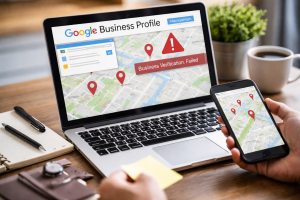
Across multiple regions, service area businesses are struggling to verify second locations on Google Business Profile.
Owners often believe the problem is distance, based on a guideline about travel time. Expert insights and case reports show that the real trigger for failed verification and sudden suspension is overlapping service areas between profiles.
The issue arises when two locations claim the same cities or postal codes, which Google interprets as duplicate coverage rather than legitimate expansion.
What the Guideline Actually Says
The widely quoted wording about a two-hour driving limit applies to a single profile’s coverage boundary. It limits how far one business location may claim to serve customers. It does not require two separate locations to be two hours apart.
Many legitimate businesses operate locations 30 to 45 minutes from each other and verify successfully when each profile serves its own distinct territory. Distance on its own rarely causes rejection.
Why Verification Breaks for Second Locations
Verification problems typically start when Location A and Location B list the same neighborhoods, cities, or zip codes.
When those areas overlap, Google treats the second listing as an attempt to appear twice in the same search market. The system flags this as a guideline violation, which often results in failed video verification or immediate suspension.
From Google’s perspective, one profile already serves that area, so a duplicate listing looks like an effort to capture extra visibility rather than serve a separate customer base.
Why This Insight Matters for Business Owners
Many owners respond to verification failures by changing addresses, resubmitting videos, or assuming that proximity is the cause. This creates frustration and delays growth.
Understanding how service territories affect approval helps businesses expand more strategically.
Clearly separated coverage areas reduce risk, strengthen credibility signals, and align each location with how Google evaluates authenticity for multi-location operations.
How Businesses Can Improve Their Chances of Approval
Each location should operate as its own service hub with a distinct territory and identity. That includes separate contact numbers and non-overlapping coverage lists.
Treat service areas as boundaries that define responsibility, not as spaces to duplicate across profiles. Doing so gives Google clearer proof that each listing serves a unique customer group instead of competing against itself in search results.
Guidance You Can Apply Now
Here are specific actions you can take immediately to improve your chances of successful verification.
- Review both profiles and remove any shared cities or postal codes.
- Assign a dedicated phone number to the second location that routes to a different line or team member.
- Define separate territories before submitting or re-submitting verification.
- Avoid copying service area lists across locations, even if operations are close by.
- Recheck the settings after edits to confirm that overlap has been fully removed.
Key Takeaways
- The two-hour guideline limits the reach of one profile, not the spacing between locations.
- Overlapping service territories are the leading cause of failed verification and suspension.
- Distinct service areas signal legitimacy for multi-location businesses.
- Locations can verify successfully even when they operate less than an hour apart.
- Unique phone numbers and territory boundaries strengthen approval confidence.

Zulekha
AuthorZulekha is an emerging leader in the content marketing industry from India. She began her career in 2019 as a freelancer and, with over five years of experience, has made a significant impact in content writing. Recognized for her innovative approaches, deep knowledge of SEO, and exceptional storytelling skills, she continues to set new standards in the field. Her keen interest in news and current events, which started during an internship with The New Indian Express, further enriches her content. As an author and continuous learner, she has transformed numerous websites and digital marketing companies with customized content writing and marketing strategies.
