
Generative AI Tracking Data Is Live In GSC, But It’s Not What You Think
Google finally split AI visibility into its own report. Impressions, pages, countries, devices. Everything except the two numbers your clients will ask about first: clicks and queries.
The Short Version
- Search Console now has a dedicated Generative AI tab under Performance, tracking impressions from AI Overviews, AI Mode, and generative features in Discover.
- It launched June 3, 2026 to a limited set of properties. By August 11, it reached most Search Console profiles.
- You get impressions, pages, countries, devices, and dates. You do not get clicks, CTR, or query data.
- Pew’s browsing data shows why that gap stings: organic clicks drop from 15% to 8% when an AI summary is present.
- The agencies and partners we talk to keep raising the same five AI tracking pain points. Each one has a fix, and that playbook already pushed one client from 15% to 80% AI visibility in two months.
What Google Actually Shipped
On June 3, 2026, Google announced generative AI performance reports on the Search Central blog. The pitch: a dedicated view of your impressions inside AI Overviews, AI Mode, and the generative features creeping into Discover. The report sits in the left nav, right under the classic Search results view.
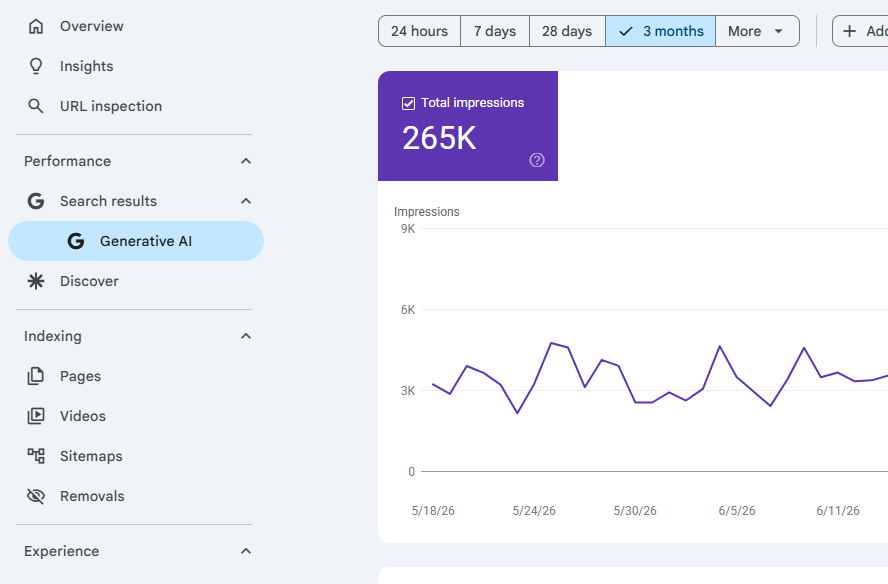
The new Generative AI tab inside one of our Search Console properties. 265K impressions in three months. Clicks recorded against them: zero, because the report doesn’t count any.
An impression counts any time one of your URLs appears inside an AI answer. Data runs on Pacific Time and tables cap at 1,000 rows, same rules as the classic performance report. No tab on your property yet? Google hides the report until a site logs enough AI impressions to matter.
What You Get vs What You Don’t
Five dimensions in, two metrics out. Here’s both sides of the ledger.
- Impressions across AI Overviews, AI Mode, and generative Discover features
- Pages: the exact URLs being pulled into answers
- Countries and devices behind those impressions
- Dates, from hourly all the way to monthly granularity
- Clicks or CTR. Nothing connects an impression to a visit
- Queries. You can’t see which prompts surfaced you
- A feature split. AI Overviews and AI Mode arrive blended
- History. Data starts at rollout, so your baseline starts today
Why the Missing Clicks Sting
Impressions without clicks would be a footnote if AI answers were rare. They’re on nearly half of tracked queries and climbing.
When an AI Overview is present, clicks on regular results drop from 15% to 8%. Pew tracked 68,879 real searches to get there.
Share of visits that click a source cited inside the AI summary itself. Being cited beats being buried, but barely anyone clicks through.
BrightEdge’s February 2026 tracking, up 58% year over year. Health and education queries run closer to 80%.
What Agencies Keep Telling Us
We talk to agency owners and partners every single week. Since spring, the same five things about AI tracking and ranking keep coming up on those calls. Our own numbers back them up.
AI Traffic Hides Inside Direct
Assistants and AI answers strip referrer data, so the visit lands as Direct. We’ve seen it in our own analytics: AI-tagged referrals barely register while Direct keeps swelling with sessions that start on deep service pages nobody types by hand. Clients see the same split and conclude AI brings nothing. It brings plenty. It just checks in under a fake name.
Impressions With No ROI Story
A client sees 265K AI impressions and asks the fair question: what are they worth? With no clicks and no revenue thread, the honest answer is “we can’t prove it yet.” That’s a rough line to deliver in a quarterly review, and right now it’s the only one available.
Rankings Stopped Predicting Traffic
Pages hold position one and still bleed clicks because the answer sits above them. The rank report says nothing changed. The traffic report says everything did. The agency wears the blame for a gap its own tooling can’t explain.
Nobody Has a Citation Playbook
Clients now ask how to show up inside the answer, and most vendors respond with the same deliverable list they sold in 2023. The signals that decide citations, brand mentions, branded search, entity presence across trusted sites, are barely on the standard SEO menu.
Reporting Overhead Tripled
Teams now reconcile three data sets that don’t share definitions: classic organic, the new Generative AI report, and assistant referral logs. Every monthly report takes longer to build and more effort to defend.
Five Moves, One Per Pain Point
None of this needs a new tool stack. It needs a different Tuesday.
Rebuild Attribution First
Create a channel group that catches chatgpt.com, perplexity.ai, gemini.google.com, and copilot referrers, then flag direct sessions landing on deep URLs as suspected AI visits. It won’t be perfect. It’ll be honest, and it’ll stop AI traffic from vanishing into Direct.
Baseline AI Impressions Now
Export the Generative AI report, screenshot the trendline, date-stamp both. Google says more metrics may come. When they do, you’ll own a before-and-after nobody else in the pitch room has.
Report Citation Share Next to Rank
Pair rank tracking with citation checks on money keywords. “We hold number three and we’re cited in the answer” is a story. “Number three, traffic down 20%” is a fire alarm.
Earn the Signals That Get You Cited
Ahrefs studied 75,000 brands: branded web mentions correlate with AI Overview visibility at 0.664. Raw backlinks came in at 0.218. Mentions and links together beat either alone, so build both into every off-page plan.
Brief Clients Before They Ask
Send a one-pager on the new report this week. The agency that explains the change owns the narrative. The one that waits gets audited.
How We’re Solving It for 150+ Agencies
We rebuilt our off-page menu around one fact: AI engines cite brands the wider web already talks about. So our brand mention services place clients inside the listicles, comparisons, and resource pages LLMs pull answers from, while blogger outreach earns unpaid mentions on real blogs in the client’s niche. That’s the exact signal the 0.664 correlation rewards.
Authority still gatekeeps all of it. Our link building service keeps DR compounding so a client stays credible enough to cite, and guest posts put a full article, entity context, and a link on a relevant site in one placement.
And for agencies, all of it ships under your brand. Our white-label link building runs with signed NDAs, pre-approval on every domain before outreach starts, and delivery inside 25 days. Your reports carry your logo. Someone else carries the workload.
GSC Generative AI Report FAQ
Where Do I Find the Generative AI Report in Search Console?
Open Performance in the left nav. The Generative AI tab sits under Search results as an expandable item. If it’s missing, your property probably hasn’t logged enough AI impressions yet, or the rollout hasn’t reached that domain.
Does the Report Show Clicks or Queries From AI Overviews?
No. You get impressions, pages, countries, devices, and dates. Google has said it’s weighing more metrics based on feedback, but nothing connects an AI impression to a visit today.
Can I Block My Site From AI Overviews and AI Mode?
Google is testing a Search Console toggle that pulls content out of AI features. Think hard before flipping it. Opting out of the answer doesn’t opt the query out of existence. It just hands the citation to a competitor.
Does Link Building Still Matter for AI Visibility?
Yes. Links decide whether you’re trusted, mentions decide whether you’re recalled. The brands showing up inside AI answers hold both, which is why we run them as one program instead of two line items.
Ready to Show Up Inside the Answer?
150+ agencies use Stan Ventures to earn the mentions and links AI engines cite. White-labeled, pre-approved domains, delivered in 25 days.

Deepan Paul
AuthorDeepan Paul is a Team Lead of the Internal Marketing Department at Stan Ventures, with four years of experience helping brands recover, grow, and hold on to organic traffic across global B2B, B2C, and D2C markets. He's known as a ranking revival expert. When traffic drops, pages fall out of the index, or visibility disappears after an update, he finds the cause and fixes it. Today he runs Stan Ventures' own organic presence, and that goes well past Google. He tracks and grows how the brand shows up in AI Overviews and across AI tools like ChatGPT, Perplexity, and Gemini, where citations decide who gets mentioned and who doesn't. His work covers technical SEO, content strategy, indexing, and building growth systems that hold up when algorithms shift. He has managed international clients and led cross-functional teams, keeping every SEO decision tied to what the business actually needs. Outside of client work, Deepan trains SEO professionals, speaks at industry events, and contributes insights to digital marketing publications. His approach is simple: build systems that keep working, instead of chasing quick wins.
