
Enterprise use of AI agents more than doubled in a year. 37% of companies now have agents deployed, up from 17% in last year’s survey.
Those figures come from the Gartner 2027 CIO and Technology Executive Survey, which polled 2,002 CIOs and technology executives between May and July 2026. Another 34% told Gartner they’ll deploy agents within the next 12 months. If those plans hold, roughly 7 in 10 enterprises will have agents running by late 2027.
Most coverage has treated this as an IT budget story.
We read it as a search story. Every one of those agents goes out and reads the web on someone’s behalf, and an agent building a shortlist doesn’t scroll to page two to find you.
Agents Are the Fastest Moving Line in Gartner’s Survey
GenAI is already mainstream inside enterprises. Agents are catching up fastest.
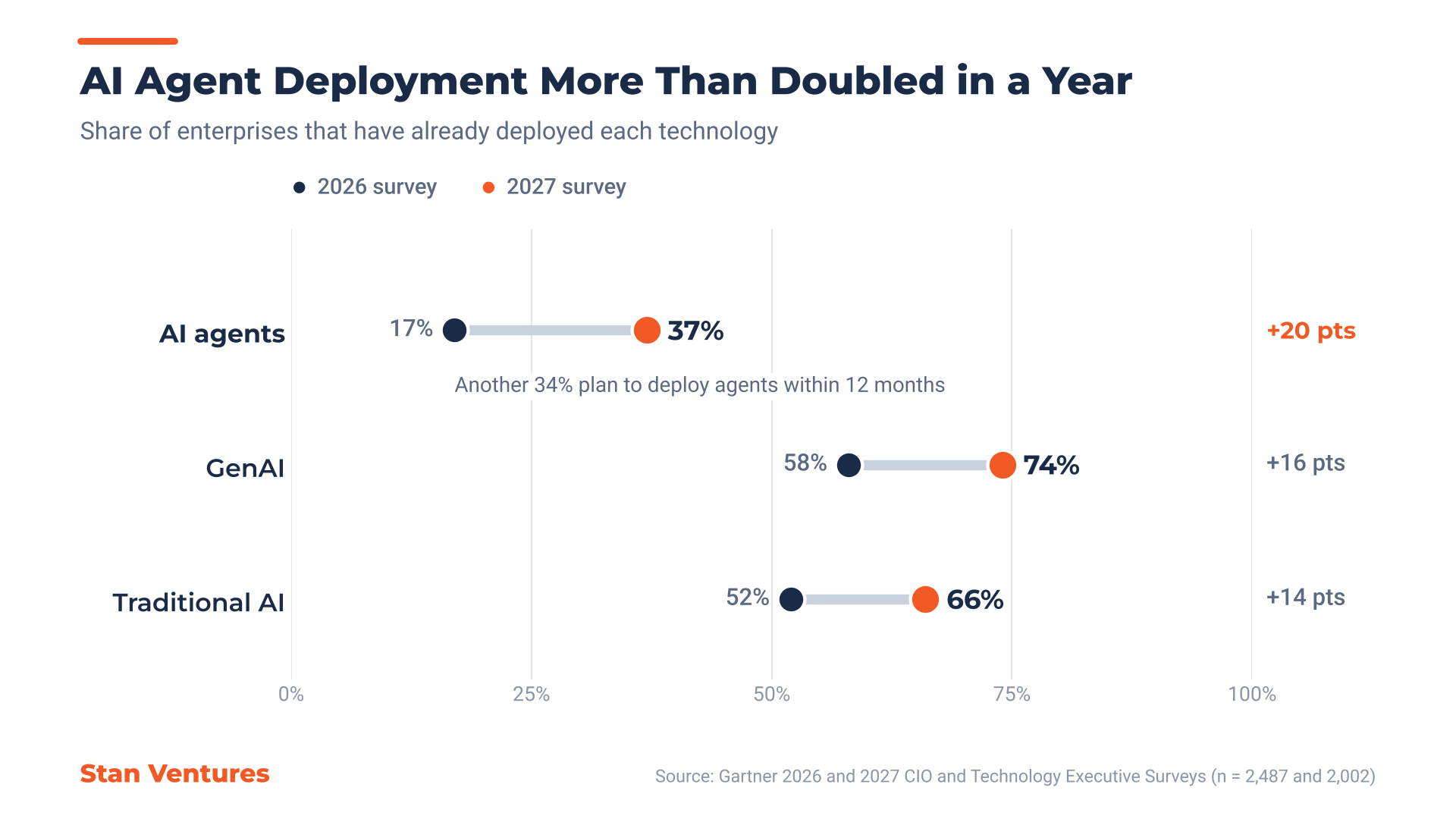
Source: Gartner 2027 CIO Agenda Preview, share of CIOs and technology executives reporting each technology as already deployed.
The three get mixed up a lot, so here’s the quick difference:
- Traditional AI predicts. Models trained on past data score or forecast things, like fraud flags, demand forecasts or product recommendations.
- GenAI creates. It writes text, images or code when you prompt it, like ChatGPT drafting an email.
- AI agents act. An agent is GenAI given a goal and a set of tools. It plans the steps and does the work itself, like searching, comparing vendors or filling in forms.
That last group is the one that reads the web on a buyer’s behalf.
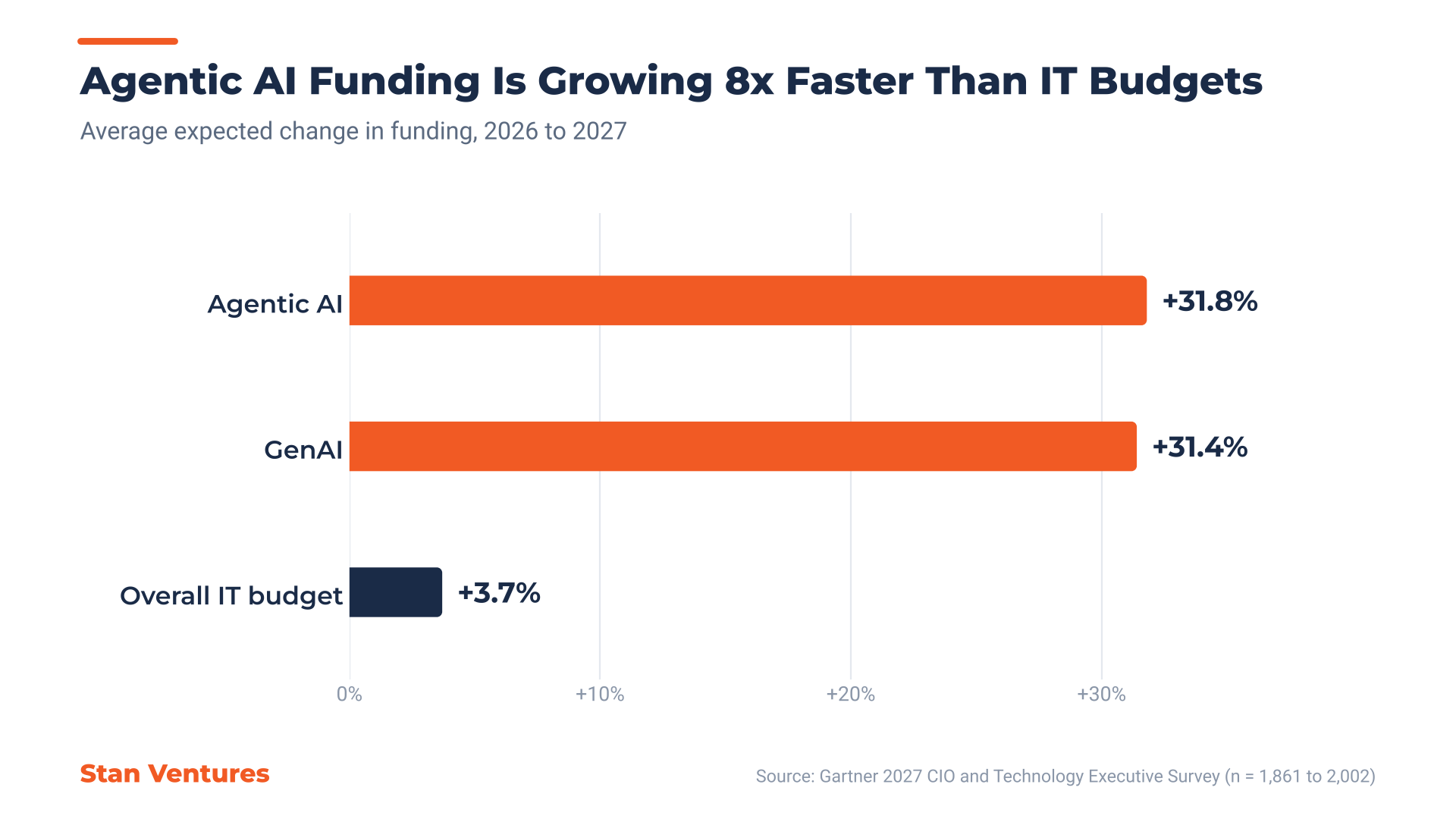
The money is following. Funding for agentic AI is set to rise 31.8% on average in 2027, the biggest increase of any technology area Gartner tracked. Overall IT budgets are only expected to grow 3.7%.
One smaller number matters more for marketers. 16% of enterprises already use Model Context Protocol (MCP), and another 21% plan to within 12 months. MCP is the open standard that lets an AI agent plug into outside tools and data sources. It’s the pipe agents will use to pull information about vendors, products and prices.
The catch: value hasn’t caught up with adoption. Only 13% of CIOs report significant value from AI so far. Gartner VP Analyst Daniel Sanchez Reina warned that the gap between AI ambition and IT reality exposes CIOs to “severe financial, organizational and political risks.”
Your Next Buyer May Send an Agent First
Agents are being installed inside the companies you sell to. Gartner has already said where that leads.
In its 2026 strategic predictions, Gartner forecast that by 2028, 90% of B2B buying will be AI agent intermediated, pushing more than $15 trillion of spend through agent exchanges.
Put the two findings side by side. The agents are going in now. The purchasing follows.
So the first thing to research your brand in 2027 could easily be an agent asked to build a vendor shortlist. It won’t read your homepage headline. It’ll pull from what the web already says about you: which publications mention you, which comparison pages list you, and whether your pricing and specs sit in text it can actually parse.
Brands with thin third-party coverage simply get left off the list. Nobody emails them to say so.
Here’s where we’d push back on most 2027 marketing plans. They still budget as if every visitor is a person with a browser, and they treat AI visibility as a side project for next year.
We’re Already Seeing It in Our Own Pipeline
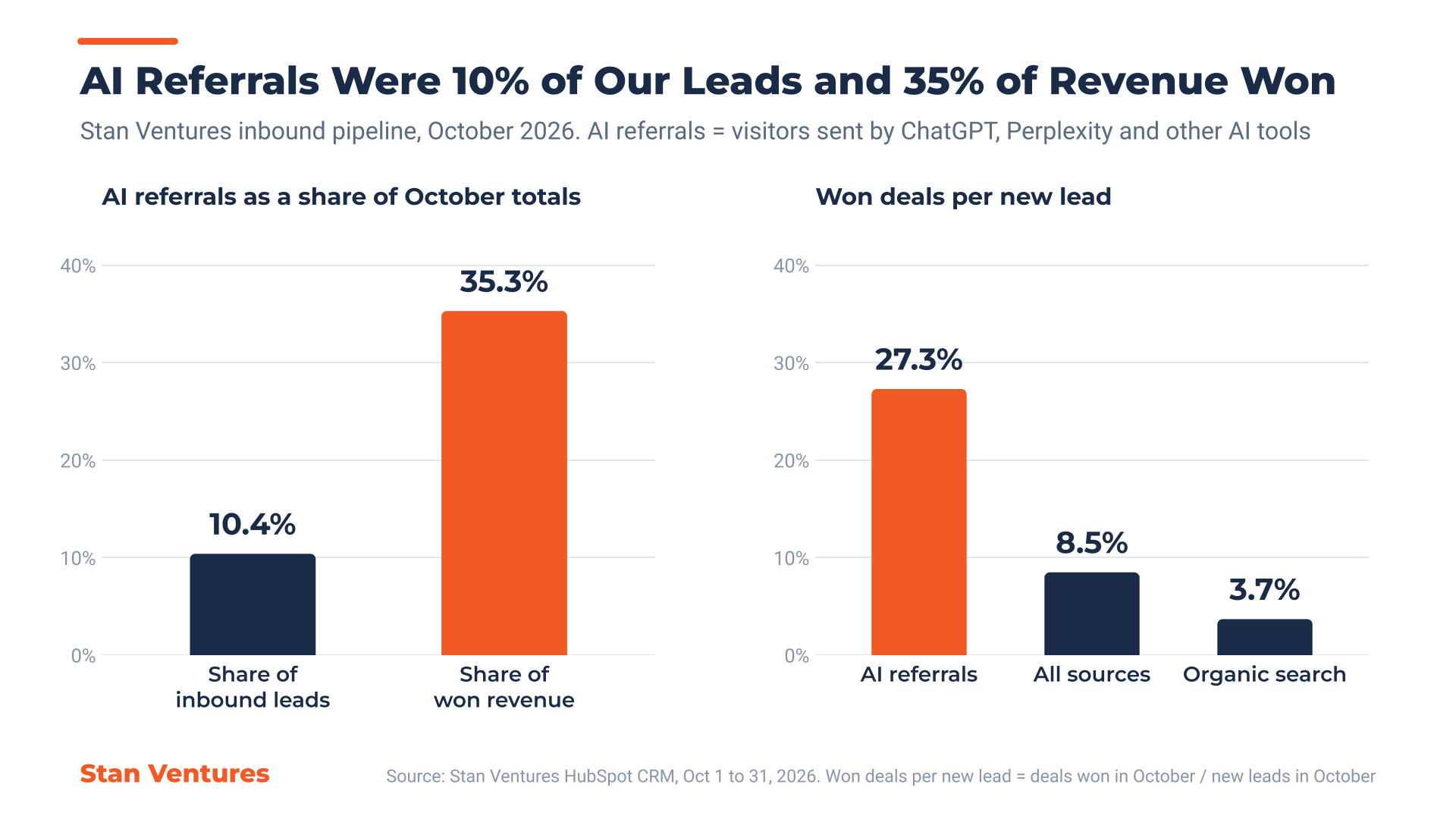
AI referrals are still a small slice of our leads, but they close. In October 2026, visitors sent to us by AI tools like ChatGPT and Perplexity made up 11 of our 106 inbound leads, about 10%. They closed 3 of our 9 won deals and brought in 35% of won revenue. Measured as won deals per new lead that month, AI referrals came in at 27%, against 3.7% for organic search.
What brands buy from us has shifted too. More of them now order backlinks together with AI Mentions instead of backlinks on their own.
“Agents don’t discover brands. They inherit whatever the web already says about you. If the only place your brand looks credible is your own website, an agent has nothing to cite,” said Dileep Thekkethil, Director of Marketing at Stan Ventures.
Five Checks to Run This Week
None of these need a budget sign-off.
- Run your category prompts. In a logged-out session, ask ChatGPT, Perplexity and Gemini for the best options in your category for your buyer. Note whether you’re named, and where.
- List the sources those answers cite. Those pages are now your most valuable placement targets.
- Put pricing, specs and comparisons in plain text. A price inside an image, a PDF or a gated form is close to invisible to an agent.
- Check your robots.txt for OAI-SearchBot and PerplexityBot. Blocking them can keep your pages out of ChatGPT search and Perplexity answers.
- Earn mentions where agents look. That means industry publications, comparison posts and listicles your buyers already read. It’s slower than editing your own site, and it’s the part that compounds.
See Who Gets Named Instead of You
Want to know where your brand shows up in ChatGPT, Perplexity and Google AI Overviews today? Book a consultation call with our AI Mentions team and we’ll show you which competitors get named for your category prompts, and which sources put them there.

Deepan Paul
AuthorDeepan Paul is a Team Lead of the Internal Marketing Department at Stan Ventures, with four years of experience helping brands recover, grow, and hold on to organic traffic across global B2B, B2C, and D2C markets. He's known as a ranking revival expert. When traffic drops, pages fall out of the index, or visibility disappears after an update, he finds the cause and fixes it. Today he runs Stan Ventures' own organic presence, and that goes well past Google. He tracks and grows how the brand shows up in AI Overviews and across AI tools like ChatGPT, Perplexity, and Gemini, where citations decide who gets mentioned and who doesn't. His work covers technical SEO, content strategy, indexing, and building growth systems that hold up when algorithms shift. He has managed international clients and led cross-functional teams, keeping every SEO decision tied to what the business actually needs. Outside of client work, Deepan trains SEO professionals, speaks at industry events, and contributes insights to digital marketing publications. His approach is simple: build systems that keep working, instead of chasing quick wins.
