
Not long ago, SEO had clear rules.
Research your keywords. Build your backlinks. Optimize your title tags. Wait. Repeat.
The formula wasn’t glamorous. But it worked.
Entire agencies, businesses, and careers were built on its predictability.
Then generative AI arrived.
And Google didn’t just update the rulebook. It threw it out entirely.
Between AI Overviews, ChatGPT, Perplexity, and a string of algorithm updates targeting low-quality content — the search landscape of 2026 looks almost unrecognizable compared to 2020.
Traffic patterns that held for years collapsed overnight.
Content strategies that once delivered reliable results are now delivering penalties.
And the metrics SEOs tracked for decades — rankings, keyword density, domain authority — are being replaced by something harder to fake: genuine expertise and trustworthiness.
This isn’t a story about SEO dying.
It’s a story about SEO growing up.
The practitioners who understand what’s changing will find more opportunity in this disruption than they ever found in the old rules.
Those who don’t will watch their traffic graphs tell a very different story.
The Scale of What’s Actually Changing
Google processes 8.5 billion searches every single day.
For most of the past two decades, those searches returned ten blue links, some ads, and maybe a featured snippet.
The structure was so stable that most SEOs stopped thinking about it.
That structure no longer exists.
AI Overviews — Google’s generative AI summaries that appear at the top of results — are now visible to over a billion users globally.
When a user asks a question and an AI Overview appears, they often get a synthesized answer before they ever see a single blue link.
The click never happens.
Your content may have been used to generate the answer. Your website was never visited.
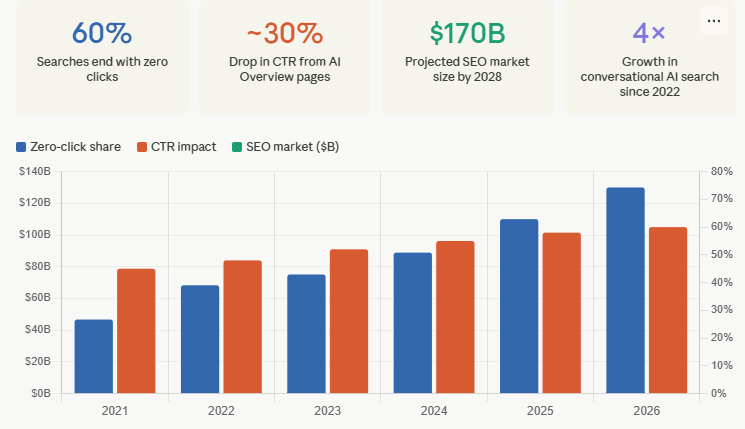
This is what’s driving the zero-click search phenomenon reshaping SEO economics.
Over half of all Google searches now end without a click to any external website.
That percentage is growing.
Simultaneously, a parallel shift is happening outside of Google entirely.
A growing segment of users — particularly younger, tech-forward demographics — are now beginning their searches on ChatGPT, Perplexity, Claude, or Gemini.
These tools don’t return ten links. They return a synthesized answer with occasional citations.
If your brand isn’t in the training data and citation pool of these AI systems, you’re invisible to an increasingly important slice of search behavior.
Understanding how Google traditional search compares to AI search is no longer optional. It’s a prerequisite for any viable strategy today.
The Old Rules That Are Dead
Let’s be direct about which practices are no longer serving you.
Keyword Density as an Optimization Signal
The idea of hitting a specific keyword density percentage is essentially obsolete.
Google’s Natural Language Processing now understands semantic meaning, topical relevance, and context.
It doesn’t need to see your exact keyword phrase 14 times.
What matters is whether your content comprehensively covers a topic and demonstrates genuine understanding.
A page that uses your target keyword three times but thoroughly explores all dimensions will outperform a page that keyword-stuffs its way to 2.5% density but says nothing original.
Publishing Volume Over Depth
The “publish five blog posts a week” playbook has been actively targeted by multiple algorithm updates.
Google’s Helpful Content system specifically targets sites producing large volumes of content primarily for search engines.
AI writing tools have made this dramatically worse.
The web is now flooded with AI-generated content that is grammatically correct, topically relevant, and completely devoid of original insight.
Google is getting better at detecting it.
The teams winning today are publishing less but going far deeper.
One genuinely comprehensive, expertly written piece is worth more than twenty thin posts that get indexed and forgotten.
Exact-Match Anchor Text Manipulation
Pointing dozens of links at a page using the precise keyword phrase you want to rank for is a red flag.
Google’s link quality analysis has made it a reliable path to ranking suppression or outright penalty.
The anchor text strategy that works in 2026 is diversity — a natural mix of branded anchors, URL anchors, partial-match phrases, and generic terms.
Exact-match phrases used sparingly. Only where they occur organically.
Chasing Third-Party Domain Metrics in Isolation
Domain Authority and Domain Rating are proxies. Not Google metrics.
They can be manipulated. They decay in accuracy over time.
They tell you nothing about the metric that actually matters for link value: whether the site has genuine organic traffic from real users who trust it.
A DR 75 site with 200 monthly visitors is worthless as a link source.
A DR 35 niche publication with 40,000 engaged readers in your exact industry is extraordinarily valuable.
Focusing on the number rather than the reality has wasted countless link building budgets.
Ignoring Technical SEO
Core Web Vitals — the performance metrics measuring loading speed, interactivity, and visual stability — are now direct ranking signals.
Crawling and indexation issues that were minor inconveniences in 2018 can now prevent strong content from ranking at all.
A site that is slow to load, difficult to crawl, or structurally confusing is increasingly disadvantaged.
Not because Google penalizes it explicitly — but because the systems responsible for understanding content simply don’t engage with it as deeply.
What AI Overviews Actually Do to Your Traffic
The immediate effect is well-documented.
When an AI Overview appears for a query, click-through rates on organic results decline.
The user sees an answer, satisfies their need, and moves on without clicking.
For informational queries at the top of the funnel — definitions, explanations, how-to basics — this can represent a significant traffic reduction.
But there are two counter-dynamics that receive far less attention.
First: Sites cited within AI Overviews often see increases in branded search volume and direct traffic — even as click-through on that specific query drops.
Being cited by Google’s AI functions as an implicit endorsement.
Users who see your brand cited in an authoritative answer are more likely to seek you out directly later.
This is a trust signal. Its long-term value may exceed the short-term click it replaces.
Second: Not all query types are equally affected.
Transactional queries — “buy running shoes,” “SEO agency pricing,” “book a hotel” — still drive clicks because the user has something specific to do.
Comparison and review queries still drive clicks when users want to evaluate options in detail.
Local queries still drive clicks because the user needs to act on a physical location.
The queries most devastated by AI Overviews are pure informational ones — which were always harder to convert anyway.
The strategic implication is a portfolio rebalancing.
Invest less in pure informational content designed to capture top-of-funnel awareness.
Invest more in detailed comparisons, original research, product-specific content, and local landing pages.
Understanding zero-click SEO is now a core strategic competency — not an edge case.
The New Rules: What Actually Works Now
Optimize for Citability, Not Just Rankability
This is the single most important conceptual shift in AI-era SEO.
In the old world, you optimized content to rank on page one.
In the new world, you also need to optimize content to be cited by AI systems.
Citability and rankability are related — but genuinely different goals.
A piece of content can rank well while being too thin to cite.
A deeply expert piece can earn AI citations that drive branded awareness — even if its traditional ranking is modest.
The content characteristics AI systems cite most frequently:
- Original data and research
- Expert analysis from named, credentialed professionals
- Comprehensive topic coverage from multiple angles
- Clear factual accuracy with primary source citations
- Well-structured formatting that makes information easy to extract
Think of it this way.
AI systems are trying to identify the most trustworthy, comprehensive source on any given topic.
Content that earns that designation reads like it was written by someone who genuinely knows the subject — and has something original to say about it.
Build Topical Authority, Not Just Individual Page Rankings
Google increasingly evaluates websites, not just pages.
A site that comprehensively covers a topic cluster — with a network of interconnected content addressing every major sub-question — develops topical authority that elevates every piece of content within that cluster.
The pillar-cluster content model has never been more important.
A site with 15 deeply researched, interlinked articles on a niche topic will consistently outperform a site with 150 shallow, disconnected posts on the same topic.
Topical depth signals genuine expertise in a way that content volume never could.
Match Search Intent With Precision
Search intent has always mattered.
In the AI era, it’s paramount.
Google’s AI systems are remarkably good at detecting when content technically targets a keyword but doesn’t truly serve the user’s underlying need.
Informational queries need comprehensive explanations.
Commercial queries need honest comparisons.
Transactional queries need clear product information and conversion pathways.
Mixing these up — or trying to serve multiple intents with one piece of content — is increasingly penalized.
Implement Structured Data Comprehensively
Properly implemented structured data helps both Google and AI tools understand the content, entities, and relationships within your pages.
Article, FAQ, HowTo, Product, Organization, and Person schema all help AI tools parse your content more accurately.
Sites using rich schema consistently appear more frequently in AI-generated answers and featured snippets.
The investment required is modest. The competitive advantage is significant.
E-E-A-T Is Now Non-Negotiable
Google’s quality framework — Experience, Expertise, Authoritativeness, Trustworthiness — is no longer background context.
It’s a primary evaluation lens for content quality.
The addition of “Experience” in late 2022 was more significant than most practitioners appreciated.
It specifically rewards content written by people with genuine first-hand experience.
A review written by someone who actually used the product.
A medical article written by a practicing clinician.
A financial guide written by someone who has navigated the situation they’re describing.
This is content AI cannot authentically replicate.
Which makes it increasingly valuable as a differentiator.
Practically, E-E-A-T compliance means:
- Every significant piece of content has a named author with verifiable credentials
- Author pages link to professional profiles and past publications
- Content cites primary sources rather than aggregating secondary ones
- The website is transparent about who runs it, how to contact them, and what their qualifications are
For YMYL topics — health, finance, legal — Google’s quality bar is highest.
The E-E-A-T playbook for agencies is essential reading for implementing these principles across client content at scale.
Link Building Has Not Died — It Has Evolved
There’s a persistent narrative that AI is making backlinks irrelevant.
This narrative is wrong.
Backlinks remain one of the most powerful signals in Google’s ranking algorithm.
What has changed is which backlinks carry value — and which are worthless or harmful.
The gap between high-quality and low-quality links has widened enormously.
Links from sites with genuine organic traffic, editorial standards, and topical relevance remain extraordinarily valuable.
Google’s ability to identify and discount links from link farms, PBN networks, and low-traffic guest post mills has improved dramatically.
Digital PR and original research remain the gold standard.
A study or proprietary data analysis that earns coverage in authoritative publications creates exactly the kind of editorial links Google most values.
Manual blogger outreach — personalized, relationship-driven — continues to produce high-quality contextual links when done correctly.
The critical word is personalized.
Mass email campaigns to scraped contact lists produce spam complaints.
Thoughtful, individualized outreach that leads with genuine value produces editorial placements that matter.
Niche edits — contextual link insertions in existing, already-indexed articles on relevant high-traffic sites — offer something new guest posts don’t.
Link equity from a page that has already proven its value to Google.
For agencies managing multiple client campaigns, maintaining quality at scale is a real challenge.
Outsourcing link building to a trusted white label partner — one with strict vetting standards for publisher traffic and editorial quality — is how leading agencies serve clients well without building enormous in-house operations.
The absolute minimum standard for any link acquisition:
The linking site must have at least 1,000 monthly organic visitors.
This isn’t arbitrary. It’s a reliable proxy for whether Google trusts the site.
Sites below this threshold — regardless of domain metrics — are not worth your time or budget.

Brand Mentions: The Signal Most SEOs Are Ignoring
One of the most significant shifts in AI-era search is the rise of unlinked brand mentions as a meaningful trust signal.
When AI models are trained on web data, they don’t just analyze hyperlinks.
They analyze context.
How often is a brand mentioned? In what contexts? Alongside which other brands? With what sentiment? On what types of platforms?
A brand consistently mentioned in credible industry publications, cited in expert roundups, discussed positively in community forums — it’s developing a form of AI-era trust that no amount of traditional link building can fully replicate.
This means activities historically classified as “PR” or “brand marketing” are now directly contributing to search visibility.
Speaking engagements, podcast appearances, industry awards, expert contributions to third-party publications — all generating brand mention data that AI systems use to evaluate authority.
It also means tracking your brand mentions is a high-value SEO activity that most teams still underinvest in.
And actively pursuing unlinked mention reclamation — converting existing unlinked mentions into hyperlinks through outreach — is one of the highest-ROI activities available right now.
The brand mentions and AI visibility guide covers the mechanics of building this presence systematically.
What This Means If You’re Running an SEO Agency
The transition to AI-era search is creating real pressure on agency relationships.
Clients who built growth expectations on organic traffic projections from 2021 are watching those numbers underperform.
They’re reading alarming headlines.
They want explanations backed by results.
The agencies navigating this environment successfully are doing several things differently.
They’re reframing the metrics conversation.
Traditional rank tracking and raw organic traffic are increasingly inadequate proxies for SEO value.
Sophisticated agencies are expanding reporting to include AI Overview citation frequency, branded search volume growth, featured snippet capture rates, and revenue attributable to organic acquisition.
They’re investing in content quality infrastructure.
This means having genuine subject matter experts contributing to content, building author credibility assets, and systematically implementing E-E-A-T signals across client sites.
These investments take time to build. But they compound in ways that purely technical optimization never did.
They’re using white label SEO partnerships strategically.
Not to outsource work and save money — but to access specialized expertise that makes the overall service offering stronger.
They’re investing in client education as a core service.
The agencies with the strongest retention rates right now are the ones that help clients understand why the landscape is changing.
What the new metrics mean.
Why the strategy being recommended is positioned for where search is going — not where it was.
The psychological principles behind retaining SEO clients have never been more important.
The period of transition and uncertainty we’re in is precisely when client relationships are most fragile — and most valuable to protect.
Your AI-Proof SEO Strategy: A Practical Framework
Theory is valuable. Practical application is what matters.
Step 1 — Audit for citability first.
Before creating new content, evaluate your existing content through the lens of AI citability.
Does each major piece contain original insight or data?
Does it have a named, credentialed author?
Does it comprehensively address the topic?
Does it cite authoritative primary sources?
Content that fails these criteria should be upgraded before you invest in new production.
Step 2 — Map your topical authority gaps.
Identify the three to five core topic clusters most important to your business or clients.
For each cluster, map out the full universe of questions users ask across the customer journey.
Identify which questions you currently answer well, which you answer poorly, and which you don’t address at all.
The gaps are your highest-priority content investments.
Step 3 — Fix the technical foundation.
Run a comprehensive technical SEO audit covering Core Web Vitals, crawlability, indexation, canonical tags, structured data coverage, and mobile usability.
Address critical issues before investing in content or links.
A technically broken site underperforms regardless of content and link quality.
Step 4 — Build a diversified link acquisition portfolio.
Draw from at least three distinct acquisition methods.
Editorial outreach for high-authority placements.
Content-driven digital PR for tier-one media.
Niche edits for efficient authority transfer to priority pages.
Avoid over-reliance on any single tactic. Diversity is a resilience strategy.
Step 5 — Invest in brand presence beyond SEO.
Podcast appearances, industry conference participation, expert contributions to trade publications, and active engagement in professional communities all generate the brand mention signals that AI systems use to evaluate authority.
Step 6 — Expand your measurement framework.
Track AI Overview appearances for your target queries.
Monitor branded search volume trends in Search Console.
Measure featured snippet ownership across your topic clusters.
Calculate SEO ROI tied to business outcomes — not just traffic.
Step 7 — Stay ahead of AI search evolution.
Subscribe to Google Algorithm Updates tracking.
Follow primary sources from Google.
Invest in ongoing education.
The teams that treat AI search as a permanent area of study will compound advantages over time.
Conclusion
Every major transition in search has ultimately rewarded the same underlying qualities.
Genuine helpfulness.
Demonstrated expertise.
Technical accessibility.
PageRank rewarded sites the web linked to because they were genuinely valuable.
Panda penalized thin content because it served users poorly.
Penguin targeted manipulative links because they were gaming rather than earning authority.
Helpful Content went after content produced for search engines rather than people.
The AI transition is the same story — told at a higher order of magnitude.
The systems evaluating content are more sophisticated.
The signals they analyze are richer.
The gap between content that genuinely serves users and content that tries to manipulate its way to visibility has never been wider.
But the underlying principle hasn’t changed.
Build something worth citing.
Write with genuine expertise.
Earn your links through real editorial value.
Make your site technically excellent.
Build a brand that people recognize and trust.
These have always been the right things to do.
They’ve just become harder to fake — and more rewarding to do authentically.
The old rules are gone.
The new ones are, in the deepest sense, the same ones they’ve always been.

Deepan Paul
AuthorDeepan Paul is a Team Lead of the Internal Marketing Department at Stan Ventures, with four years of experience helping brands recover, grow, and hold on to organic traffic across global B2B, B2C, and D2C markets. He's known as a ranking revival expert. When traffic drops, pages fall out of the index, or visibility disappears after an update, he finds the cause and fixes it. Today he runs Stan Ventures' own organic presence, and that goes well past Google. He tracks and grows how the brand shows up in AI Overviews and across AI tools like ChatGPT, Perplexity, and Gemini, where citations decide who gets mentioned and who doesn't. His work covers technical SEO, content strategy, indexing, and building growth systems that hold up when algorithms shift. He has managed international clients and led cross-functional teams, keeping every SEO decision tied to what the business actually needs. Outside of client work, Deepan trains SEO professionals, speaks at industry events, and contributes insights to digital marketing publications. His approach is simple: build systems that keep working, instead of chasing quick wins.
