
John Mueller cautions digital marketers against using fake author bios as an SEO tactic, stating they are obvious and ineffective.
He stated on Bluesky that readers can easily detect bios designed solely to manipulate search rankings, calling them “awkward, not reassuring.”
His remarks reinforce Google’s push for authenticity, sending a strong message to content creators relying on artificial authority signals.
John Mueller recently responded to a post by Nikki Pilkington, a digital marketing expert. Nikki had urged content creators to stop using author bios as mere SEO tools and instead use them to build trust with real readers.
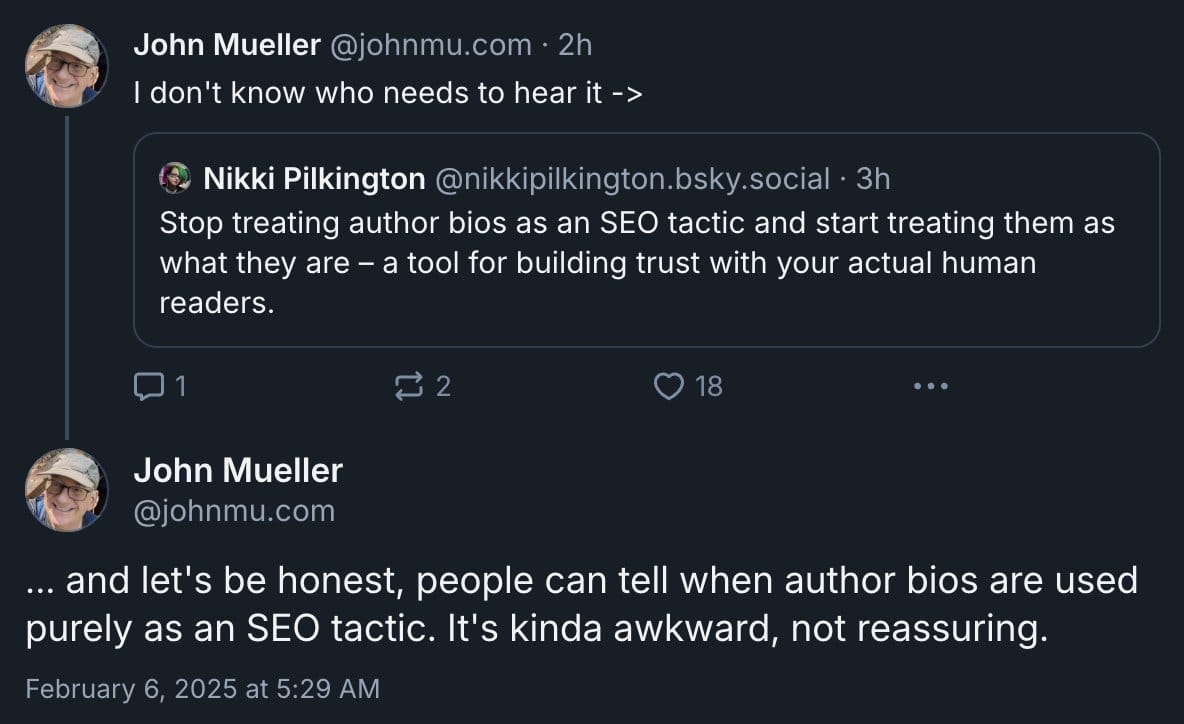
Mueller amplified this message, stating, “Let’s be honest, people can tell when author bios are used purely as an SEO tactic. It’s kinda awkward, not reassuring.”
This statement serves as a wake-up call to many digital marketers who craft bios primarily to game Google’s algorithm rather than to provide genuine credibility.
It highlights the shift in Google’s priorities—away from keyword stuffing and artificial authority signals, and toward authentic, user-focused content.
Why Author Bios Matter (And How They Get Abused)
Author bios are traditionally used to establish credibility, showcase expertise, and give readers confidence in the information provided. However, many websites have exploited them to boost their search rankings, stuffing them with keywords and linking them to questionable author profiles that lack real-world credentials.
Some common SEO-driven tricks include:
- Using generic, AI-generated bios with no real author behind them.
- Repeating the same credentials across multiple articles, even when the author has no actual expertise in the topic.
- Overloading bios with keywords and links solely for ranking purposes.
- Assigning random names to content pieces to make them appear authoritative when they are, in fact, ghostwritten.
- Using fake credentials or exaggerating experience to establish false authority.
Mueller’s statement indicates that Google is not only aware of these tactics but is also actively discouraging them. As Google’s algorithms improve, these artificial strategies are becoming less effective and may even face penalties.
The Impact on Digital Publishers and SEO Experts
Website owners, bloggers, and content marketers need to fundamentally change how they create author bios. Rather than focusing on manipulating search rankings, they should emphasize transparency and reliability.
Some key implications include:
- Real Authors Over Fake Profiles: Publishers may need to verify contributors more thoroughly, ensuring that articles are written by real experts rather than generic ghostwriters.
- Quality Over Quantity: Instead of churning out mass-produced content with weak bios, there will be a greater emphasis on credibility and expertise.
- Potential SEO Penalties: Websites that rely on fabricated bios may see ranking drops if Google starts enforcing stricter credibility checks.
- Improved User Trust: Sites that focus on genuine author credibility may see increased reader engagement and trust, leading to better retention rates.
- Industry Reputation: Brands that are caught using deceptive author bios could suffer reputational damage, losing credibility in their niche.
Google’s History of Cracking Down on Manipulative SEO
Google has long been fighting against artificial SEO tactics. From the Penguin update that targeted link schemes to the Helpful Content Update designed to weed out low-quality content, the search giant has been consistently refining its algorithms to prioritize user experience over SEO trickery.
This latest stance on author bios aligns with Google’s broader mission to reward transparency and expertise. It echoes past efforts such as the E-E-A-T (Experience, Expertise, Authoritativeness, Trustworthiness) framework, which favors content from legitimate experts rather than anonymous or mass-produced sources.
Google’s continued commitment to prioritizing quality over manipulation suggests that brands must adopt long-term, sustainable content strategies rather than short-term hacks.
The Future of Author Bios: What Content Creators Should Do Now
Given Google’s emphasis on authenticity, here’s what digital publishers should focus on:
Use Real Experts: Assign articles to qualified professionals in the field.
Keep It Transparent: Provide genuine credentials, links to real professional profiles, and clear authorship details.
Avoid Keyword Stuffing: Craft bios for humans, not search engines.
Engage Authentically: Treat author bios as a tool for building trust rather than just another SEO hack.
Audit Existing Author Bios: Review previously published content to ensure all bios are accurate and reflect real expertise.
Enhance User Engagement: Encourage authors to engage with their audience through comments, social media, and additional contributions, reinforcing their credibility.
Adapt to Google’s Algorithm Changes: Stay updated on Google’s evolving guidelines to ensure that content strategies align with the latest best practices.
Key Takeaways
- John Mueller warns against using author bios as an SEO trick.
- Readers can easily tell when bios are fake or manipulative.
- Websites using artificial bios may face SEO consequences in the future.
- Authenticity and expertise will be more critical for rankings.
- Content creators should prioritize transparency over SEO tactics.

Dileep Thekkethil
AuthorDileep Thekkethil is the Director of Marketing at Stan Ventures, where he applies over 15 years of SEO and digital marketing expertise to drive growth and authority. A former journalist with six years of experience, he combines strategic storytelling with technical know-how to help brands navigate the shift toward AI-driven search and generative engines. Dileep is a strong advocate for Google’s EEAT standards, regularly sharing real-world use cases and scenarios to demystify complex marketing trends. He is an avid gardener of tropical fruits, a motor enthusiast, and a dedicated caretaker of his pair of cockatiels.
