
Google officially launched “Preferred Sources” for English-language users worldwide. The feature allows users to manually curate their “Top Stories” feed, prioritizing trusted publishers ranging from major global outlets to niche local blogs.
Google has officially announced the worldwide rollout of Preferred Sources in Search, a landmark feature that gives users direct control over the publications they see in the “Top Stories” carousel.
The announcement, made via Google’s official X (formerly Twitter) handle today, confirms that the feature is rolling out immediately to English-language users globally, with support for additional languages scheduled for early 2026.
We’re launching Preferred Sources in Search worldwide ⭐️
Preferred Sources in Search lets you customize your Top Stories in Search to see more from the outlets and sites you value, from global news outlets to local blogs.
This feature is rolling out in the coming days to… pic.twitter.com/iKYGlAg5S4
— Google (@Google) December 10, 2025
This update represents a fundamental shift in how Google serves news content. By moving away from purely algorithmic selection—which traditionally favored freshness and domain authority—Google is now integrating a strong user-preference signal directly into the SERP (Search Engine Results Page).
What are Preferred Sources?
Preferred Sources allows users to “follow” specific news outlets and blogs. Once a user selects a source, Google’s algorithms are instructed to prioritize content from that publisher in the Top Stories section whenever relevant queries are made.
According to Google, the feature is designed to help users “see more from the outlets and sites you value, from global news outlets to local blogs.”
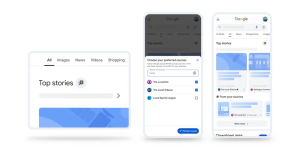
Visually, the feature introduces a new UI element to the Top Stories section:
- The Settings Icon: Users will see a customize/settings icon within the Top Stories header.
- The Selection Menu: Clicking this opens a “Choose your preferred sources” interface where users can search for and select specific websites.
- The Result: Stories from these selected publishers will appear with a distinct label reading “From your sources,” ensuring they stand out against generic aggregators or competitors.
From Pilot to Global Launch: The Data
While today marks the global expansion, “Preferred Sources” has been in testing within the United States and India since August 2025. The data from this pilot phase offers compelling evidence for why publishers should take this feature seriously.
Google revealed that during the test phase, users selected nearly 90,000 unique sources, demonstrating a strong appetite for variety. Interestingly, the selections weren’t limited to major legacy media; users frequently prioritized local news blogs, niche hobbyist sites, and community sports pages.
Most critically for SEOs and webmasters, Google reported that users click through to their “Preferred Sources” twice as often as they do to standard algorithmic suggestions. This 2x click-through rate (CTR) boost effectively turns brand loyalty into a direct ranking factor.
The “Spotlighting Subscriptions” Connection
Coinciding with this rollout, Google also alluded to updates regarding “Spotlighting subscriptions,” a related initiative aimed at helping users get more value from their paid news subscriptions.
While “Preferred Sources” focuses on the open web, the subscription spotlighting ensures that if a user pays for a paywalled site (like The New York Times or The Wall Street Journal), those links are highlighted prominently in Search and Gemini AI results.
Together, these features signal Google’s intent to position itself as a partner to the publishing ecosystem, rather than just an aggregator—a necessary move as the company faces increasing scrutiny over its AI Overviews (formerly SGE) potentially cannibalizing web traffic.
Implications for Publishers and SEO Strategy
For the digital marketing community, the global launch of Preferred Sources necessitates a strategy pivot. The battle for Top Stories real estate is no longer just about schema markup, AMP (or its successors), and breaking news speed. It is now about Brand Affinity.
- The “Subscribe” Call-to-Action
Publishers must now treat Google Search much like a social media platform. Just as YouTubers ask viewers to “smash the subscribe button,” website owners should encourage readers to add them as a “Preferred Source” on Google. We expect to see a rise in on-site tutorials and pop-ups guiding users on how to whitelist the site in Search. - A Lifeline for Local and Niche SEO
This is arguably the most significant update for local SEO in years. A small “Local Sports League” blog (as used in Google’s example) typically struggles to outrank national sports giants. However, if that local blog has a loyal community that adds it as a Preferred Source, it can leapfrog national competitors in the SERPs for that specific user base. - Brand Trust vs. Keyword Optimization
While keywords remain important, this update places a premium on being a “trusted entity.” If a user trusts a brand enough to manually select it, Google rewards that site with prime visibility. This suggests that community building, newsletter engagement, and brand consistency will directly influence organic traffic performance more than ever before.
The Future of Search Feed Customization
Google has stated that while the feature is currently for English users, it will expand to all supported languages soon. This indicates a permanent change in the architecture of Google News and Top Stories.
As AI content floods the web, Google seems to be betting on human curation as a quality filter. By allowing users to whitelist the sources they trust, Google can effectively crowdsource quality control, ensuring that the AI-heavy future of Search doesn’t drown out legitimate, human-authored journalism.
Beyond Top Stories: Could User Curation Reshape Organic Rankings?
While the current rollout is strictly limited to the “Top Stories” news carousel, the infrastructure suggests a much broader potential for the future of Search. If Google successfully implements this for news, it is highly probable that similar curation tools could eventually make their way to standard organic search results (the traditional “10 blue links”).
For years, power users have clamored for the ability to permanently “mute” content farms or “boost” specific forums in their general search results. If “Preferred Sources” expands to the core search experience, it would transform Google from a purely algorithmic engine into a personalized discovery engine.
Crowdsourcing Quality Signals
Perhaps the most significant implication of this feature is the data it provides back to Google. By analyzing which sites users explicitly “prefer” and which they ignore, Google is effectively crowdsourcing its quality signals.
Currently, Google relies on paid Search Quality Raters and implicit user behavior (clicks, dwell time, pogo-sticking) to train its ranking systems. “Preferred Sources” introduces a layer of explicit user intent.
If thousands of users in a specific niche (e.g., Python coding) consistently add a specific small blog to their preferred list while ignoring a larger, SEO-spammed aggregator, Google gains an undeniable data point regarding authority and trust.
Over time, this aggregated preference data could feed back into the generic ranking algorithm, helping Google distinguish between “content designed to rank” and “content designed to be read.”
In an era where AI-generated spam threatens to overwhelm the index, using real humans to curate the web might be the ultimate signal Google needs to maintain search quality.
Key Takeaways
- The feature is live for English users globally. Check your Top Stories rankings over the coming weeks for volatility.
- Sites added as a “Preferred Source” see a 2x higher click-through rate on average.
- SEOs should advise clients to create campaigns encouraging their audience to add the site as a Preferred Source.
- Small, niche, and local publishers have a new mechanism to compete with high-DR (Domain Rating) authority sites by leveraging their loyal audience.
- As Google integrates more AI, “Preferred Sources” ensures your content remains visible to your core audience, bypassing purely algorithmic filters.

Dileep Thekkethil
AuthorDileep Thekkethil is the Director of Marketing at Stan Ventures, where he applies over 15 years of SEO and digital marketing expertise to drive growth and authority. A former journalist with six years of experience, he combines strategic storytelling with technical know-how to help brands navigate the shift toward AI-driven search and generative engines. Dileep is a strong advocate for Google’s EEAT standards, regularly sharing real-world use cases and scenarios to demystify complex marketing trends. He is an avid gardener of tropical fruits, a motor enthusiast, and a dedicated caretaker of his pair of cockatiels.
