A new analysis confirms that artificial intelligence now produces more written articles online than human authors, marking a major shift in digital publishing. Yet the surge in AI-generated content appears to have reached its peak, raising questions about visibility, performance, and trust in online information.
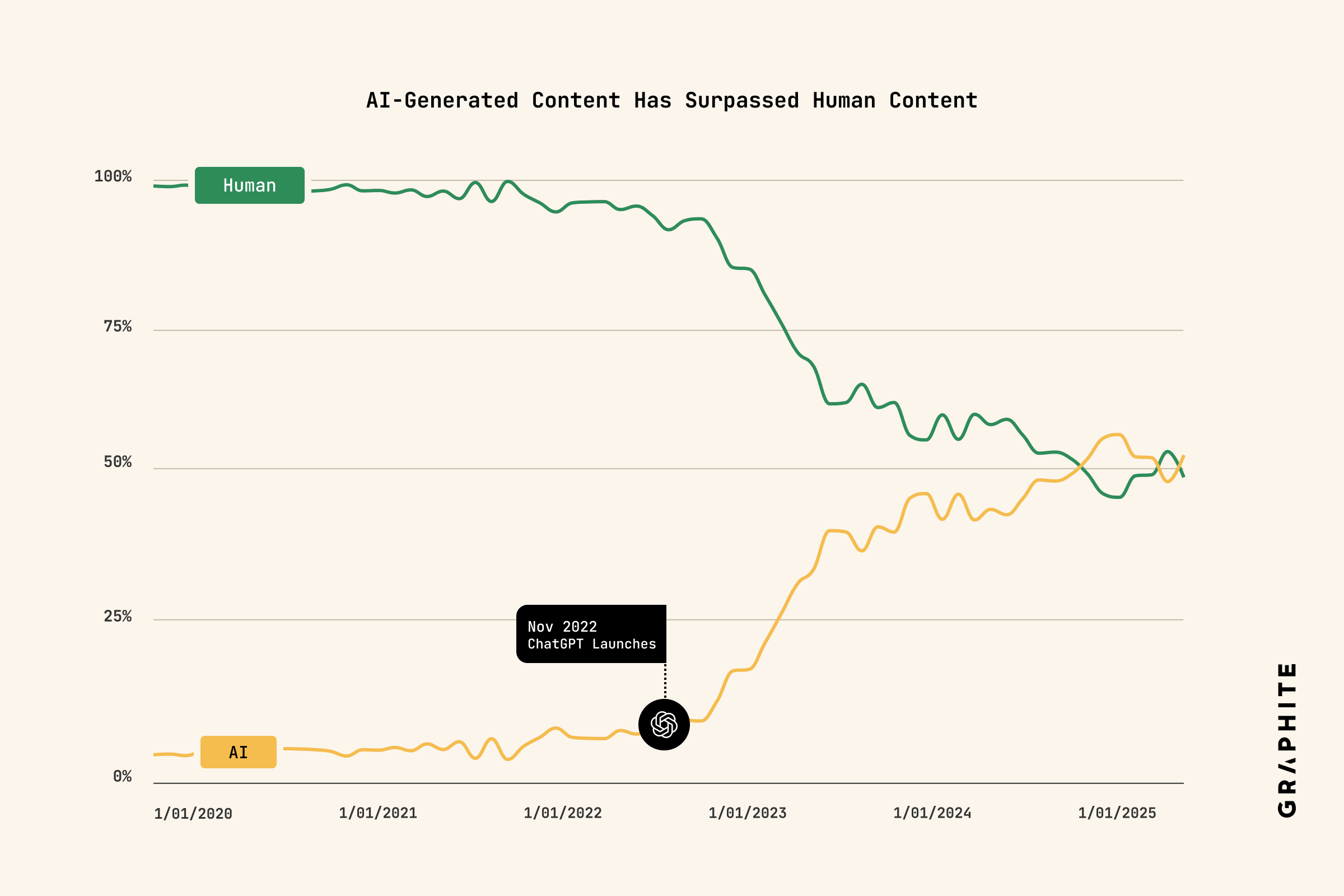
In November 2024, the number of AI-generated articles published online surpassed those written by humans for the first time.
The finding comes from a large-scale study of 65,000 English-language web pages, which showed that AI content accounted for about 52 percent of all newly published material by early 2025.
The research team based its analysis on Common Crawl, one of the largest publicly available web archives.
Articles were selected at random, filtered to confirm they were in English and contained at least 100 words, and then tested using SurferSEO’s AI detection algorithm.
Each article was classified as AI-generated if the detector determined that more than half of its content was produced by artificial intelligence.
This study provides one of the clearest quantitative looks at how AI content creation has transformed online publishing since ChatGPT’s release in late 2022.
Below is a video on the rise of AI-generated content that I found on X:
How AI Writing Took Over
The data show a steep rise in AI-generated articles immediately after ChatGPT launched.
Within twelve months, AI authorship jumped from roughly 5% in 2022 to nearly 40% in late 2023.
By November 2024, it had overtaken human output.
The shift has been largely driven by economics. Producing an AI-written article costs a fraction of a cent, while human-written pieces cost around $10 to $100 each.
For websites that depend on constant content production, the financial incentive to adopt AI tools has been overwhelming.
Companies, marketing agencies, and independent publishers began using systems like ChatGPT, Claude, and Gemini to generate content at scale.
As the study notes, the quality of this material has improved rapidly.
An MIT study found AI-generated content can match or even outperform human writing in clarity and tone, while a separate Originality AI report showed that readers often struggle to tell the difference.
Despite this improvement, visibility is another story.
The researchers found that AI-generated articles rarely appear among top Google search results and are largely absent from tools like ChatGPT’s browsing summaries. This means that while AI may dominate by quantity, it does not dominate in reach or influence.
Growth Has Stalled
After two years of rapid expansion, the growth rate of articles created by AI has now plateaued.
Since mid-2024, their share of total published material has remained stable. The researchers believe this slowdown reflects diminishing returns: publishers may be realizing that mass-produced AI articles do not drive traffic or revenue as effectively as expected.
The separate study referenced in the paper supports this hypothesis, showing that AI-generated articles underperform in search rankings compared with human-written work.
Search algorithms appear to reward originality, credibility, and authorship transparency, traits that machine-produced text often lacks.
This plateau could mark the start of a recalibration phase, as publishers reconsider how to balance automation with human oversight.
Testing Accuracy and Bias
Because AI detection remains controversial, the researchers first verified their method. They tested SurferSEO’s AI detection algorithm using two benchmarks:
- Human-written baseline: Articles published before ChatGPT’s launch (January 2020–November 2022) were assumed to be human-written. Only 4.2% of these were incorrectly flagged as AI-generated, indicating a relatively low false positive rate.
- AI-generated baseline: The team created 6,009 new articles using OpenAI’s GPT-4o, covering subjects from commerce to enterprise technology. SurferSEO correctly identified 99.4 percent of these as AI-generated, with a 0.6 percent false negative rate.
These validation steps gave the researchers confidence to apply the method to their full 65,000-article dataset.
They also acknowledged that the study did not account for AI-assisted articles, pieces initially drafted by AI but edited or rewritten by humans. These are likely widespread and could mean that the actual percentage of AI involvement in online writing is even higher.
The Economics of Scale
The financial motivation behind this shift cannot be overstated. Producing AI content costs virtually nothing, while hiring human writers carries substantial expenses.
As a result, many sites that once relied on freelance writers now use AI systems to maintain their publishing schedules.
However, quantity does not always translate into effectiveness. Search engines are increasingly filtering out low-value content, and readers are growing more skeptical of generic writing that lacks authorship or citations.
As one section of the study notes, “AI-generated articles are abundant, but they are not necessarily being read.” The implication is clear: producing vast amounts of content no longer guarantees visibility or engagement.
Industry Reactions and Concerns
The finding that AI now writes most online articles has triggered debate across academic and professional communities.
Critics warn that as more AI-generated content circulates, newer AI models trained on this material could face “model collapse” — a feedback loop that degrades their performance over time. They also worry about the erosion of authenticity in online communication.
Digital ethicist Dr. Émile P. Torres described the trend starkly: “Search results, social feeds, and even video captions are becoming indistinguishable floods of machine-written content. It’s making the internet harder to use.”
Absolutely terrible. The enslopification of the Internet is making it almost unusable at this point. Youtube is overflowing with slop. Google Search results are full of slop. Tons of Twitter users are just sloppy AIs. It’s pretty catastrophic–and getting worse! Accelerate! https://t.co/iHDXs35rAm
— Dr. Émile P. Torres 🛑 (@xriskology) October 26, 2025
Others take a more balanced view. They argue that AI enables faster knowledge distribution and allows human writers to focus on higher-level storytelling, analysis, and creativity. Many see the technology as a tool rather than a replacement.
The consensus is that editorial oversight and transparency will be essential to preserve trust in digital media.
What Readers Should Know
For readers, the rapid expansion of AI-written material means the online information environment has changed significantly. Articles on everything from financial advice to health tips are increasingly machine-generated.
Here are practical steps to navigate this new environment:
- Check authorship and sources. Articles with clear bylines, citations, and publication details are more likely to be credible.
- Be cautious with generic answers. If an article reads smoothly but lacks specificity or references, it may be AI-generated.
- Cross-verify important facts. Especially for advice, rely on multiple trusted outlets or official data.
- Support transparent publishers. Outlets that disclose AI usage contribute to a healthier online ecosystem.
Implications for Writers and Publishers
For professional writers, this shift represents both a challenge and an opportunity.
Routine writing tasks are increasingly automated, reducing demand for bulk SEO articles. However, there is growing value in skills that AI cannot easily replicate: original reporting, nuanced analysis, and editorial judgment.
Publishers are also learning to use AI selectively — as a drafting or research assistant, not a full author. Combining automation with human editing may yield the most effective balance between cost efficiency and reliability.
The research team predicts that this hybrid model could define the next stage of online publishing.
Key Takeaways
- AI-generated content surpassed human-written content in late 2024, reaching about 52 percent of new online articles.
- Growth has plateaued since mid-2024, suggesting limited performance benefits.
- AI detection accuracy is high, with 4.2% false positives and 0.6% false negatives reported.
- AI-assisted writing likely increases the true share of machine involvement beyond 52 percent.
- Economic incentives remain the driving factor, but visibility and trust issues persist.

Zulekha
AuthorZulekha is an emerging leader in the content marketing industry from India. She began her career in 2019 as a freelancer and, with over five years of experience, has made a significant impact in content writing. Recognized for her innovative approaches, deep knowledge of SEO, and exceptional storytelling skills, she continues to set new standards in the field. Her keen interest in news and current events, which started during an internship with The New Indian Express, further enriches her content. As an author and continuous learner, she has transformed numerous websites and digital marketing companies with customized content writing and marketing strategies.
