
Search is no longer just about ranking on page one.
Google AI Overviews now appear in roughly 13 to 16 percent of all search queries, and that number is climbing fast.
These AI-generated summaries sit above traditional organic results and answer user questions directly, often without requiring a single click to any website.
For white-label agencies, this shift creates both a challenge and a real opportunity.
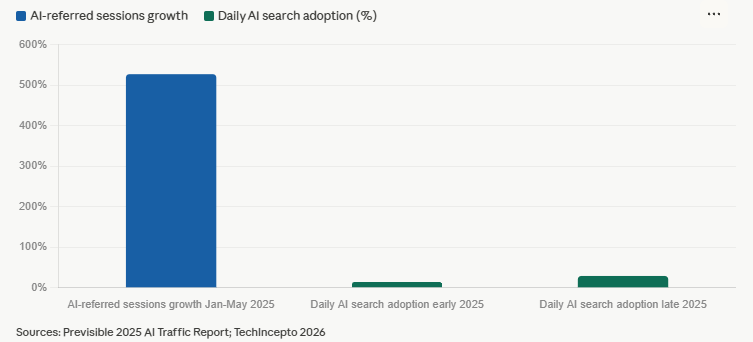
AI-referred sessions jumped 527% between January and May 2025 , signaling that users are rapidly changing how they find information.
If your clients’ content is not being cited inside these AI-generated answers, you are losing visibility even when rankings look healthy.
This guide explains exactly what Generative Engine Optimization (GEO) is, why it matters for white-label agencies right now, and the specific steps you can take to get your clients’ content cited inside Google AI Overviews.
What Is GEO and Why Does It Matter for White-Label Agencies
Generative Engine Optimization, or GEO, is the practice of structuring and optimizing content so that AI-powered platforms like Google AI Overviews, ChatGPT, and Perplexity cite it when generating answers to user queries.
Unlike traditional SEO that focuses on ranking in search results, GEO ensures your content gets cited when AI engines answer user questions.
The distinction matters a great deal for agencies managing multiple client accounts.
Traditional SEO puts a link on the results page.
A user may or may not click it.
GEO places your client’s brand, data, or definition directly inside the answer a user reads.
That is brand visibility at the exact moment of information consumption, whether or not the user ever visits the site.
97 percent of digital leaders surveyed by Conductor report positive impact from their GEO efforts, and GEO now represents 12 percent of average digital marketing budgets, with 32 percent of digital leaders declaring it their top priority for 2026.
For white-label agencies, adding GEO to your service stack is not just a competitive advantage.
It is quickly becoming a client expectation.
If you are still building out your agency’s SEO foundation, our guide on what white-label SEO is and how agencies use it gives you the full picture before you layer in GEO strategies.
GEO Is Not a Replacement for SEO. It Builds on Top of It.
This is the most important thing to understand before changing anything for your clients.
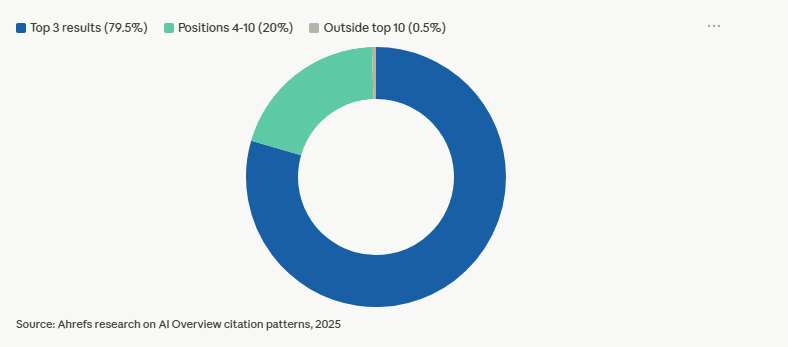
Research shows 99.5 percent of AI Overview citations come from top 10 organic results, and nearly 80 percent come from the top 3 results.
You cannot skip traditional SEO and jump straight to GEO.
Rankings still matter enormously.
The difference is that ranking well is no longer sufficient on its own.
Your content must also be optimized for AI extraction, synthesis, and citation. Marketing Agent Blog
Think of GEO as an additional layer you build on top of a solid SEO foundation.
The agencies winning in AI search right now are the ones who mastered traditional ranking first and are now upgrading how their content is structured, formatted, and signaled to AI systems.
Our white-label link building service remains one of the strongest foundations you can build for clients, since authoritative backlinks directly influence both organic rankings and AI Overview citation eligibility.
Step 1: Structure Content So AI Can Extract It Immediately
Google’s AI does not read a full article the way a human does.
It scans for clear, extractable answer blocks.
The first 200 words of any article should directly and completely answer the primary query, not build up to the answer. Enrichlabs
This means every piece of content your clients publish needs to lead with the answer, not save it for the middle or end.
Use H2 and H3 headings that are phrased as actual questions users type into Google.
Follow each question heading immediately with a direct, concise answer in two to four sentences.
Keep answers tight, between 30 and 50 words maximum for the opening response, and keep maximum sentence length to 20 words.
After the short answer block, you can go deeper with supporting details, examples, and data.
This structure serves both human readers and AI extraction systems simultaneously.
It also improves your chances of capturing featured snippets, which frequently serve as source material for AI Overviews.
Step 2: Add FAQ Sections to Every Key Page
FAQ sections are one of the highest-impact GEO tactics available right now.
Studies consistently show FAQ sections produce measurable citation lifts, and implementation time is minimal.
The format is naturally aligned with how AI systems extract and cite information.
Each question mirrors a real user query, and each answer provides a clean, citable response.
Aim for 8 to 12 questions per FAQ section.
Keep each answer between 50 and 80 words.
Use confident, factual language and avoid promotional phrasing.
Pair visible FAQ content with FAQ schema markup in JSON-LD format so Google can identify and process the Q&A structure programmatically.
For complex topics, create dedicated FAQ pages and update them regularly based on emerging customer questions.
When building content strategies for clients, this is one of the quickest wins a white-label team can deliver with measurable results.
Step 3: Implement Schema Markup the Right Way
Schema markup is the direct communication channel between your clients’ content and Google’s AI systems.
Structured data using Schema.org vocabulary is the language that AI models speak, and implementing comprehensive, accurate schema markup dramatically improves your chances of being cited.
The schema types that matter most for AI Overview optimization are FAQ Schema for question and answer content, HowTo Schema for step-by-step instructional content, Article Schema that includes author details and publication date, and Organization Schema that establishes brand identity and authority.
Always implement schema in JSON-LD format.
JSON-LD separates markup from HTML, reducing errors and improving maintenance at scale.
Validate every implementation using Google’s Rich Results Test before publishing.
Re-validate after any template or CMS changes.
For white-label agencies managing multiple client sites, build schema implementation into your standard on-page SEO workflow so it is never an afterthought.
Our white-label SEO reseller services include on-page optimization as a core deliverable, which means schema can be rolled out across client accounts at scale without adding operational overhead to your team.
Step 4: Build Topical Authority Through Content Clusters
Google’s AI does not just evaluate individual pages.
It evaluates how comprehensively a domain covers an entire topic area.
Instead of writing one shallow blog post, build a content cluster, a pillar page covering the main topic, supported by multiple in-depth subtopic articles that all link together.
A pillar page covers the broad topic in full.
Supporting cluster articles each go deep on a specific subtopic.
All cluster articles link back to the pillar, and the pillar links out to the clusters.
This internal linking architecture does two things at once.
It distributes authority across the content cluster, and it signals to Google that a site has genuine expertise across a subject, not just surface-level coverage of individual keywords.
The more interconnected your content, the easier it is for AI to understand your domain expertise.
For white-label agencies, building content clusters for clients is one of the most scalable ways to create lasting GEO visibility.
Our fully managed SEO services are designed around exactly this kind of strategic content architecture, so your clients get topical depth without your team carrying the production load.
Step 5: Strengthen E-E-A-T Signals Across Every Page
E-E-A-T stands for Experience, Expertise, Authoritativeness, and Trustworthiness.
It is Google’s framework for evaluating content quality, and AI systems use the same signals to decide what is worth quoting.
Trust signals like author bios, citations, and structured data help content get cited in AI Overviews.
Every article your clients publish should have a named author with a linked bio page that demonstrates genuine expertise in that subject area.
The author bio should reference credentials, relevant experience, and links to authoritative external profiles where appropriate.
Content should cite credible external sources, include original data or case study findings where possible, and avoid vague or promotional language.
According to Google’s 2025 search quality guidelines, content that directly answers user questions while demonstrating hands-on experience performs 3.2 times better in AI-generated responses.
For white-label agencies, this means building author profiles for your clients’ websites is no longer optional.
It is a core part of the content deliverable.
Step 6: Target Long-Tail, Question-Based Queries
Short, broad keywords are increasingly answered by AI Overviews with zero clicks going anywhere.
The smarter play for your clients right now is to target longer, more specific queries that reflect genuine research intent.
Queries with 8 or more words are 7 times more likely to trigger Google AI Overviews.
This means content that answers specific, nuanced questions stands a much better chance of being cited than content targeting short generic keywords.
Use tools like Google’s People Also Ask boxes, AnswerThePublic, and Google Search Console to find the exact questions your clients’ audiences are asking.
Build content directly around those questions.
Use them as H2 headings, FAQ entries, and section openers.
The more precisely your content matches a real user query, the more extractable it becomes for AI systems looking for a clean answer to surface.
Step 7: Keep Content Fresh and Update Regularly
AI systems strongly favor recent content, especially for fast-moving topics.
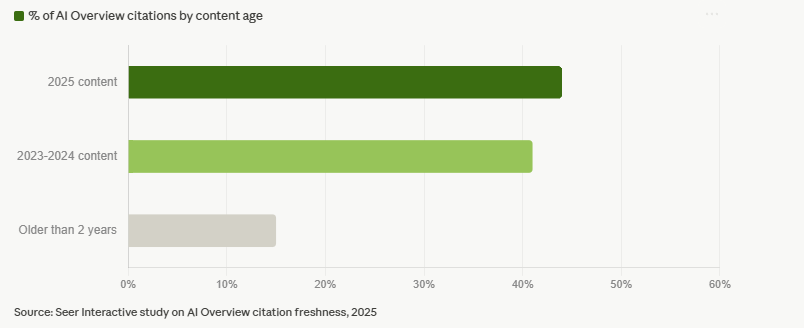
A study by Seer Interactive found that 85 percent of AI Overview citations were published in the last two years, with 44 percent of them from 2025 alone.
This means publishing once and forgetting is a GEO liability.
Prioritize refreshing high-performing blog posts with new data, updated examples, and revised statistics on a regular schedule.
Add a visible “last updated” timestamp to key pages.
Include a “What changed in 2025” or “2026 update” section in evergreen articles to signal freshness to both AI systems and human readers.
For white-label agencies, content refresh workflows should be built into your quarterly client deliverables, not treated as a one-off task.
Our blog management services include regular content updates as part of the ongoing deliverable, which makes this process systematic rather than reactive.
Step 8: Track AI Visibility Alongside Traditional Rankings
Most agencies are still only measuring keyword rankings and organic traffic.
That is no longer enough.
As of September 2025, only 16 percent of brands systematically track AI search performance.
That gap is your opportunity.
Start tracking AI visibility by manually searching your clients’ target queries in Google and noting whether an AI Overview appears and whether their content is cited.
Monitor referral traffic in Google Analytics for sessions coming from AI platforms.
Watch for increases in branded search volume, which often indicate users discovered the brand through an AI-generated answer and then searched for it directly.
Use Google Search Console to compare impressions and click-through rate trends on pages you have optimized for GEO, looking for shifts after optimizations are made.
As third-party GEO tracking tools continue to mature through 2025 and 2026, incorporate them into your standard client reporting to make AI visibility a measurable KPI you can report on alongside traditional metrics.
The White-Label Agency Opportunity in GEO
As search engines rapidly transition toward AI-generated results, including features like Google’s AI Overviews and conversational search interfaces, these changes are fundamentally altering how users interact with search, reducing reliance on traditional organic listings and compressing click-through rates across many industries.
White-label agencies are in a uniquely powerful position right now.
You manage content and SEO across multiple client accounts simultaneously.
Every GEO process you build, every schema template you create, every content cluster framework you develop, can be replicated across your entire client portfolio.
That is leverage that in-house teams at individual businesses simply do not have.
The agencies that move early on GEO will be able to show clients measurable AI visibility improvements while competitors are still catching up.
47 percent of brands still have no GEO strategy.
That means nearly half of your clients’ competitors are invisible in AI search right now.
That is the window.
If you want to understand how the benefits of white-label SEO apply specifically to scaling new service lines like GEO, that resource walks through exactly how outsourced fulfillment makes adding services like this operationally viable without hiring.
FAQ
What is the difference between GEO and traditional SEO?
Traditional SEO focuses on ranking a page in the list of blue links on a search results page.
GEO focuses on getting your content cited inside the AI-generated answer that appears above those results.
Both strategies reinforce each other, since strong organic rankings are still the most reliable path to AI Overview inclusion.
Do I need to abandon SEO to focus on GEO?
No.
GEO builds on top of SEO, it does not replace it.
The organic search ranking position remains the single strongest predictor of AI Overview inclusion.
Strong rankings, authoritative backlinks, and technical SEO health are still the foundation everything else sits on.
How long does it take to see GEO results?
Initial visibility can appear within 2 to 4 weeks, faster than traditional SEO’s 3 to 6 month timeline.
FAQ sections and schema markup tend to show results the quickest.
Content cluster builds and E-E-A-T improvements take longer but deliver more durable results.
Which schema types matter most for Google AI Overviews?
FAQ Schema, HowTo Schema, Article Schema, and Organization Schema are the four highest-priority schema types for AI Overview optimization.
Implement all four in JSON-LD format and validate using Google’s Rich Results Test.
Can white-label agencies offer GEO as a service?
Yes, and many are already building it into their standard deliverables.
The core GEO tactics, including content restructuring, schema markup, FAQ creation, and content cluster architecture, are all implementable through a white-label fulfillment model without requiring a dedicated in-house GEO specialist on your team.
Conclusion
Google AI Overviews are not a future development to monitor from a distance.
They are live, they are expanding, and they are changing how your clients’ potential customers find information right now.
The agencies that treat GEO as a bolt-on or an experiment will fall behind.
The ones that build it systematically into their content, technical SEO, and reporting workflows will have a genuine competitive advantage in 2025 and beyond.
Start with the fundamentals covered in this guide.
Structure content for extraction.
Add FAQ sections with proper schema.
Build topical authority through content clusters.
Strengthen E-E-A-T signals.
Target long-tail queries.
Keep content fresh.
Measure AI visibility alongside traditional metrics.
Each of those steps compounds over time, and each one makes your clients harder to displace in AI-generated answers.

Deepan Paul
AuthorDeepan Paul is a Team Lead of the Internal Marketing Department at Stan Ventures, with four years of experience helping brands recover, grow, and hold on to organic traffic across global B2B, B2C, and D2C markets. He's known as a ranking revival expert. When traffic drops, pages fall out of the index, or visibility disappears after an update, he finds the cause and fixes it. Today he runs Stan Ventures' own organic presence, and that goes well past Google. He tracks and grows how the brand shows up in AI Overviews and across AI tools like ChatGPT, Perplexity, and Gemini, where citations decide who gets mentioned and who doesn't. His work covers technical SEO, content strategy, indexing, and building growth systems that hold up when algorithms shift. He has managed international clients and led cross-functional teams, keeping every SEO decision tied to what the business actually needs. Outside of client work, Deepan trains SEO professionals, speaks at industry events, and contributes insights to digital marketing publications. His approach is simple: build systems that keep working, instead of chasing quick wins.
