The latest discussion around domain names and SEO began when Google’s John Mueller addressed a question about generic Top-Level Domains (gTLDs), particularly those that contain keywords such as .music.
His response was clear, direct, and surprising for many business owners and marketers who continue to wonder whether the right domain extension can offer an edge in ranking.
Mueller clarified that keyword-based gTLDs provide absolutely no SEO advantage, which instantly reignited debates about how Google interprets relevance and what actually matters when choosing a domain.
What Are gTLDs and Why Have They Become So Common?
If you’ve been online since the early 2000s, you probably remember simpler times such as .com, .net, .org. That was pretty much it. But since 2013, the internet opened its gates to hundreds of new generic Top-Level Domains that allow websites to brand with more personality and specificity.
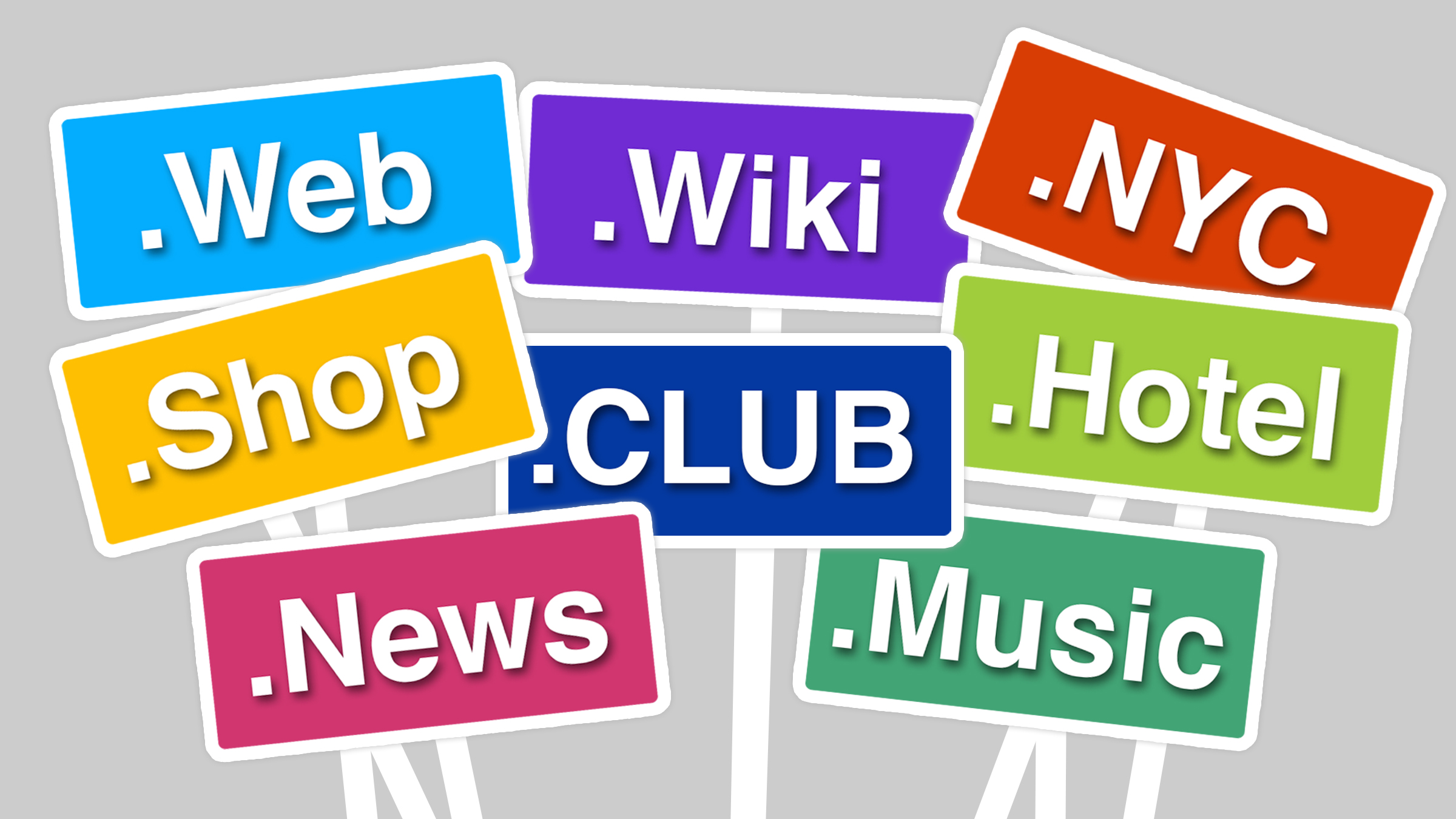
Think of options like:
- .photography
- .marketing
- .guru
- .travel
- .music
You have surely seen them around and thought, that looks interesting, does it help with ranking? I’ve wondered that too. We all have.
These new extensions were meant to give businesses more choices and help them stand out, especially as .com domains become scarce.
But do they offer some hidden SEO boost? Google says no. But let’s see why that answer is more nuanced than it appears.
Do Keyword-Based gTLDs Influence Search Rankings?
The conversation that sparked this renewed attention began with a Reddit user who asked whether registering a .music domain carries any SEO benefit.
They were unable to secure the .com version of their name and wondered if the .music variant could still help them stand out or perhaps even rank better.
John Mueller responded by saying, “There’s absolutely no SEO advantage from using a .music domain.” His answer leaves no room for misinterpretation.
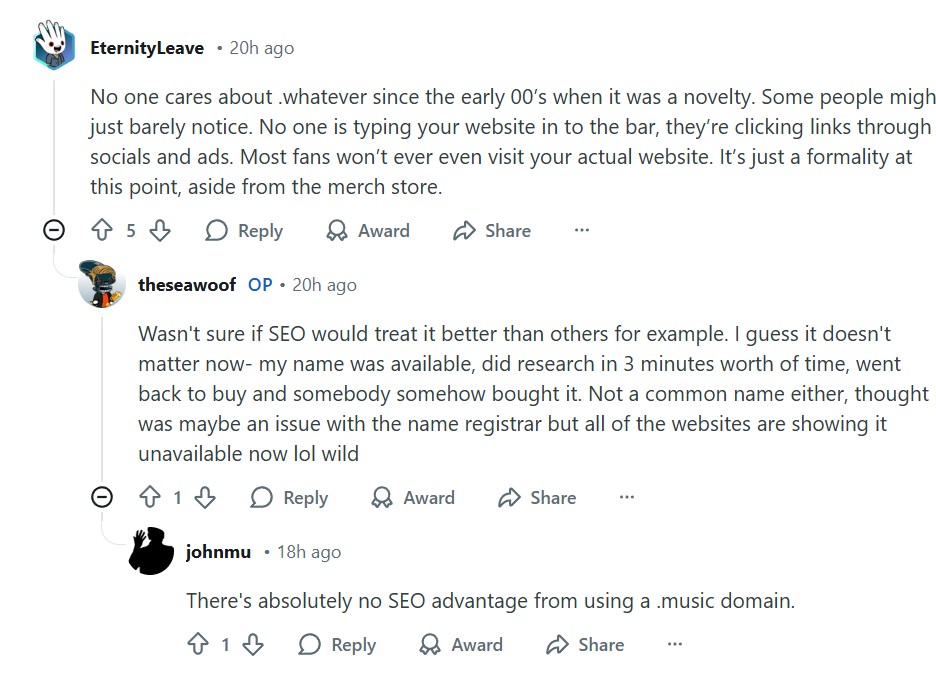
It reinforces Google’s long-standing position that TLDs, on their own, do not influence search rankings.
In other words, Google does not assume that a website using .music is more relevant to music-related searches, nor does it assume that .shop signals a better e-commerce experience.
This reveals an ongoing disconnect between how Google evaluates relevance and how many SEOs think relevance works. While search professionals often focus on what Google considers to be technically relevant, Google’s own approach centers on how humans perceive and interact with content. That difference shapes everything we understand about modern SEO.
If TLDs Don’t Matter to Google, Do They Matter to People?
Interestingly, even though gTLDs do not provide ranking advantages, they can offer extremely valuable benefits from a human perspective. This is where the idea of Human Optimization becomes powerful.
While it is easy to get lost in technical SEO factors, businesses often overlook the fact that humans are the ones who click, read, share, trust, and return to websites. Google’s systems learn from these human interactions at scale.
Therefore, even if a TLD does not directly influence rankings, it may indirectly contribute to success by improving user engagement or brand perception.
For instance, a keyword-based gTLD may instantly communicate what a website does, which can make a strong impression on visitors.
A domain like artistname.music might look professional, trustworthy, and relevant to fans or industry partners. These impressions can affect click-through rates, brand recall, and even how likely people are to link to the site.
How Does Human Behavior Shape SEO Outcomes?
Google’s ranking systems are heavily influenced by large-scale user behavior patterns.
When people engage more positively with a website by clicking, staying longer, sharing, or linking those actions become signals that help search engines understand which sites deserve more visibility.
These behaviors are not tied to TLDs, but they can be influenced by them indirectly.
For example, a memorable or meaningful TLD might encourage users to search for a brand name more frequently, which sends a strong signal to Google about brand authority.
Likewise, an industry-specific TLD could make a site appear more credible, improving the likelihood of earning backlinks from other websites. These human-driven factors accumulate over time and contribute to search performance.
Consequently, while a .music TLD will never cause Google to rank a website higher simply because of the extension, it could help create a stronger brand identity that leads to positive user interactions.
These interactions matter far more to Google than the TLD itself.
Should Businesses Choose Keyword-Based gTLDs?
The answer depends entirely on branding and audience perception rather than SEO. If a keyword-based gTLD helps a business communicate its purpose more clearly, differentiate itself in a crowded market, or create a memorable identity, then it may be an excellent choice.
However, businesses should not invest in these domains with the expectation that they will rank better simply because of the extension.
Instead, they should consider questions such as:
- Does this TLD improve the clarity of my brand?
- Will my audience find this extension credible and trustworthy?
- Does the domain help people understand what I offer at a glance?
- Will it be easier for users to remember and share?
If a company’s answers are mostly yes, then a keyword gTLD can be a smart branding investment.
TL;DR – Key Takeaways
- Keyword-based gTLDs such as .music offer no direct SEO advantage, according to Google.
- Google does not treat keyword TLDs as relevance signals in rankings.
- gTLDs can still influence human trust, memorability, and engagement, which indirectly impacts success.
- Choose a gTLD for branding, not for SEO purposes.
- Human behavior, not TLD keywords, contributes to positive ranking signals over time.
- A keyword gTLD is valuable only if it strengthens your brand identity and user perception.

Dipti Arora
AuthorDipti Arora is a Senior Content Writer with over seven years of experience creating impactful content across Digital Marketing, SEO, technology, and business domains. She has a strong background in managing news verticals and delivering editorial excellence. Dipti has contributed to leading publications such as The Times of India and CEO News, where her research-driven storytelling and ability to simplify complex subjects have consistently stood out. She is passionate about crafting content that informs, engages, and drives meaningful results.
