
At Stan Ventures, we recently conducted a deep-dive analysis that captured Google’s upcoming AI Mode in search results.
And based on what we observed, this isn’t a minor tweak—it represents a potential shift in how users interact with content, how Google processes queries, and how websites will need to adapt.
Here’s what we uncovered.
What Is Google’s AI Mode and How Does It Work?
New tab labeled “AI Mode” appearing at the top of the standard search results page. But unlike a simple filter, clicking this tab triggers a new query execution, pulling the same search term but delivering results in a completely different format.
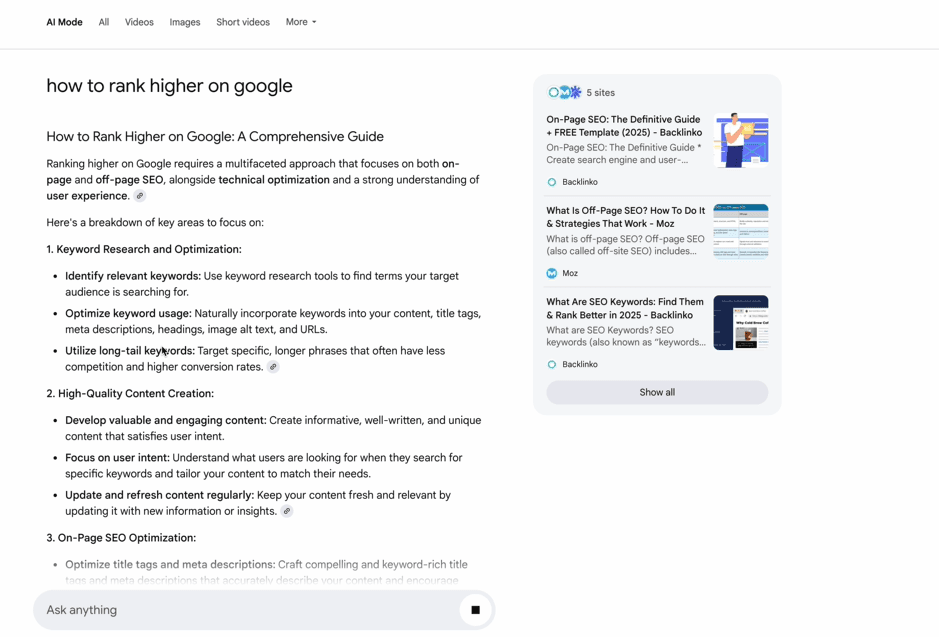
Instead of the traditional list of blue links, Google generates a blog-style summary of the topic. It’s written in a natural, long-form style that appears to directly answer the query within the search interface itself.
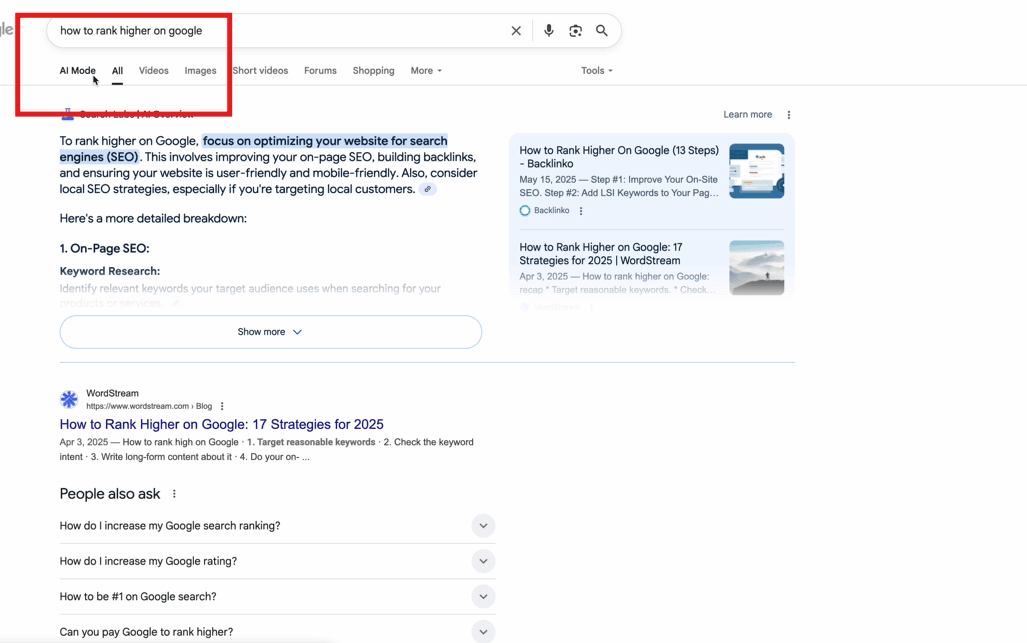
And here’s the key difference: this content isn’t copied. It’s custom-generated by Google, using data from multiple websites.
Where Does This Content Come From?
During the analysis, we noticed that the AI-generated content referenced multiple sources per paragraph. In one instance, three websites were used to compose a single paragraph. In another example, as many as 160 websites contributed to a single AI Mode result.
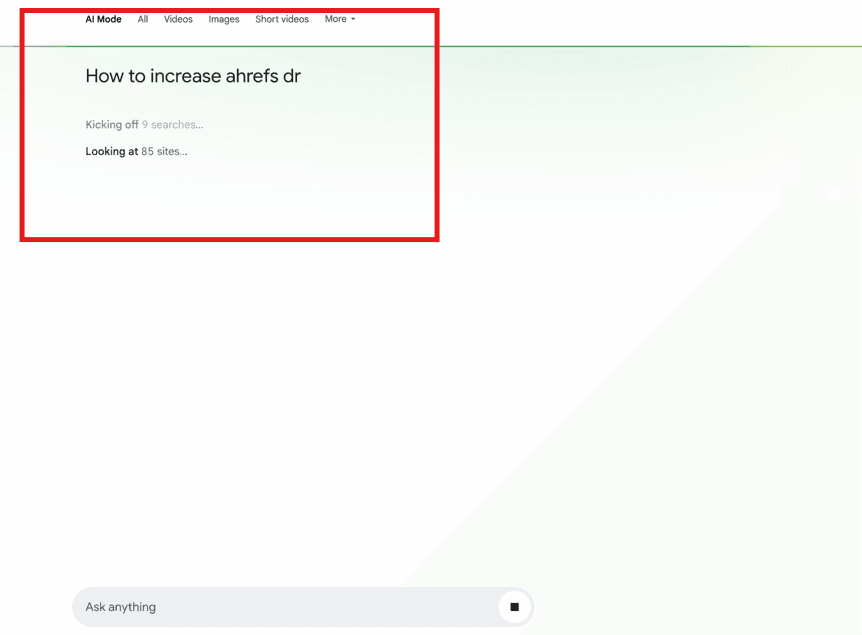
Yet, instead of presenting quotes or snippets, Google appears to be rephrasing and synthesizing this information into a unified article-like output. It restructures original insights and removes the need for users to visit multiple sites.
This is not just a better answer—it’s a self-contained one.
Will Users Still Click Through to Original Sites?
This is where it gets concerning for publishers and SEOs.
Based on the flow we observed, it’s highly likely that a significant percentage of users will find their information needs fulfilled right within AI Mode.
While we can’t put an exact number on it, the design strongly suggests a reduced motivation to click on source links, even when they are listed underneath the AI summary.
And that’s the challenge: your website may contribute to the answer but never receive the traffic it would have in the past.
Does Traditional SEO Still Matter?
Yes—and perhaps even more than before.
Our analysis shows that the majority of websites Google pulled from in AI Mode were already ranking on the first page of traditional search results. That means your content still needs to perform well in the classic ranking model to be included in AI-generated responses.
So, strategies like link building, high-quality content creation, site structure, and technical SEO are still foundational.
But the endgame has changed. Inclusion may no longer guarantee engagement.
Who Stands to Lose the Most?
Informational websites—blogs, knowledge bases, news articles—are the most likely to be affected. If your monetization relies heavily on traffic and ad impressions, AI Mode presents a new and significant threat.
Product and service-based businesses may fare better. The AI summary can explain what you do, but it can’t complete a purchase (unless you are in Google Shopping) or book a consultation. In those cases, the user still needs to visit your site to take action.
That transactional gap may offer a buffer for commercial websites—but it doesn’t exempt them entirely.
Strategic Takeaways from Our Analysis
- Ranking still matters: You need to be in the top positions to be sourced in AI Mode.
- Traffic is no longer guaranteed: Even if you’re a source, users may not visit your site.
- Monetize differently: Shift focus from visits to outcomes—signups, engagement, brand visibility.
- Add value beyond content: Include tools, interactive elements, and services that AI can’t replicate.
The Content Model Needs to Evolve
If the AI Mode we observed becomes a permanent part of the Google experience, content creators can no longer rely solely on search-driven traffic. The entire model—from content creation to monetization—may need to adapt.
At Stan Ventures, we’re not only watching these changes unfold—we’re helping our clients pivot ahead of them. If you’re wondering how AI in search will affect your SEO roadmap, let’s connect.
Book a strategy session with our experts
The SERP is evolving. The question is—will your strategy?

Dileep Thekkethil
AuthorDileep Thekkethil is the Director of Marketing at Stan Ventures, where he applies over 15 years of SEO and digital marketing expertise to drive growth and authority. A former journalist with six years of experience, he combines strategic storytelling with technical know-how to help brands navigate the shift toward AI-driven search and generative engines. Dileep is a strong advocate for Google’s EEAT standards, regularly sharing real-world use cases and scenarios to demystify complex marketing trends. He is an avid gardener of tropical fruits, a motor enthusiast, and a dedicated caretaker of his pair of cockatiels.
