Microsoft has officially revealed a major upgrade to Copilot, merging the best of AI-powered search with human trust and transparency.
Starting this fall, Copilot users will now see prominent clickable citations, aggregated source listings and a dedicated search experience directly integrated into the AI assistant.
The company’s announcement, made during its Copilot Sessions, reaffirms its mission: to make technology serve people, not the other way around.

And let’s be honest, that’s a bold promise in an era where AI often feels like a black box. So, what’s really changing here?
What’s New in Copilot’s AI Search Update?
Microsoft’s latest update reimagines how AI presents information. Starting this month, Copilot responses will include prominent, clickable citations, a “Show all sources” option for deeper exploration, and even a new search experience built right into Copilot.
The changes are already live for many users across copilot.com, Edge, and the Copilot mobile apps on iOS and Android.
According to Microsoft, the upgrade is about more than convenience, it is about credibility.
“Copilot’s responses will now include exactly where the information comes from, with relevant, clear, and clickable sources,” the Copilot Team wrote in their announcement.
In short: Copilot is now as much about search verification as it is about search generation.
Why Did Microsoft Add Citations to Copilot?
AI models are powerful, but they’ve faced one persistent problem: trust. When AI tools summarize the web without context or references, users are left wondering if they can believe what they are seeing.
Microsoft is fixing that.
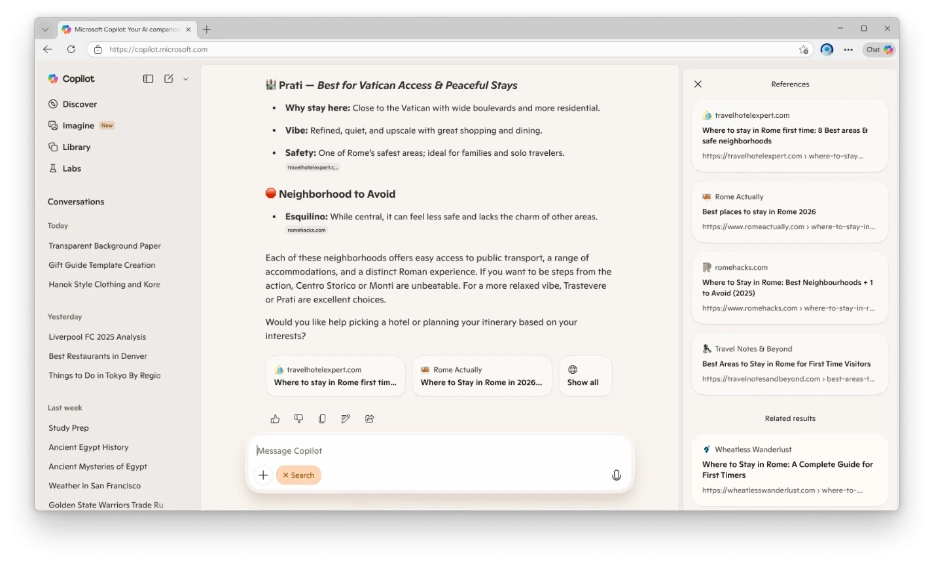
Now, each Copilot response includes citations that link directly to the original publishers. These appear prominently within the AI’s answer, and you can click “Show all” to view a full list of references in a right-hand panel.
Imagine searching for “best neighborhoods to stay in Rome.” Instead of reading a vague AI summary, you now see a curated answer with clickable links to actual travel publishers, review sites, and tourism pages, all in one glance.
That small addition changes everything. It lets you move from summary to source seamlessly, which means no guessing, no misinformation, no hidden AI logic.
“Knowing where information comes from matters,” Microsoft explained. “Citations let you move beyond summaries, just click to view the source directly, whenever you choose.”
How Does the New Dedicated Search in Copilot Work?
For those who still crave the control of a traditional search, Microsoft has introduced a dedicated “Search” experience inside Copilot.
To access it, you simply click the dropdown in Copilot and select Search.
From there, Copilot dynamically tailors responses:
- For simple questions, it gives you a concise answer with clear references.
- For complex or analytical queries, it provides in-depth summaries with full citations and related results.
Think of it as the sweet spot between Google Search and ChatGPT, fast when you need quick facts, deep when you want context.
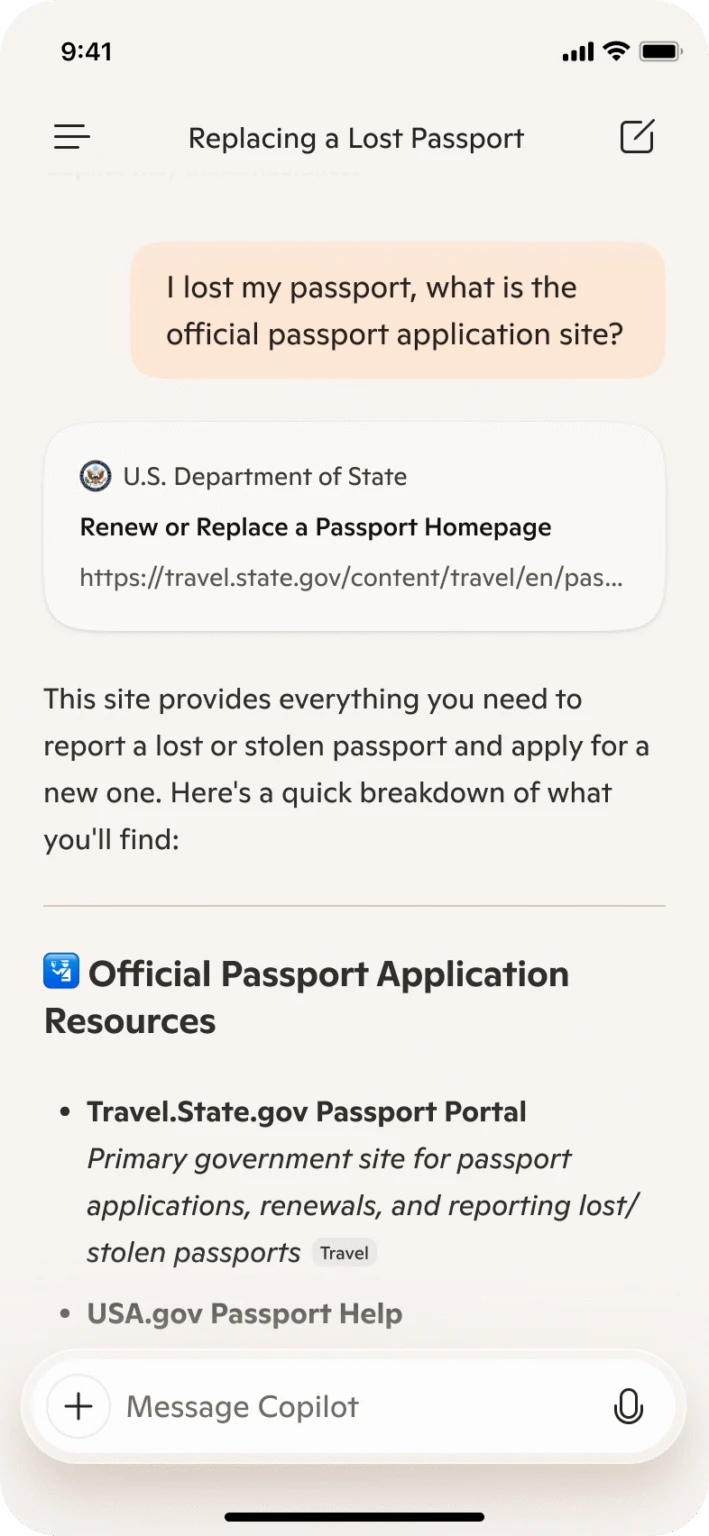
And to make the experience even smoother, Microsoft added navigational links at the top of answers. So if you ask “TripAdvisor NYC,” you can instantly click into the official site.
Why Microsoft Is Calling This a “Human-Centered AI Experience”
Microsoft’s Copilot Sessions event reaffirmed its mission: “making technology work in service of people, not the other way around.”
At the core of that mission is trust, and this update is designed to strengthen it.
“Searching has always reflected a deeply human instinct, the drive to satisfy curiosity and the need to trust in what we find,” Microsoft said.
In other words, Microsoft isn’t just adding citations because it looks good, it is embedding human trust mechanisms back into how AI interacts with the web.
This approach represents a growing contrast between Microsoft’s Copilot and other AI chat systems that rely on opaque sources or uncredited training data.
Here, every piece of information leads back to a verified publisher.
And that’s not a small thing, especially for the creators and journalists whose work often fuels AI’s intelligence without visibility or compensation.
What Does This Mean for Publishers and the Web Ecosystem?
Microsoft made it clear: this update is not just about users, it is also about supporting a healthy web ecosystem.
In an official statement, Microsoft emphasized:
“We’ve designed these changes with publishers and content owners in mind. Cited sources are easily accessible in-line, highlighted prominently, and all references are available in the right pane. This allows you to be just a click away from the publisher and content owner sources that were used.”
This is a notable shift from how most AI platforms treat content, often summarizing or rephrasing web material without attribution.
By restoring visibility to original creators, Microsoft hopes to bridge the growing gap between AI systems and online publishers, ensuring both benefit from the evolving search experience.
It’s a strategic move too, one that could position Bing and Copilot as the ethical AI search alternative to competitors like Google’s Gemini or OpenAI’s ChatGPT.
How Will This Impact Bing and the Future of AI Search?
Here’s where things get interesting. While Microsoft hasn’t explicitly said how these updates will tie into Bing, it’s clear that Copilot is absorbing Bing’s core search DNA.
Copilot now acts as a meta-layer of Bing, combining its real-time search engine with generative summarization. In practical terms, that means Bing’s infrastructure still powers discovery, but Copilot controls how users experience that information.
This blended experience is what Microsoft calls “the best of both worlds — speed and depth.”
“Search is designed to keep you in control, fast when you need it, deep when you need detail, and always grounded in the best of the web,” the company wrote.
If anything, this could signal a gradual rebranding of Bing into Copilot’s broader AI ecosystem.
After all, Copilot now appears across Windows, Edge, Microsoft 365, and Azure. Integrating AI search natively makes it more accessible and more powerful than ever.
A New Standard for AI Transparency
As regulators, educators, and creators continue to question how AI models use online content, Microsoft’s approach offers a tangible answer: show your sources.
By turning citations into a design feature rather than a technical afterthought, Copilot’s new AI Search reinforces accountability in an era where misinformation spreads faster than facts.
And for users, that means something simple but profound, when a Copilot says something, you can check it yourself.
That single step could redefine what “trust” means in AI interactions.
Why This Update Matters for You
So, what does all this mean for everyday users, marketers, and SEOs?
- You’ll get smarter, source-backed answers instead of unverified summaries.
- Publishers and creators will retain visibility and traffic through integrated citations.
- Businesses relying on organic visibility may see new opportunities for brand mentions and AI-driven referral traffic.
- And the line between “searching” and “chatting” will continue to blur, only this time, with more integrity built in.

Dipti Arora
AuthorDipti Arora is a Senior Content Writer with over seven years of experience creating impactful content across Digital Marketing, SEO, technology, and business domains. She has a strong background in managing news verticals and delivering editorial excellence. Dipti has contributed to leading publications such as The Times of India and CEO News, where her research-driven storytelling and ability to simplify complex subjects have consistently stood out. She is passionate about crafting content that informs, engages, and drives meaningful results.
