
AI’s share of Black Friday buying decisions will keep climbing in 2026, but slowly. We forecast that about 18% of US online sales will be influenced by AI and shopping agents, up from about 17% in 2025, on a record day of about $12.9 billion in US online spending.
- About 1 in 3 Black Friday shoppers will ask an AI assistant for help at some point before they buy.
- About 18% of online sales dollars, roughly $2.3 billion, will be influenced by AI and shopping agents.
- Between 0.5% and 1.3% of sales dollars, about $65 million to $170 million, will arrive from a shopper clicking a link inside an AI tool. Our central estimate is about 1%.
Why slowly? AI use is broad, but shoppers still finish most purchases on their own. Only 16% would let AI complete a purchase for them, and 64% of shoppers who use AI for ideas leave the tool to buy elsewhere.
That also makes AI’s role easy to miss: brands that only count AI referral traffic will undercount it by more than 15 times.
Where 2025 Landed
US shoppers spent a record $11.8 billion online on Black Friday 2025 (November 28), up 9.1% from $10.8 billion in 2024, according to Adobe. Adobe’s own pre-season forecast had been $11.7 billion, so the day came in slightly ahead of expectations.
Three details from 2025 set up the 2026 forecast:
- Higher prices, fewer items. Salesforce found order volumes fell 1% while average selling prices rose 7%, so part of the dollar growth was inflation rather than more buying (Reuters).
- AI already had a measurable share. Salesforce reported that AI and agents influenced $14.2 billion of global Black Friday online sales, including $3 billion of $18 billion in the US, or about 1 in 6 US dollars (Reuters).
- AI traffic was surging and converting. Across the 2025 holiday season, traffic from generative AI tools to US retail sites rose 693%, and those visits converted 31% better than other traffic, 38% better on Black Friday itself (Adobe).
Over the full 2025 season, Salesforce credited AI and agents with $262 billion of $1.29 trillion in global online sales, about 20% (Salesforce).
How Much Black Friday 2026 Will Bring In
Our base case is $12.9 billion, matching Adobe’s September 28 forecast of 9.2% growth. Black Friday is set to grow faster than any other big day this season because retailers are putting their deepest discounts on TVs, apparel, appliances, toys and furniture on that day rather than on Cyber Monday.
| Scenario | Black Friday 2026 (US online) | Growth vs 2025 | What has to happen |
|---|---|---|---|
| Conservative | $12.6 billion | +6.7% | Black Friday only keeps pace with the full season |
| Base | $12.9 billion | +9.2% | Adobe’s day forecast holds |
| Upside | $13.0 billion | +10.1% | Adobe’s forecast is beaten by the same margin as in 2025 |
The wider picture supports the base case:
- Adobe expects $275.1 billion online for November and December, up 6.7%, with Cyber Monday ($15.1 billion, up 6.2%) still the single biggest day.
- Deloitte forecasts holiday e-commerce of $316.1 billion to $318.9 billion, up 7.5% to 8.4%, which leaves room for a faster Black Friday.
- AI traffic to retail sites is still compounding. In September 2026 it was up 71% year over year and converted 90% better than other traffic, the widest gap Adobe has recorded (Adobe). Adobe expects AI traffic on Black Friday itself to rise 95%.
The main downside risk is price fatigue. If shoppers keep buying fewer items as in 2025, dollar growth leans on inflation and can stall quickly.
How Many Buyer Decisions AI Will Touch
There is no single answer to “what share of decisions will AI impact”, because AI shows up at four different depths. We forecast each one separately.
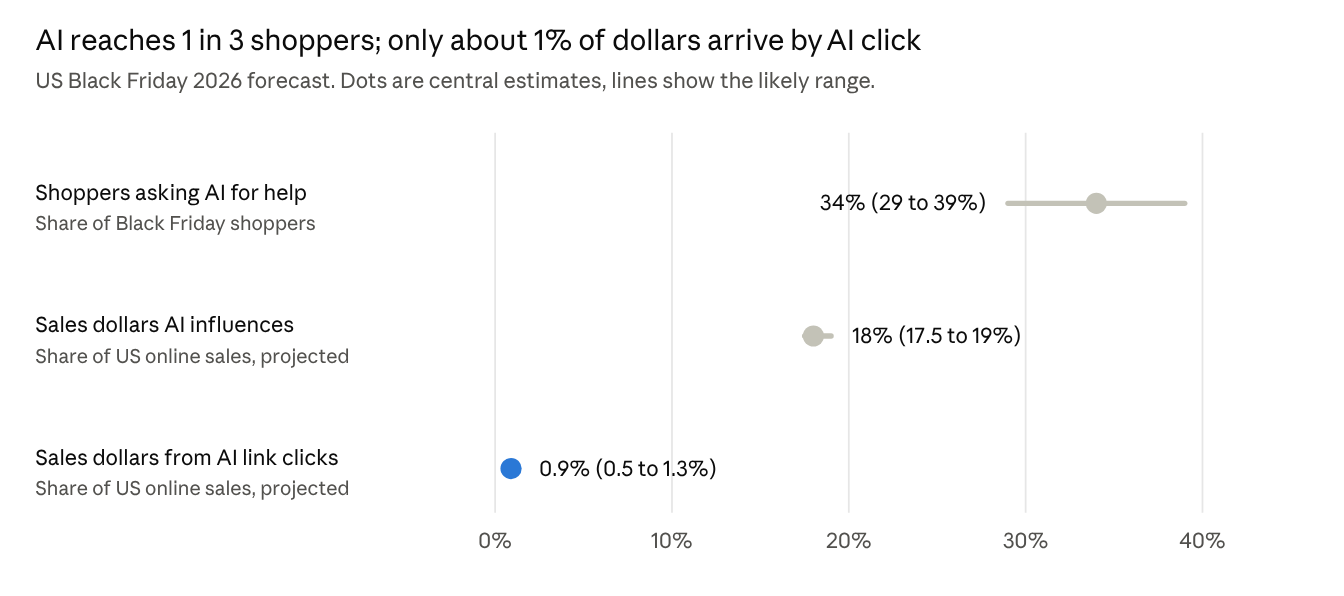
Stan Ventures projection from PwC, YouGov and Deloitte 2026 surveys, Salesforce 2025 Black Friday data, and Adobe and Semrush traffic data
- Shoppers who ask AI for help. 2026 surveys cluster around one in three: PwC found 29% of consumers plan to use AI for holiday shopping (up from 22%), YouGov found 34% of likely Black Friday and Cyber Monday shoppers (up from 16% in 2025), and Deloitte found 39% call generative AI their main tool for at least one holiday task.
- Sales dollars AI influences. This counts purchases where AI recommendations, AI search, shopping agents or AI customer service played a part, using Salesforce’s definition. It was about 17% of US Black Friday sales in 2025 and has been rising roughly one point a year.
- Sales dollars from an AI link click. This is what analytics tools see: a shopper clicks a link inside ChatGPT, Gemini or Perplexity and buys. We estimate 0.5% to 1.3% of sales dollars, about 1% at the center. The traffic is small, but it converts far better than average.
- Purchases an AI agent completes. Only 16% of US shoppers say they would let AI finish a purchase for them (Deloitte), and no tracker publishes a figure yet. Expect this layer to stay well below 1% of dollars in 2026.
For Gen Z and millennials the first layer is already close to half: 49% and 50% of them name generative AI as their main tool for at least one holiday task.
Why AI’s Influence Stays Hidden
Most AI-shaped purchases will never show up as AI traffic. PwC found 64% of shoppers who use AI for ideas open a separate tab and go to a retailer’s site to buy, instead of clicking the link the AI tool offers. That visit is logged as direct, branded search or marketplace traffic.
The raw traffic numbers confirm how small the visible slice is. Across 19 major US retailers in the 2025 holiday season, AI referrals made up about 0.15% of all visits, against roughly 18% from organic search (Semrush). Yet the same season, Salesforce credited AI with influencing about a fifth of online sales.
What this means for brands heading into Black Friday:
- Being named in the AI answer is the new shelf position. If a shopper asks for “the best air fryer under $100” and your product is not in the reply, you are out before the comparison starts.
- Judge AI by its knock-on effects, not just its clicks. Watch branded search, direct visits and marketplace sales for lifts that line up with AI visibility.
- Make product data easy for AI tools to read. Clear prices, stock status, specs and reviews on product pages are what assistants quote back to shoppers.
- Earn mentions on the sources AI tools cite. Assistants lean on reviews, roundups and trusted publishers, so coverage there carries into AI answers.
What Stan Ventures Says
“Black Friday will set another record, but the bigger shift is where the buying decision gets made. One in three shoppers will ask an AI assistant before they buy, and most will never click the link it gives them. Brands that judge AI only by referral traffic are seeing about 1% of the picture and missing the rest.” Prady Kumaar, CEO and Co-Founder, Stan Ventures
“AI assistants build their answers from sources they already trust: reviews, roundups and respected publishers. If your product is not mentioned there, it rarely makes the shortlist. There is still time before Black Friday to fix product pages so AI tools read prices, stock and specs correctly, and that alone can decide whether you are recommended.” Dileep Thekkethil, Director of Marketing, Stan Ventures
Three Hypotheses We Will Test After Black Friday
Hypothesis 1 is the core claim of this piece. Hypotheses 2 and 3 test the spending and traffic numbers around it. All three can be checked against data Adobe and Salesforce publish within a week of the day, which sets up the scorecard follow-up.
| Hypothesis | Our prediction | How we check it | Proved wrong if |
|---|---|---|---|
| 1. Core: AI’s share of buying decisions keeps climbing, but slowly. Adoption is broad, yet shoppers still finish most purchases on their own | About 18% of US Black Friday online sales influenced by AI, up from 17% | Salesforce’s US Black Friday figures: AI-influenced sales divided by total US online sales | The share is flat at 17% or below, or jumps past 20% |
| 2. Black Friday outgrows Cyber Monday. Earlier, deeper discounts pull spending forward to Friday | Black Friday grows about 9%, Cyber Monday about 6% | Adobe’s actuals for November 27 and November 30 | Cyber Monday’s growth matches or beats Black Friday’s |
| 3. AI clicks nearly double, yet stay a sliver of traffic. Most AI-assisted shoppers open a new tab instead of clicking through | AI-referred visits up about 95%, still under 1% of retail visits, converting better than other traffic | Adobe’s Black Friday AI traffic growth and conversion gap, plus Semrush or Similarweb visit share | AI visits pass 1% of retail traffic, or convert no better than other visitors |
How We Built the Forecast
| Figure | How it was worked out | Main caveat |
|---|---|---|
| $12.9 billion Black Friday | Adobe’s day forecast. Conservative case = 2025’s $11.8 billion grown at the full-season rate of 6.7%. Upside = Adobe’s forecast raised by its 2025 beat ($11.8 billion actual vs $11.7 billion forecast) | Adobe measures US online retail only |
| 1 in 3 shoppers use AI | Range of PwC (29%), YouGov (34%) and Deloitte (39%) 2026 surveys | Surveys measure intent, and each defines “using AI” differently |
| 18% of dollars AI-influenced | Salesforce’s 2025 US Black Friday share ($3 billion of $18 billion, 16.7%) plus about one point a year, the pace of its Cyber Week share (19.1% in 2024, 19.9% in 2025). Applied to Adobe’s $12.9 billion = about $2.3 billion | Mixes a Salesforce share with an Adobe total. Salesforce’s own 22% Cyber Week projection for 2025 overshot the 19.9% actual, so we stayed below its trend |
| About 1% of dollars via AI click | AI share of retail visits (0.15% Semrush, 0.4% Similarweb) grown by Adobe’s 95% Black Friday AI traffic forecast, then weighted by the 83% revenue-per-visit premium. Gives 0.5% to 1.3%, about $65 million to $171 million | Visit share varies widely by retailer and category |
How to Optimize Your Black Friday Offer for AI Search
- Put the deal in plain text on the page. Your sale price, original price, end date and stock status should be written on the page itself and not only inside a banner image, because AI tools can only quote what they can read.
- Update your product schema. Your Product and Offer markup should show the sale price, the availability and a priceValidUntil date. Otherwise, the assistants may end up quoting last week’s price.
- Claim and verify your business in ChatGPT Business Hub. It launched in beta on November 10, 2026, and it lets verified businesses update their details and add product feeds with current pricing and availability. OpenAI says ChatGPT may use this information in its answers, which makes it the most direct way to get your Black Friday price into ChatGPT. However, don’t leave it for the last minute. Verification uses a business phone, business email, DNS record or Shopify login, followed by an identity check, so keep a few days in hand.
- Refresh your other shopping feeds. Google Merchant Center and any other AI shopping feeds you are enrolled in should carry the Black Friday price before the day and not on it.
- Use one deal URL every year. A stable page like /black-friday keeps building links and citations over time, whereas a new URL each year starts from zero.
- Get into the roundups AI cites. The assistants lean on reviews, roundups and trusted publishers when they build their answers. Most deal roundups close their lists in the week before Black Friday, so the time to pitch is now.
- Answer the comparison question on the page. Shoppers ask things like “best air fryer under $100.” So say who the product is for, list the key specs and explain how it compares, all in plain language.
- Don’t block AI crawlers. Check that your robots.txt and CDN bot protection are not blocking crawlers like OAI-SearchBot or PerplexityBot. In fact, some sites tighten their bot rules during traffic spikes and drop out of AI answers without even knowing it.
- Run the five-prompt price test. Before Black Friday, ask ChatGPT, Gemini and Perplexity five questions a shopper would ask about your category, such as “best [product] deal this Black Friday.” Note whether you appear and whether the price shown matches your sale price, then repeat on the day. A wrong or missing price is the fastest fix you can make, and the clearest sign of whether the steps above have worked.
How to Measure This Black Friday Differently
- Track the clicks you can see. In GA4, set up a custom channel for AI referrers such as chatgpt.com, perplexity.ai, gemini.google.com, copilot.microsoft.com and claude.ai, and compare its conversion rate with your site average. In September 2026, AI traffic to US retail sites converted 90% better than other traffic, the widest gap Adobe has recorded.
- Track the halo. Watch your branded search impressions in Search Console, your direct traffic and your marketplace sales against a pre-November baseline. The lifts that line up with your AI visibility are the AI influence that your analytics credits to other channels.
- Track visibility and not just traffic. Measure your share of voice across 20 to 50 Black Friday prompts, and check it daily from now through Cyber Monday.
- Use ChatGPT Business Hub. Once you are verified, it shows a 28-day count of ChatGPT mentions, website clicks and discovery topics, which are the common themes in the answers that cite you and the closest signal you will get to intent. However, there are a few things to keep in mind.
- It doesn’t show individual prompts or conversations, and it covers ChatGPT only. Insights also only appear when activity meets OpenAI’s reporting thresholds, so smaller brands may see little or no data.
- The clicks are recorded clicks and not confirmed visits or sales, so report them next to your GA4 AI channel and not in place of it.
- The window rolls every 28 days. So export or screenshot it before Black Friday and again after Cyber Monday, or your baseline will roll off.
- The gap between mentions and clicks is the hidden influence made visible. Every mention that doesn’t become a click is a shopper who may still buy through another route.
- Ask the customer. Add “ChatGPT or another AI assistant” as an option in your post-purchase “how did you hear about us” survey. It is the cheapest way to catch the shoppers who never click.
Google Keeps the Click, AI Takes the First Question
Is AI about to take the Black Friday shoppers away from Google? We at Stan Ventures don’t think so, at least not this year. Here is our prediction, along with the numbers behind it.
- In 2025, across 19 major US retailers, organic search drove about 18% of holiday visits, while AI referrals drove about 0.15%. That is roughly 120 to 1 in Google’s favor.
- For 2026, Adobe expects AI traffic on Black Friday to rise 95%. If organic search holds roughly flat, AI will reach about 0.3% of retail visits, and the ratio will narrow to about 60 to 1.
- So what does that mean? AI halves Google’s lead in a single year, and yet Google still sends about 60 times more shoppers to retail sites.
However, the bigger shift is happening upstream. One in three shoppers will ask AI before they buy (PwC 29%, YouGov 34%, Deloitte 39%), and for Gen Z and millennials it is close to half. But most of them still finish their purchase on Google or on the retailer’s own site.

Dileep Thekkethil
AuthorDileep Thekkethil is the Director of Marketing at Stan Ventures and an SEMRush certified SEO expert. With over a decade of experience in digital marketing, Dileep has played a pivotal role in helping global brands and agencies enhance their online visibility. His work has been featured in leading industry platforms such as MarketingProfs, Search Engine Roundtable, and CMSWire, and his expert insights have been cited in Google Videos. Known for turning complex SEO strategies into actionable solutions, Dileep continues to be a trusted authority in the SEO community, sharing knowledge that drives meaningful results.