
Publishing more AI content no longer brings more traffic. Two years ago, many brands treated content as a volume game: publish more pages, cover more keywords, collect more clicks. That approach is breaking down from three directions at once. Readers now have a name for machine-made filler. Search engines have written policies and built systems to filter it out. And brands are putting money back into people who can report, verify and write.
This research paper looks at that shift through four sets of evidence: search demand for the term “AI slop” from three independent keyword tools, search demand across 15 countries, public policy and research from Google and Ahrefs, and workforce data on journalists moving into brand roles.
It closes with Stan Ventures’ own data from 1,544 guest post placements, which shows what search engines reward once volume stops working.Our conclusion is simple. Content that adds nothing new is getting filtered out, and credibility is now the scarce resource. The brands hiring journalists have worked that out.
Key Findings
- Average monthly US searches for “AI slop” rose 31 to 38 times in two years, depending on the tool. Google Keyword Planner now puts the term at 60,500 US searches a month.
- All three tools we checked (Ahrefs, Semrush and Google Keyword Planner) show the same direction and a similar size of rise, even though each counts searches differently.
- The backlash isn’t only American. The 14 countries that search the English term most after the US, from the UK and Germany to India, Brazil and Japan, search it about 52,000 times a month combined, more than the US total of 43,000.
- US searches for “AI slop” grew quickly through 2025, then held at roughly 42,000 to 45,000 a month per quarter in 2026. The term has moved from a niche joke to everyday vocabulary.
- More than 2,800 journalists moved into brand journalism, content or communications roles between January 2015 and May 2026, and brand editorial roles at companies such as Stripe now pay up to $287,400.
- In Stan Ventures’ study of 1,544 guest post placements, a publisher’s real audience was linked to whether Google indexed the article. Its Domain Rating was not. Articles on the weakest quarter of publishers by organic traffic value went unindexed 9.0% of the time, against 0.3% to 3.7% for the rest.
What “AI Slop” Means
“Slop” is no longer internet slang. Merriam-Webster chose “slop” as its 2025 Word of the Year, defining it as “digital content of low quality that is produced usually in quantity by means of artificial intelligence.”
Two parts of that definition matter for brands. The first is quality: the content is weak. The second is quantity: it’s made in bulk. Plenty of businesses use AI to help write good content, and that isn’t what the word describes. “Slop” describes the strategy of publishing at volume and hoping some of it ranks.
Once people have a word for something, they start to notice it, talk about it and search for it. The search data below shows how quickly that happened.
How Fast the Term Spread
Keyword tools estimate search demand in different ways, so a single tool’s number can be challenged. To avoid relying on one source, we pulled US search volume for “ai slop” from Ahrefs Keywords Explorer, Semrush and Google Keyword Planner. The table compares the average monthly searches each tool reports for the same three 12-month periods.
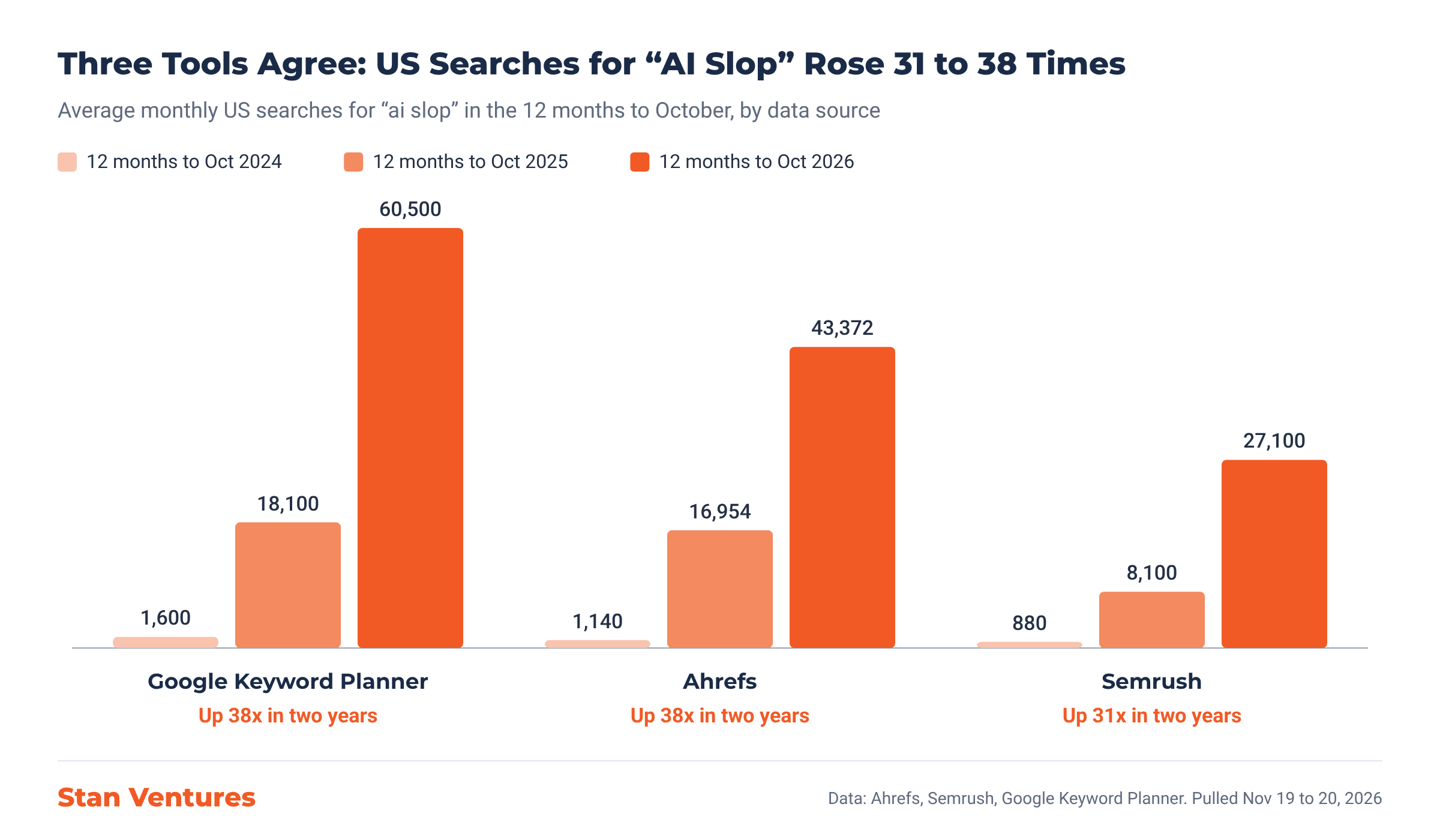
| Data source | 12 months to Oct 2024 | 12 months to Oct 2025 | 12 months to Oct 2026 | Rise over two years |
|---|---|---|---|---|
| Google Keyword Planner | 1,600 | 18,100 | 60,500 | 38x |
| Ahrefs | 1,140 | 16,954 | 43,372 | 38x |
| Semrush | 880 | 8,100 | 27,100 | 31x |
The tools disagree on the size of the audience. Google Keyword Planner reports more than twice what Semrush does. They agree on the direction and on the scale of the change: every tool shows demand rising more than 30 times in two years. That agreement is what makes the finding hold up.
Month by Month
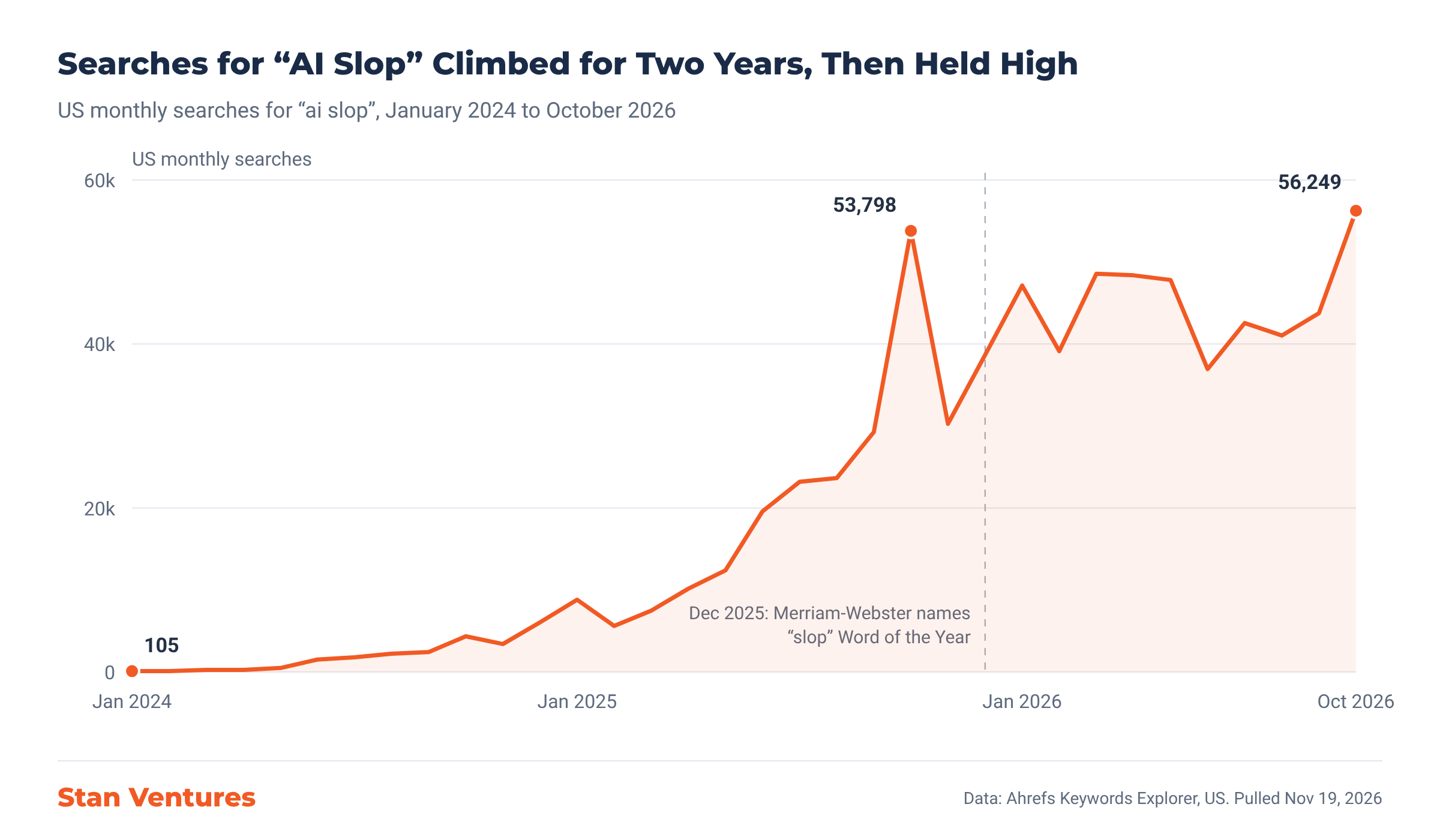
Ahrefs gives the most detailed monthly history, so we used it to see how the rise unfolded. The table shows the average monthly US searches in each quarter.
| Quarter | Average monthly searches |
|---|---|
| Q1 2024 | 158 |
| Q2 2024 | 755 |
| Q3 2024 | 2,155 |
| Q4 2024 | 4,604 |
| Q1 2025 | 7,306 |
| Q2 2025 | 14,053 |
| Q3 2025 | 25,371 |
| Q4 2025 | 40,910 |
| Q1 2026 | 44,938 |
| Q2 2026 | 44,377 |
| Q3 2026 | 42,448 |
Three patterns stand out.
First, the term roughly doubled every quarter or two through 2024 and 2025. In January 2024, Ahrefs recorded 105 US searches. By October 2025, it recorded 53,798 in a single month.
Second, demand stopped climbing in 2026 and held at a high level. Quarterly averages stayed between about 42,000 and 45,000 a month. A term that stops growing but doesn’t fall has usually become part of everyday language. People no longer search it because it’s new. They search it because they use it.
Third, October 2026 set a new monthly high of 56,249 searches. Google Keyword Planner shows the same late rise, with searches up 49% over the three months to October. The conversation isn’t fading.
In total, Ahrefs counts about 451,500 US searches for “ai slop” between January and October 2026, compared with about 194,000 in the same months of 2025 and about 13,600 in 2024.
The Backlash Is Global
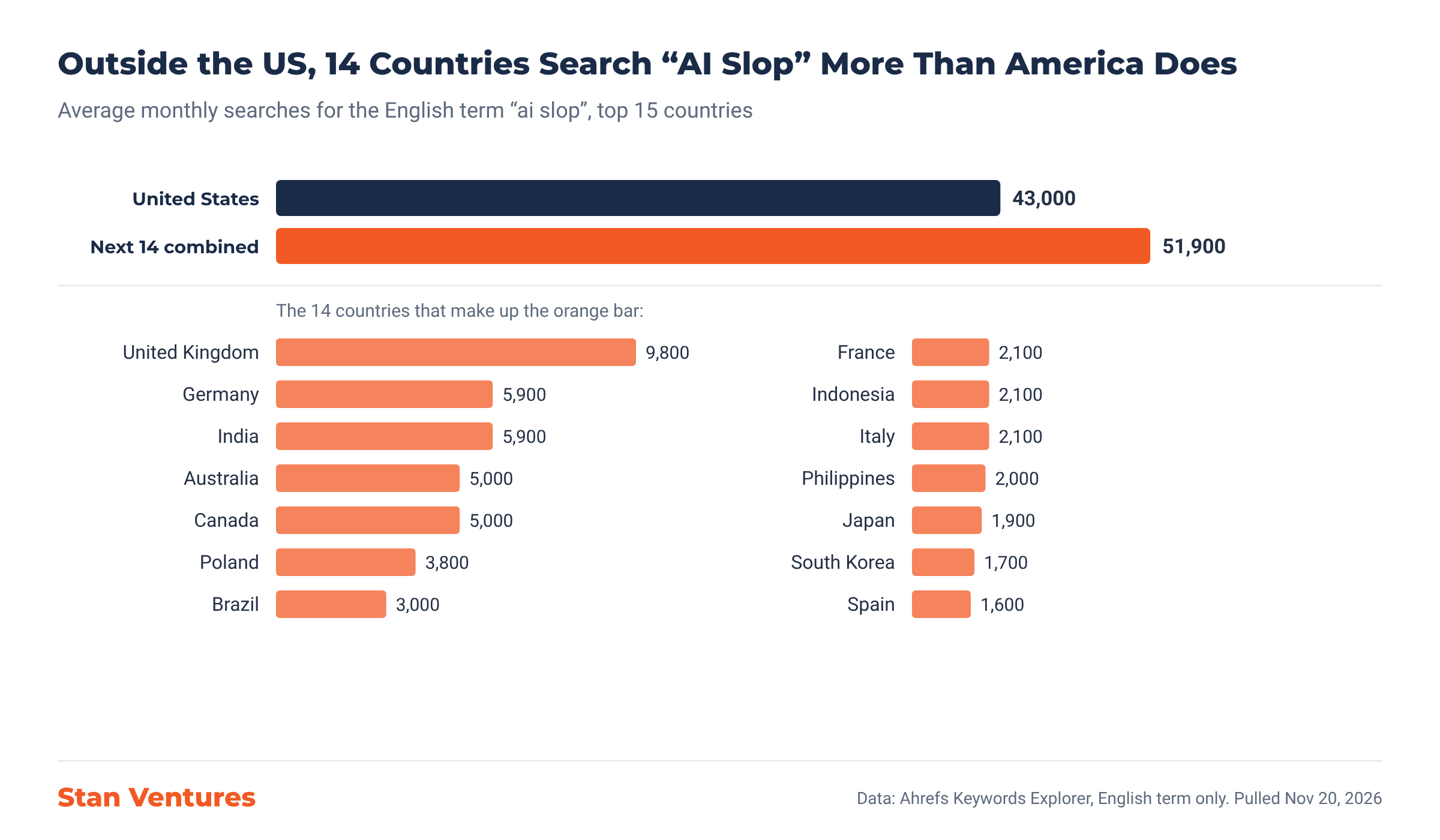
The US is the largest single market for the term, but it accounts for less than half of the searches across the 15 countries where it’s searched most. The table lists average monthly searches for the English term “ai slop” in each country, according to Ahrefs.
| Country | Average monthly searches |
|---|---|
| United States | 43,000 |
| United Kingdom | 9,800 |
| Germany | 5,900 |
| India | 5,900 |
| Australia | 5,000 |
| Canada | 5,000 |
| Poland | 3,800 |
| Brazil | 3,000 |
| France | 2,100 |
| Indonesia | 2,100 |
| Italy | 2,100 |
| Philippines | 2,000 |
| Japan | 1,900 |
| South Korea | 1,700 |
| Spain | 1,600 |
Outside the US, these 14 countries add about 51,900 searches a month. That’s more than the US on its own.
These figures understate the real interest. They only count the English term. Searchers in Germany, Brazil, Japan or Korea who use a phrase in their own language aren’t included. Even so, people in non-English-speaking markets such as Germany, Poland and Brazil are searching the English phrase thousands of times a month. The idea, and the frustration behind it, has crossed borders.
What People Search for Alongside “AI Slop”
Related searches show how people are reacting to AI content, not just naming it. The table compares US average monthly searches for three related terms in the 12 months to October 2026, from Ahrefs and Google Keyword Planner.
| Search term | Ahrefs | Google Keyword Planner |
|---|---|---|
| humanize ai text | 25,000 | 33,100 |
| ai content detector | 10,000 | 14,800 |
| what is ai slop | 5,800 | 5,400 |
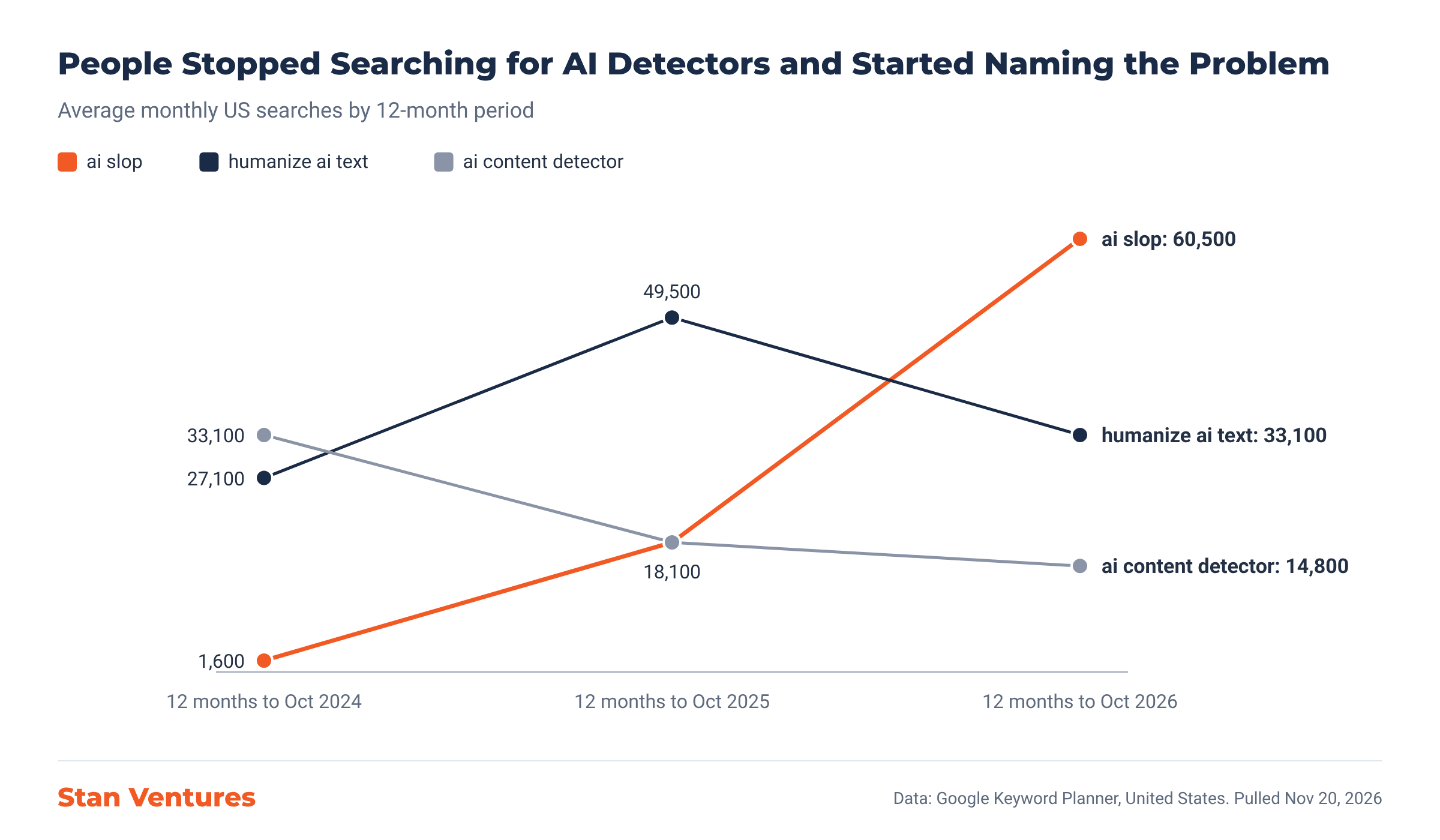
Google Keyword Planner also shows how these terms changed over time, and the trends point in different directions.
| Search term | 12 months to Oct 2024 | 12 months to Oct 2025 | 12 months to Oct 2026 |
|---|---|---|---|
| ai slop | 1,600 | 18,100 | 60,500 |
| what is ai slop | 20 | 1,000 | 5,400 |
| humanize ai text | 27,100 | 49,500 | 33,100 |
| ai content detector | 33,100 | 18,100 | 14,800 |
Searches for “ai content detector” fell by more than half in two years, while searches for “ai slop” rose 38 times. Searches for “humanize ai text” peaked in the year to October 2025 and have since dropped by about a third.
One reading of this is that people no longer need software to spot AI filler. They recognize it, and they have a word for it. Meanwhile, the people trying to disguise machine-written copy are still searching for ways to do it, about 33,100 times a month in the US. That’s a sign of how much of this content is still being produced, and how much of it its own publishers know won’t pass as human.
Why Publishing at Volume Stopped Working
Search Engines Changed the Rules
Google moved against mass-produced content in March 2024. In its March 2024 core update announcement, Google introduced three new spam policies, including one on scaled content abuse. The policy targets pages “generated for the primary purpose of manipulating search rankings and not helping users,” whether a machine, a person or both made them.
That last point matters. The policy doesn’t ban AI. It bans the strategy: producing content at scale to win rankings. When the rollout finished in April 2024, Google reported 45% less low-quality, unoriginal content in its search results, beating the 40% reduction it had expected.
The work hasn’t stopped. In 2026, Google researchers published a paper on automatically investigating coordinated “AI slop” networks. The paper mostly covers networks of AI-generated media on platforms rather than web search rankings. Still, it shows that “AI slop” is now a term Google’s own researchers use, and a problem they’re building tools to find.
AI-Heavy Pages Earn Less Visibility
The effect shows up in the data. An Ahrefs study of 331,000 pages found that pages with low or moderate amounts of AI content earned two to three times the organic impressions of pages that were mostly AI-written.
Ahrefs’ framing is worth keeping. Google doesn’t punish AI content as such. It punishes bad content, and pages written mostly by AI are more likely to be bad.
Why Mass-Produced Content Fails on Its Own Terms
Even without a policy, volume content has a structural problem. A page written by a model trained on the existing web tends to repeat what the existing web already says. It has no new facts, no first-hand experience and no named source a reader can check. Ranking systems are built to find the most useful answer to a question, and a page that adds nothing has nothing to win on.
The same logic now applies to AI assistants. When ChatGPT, Perplexity or Google’s AI Overviews answer a question, they lean on sources that other sources already trust. A brand that publishes a thousand interchangeable pages gives an assistant nothing worth citing. A brand that publishes one piece of original reporting, or gets quoted in a publication its buyers read, does.
Why Brands Are Hiring Journalists
The Numbers Behind the Move
Brands have been hiring journalists for years, and the pace is steady. Workforce data from Live Data Technologies, analyzed and published by Stacker, shows more than 2,800 journalists moved into brand journalism, content or communications roles between January 2015 and May 2026, at a rate of 230 to 340 a year.
The pay shows what companies think these skills are worth. Recent brand journalism listings compiled by Stacker include an editorial director role at Stripe paying up to $287,400 and a brand editorial role at Datadog paying up to $204,000.
What Journalists Bring That Automation Cannot
Reporters are trained to do four things that bulk AI content can’t:
- Find a story: something new, rather than a summary of what’s already published.
- Get a named source on the record, so a reader can see who’s speaking and why they know.
- Check facts before publishing, and correct them when they’re wrong.
- Write for a reader who owes them nothing and will leave after one dull sentence.
Those are the qualities that make content worth citing, whether the one doing the citing is an editor, a search engine or an AI assistant. As the cost of producing generic content falls toward zero, its value falls with it. Original reporting moves the other way.
A Note on Cause
The move from newsrooms to brands began long before generative AI. Newsroom layoffs, better pay and steadier hours have pushed journalists toward brand roles for more than a decade, and the Live Data Technologies analysis doesn’t link the trend to AI. We aren’t claiming the slop backlash caused the hiring. The two trends run alongside each other, and they point to the same conclusion: credibility is getting more valuable, and the people trained to build it are in demand.
What Stan Ventures Sees in Its Own Data
Stan Ventures places content on third-party publisher sites for 150+ agency partners and 5,000+ brands, through a vetted network of 50,000+ publisher sites. That gives us a direct view of a question at the center of this paper: once content is published, what decides whether search engines treat it as worth showing?
In August and September 2026, we analyzed 1,544 guest post placements across 412 publisher domains and checked whether Google had indexed each article. We then compared indexation against eight publisher metrics from Ahrefs, including Domain Rating, organic traffic, organic traffic value, referring domains and outbound links.
The most common shortcut for judging a publisher, Domain Rating, showed no clear pattern. The publisher’s real audience did.
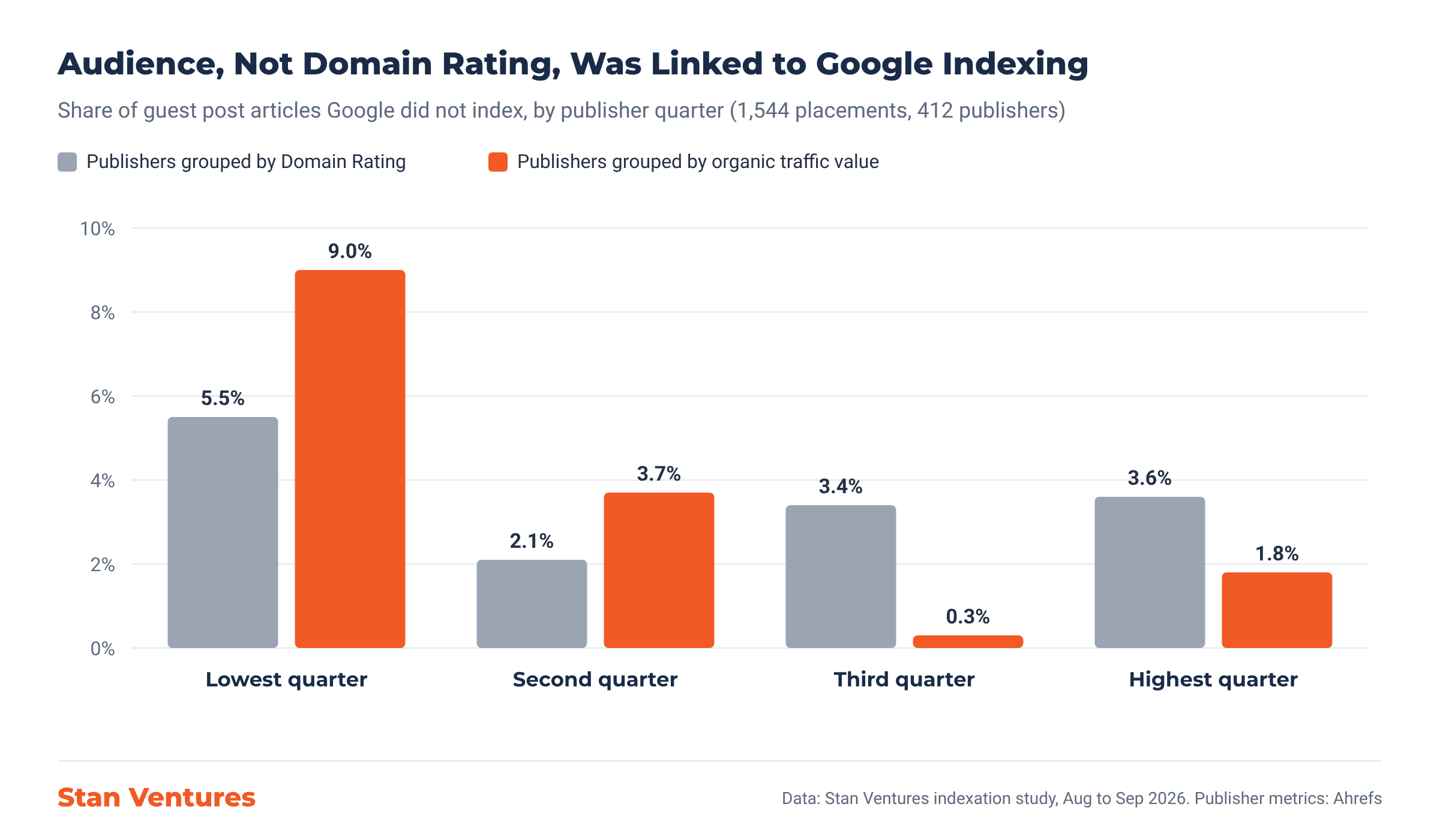
| Publisher quarter | Grouped by Domain Rating | Grouped by organic traffic value |
|---|---|---|
| Lowest quarter | 5.5% | 9.0% |
| Second quarter | 2.1% | 3.7% |
| Third quarter | 3.4% | 0.3% |
| Highest quarter | 3.6% | 1.8% |
Grouped by Domain Rating, failure rates moved up and down with no steady trend, and the differences were small enough to be explained by chance. Grouped by organic traffic value, an estimate of what a site’s search traffic would cost to buy through ads, the weakest quarter of publishers failed far more often than the rest.
Publishers with zero organic traffic had 89.1% of their articles indexed, against 97.1% for everyone else. And publishers with a Domain Rating of 50 or higher but fewer than 1,000 monthly visits did worse than average, with 89.6% indexed against 97.0%. On low-traffic sites, a high Domain Rating was a warning sign, not a reassurance.
This is the same pattern the “AI slop” data shows, seen from the publisher’s side. A site can look strong on a metric and still have no readers. Search engines appear to notice the difference. Authority comes from real audiences, and it can’t be produced at volume.
What This Means for Brands and Agencies
The evidence points to a clear set of changes for anyone who publishes content to win search or AI visibility.
- Stop measuring content by volume. A content plan built on page count is a plan built on the approach Google’s scaled content abuse policy targets. Measure what each page adds that isn’t already online.
- Put original information in every piece. A first-party number, a named expert, a dated event or a real customer result gives a page a reason to exist and a reason to be cited.
- Use AI as a tool, not as the writer. The Ahrefs data shows pages with low or moderate AI content perform well. The problem is pages where AI does all the work.
- Hire or borrow editorial skills. Not every brand needs a former reporter on staff. Every brand needs someone who can find a story, check a fact and get a source on the record.
- Earn mentions in publications people actually read. Coverage in a real publication with a real audience carries weight with readers, search engines and AI assistants. A placement on a site with no audience carries little, whatever its Domain Rating says.
- Judge publishers by their audience, not their score. Before you place content, check whether the site earns real search traffic. In our data, organic traffic value was a far better guide than Domain Rating.
Expert Perspective
“For two years the bet was that more content meant more traffic. That bet has run out. Google is filtering mass-produced pages, people now have a word for content they don’t want, and AI assistants recommend the brands that real publications and real experts vouch for. The companies hiring journalists have worked that out. Authority comes from being worth citing, and there is no way to automate that.”
Pradeep Kumaar, CEO and Co-Founder, Stan Ventures
Methodology
Search Volume
US search volumes for “ai slop” are average monthly searches for the 12 months ending October 2024, October 2025 and October 2026. We retrieved them on November 19 and 20, 2026 from three tools:
- Ahrefs Keywords Explorer, US database. We averaged Ahrefs’ monthly figures from November 2023 to October 2026 into the same three 12-month periods. Quarterly figures are averages of the three months in each quarter.
- Semrush Keyword Overview, US database, using the 12-month average from Semrush’s October 2024, October 2025 and October 2026 data.
- Google Keyword Planner, location set to the United States, all languages, Google Search only. We ran custom date ranges of November 2023 to October 2024, November 2024 to October 2025 and November 2025 to October 2026.
Each tool estimates search demand its own way, and both Semrush and Google Keyword Planner round volumes into ranges. That’s why their counts differ. We report each tool’s figures separately and compare the size of the rise within each tool, rather than mixing figures across tools.
Country Data
Country figures are Ahrefs’ average monthly searches for the English term “ai slop” in each country, pulled on November 20, 2026. They don’t include searches in other languages.
Related Searches
Related search terms were pulled from Ahrefs and Google Keyword Planner on the same dates and settings as the main term.
Indexation Study
The Stan Ventures indexation study covers 1,544 guest post placements on 412 publisher domains, made in August and September 2026. We checked each article once for Google indexation at the time of link verification. Publisher metrics came from Ahrefs and were pulled on October 6, 2026. We grouped publishers into four equal quarters for each metric and compared the share of articles indexed in each group. Our analysis accounted for the fact that many articles sat on the same publisher, so a few large publishers couldn’t skew the result.
Third-Party Data
Workforce figures come from Live Data Technologies as published by Stacker. Salary figures come from job listings compiled by Stacker. Policy wording and results come from Google’s own announcements. All third-party figures are linked to their original sources in the text.
Limitations
- Search volume is an estimate. No keyword tool has access to Google’s full search logs, which is why we used three tools and focused on the direction and size of change rather than any single count.
- Search interest isn’t the same as opinion. Some people searching “ai slop” may be curious, some critical and some making it. The data shows awareness, not sentiment.
- Country data counts only the English term and so understates interest in non-English markets.
- The workforce data shows a long-running trend that started before generative AI. We present it as a parallel trend, not as an effect of the slop backlash.
- The indexation study shows a link between publisher audience and indexation, not proof that one causes the other. Weak sites may both index poorly and earn little traffic for the same underlying reason. Each article was checked once, and publisher metrics were measured after placement.
- The Google research paper on “AI slop” networks mostly concerns AI-generated media on platforms. We cite it as evidence that the problem is recognized, not as a description of how web search ranks pages.
Frequently Asked Questions
What Is AI Slop?
Low-quality content made in bulk with AI. Merriam-Webster defines “slop” as “digital content of low quality that is produced usually in quantity by means of artificial intelligence,” and named it the 2025 Word of the Year.
Does Google Penalize AI-Generated Content?
Not for being AI-generated. Google’s scaled content abuse policy targets content produced at scale to manipulate rankings, however it’s made. In practice, pages written mostly by AI tend to perform worse: Ahrefs found pages with low or moderate AI content earned two to three times the impressions of mostly AI-written pages.
How Much Have Searches for “AI Slop” Grown?
Average monthly US searches rose 31 to 38 times between the 12 months to October 2024 and the 12 months to October 2026, depending on the tool. Google Keyword Planner reports 60,500 US searches a month, Ahrefs 43,372 and Semrush 27,100.
Is the Backlash Against AI Content Only Happening in the US?
No. After the US, the 14 countries that search the English term most, including the UK, Germany, India, Australia, Canada and Brazil, search it about 52,000 times a month combined, more than the US does.
Why Are Brands Hiring Journalists?
Journalists know how to find original stories, get named sources on the record and check facts. Those skills make content worth citing by readers, publications, search engines and AI assistants. More than 2,800 journalists moved into brand, content or communications roles between 2015 and May 2026.
Is Domain Rating a Good Way to Judge a Publisher?
Not on its own. In Stan Ventures’ study of 1,544 placements, Domain Rating showed no clear link to whether Google indexed an article. A publisher’s organic traffic value did. Sites with a high Domain Rating but very little traffic performed worse than average.
If you want your brand cited by the publications, search engines and AI assistants your buyers use, book a consultation call with our team.

Dileep Thekkethil
AuthorDileep Thekkethil is the Director of Marketing at Stan Ventures and an SEMRush certified SEO expert. With over a decade of experience in digital marketing, Dileep has played a pivotal role in helping global brands and agencies enhance their online visibility. His work has been featured in leading industry platforms such as MarketingProfs, Search Engine Roundtable, and CMSWire, and his expert insights have been cited in Google Videos. Known for turning complex SEO strategies into actionable solutions, Dileep continues to be a trusted authority in the SEO community, sharing knowledge that drives meaningful results.