
Google’s sudden overhaul of its Site Reputation Abuse (SRA) policy has sparked widespread concern among publishers and digital marketers.
Introduced in March 2023, the SRA policy provided an eight-month adjustment period to align with the rules. However, recent changes have eliminated safe harbor for affiliate content, leaving the industry grappling with uncertainty.

The March Policy
When Google unveiled the SRA policy in March, it sought to combat a tactic known as “Parasite SEO,” where third-party content exploits a host site’s reputation to manipulate rankings. The March policy offered clear guidelines:
Allowed Practices:
- Content created under close first-party oversight, such as advertorials or native advertising, was considered compliant if it added value for users.
- Examples of permissible content included press releases, editorial pieces, and curated coupons explicitly intended for readers.
This framework gave publishers an opportunity to align their practices with Google’s expectations.
With an eight-month grace period, many felt confident in their ability to comply while maintaining affiliate marketing as a viable revenue source.
A Drastic Shift in Enforcement
Last week, Google updated the site reputation abuse policy, expanding the definition of abuse to include all third-party content, even when created by in-house teams. This update eliminated the prior allowance for affiliate content produced under first-party oversight.
According to Chris Nelson of Google’s Search Quality team, “No amount of first-party involvement alters the fundamental third-party nature of the content or the unfair, exploitative nature of attempting to take advantage of the host’s site ranking signals.”
As SEO expert Lily Ray highlighted in her tweet, even articles written by full-time, in-house staff—such as “best credit cards” or “Black Friday deals”—are now at risk of penalties if they qualify as affiliate or sponsored content.
These Site Reputation Abuse penalties are wild.
Google created and shared the SRA policy in March. For 8 months, sites engaged in Site Reputation Abuse theoretically had time to prepare.
But then last week, Google abruptly changed the guidelines to indicate that no amount of… pic.twitter.com/Zd8N9wXEZM
— Lily Ray 😏 (@lilyraynyc) November 24, 2024
Ray noted that manual action reconsideration requests are being rejected, even when publishers demonstrate their content is original and created without third-party deals.
This rigid enforcement has created confusion, as some sites with similar content remain unaffected—at least for now.
Comparing the Policies: March vs. Updated Version
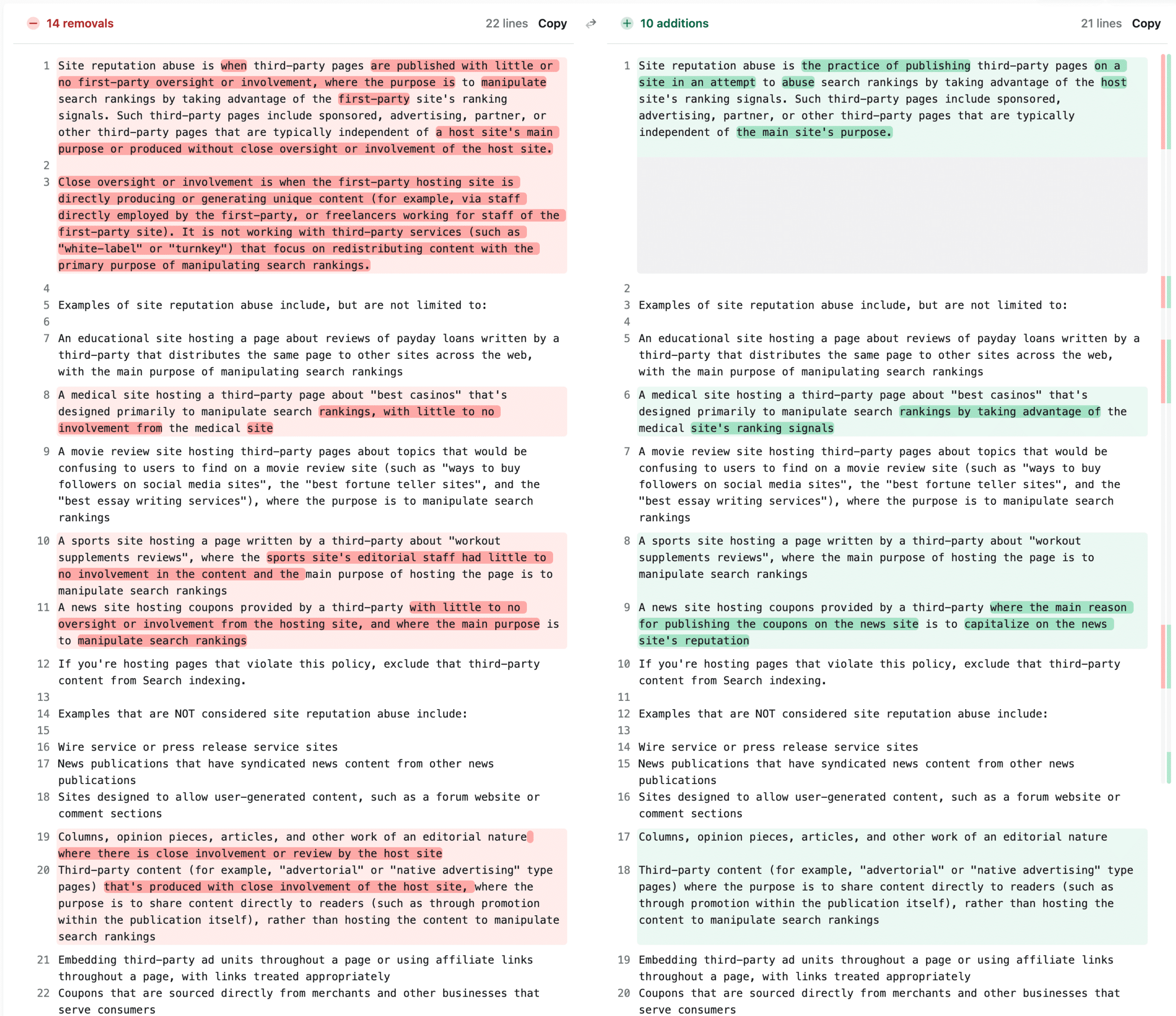
Unclear Criteria and Uneven Implementation
Ray’s observations point to a chaotic implementation of the policy, with unclear criteria for determining what qualifies as “abusive third-party content.”
She questioned why some publishers are penalized while others are not. Ray highlighted the uncertainty, stating, “Not all sites with this type of content have been penalized (yet?), so just because a site hasn’t been hit yet doesn’t mean it won’t eventually be hit.”
This lack of transparency leaves publishers operating under a cloud of unpredictability.
Insights from the Community
Several comments under Lily Ray’s tweet shed light on the widespread confusion and concern among publishers.
Nate Hake shared a sentiment that many small publishers have echoed since the September and March updates: “Why are some publishers ‘allowed’ to have affiliate content when others aren’t?”
He pointed out that small publishers, unlike major players, don’t have the same opportunities to appeal penalties, further exacerbating the uneven application of Google’s policies.
“Why are some publishers ‘allowed’ to have affiliate content when others aren’t?”
This is precisely how a lot of us small sites felt after the Sept ’23 and March updates!
The only difference is that we don’t get the opportunity to appeal
(And, FTR, Lily – you were an…
— Nate Hake (@natejhake) November 24, 2024
Tamir Oron proposed an interesting theory: “Google wants publishers to use Google Ads, so that’s why they are deindexing their content.”
Easy, Google wants publishers to use Google Ads, so that’s why they are deindexing their content
— Tamir oron (@Tamiroron) November 24, 2024
This suggestion aligns with growing concerns that Google’s updates could be pushing publishers away from affiliate content and toward its own ad platform.
Meanwhile, Harpreet, commenting on the treatment of content with first-party involvement, remarked, “Sponsored content with first-party writers is just a loophole.”
I’m ok with this because me SF Gate’s staff had heavy involvement with their content. Their staff didn’t let sponsors get away with certain content. Despite their involvement they were given a penalty a few months ago. Sponsored content with first party writers is just a loophole
— Harpreet (@harpreetchatha_) November 24, 2024
This reflects frustrations from publishers who invest significant editorial resources, only to see their content penalized due to its association with affiliate marketing.
Implications for the Industry
The fallout from these changes is profound. Publishers relying on affiliate marketing face potential revenue disruptions as they scramble to align with shifting rules. Without clear guidelines, they risk investing in strategies that could be penalized in the future.
Practical Steps for Publishers
Given this uncertain environment, publishers should take proactive steps:
Audit Affiliate Content: Review existing articles to ensure they align with Google’s policies and provide genuine user value.
Diversify Revenue Streams: Explore alternative monetization strategies, such as subscriptions or sponsored content that aligns with editorial goals.
Engage with Google: Submit detailed evidence during reconsideration requests and advocate for clearer enforcement criteria.
Stay Informed: Monitor updates to Google’s policies and algorithms to stay ahead of potential changes.
Consult Experts: Work with SEO specialists and compliance advisors to adapt strategies effectively.
The Bigger Picture
This abrupt shift marks a significant departure from Google’s historical approach, which often allowed publishers to make gradual adjustments. The new policy reflects Google’s intent to crack down on perceived content abuse by targeting affiliate content produced even by in-house teams.
However, the lack of clear enforcement standards has left publishers navigating uncharted waters.
As Lily Ray succinctly put it, this policy has created a “crazier cat-and-mouse game” than ever before.
For publishers, the only certainty is the need to remain vigilant and adaptable in this evolving landscape.
Key Takeaways
- Google’s revised SRA guidelines pose new challenges for publishers relying on affiliate content.
- The arbitrary application of penalties raises questions about fairness in Google’s practices.
- Publishers may need to rethink their monetization strategies amid heightened scrutiny.
- The lack of clear definitions regarding “abusive third-party content” complicates compliance efforts.
- The evolving landscape necessitates vigilance and adaptability from digital marketers.

Dileep Thekkethil
AuthorDileep Thekkethil is the Director of Marketing at Stan Ventures, where he applies over 15 years of SEO and digital marketing expertise to drive growth and authority. A former journalist with six years of experience, he combines strategic storytelling with technical know-how to help brands navigate the shift toward AI-driven search and generative engines. Dileep is a strong advocate for Google’s EEAT standards, regularly sharing real-world use cases and scenarios to demystify complex marketing trends. He is an avid gardener of tropical fruits, a motor enthusiast, and a dedicated caretaker of his pair of cockatiels.
