On July 21, 2025, something rare happened in the search engine wars, a top executive from Microsoft publicly compared the company’s Copilot Search experience with Google’s AI Mode, posting a real-time demonstration video on LinkedIn.
It was not just a product update or subtle nudge at the competition.
This was a direct, transparent technical comparison which showcased how two of the most powerful tech giants are approaching the same AI-powered future… in completely different ways.
Let us be honest that in an industry as competitive as search, that kind of head-to-head analysis is nearly unheard of.
So why now? Why this comparison? And what can we really take away from it?
How Microsoft and Google Handle the Same Search Query—Very Differently
The post came from Jordi Ribas, Microsoft’s Corporate Vice President of Search & AI, who has been one of the key figures leading Microsoft’s AI-driven transformation of Bing and Edge.
In his post, he wrote:
“They are both excellent AI search products, but we are taking a different approach for some query segments.”
Simple? Yes.
But that single sentence opened the door to a deeper and more nuanced comparison of how Microsoft and Google are thinking about AI in search.
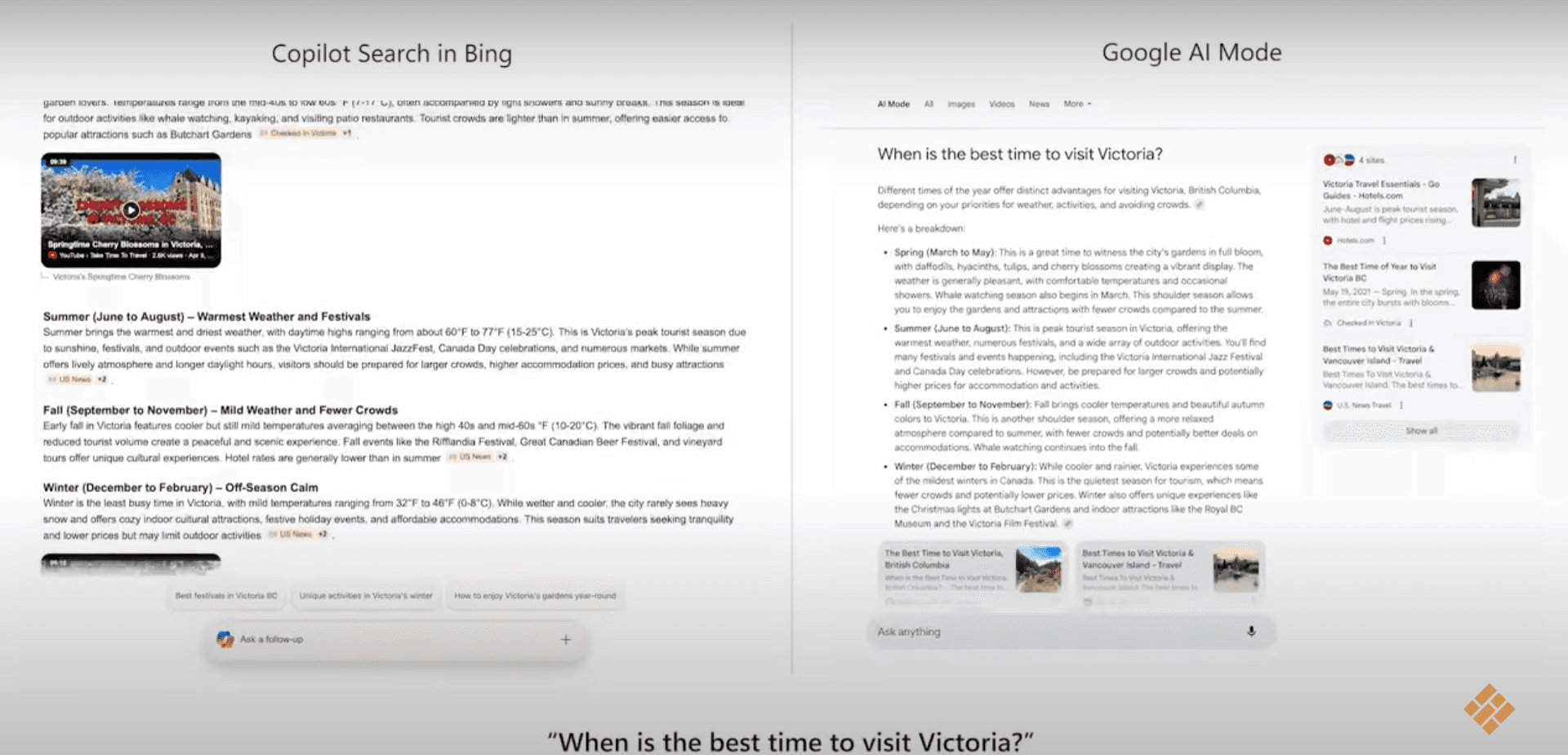
To illustrate his point, Ribas chose a common real-world example of a travel-related search for “best time to visit Victoria”, followed by two natural follow-ups:
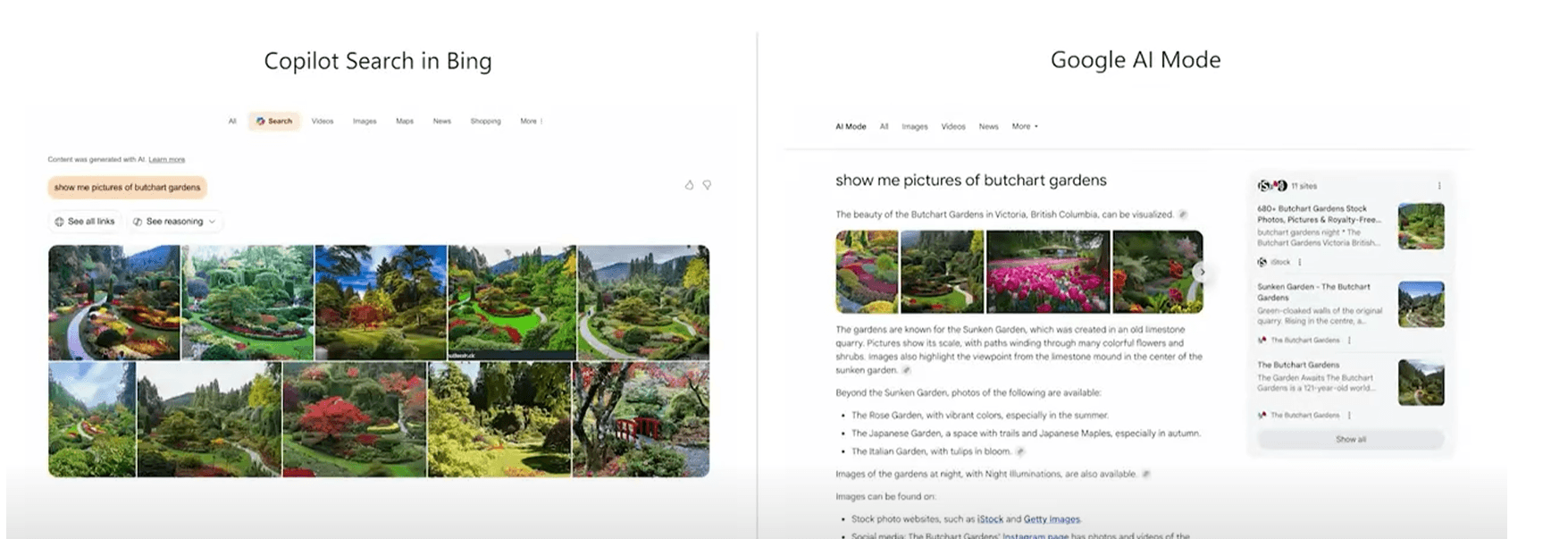
- Pictures of Butchart Gardens”
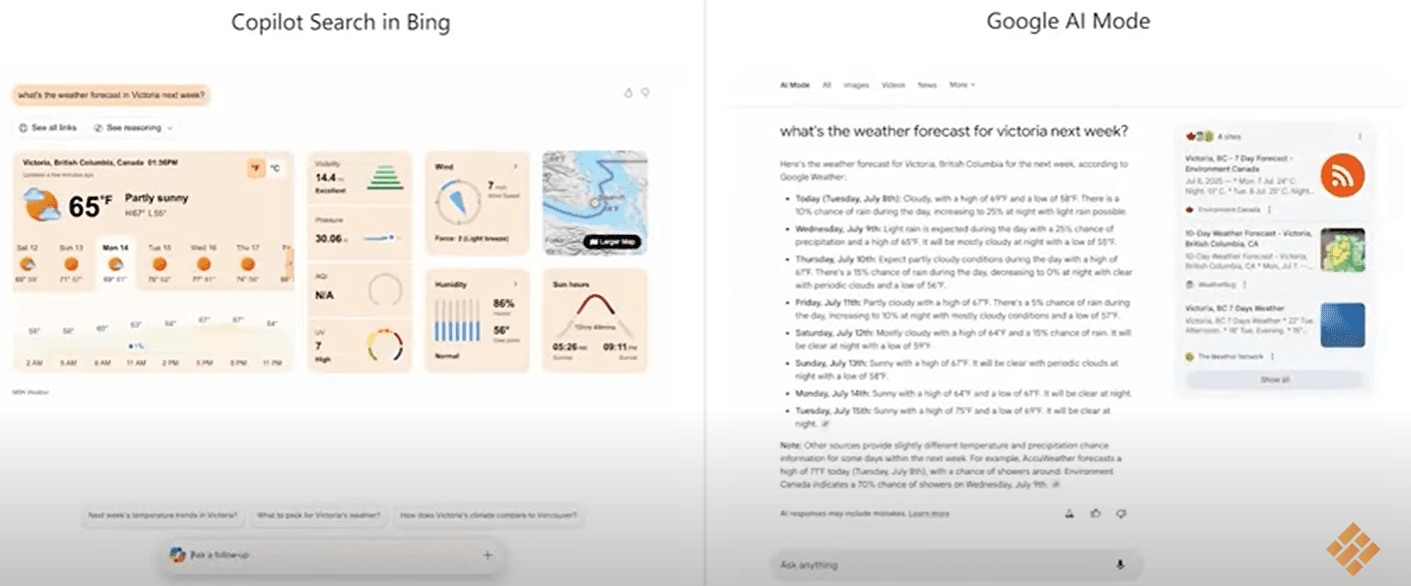
- “Weather forecast in Victoria”
It is a familiar user journey. But the difference in how each search engine handled it? Huge.
How Microsoft Copilot and Google AI Mode Respond Differently
Let us break it down.
For the initial query “best time to visit Victoria” both platforms performed well. They returned relevant, generative responses summarizing ideal travel seasons, local weather and activities.
So far, so good.
But then came the follow-up queries. And here is where things got interesting.
Microsoft Copilot Search: Structured and Straight to the Point
- Image Query: For “Pictures of Butchart Gardens,” Copilot displayed a rich answer card featuring high-quality, scrollable images of the gardens with clear visual presentation and source links.
- Weather Query: For “Victoria weather,” Copilot showed a clean 7-day weather forecast in a data-rich card format, similar to what you do see on weather apps.
But what did it not do? It did not offer generative text explanations, no paragraphs and no filler.
Google AI Mode: Generative and Conversational
- Image Query: Google’s AI Mode displayed a text-based description of Butchart Gardens with an embedded image and links.
- Weather Query: Google provided a paragraph summarizing the weather, embedded with forecast data but focused more on narrative than structured layout.
So here is the fundamental difference:
Microsoft focuses on structured, visual-rich cards.
Google leans heavily into generative text — even for things like weather and images.
Why It Matters: Strategic Design Decisions in AI Search
This is not just about one travel query. It is about the philosophical divide in how Microsoft and Google are building the next generation of search.
Jordi Ribas even hinted at this during the follow-up discussion in comments:
“We are focused on hybrid architecture — structured cards for certain categories like weather, travel, shopping.
Summaries and conversational answers for others. Google seems to apply generative responses more uniformly.”
And that matters a lot. Why? Because the way people interact with search is changing fast. AI-powered interfaces are replacing traditional 10-blue-links.
But how you present that AI whether as text, cards, visuals, summaries will determine how effective it actually is.
Personalization, Models And What’s Powering It All
One of the most revealing parts of Ribas’s post was not just what was shown but what was said afterward.
When asked about personalization, he replied:
“At this point, Copilot Search is primarily based on the query and session. But the impact of personalization and contextualization will increase over time.”
Translation? Microsoft is not fully leaning into behavioral data yet. They are taking a more conservative and privacy-conscious approach, while still laying the groundwork for future context-aware AI.
And what about the tech behind the scenes?
“We use advanced GPT models also,” Ribas confirmed. “Both search products will continue to evolve obviously, so every benchmark is just a moment in time.”
That last line is key and this is just the beginning.
Behind the Numbers: Search Share, Revenue, and What’s at Stake
So where does all this fit in the broader picture? Let’s talk about all numbers.
As of Q1 2024, Google dominates with 89.12% global search market share, according to Cloudflare.
Microsoft Bing, even with Copilot, holds just 2.51%. But there is more than just sharing.
Microsoft’s ad business crossed $20 billion in revenue, driven heavily by AI in Copilot and Edge. When Copilot is present in a search journey then click-through rates double and purchase conversions rise 53%
That is powerful and even if Bing is still the underdog in search.
Meanwhile, Google expanded its AI Overviews to nine European countries in March 2025, triggering both global reach and regulatory scrutiny over potential favoritism to its own services.
So… Who’s Winning This AI Search War?
Let us pause and ask the real question: Is one of these platforms clearly better? Honestly, no.
What this demo does reveal is that both companies are betting on very different theories of user behavior.
Google believes users want narrative-driven AI summaries, even for basic data queries.
Microsoft bets that people want visual clarity and structured data when searching for things like weather, images or shopping.
And that divergence may shape the entire future of how we search. Ribas said it best in his closing statement:
“The convergence of traditional and generative search in the future years will be fascinating. We hope you come along for the ride.”
It’s Not Just a Product Battle. It’s a Paradigm Shift.
We are no longer in the age of “type and scroll.” Instead we are in the age of “ask and expect a complete answer.”
Microsoft’s Copilot and Google’s AI Mode are both racing toward that goal but from very different angles.
So as Ribas says: Let’s see where this goes. Because the future of search won’t be decided by features but it will decide by how users actually respond to these evolving experiences.

Dileep Thekkethil
AuthorDileep Thekkethil is the Director of Marketing at Stan Ventures, where he applies over 15 years of SEO and digital marketing expertise to drive growth and authority. A former journalist with six years of experience, he combines strategic storytelling with technical know-how to help brands navigate the shift toward AI-driven search and generative engines. Dileep is a strong advocate for Google’s EEAT standards, regularly sharing real-world use cases and scenarios to demystify complex marketing trends. He is an avid gardener of tropical fruits, a motor enthusiast, and a dedicated caretaker of his pair of cockatiels.
