
Google just blew up the search box you’ve used for the last 25 years.
At I/O 2026, Liz Reid, VP and Head of Search at Google, walked on stage and announced that AI Mode has crossed 1 billion monthly users. Then she showed off a redesigned search box, a personal AI agent that runs while your phone is locked, and a unified shopping cart that hops across YouTube, Gmail, and Search.
What’s New in Search
If you sell anything online, your SEO playbook from January is already out of date.
Here’s what actually changed, what’s hype, and the three things you should fix on your site this quarter.
What Liz Reid Actually Said
Forget the “AI is the future” speeches. The quote that matters is this one, from her press briefing:
“This new search box puts our most powerful AI tools right at your fingertips, and you can ask across modalities with text, images, files, videos, and search reasons across them all.”
She called it the biggest upgrade to the Search box since it launched 25 years ago. That’s not marketing. AI Mode queries are reportedly running 2 to 3 times longer than traditional search queries, which means users are no longer typing keywords. They’re typing paragraphs. They’re uploading screenshots. They’re asking follow-ups.
So if your content was built to rank for “best running shoes for flat feet,” the new query is closer to “I’m a 38-year-old woman, flat feet, knee pain after 5K runs, narrow heel, budget 150. What should I get and where can I try them near New York?”
That’s a different game.
Gemini 3.5 Flash Is the Engine Under the Hood
The reason Google can serve those long, messy queries fast enough to feel like a conversation is Gemini 3.5 Flash. Google now makes it the default model in AI Mode globally.
Three things to know about it:
- Google says it runs about 4 times faster than comparable frontier models on output tokens per second.
- It uses what Google calls “query fan-out,” which means it fires off multiple related searches in parallel and stitches the results together.
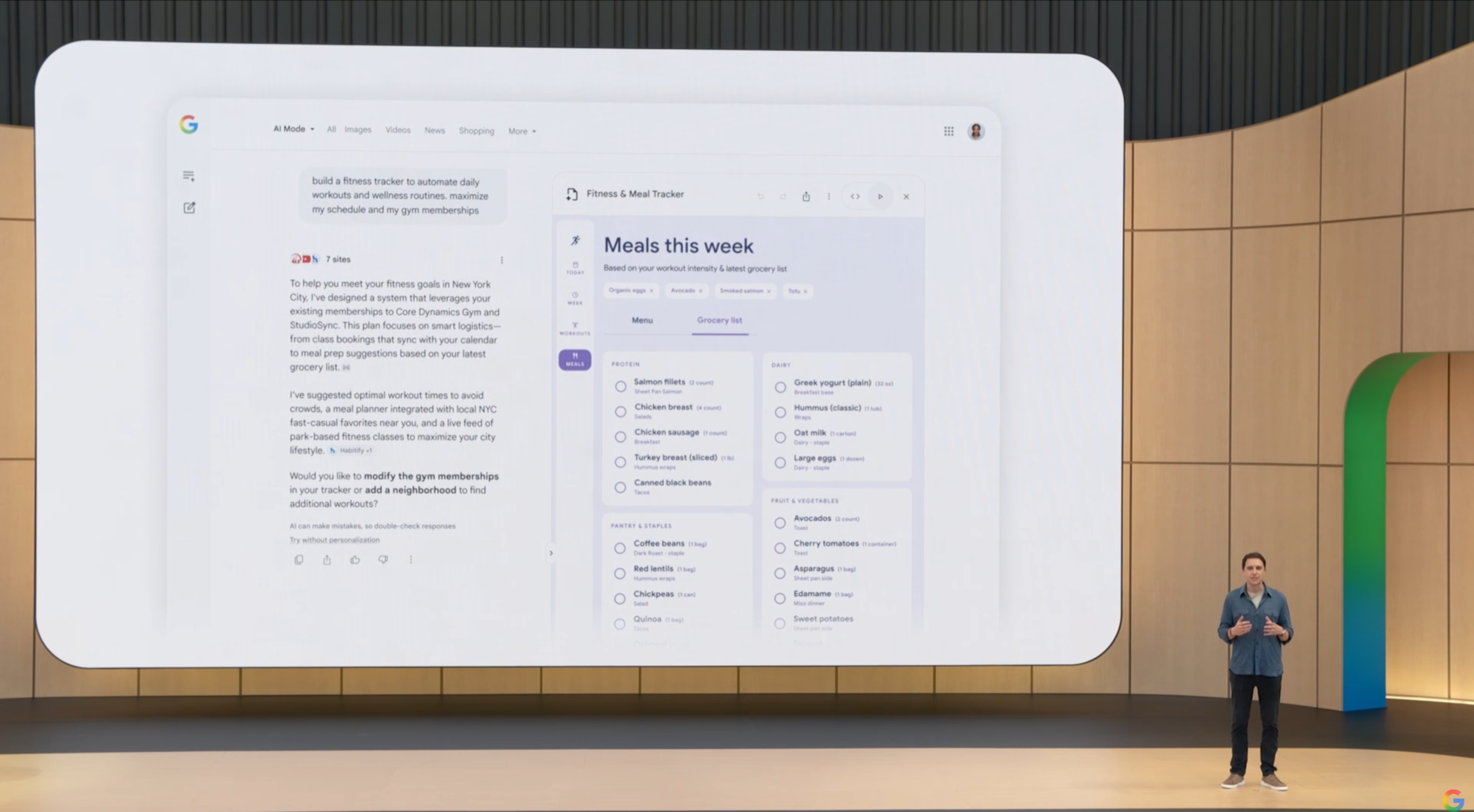
- It powers a new “generative UI” feature that builds custom dashboards and interactive visuals on the fly, right inside the search result.
That last one is the part most SEO folks are missing. If a user asks about black holes, Google can render an interactive visual instead of sending them to your blog. If they ask about a marathon training plan, Google can build a stateful tracker they come back to every day.
You can’t rank inside a custom dashboard. You can only be one of the sources Gemini decides to pull from.
Gemini Spark: The 24/7 Agent That Doesn’t Sleep
This is the announcement worth circling.
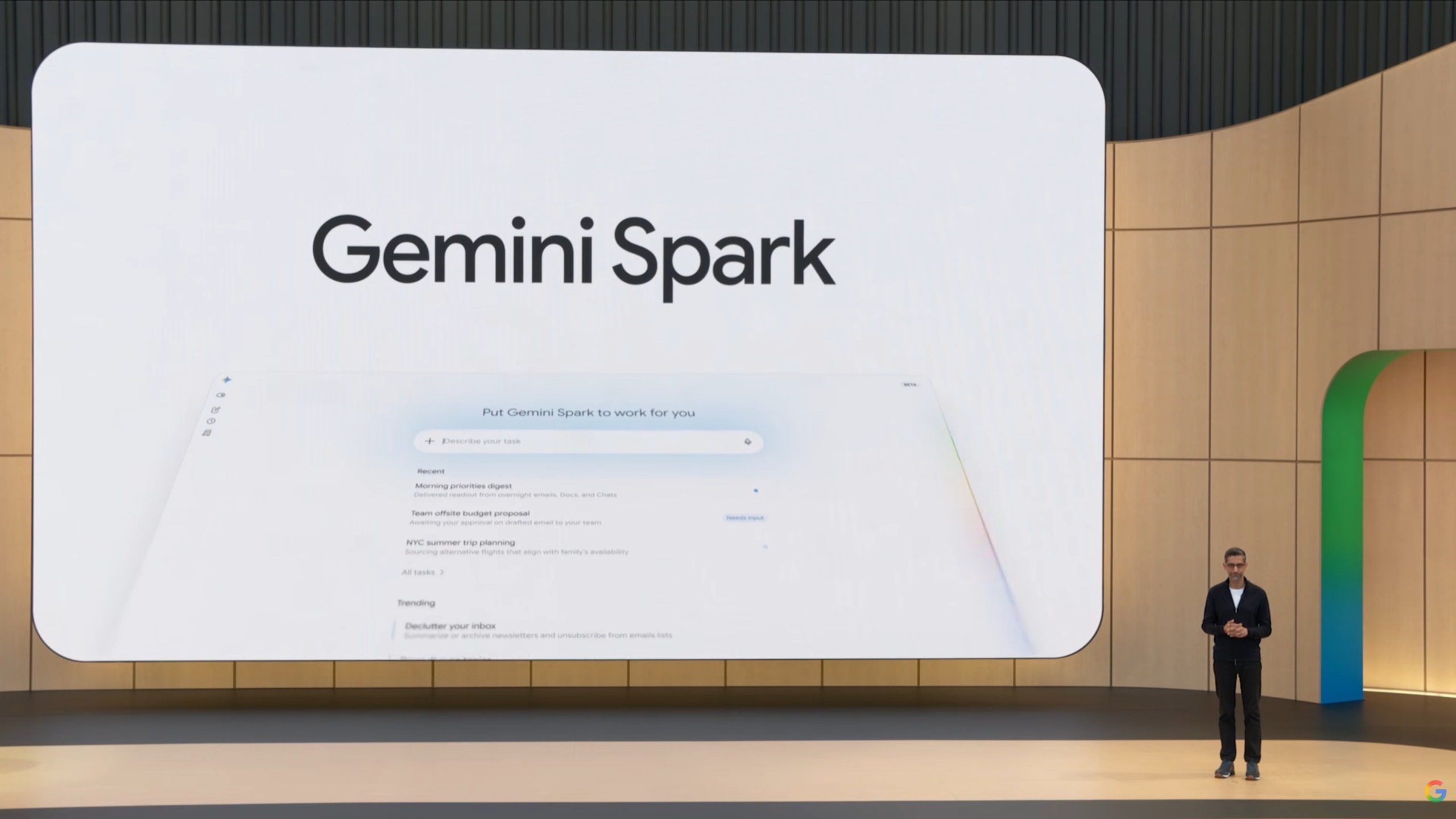
Gemini Spark is a personal AI agent that runs in the background even when your laptop is closed or your phone is locked. It’s built on Gemini 3.5 and Google’s Antigravity platform. It rolls out to Google AI Ultra subscribers in the US first, with a wider rollout through summer 2026.
What does Spark actually do?
- Monitors your credit card statements for sketchy charges
- Reads your kid’s school emails and flags the important stuff
- Drafts Google Docs and the email that goes with them
- Watches stock prices, real estate listings, sports scores, news topics, anything you tell it to track
Search now has its own version of this called Search Agents. Same idea. You tell it what to watch, it watches forever, and pings you when something changes.
Here’s the SEO consequence nobody is talking about.
Your audience is no longer “people searching for X.” Your audience now includes their agents, which check your site over and over, looking for changes.
If your prices are stale, your stock is wrong, or your content hasn’t been updated in six months, agents will route around you to a competitor who keeps their data current.
This is the end of “set it and forget it” SEO. Welcome to continuous SEO.
Universal Cart: The End of the Traditional Funnel
Google also announced Universal Cart, an AI-powered shopping hub that lets you add products from different merchants into one cart while you’re on Search, in the Gemini app, on YouTube, or reading Gmail.
Once a product hits the cart, Gemini goes to work in the background. It tracks price drops. It shows you price history. It sends back-in-stock alerts. It runs compatibility checks. It can even surface cheaper alternatives.
Behind the cart sits the Agent Payments Protocol (AP2), which Google first announced in September 2025 with 60+ partners including PayPal, Mastercard, and American Express.
AP2 lets AI agents make purchases on a user’s behalf within pre-set limits, using cryptographically signed digital contracts. The April 2026 v0.2.0 release added “Human Not Present” payments, so agents can buy limited-release tickets the second they drop.
There’s also the Universal Commerce Protocol (UCP), announced at NRF 2026 in January, co-developed with Shopify, Etsy, Wayfair, Target, and Walmart. UCP is the open standard that lets agents talk to merchants in a common language. No more custom integrations for every platform.
If you run an ecommerce site, this is the message: agents are about to do your customers’ shopping for them. Your Merchant Center data, your product schema, your real-time pricing, your stock status, all of that becomes the only thing the agent sees. Pretty pictures and clever taglines don’t matter when no human looks at your product page.
Universal Cart starts rolling out in the US this summer.
Three Things to Fix on Your Site This Quarter
Enough about what Google announced. Here’s what you actually do about it.
- Make Your Site Readable to Agents
AI crawlers don’t have the patience to wade through bloated JavaScript and ad scripts. Agents in tools like Cursor or Antigravity want clean, fast, machine-readable content.
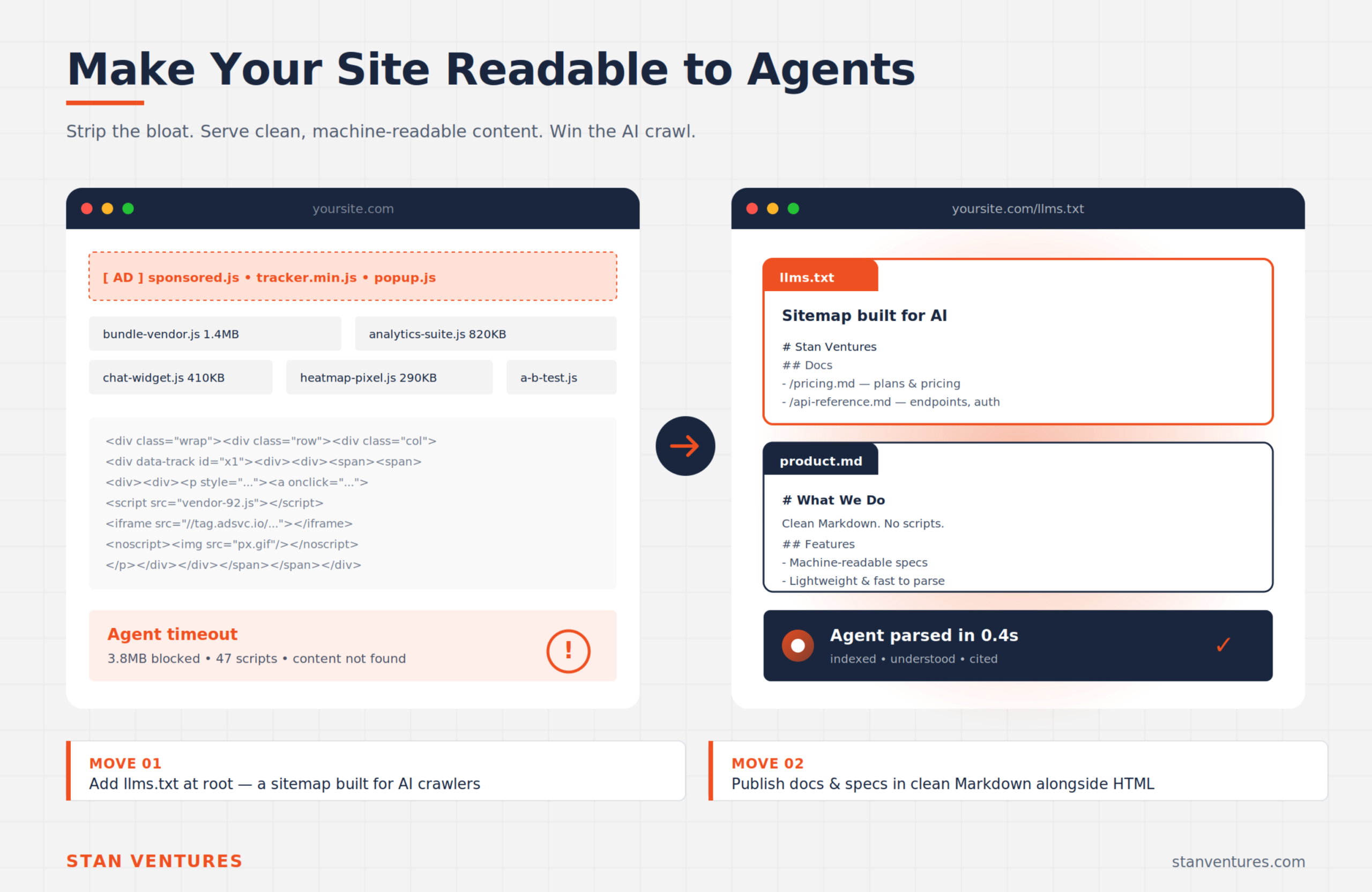
Two specific moves:
- Add an llms.txt file at the root of your site. Think of it as a sitemap built for AI, pointing crawlers at your most important pages and explaining what they’re about.
- Publish documentation, product specs, and reference content in clean Markdown alongside your HTML. The lighter the page, the faster the agent reads it.
- Fix Your Structured Data Once and For All
Schema is no longer a “nice to have” for rich snippets. It’s how agents understand the world.
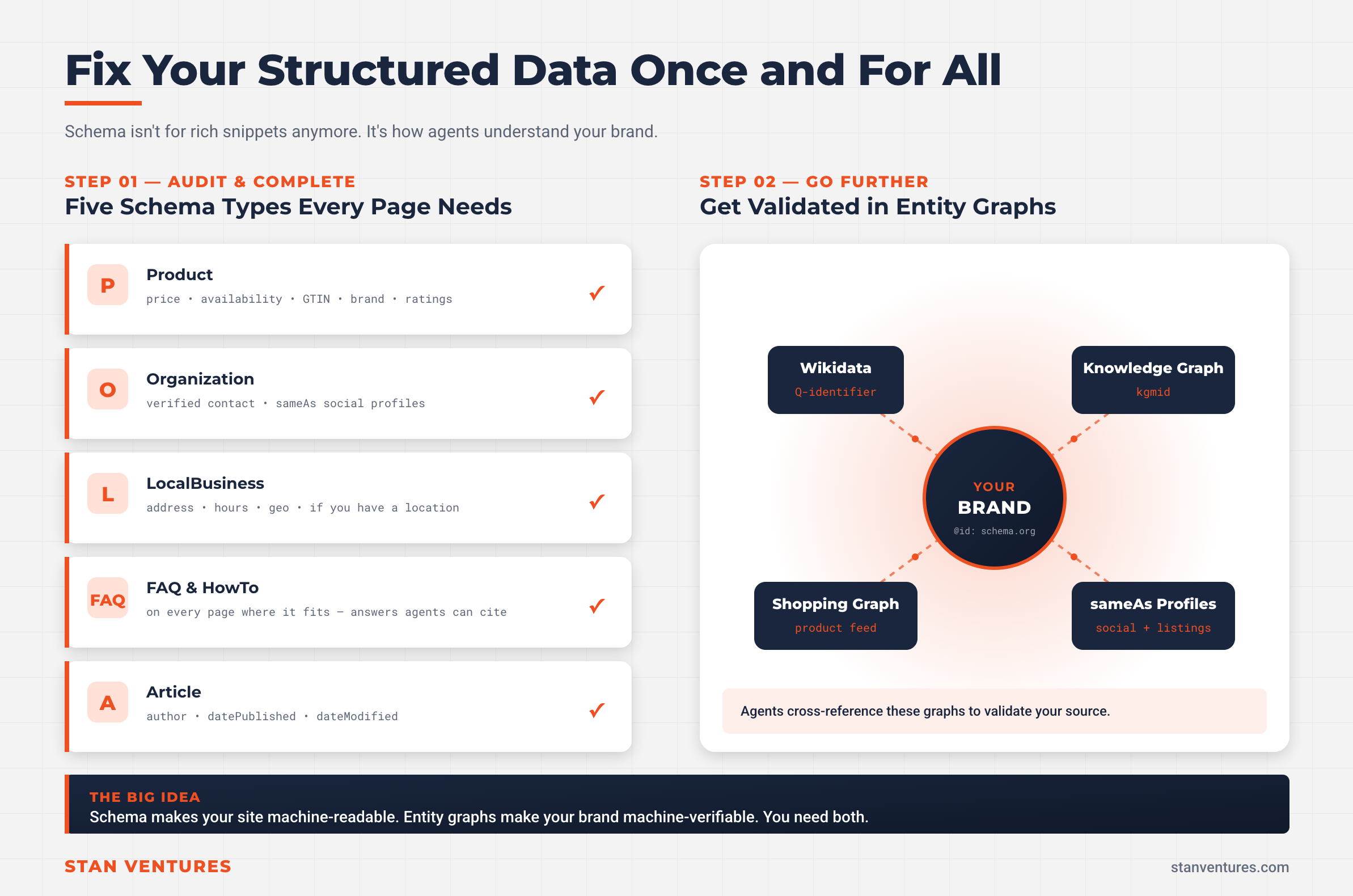
Audit and complete the following:
- Product schema (with real-time price, availability, GTIN, brand, ratings)
- Organization schema with verified contact info and social profiles
- LocalBusiness schema if you have a physical location
- FAQ and HowTo schema on every page where it fits
- Article schema with author, publish date, and update date
Then go further. Make sure your brand exists, accurately, in Wikidata, Google’s Knowledge Graph, and the Shopping Graph. Agents cross-reference these entity databases when they validate a source.
- Build Content for Follow-Up Questions, Not One-Shot Queries
When AI Mode users keep asking follow-ups inside the conversational interface, the second, third, and fourth questions matter as much as the first.
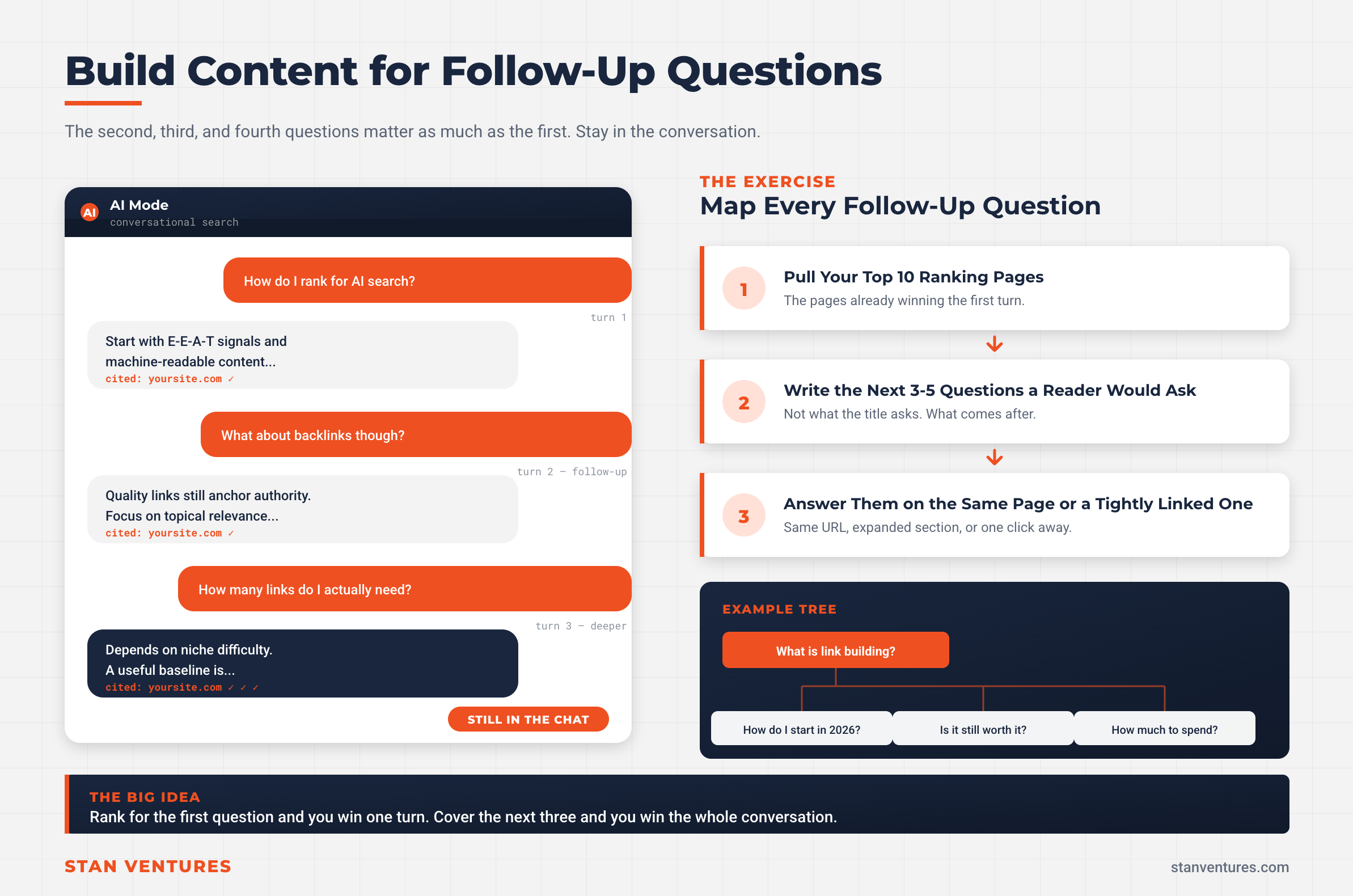
A useful exercise: take your top 10 ranking pages and write down every follow-up question a real user would ask after reading them. Then go answer those follow-up questions on the same page or on a tightly linked one. This is how you stay in the conversation instead of getting dropped after the first turn.
What Happens to Clicks?
Honest answer: nobody knows yet.
What we do know from Liz Reid’s April 2026 Bloomberg interview is that Google is still figuring out the advertising model inside AI Mode. AI Mode queries are longer and more complex, the ad rollout is still partial, and click-through behavior is shifting.
For informational queries, expect organic traffic to keep dropping. AI Overviews already serve 2.5 billion monthly users. Most people get their answer and never click.
For transactional and high-intent queries, the game changes shape. Users (and their agents) still need to buy, book, and sign up. But they decide based on structured data, price, reviews, and trust signals, not on copy or design. The agent is the new gatekeeper.
Key Takeaways
The internet of screens is fading. The internet of agents is here.
Your website used to be a destination. Now it’s an API that AI agents query, verify, and sometimes act on. If you build for that reality, with clean technical SEO, accurate structured data, fresh content, and follow-up depth, you stay visible. If you keep optimizing for a search engine that died on May 19, 2026, you won’t.
Three actions, in order: fix your schema, ship llms.txt, audit your top pages for follow-up depth. Do those before you spend another rupee on content.

Dileep Thekkethil
AuthorDileep Thekkethil is the Director of Marketing at Stan Ventures, where he applies over 15 years of SEO and digital marketing expertise to drive growth and authority. A former journalist with six years of experience, he combines strategic storytelling with technical know-how to help brands navigate the shift toward AI-driven search and generative engines. Dileep is a strong advocate for Google’s EEAT standards, regularly sharing real-world use cases and scenarios to demystify complex marketing trends. He is an avid gardener of tropical fruits, a motor enthusiast, and a dedicated caretaker of his pair of cockatiels.
