
On July 24, 2025, Google quietly rolled out a new experiment under its Search Labs umbrella and it is called “Web Guide.”
As someone who spends hours digging through search results, I can not help but ask what if Google did not just help me find answers but helped me understand the entire landscape of my question?
That is what Web Guide seems to be attempting. It does not just retrieve or respond but recognizes, interprets, expands, and offers context you didn’t know you needed.
So, what exactly is happening behind the scenes? And how is it helpful for users? Let’s see.
As Bob Dylan once said, ‘The 10-blue links are A-Changin’ -> Google Web Guide for AI organized search results
“What is Web Guide. Google explained that Web Guide groups web links in helpful ways. It can take pages related to specific aspects of your query and group them in… https://t.co/Y0PwgAXhT4
— Glenn Gabe (@glenngabe) July 24, 2025
What Is a Web Guide?
In Google’s own words:
“Web Guide is an AI-organized search results page that experiments with how we find, surface and organize results from across the web.”
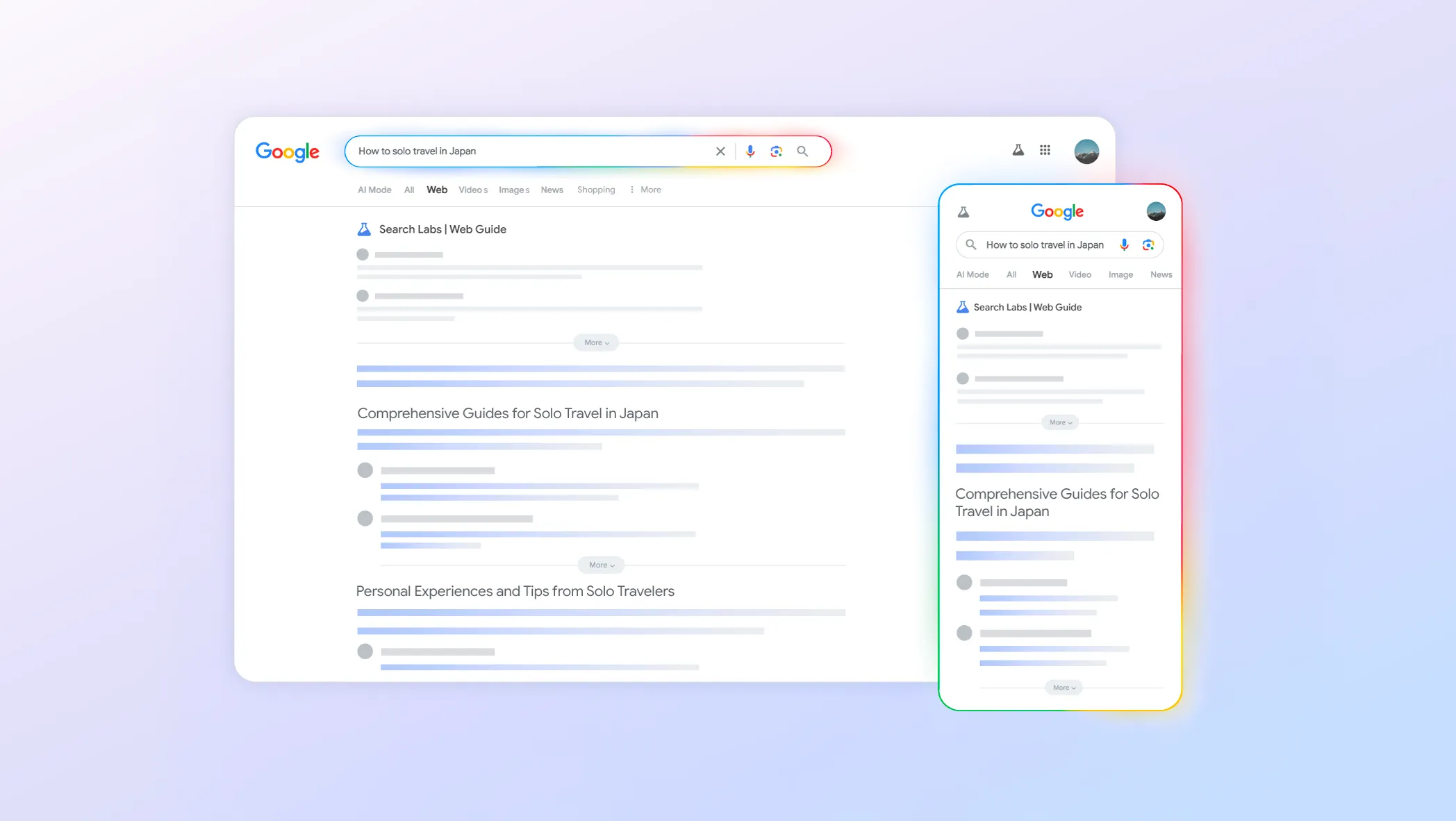
The feature uses a custom version of Gemini, Google’s most advanced AI model, to organize search results into categorized groupings much like having a digital assistant who reads the entire internet for you, understands your question and brings back not just answers but themes.
Think of it as turning a single query into a guided research session, not just a list of blue links.
How Does Google Web Guide Work?
Google explains that Web Guide applies query fan-out which is a technique where the system breaks your query into multiple related sub-queries and explores them in parallel.
This way, it does not just answer what you asked but also expands the topic based on what it thinks might help you.
For example, if you search “how to plan a sustainable wedding”, instead of giving you a linear list of results, Web Guide might break them into: Eco-friendly vendors, sustainable decor ideas, budget planning tips and green wedding dress options. Interesting right?
Each of those is a cluster, created by AI based on what users like you have historically needed and what the content across the web can offer.
This is not the same as AI Overviews. Nor is it the dining/recipe experience shown at Google I/O earlier this year.
- It is opt-in via Search Labs
- It organizes all types of queries, not just food or location
- It works under the Web tab (but Google says it will roll into the All tab soon)
- It uses a custom Gemini model trained specifically to parse web queries and content
What Does It Look Like?
If you have seen the preview GIFs shared by early testers then you will notice:
- Bold, boxed sections grouping related links
- Headings that explain the theme of each group
- A UI that feels more like a Pinterest board of topics than a classic list of results
It is like Google decided to turn its search engine into an encyclopedia, structured on the fly. And the big kicker? It could surface results you may never have seen before — even from domains that previously had low ranking.
So now we ask… is this Google’s new way to fight content saturation and SEO manipulation?
Why Does This Matter?
There is a lot to understand here. For users? It is potentially a game changer. For SEOs? It might just rewrite the rules.
Let us take a look at both.
For Users: You don’t just get links but now you will get themes.
Easier exploration: You can go deeper into your topic without rewriting your search over and over.
Less overload: By clustering results, Web Guide reduces the sense of being “buried” under too many options.
Think about it: how often have you searched something and clicked 10 different links only to piece the answer together yourself? Web Guide might do that legwork for you.
How Does This Compare to Traditional Search?
Here is the key difference:
| Traditional Search | Web Guide |
| Linear list of links | Categorized themes |
| Ranks by position | Groups by topic relevance |
| Often redundant content | More diversity in results |
| Manual exploration | AI-curated pathways |
It is not a replacement yet but it is a reimagination of what a search experience can be in an AI-first era.
Gemini at the Core
One reason this experience feels smarter is because it does not use just basic NLP. It runs on Gemini, Google’s multimodal AI model, optimized here to:
- Understand query intent
- Break down and categorize web content
- Connect content themes that users haven’t explicitly searched for
This is a lot like how ChatGPT plugins or Perplexity AI give you structured answers but applied at the scale of Google Search.
And remember, this is not Gemini as a chatbot. It is Gemini inside search which is shaping your experience invisibly.
Is This the Search Experience of the Future?
Google Web Guide may still be a Labs experiment but it gives us a glimpse into what AI-native browsing could look like. A search engine that does not just fetch but it organizes, interprets and expands.
Yes, it is early to opt in. But let’s not underestimate what is happening here. Google is training us and its AI for a future where answers come pre-organized, not just retrieved.

Zulekha
AuthorZulekha is an emerging leader in the content marketing industry from India. She began her career in 2019 as a freelancer and, with over five years of experience, has made a significant impact in content writing. Recognized for her innovative approaches, deep knowledge of SEO, and exceptional storytelling skills, she continues to set new standards in the field. Her keen interest in news and current events, which started during an internship with The New Indian Express, further enriches her content. As an author and continuous learner, she has transformed numerous websites and digital marketing companies with customized content writing and marketing strategies.
