
Court filings from Google’s antitrust trial have pulled back the curtain on how the search giant ranks pages. Much of what we know comes from Marie Haynes, who analyzed the documents and surfaced insights that challenge old assumptions about Google’s algorithm.
Google has always kept its ranking system shrouded in mystery. But thanks to evidence shared in court, we now have details the company rarely admits in public. They weren’t glossy statements for the media. They were the kind of gritty, technical notes you’d expect to find deep inside an engineering department.
Haynes’ breakdown of these exhibits shows just how far the algorithm has moved beyond its early link-based foundation.
The papers confirm that clicks, engagement patterns, and advanced AI models now play a major role in shaping what you see on a search results page.
If you haven’t read it yet, @Marie_Haynes with a great rundown of what we learned from the latest trial document -> What Google’s Trial Docs Reveal About Clicks, Links and Other Ranking Signals
“RankEmbed BERT is a ranking model that uses 70 days of search logs AND the scores of… pic.twitter.com/rdr9yhqrPc
— Glenn Gabe (@glenngabe) September 7, 2025
DocIDs: Google’s Memory for Every Page
One of the most striking details involves DocIDs, the unique identifiers Google assigns to every indexed page. They do far more than label a page. Inside each is a record of its entire life online, and that story only gets longer over time:
- User clicks and engagement signals
- Spam scores and trust evaluations
- Crawl timestamps and device data
- Popularity metrics and link information
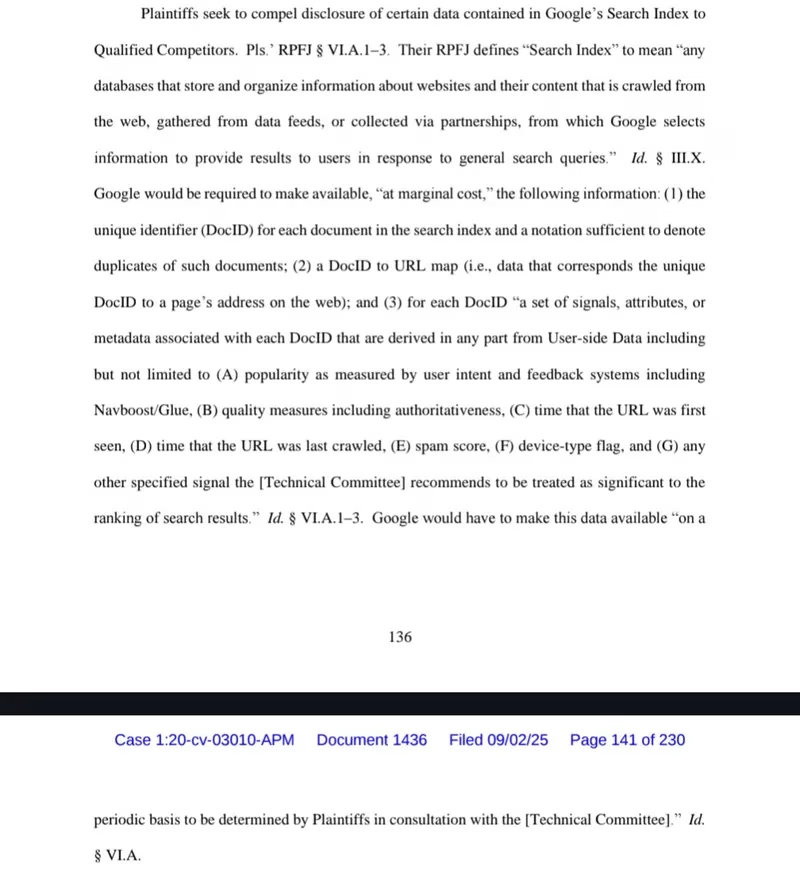
Over time, these records grow richer, making ranking less about a single factor and more about the combined weight of hundreds of signals.
Clicks Matter—But Not How You Think
SEOs have argued for years about whether clicks influence rankings. Google has always downplayed it.
The court files don’t say clicks directly move rankings, but they confirm that user interactions are collected and transformed into predictive signals for machine learning models.
Glue: Google’s Search Memory System
Another eye-opening detail is something called Glue, Google’s internal query log.
Glue captures:
- What users searched for
- Which results appeared
- Which links got clicked
- How long users stayed
- Which features (snippets, maps, videos) appeared
Glue acts as a living memory, helping models recognize patterns that lead to satisfied searches.
If users consistently pick certain types of results for a query, those patterns feed back into ranking decisions.
RankEmbed BERT: The AI Behind the Curtain
Perhaps the most revealing part of the documents is the reference to RankEmbed BERT, a machine learning model that plays a critical role in ranking.
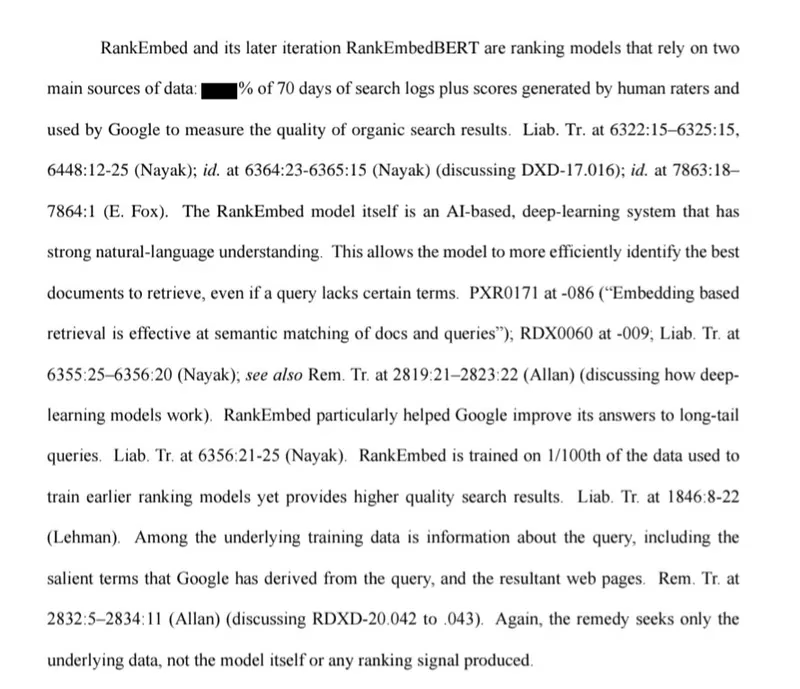
Unlike older systems, RankEmbed trains on a rolling window of about 70 days of search data.
It also learns from human quality raters like, people who score pages for expertise, trustworthiness, and clarity. Their evaluations don’t directly boost or demote pages but teach the model what “good” looks like.
This means Google’s rankings evolve with both user behavior and human judgment.
PageRank Is No Longer King
Once the cornerstone of SEO, PageRank still exists, but the documents confirm what many suspected: it’s just one signal among hundreds.
Modern ranking leans heavily on content quality, engagement signals, and AI-driven relevance predictions.
If you’re still banking on link-building alone, these papers make one thing clear—you’re playing an outdated game.
Signals That Fly Under the Radar
Haynes highlights a few other signals that deserve attention:
- Crawl frequency isn’t random. Google uses engagement and popularity to decide which pages to crawl more often.
- Spam scoring matters. High spam scores can reduce crawl priority and impact visibility.
- Chrome data may influence popularity signals. The documents hint at this, though the exact process isn’t fully explained.
What You Should Do Now
If you depend on Google traffic, here’s what these revelations mean for you:
- Track engagement beyond clicks. Look at dwell time, bounce rates, and user journeys.
- Show your expertise. Add author bios, cite credible sources, and make your content verifiably trustworthy.
- Watch crawl reports. Sudden drops in crawl frequency can signal deeper issues.
- Skip manipulative tactics. Fake clicks and shady link schemes can hurt more than they help.
- Write for intent, not just keywords. Build content that genuinely answers the questions behind the query.
The Bigger Question
What these documents really show is that search is less about static rules and more about adaptation. It changes as users change. It reacts to what works and discards what doesn’t. And it’s doing this constantly, quietly, behind the scenes.
So, the next time you type a query and hit enter, just remember: you’re not just searching. You’re shaping the system that decides what the internet looks like tomorrow.
Key Takeaways
- Every page has a DocID packed with signals from clicks to spam scores.
- Glue logs user behavior and helps models learn what satisfies intent.
- RankEmbed BERT trains on recent data and human rater feedback.
- PageRank is still around, but engagement and quality matter more.
- Crawl frequency and spam signals quietly shape visibility.

Dileep Thekkethil
AuthorDileep Thekkethil is the Director of Marketing at Stan Ventures, where he applies over 15 years of SEO and digital marketing expertise to drive growth and authority. A former journalist with six years of experience, he combines strategic storytelling with technical know-how to help brands navigate the shift toward AI-driven search and generative engines. Dileep is a strong advocate for Google’s EEAT standards, regularly sharing real-world use cases and scenarios to demystify complex marketing trends. He is an avid gardener of tropical fruits, a motor enthusiast, and a dedicated caretaker of his pair of cockatiels.
