
Key Takeaways
- Google is experimenting with “See More” hyperlinks that jump directly to relevant sections within webpages.
- The feature uses text-fragment URLs (the #:~:text= format) to highlight specific parts of a page.
- It could signal a shift toward AI-driven, deep-context retrieval, improving user experience but changing SEO behavior.
- Publishers may need to optimize section-level content and structured anchors for better visibility.
- Early sightings show the feature appearing on articles from major websites and publishers.
Google has been spotted testing a new “See More” hyperlink format in its search results, allowing users to jump directly to a highlighted section of a page.
The feature — similar to how Google AI Overviews cite sources — uses the Scroll to Text Fragment syntax (#:~:text=) that deep-links users to specific in-page content.
This move further aligns traditional search with AI-style content retrieval, where precision and context outweigh general page-level optimization.
Are You Seeing It?
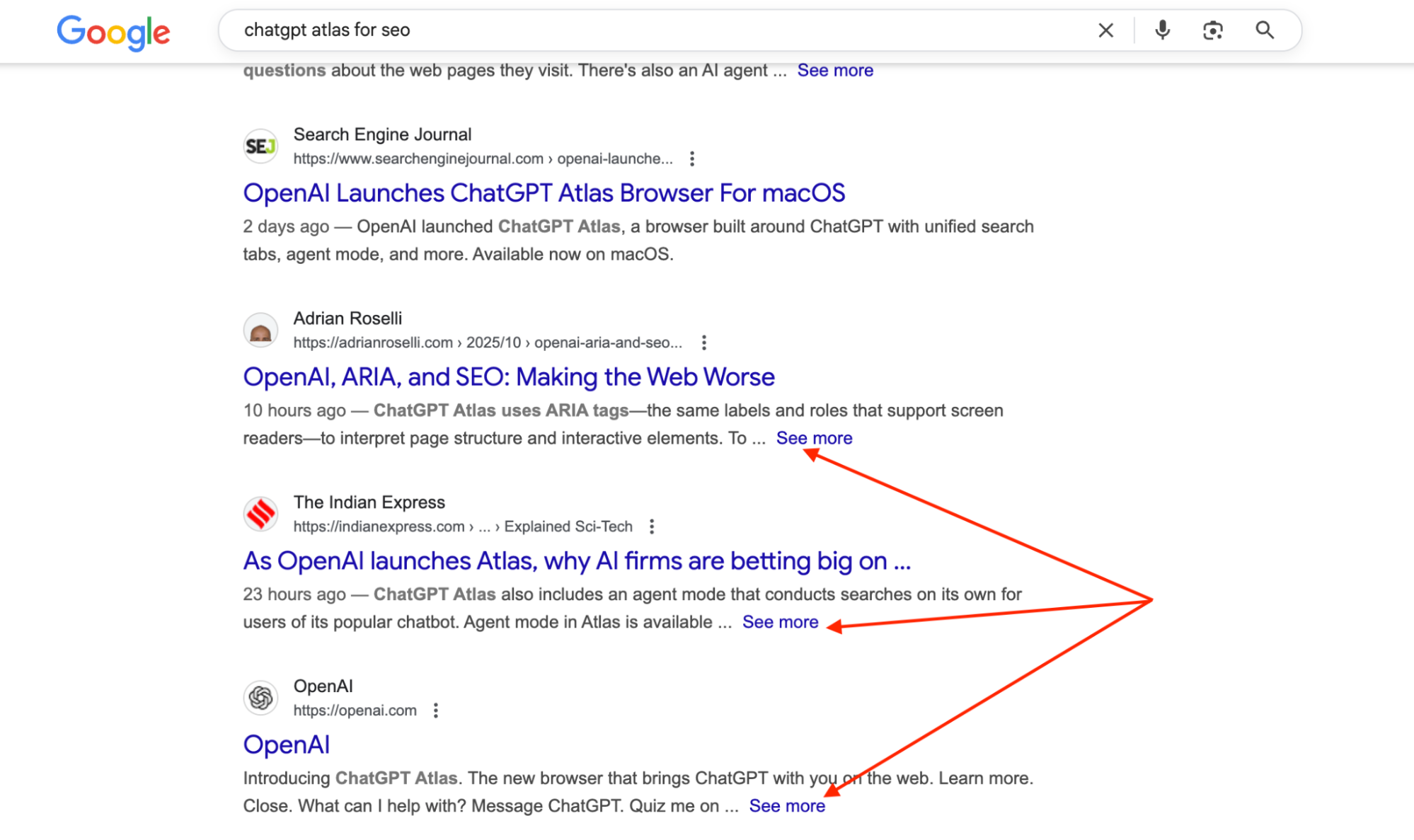
While I was doing a bit of research earlier today, Google displayed “See More” links under certain search results for queries like “ChatGPT Atlas for SEO.”
These links didn’t just open the article — they directed users to specific sections within the page.
For instance, a result linking to The Indian Express and Search Engine Journal opened directly to sections discussing ChatGPT Atlas’ Agent Mode or browser features.
The mechanism behind it mirrors Google’s Text Fragments feature introduced in Chrome.
This indicates that Google is increasingly indexing not just pages — but paragraph-level relevance.
TL;DR:
“See More” links again reiterates Google’s move from page-based SEO to section-based discoverability, which is what Gemini, AI Mode and Overviews are known for doing.”
Analysis & Insights
From an SEO standpoint, this test represents a subtle but profound shift:
- In-Page Relevance Is the New Frontier
Google may now rank individual sections of a webpage for specific search queries, focusing on contextual relevance and user intent rather than the page as a whole — especially when the query matches the intent of a particular section.
- In-Page Relevance Is the New Frontier
- See More Appears Only On Auto-Generated Meta Descriptions
This feature appears only on snippets where Google auto-generates the meta description from on-page content — not when a predefined meta description is present in the HTML. This suggests Google’s algorithm dynamically chooses to deep-link sections when it detects stronger contextual matches within the body text.
- Alignment With AI Search Paradigms
AI Overviews and ChatGPT-style engines already surface contextual snippets rather than entire URLs. This “See More” feature makes classic search results behave similarly. - Technical SEO Implications
- Proper heading tags (H2–H4) and clear anchor text could determine which sections get linked.
- Publishers should structure long-form content for fragment navigation.
- Internal linking strategies may evolve to reference specific text fragments for entity reinforcement.
TL;DR:
The “See More” feature could reward well-structured, semantically clear content over long, unorganized articles.
What’s Next for SEOs
If widely rolled out, this could change how CTR and engagement are measured.
Users might skip intros and jump straight to relevant answers — similar to how AI summaries function.
Expect Google to test AI-powered deep linking and potentially integrate this feature with AI Overviews, allowing users to jump from AI summaries into highlighted web content.
TL;DR:
Expect this feature to merge with AI Overviews, making structured, entity-optimized content even more crucial.
Quick Recap
- Google is testing “See More” links that use text fragments for deep navigation.
- This mirrors how AI models cite exact sections of a page.
- SEO teams must focus on structured, scannable content optimized for section-level discovery.
Checklist: How to Prepare
- Audit pages for clear section headings (H2–H4)
- Create distinct phrases Google can anchor to
- Test scroll-to-text URLs on key pages
- Add FAQ and HowTo schema
- Monitor traffic behavior from in-page deep links
FAQ Section
Q1. What are “See More” links in Google Search?
A: They’re hyperlinks that take users directly to a specific section or sentence within a webpage, rather than the top of the page.
Q2. How does Google create these links?
A: Google uses Text Fragment URLs (#:~:text=) to highlight a specific part of a page based on the exact words in that section. Parts of these fragments get pulled automatically as Google’s meta description.
Q3. How can publishers optimize for this?
A: Use clear headings, short paragraphs, and unique phrases that Google can match precisely to search intent.
Q4. Why is this important for SEO?
A: It aligns with AI-driven retrieval — the future of how Google and chatbots surface content.
Q5. Will this replace featured snippets?
A: Not yet, but it complements them by offering section-level context rather than standalone summaries.

Dileep Thekkethil
AuthorDileep Thekkethil is the Director of Marketing at Stan Ventures, where he applies over 15 years of SEO and digital marketing expertise to drive growth and authority. A former journalist with six years of experience, he combines strategic storytelling with technical know-how to help brands navigate the shift toward AI-driven search and generative engines. Dileep is a strong advocate for Google’s EEAT standards, regularly sharing real-world use cases and scenarios to demystify complex marketing trends. He is an avid gardener of tropical fruits, a motor enthusiast, and a dedicated caretaker of his pair of cockatiels.
